Showing posts with label Friendship. Show all posts

Saturday, August 8, 2026

Movie Quote of the Day (‘Stand by Me,’ on Friends)

The Writer [voiceover, by Richard Dreyfuss]: “It happens sometimes. Friends come in and out of your life, like busboys in a restaurant.”—Stand by Me (1986), screenplay by Raynold Gideon and Bruce A. Evans, adapted from the Stephen King novella “The Body,” directed by Rob Reiner

The coming-of-age drama Stand by Me was released 40 years ago today. Technically, its $52.3 million domestic box-office gross would not put it in blockbuster territory, but it earned a tidy profit because of its low $8 million, enabling Rob Reiner to make more and bigger films.

After viewing the finished product, King told Reiner it was the best adaptation of any of his films to that time. Audiences today are likely to respond with the same powerful emotion that the novelist did.

Though the main plot of the movie is set in 1959, its themes are universal: loss of innocence, family neglect, and, most poignantly, the transience of childhood friendships.

Even Facebook goes only so far in retaining early bonds: distance—in geography, stations in life, and, sadly these days, politics—serves as an aching reminder of all we have lost over the years.

But we have those friends when we need them the most, as we are sometimes thrown into confusion in growing up as we discover the world and start to discover ourselves. The quartet at the heart of this film are, then, just stand-ins for ourselves.

For an especially enthusiastic take on the film, see this 2017 guest post by Jessica Prescott on the blog “Hamlette’s Soliloquy.”

Tuesday, May 13, 2025

Quote of the Day (Anna Quindlen, on Old Friends)

“The thing about old friends is not that they love you, but that they know you. They remember that disastrous New Year's Eve when you mixed White Russians and champagne, and how you wore that red maternity dress until everyone was sick of seeing the blaze of it in the office, and the uncomfortable couch in your first apartment and the smoky stove in your beach rental. They look at you and don't really think you look older because they've grown old along with you, and, like the faded paint in a beloved room, they're used to the look. And then one of them is gone, and you've lost a chunk of yourself. The stories of the terrorist attacks of 2001, the tsunami, the Japanese earthquake always used numbers, the deaths of thousands a measure of how great the disaster. Catastrophe is numerical. Loss is singular, one beloved at a time.”—Pulitzer Prize-winning American journalist and novelist Anna Quindlen, Lots of Candles, Plenty of Cake: A Memoir of a Woman's Life (2012)

The image accompanying this post of Anna Quindlen, Barnard College ’74, was taken Jan. 29, 2008 (when she was head of the school’s board of trustees) by Angela Radulescu.

Tuesday, March 18, 2025

Quote of the Day (Anaïs Nin, on What a Friend Represents)

“Each friend represents a world in us, a world possibly not born until they arrive, and it is only by this meeting that a new world is born.”—French-born American diarist, essayist, novelist, and writer of short stories Anaïs Nin (1903-1977), The Diary of Anaïs Nin, Vol. 1: 1931-1934 (1966)

Tuesday, November 19, 2024

Quote of the Day (Henry Adams, on Friendship)

“One friend in a lifetime is much, two are many, three are hardly possible. Friendship needs a certain parallelism of life, a community of thought, a rivalry of aim.” — U.S. historian (and descendant of Presidents) Henry Adams (1838-1918), The Education of Henry Adams (1907; posthumously published 1918)

Saturday, June 29, 2024

Quote of the Day (Aristotle, on the Multiple Benefits of Friendship)

“Without friends no one would choose to live, though he had all other goods; even rich men and those in possession of office and of dominating power are thought to need friends most of all; for what is the use of such prosperity without the opportunity of beneficence, which is exercised chiefly and in its most laudable form towards friends? Or how can prosperity be guarded and preserved without friends? The greater it is, the more exposed is it to risk. And in poverty and in other misfortunes men think friends are the only refuge. It helps the young, too, to keep from error; it aids older people by ministering to their needs and supplementing the activities that are failing from weakness; those in the prime of life it stimulates to noble actions-'two going together'-for with friends men are more able both to think and to act….Friendship seems too to hold states together, and lawgivers to care more for it than for justice; for unanimity seems to be something like friendship, and this they aim at most of all, and expel faction as their worst enemy; and when men are friends they have no need of justice, while when they are just they need friendship as well, and the truest form of justice is thought to be a friendly quality.”—Greek philosopher Aristotle (384 BC 322 BC), Nichomachean Ethics, translated by W. D. Ross (350 BC)

Is there anyone out there on Planet Earth who doesn’t know who these friends are? Very well, then: they are Harry Potter (played by Daniel Radcliffe), Hermione Granger (Emma Watson), and Ron Weasley (Rupert Grint), schoolmates through eight cinematic adventures in the super-profitable "Harry Potter" franchise.

Hopefully, none of us will ever have the harrowing confrontations with evil that this trio must endure. But friendship is indeed the balm and refuge that Aristotle describes, as I have rediscovered in the past couple of weeks in encounters with friends who go back with me nearly 60 years, to our first years in elementary school.

Maybe Harry, Hermione and Ron will be so lucky!


Friday, March 15, 2024

TV Quote of the Day (‘The Carol Burnett Show,’ As a Visiting Friend Disrupts Mama’s Family)

Thelma "Mama" Harper [played by Vicki Lawrence]: “It is people like her that are causing the downfall of this whole country. If I was your mother...”

Midge Gibson [played by Joanne Woodward, pictured right]: [interrupting] “Well, you are not my mother, Mrs. Harper, so I have no emotional objection to punching you right in the nose!”

Mama: “Are you going to let her talk to me like that, Eunice?”

Eunice Higgins [played by Carol Burnett, left]: “Go, go, go.”

Midge: “Now I have made many mistakes in my life, but I have never been deliberately malicious and cruel and if you're an example of decency, sister, thank God I'm indecent and you…”

[referring to and pointing at Ed, Eunice's husband]

Midge: “... you weren't so high and mighty in high school when you…you were in the back seat of that convertible with me on that double date with Gigi and—and—and you practically tore off my best sweater!”

Eunice: “Oh, Ed!”

Midge: “Yeah! I finally got away and after that, he ran after Gigi! Jim had to throw him out of the car! Oh, Eunice, I'm sorry.”

Eunice: “Oh, shoot. Who cares? I'm just surprised he ever had that much energy.”— The Carol Burnett Show, Season 9, Episode 21, “The Family” sketch, original air date Feb. 14, 1976, directed by Dave Powers

Thursday, December 7, 2023

Quote of the Day (David French, on the Importance of Being There for Friends)

“Compared with the competing demands of family and work, in any given moment friendship can feel unnecessary. But as the years roll on, and countless justifiable individual absences wear down our relationships, there will come a time when we will feel their loss. But it need not be that way, especially when our simplest and highest command is merely being there.”—Columnist David French, “The Importance of Being There,” The New York Times, Sept. 25, 2023

Tuesday, October 3, 2023

Quote of the Day (C.S. Lewis, on Friendship and Survival)

“Friendship is unnecessary, like philosophy, like art, like the universe itself (for God did not need to create). It has no survival value; rather it is one of those things which give value to survival.”—British novelist and religious author C.S. Lewis (1898-1963), The Four Loves (1960)

Thursday, June 8, 2023

Quote of the Day (Randolph Bourne, on Friends as ‘Infallible Safeguards Against Misery and Poverty of Spirit’)

“A man with few friends is only half-developed; there are whole sides of his nature which are locked up and have never been expressed. He cannot unlock them himself, he cannot even discover them; friends alone can stimulate him and open them. Such a man is in prison; his soul is in penal solitude. A man must get friends as he would get food and drink for nourishment and sustenance. And he must keep them, as he would keep health and wealth, as the infallible safeguards against misery and poverty of spirit.”—Progressive Era essayist, social critic, and disabilities advocate Randolph Bourne (1886-1918), Youth and Life (1911)

Saturday, January 29, 2022

Quote of the Day (Andi Zeisler, on ‘The Dangerous Friend’)

“When you’re young, the dangerous friend urges you to shoplift, strands you in the bad part of town when you have an argument, dog-ears the good parts of Forever and leaves it in your room where your mom is sure to spy it. She may be the person who first gets you drunk or engineers the loss of your virginity to some guy she knows. But the dangerous friend isn’t dangerous because she’s daring, or precocious, or even reckless. She’s dangerous because she makes you trust her against all logical judgment, makes you want to please her even if your own happiness is compromised, and imprints herself on your mind with disconcerting speed and force." — Writer, editor, and cultural critic Andi Zeisler, “Breaking Up with Smitty,” originally from the anthology Secrets and Confidences: The Complicated Truth About Women’s Friendships (2004), edited by Karen Eng, reprinted in The Utne Reader, July-August 2005

Ms. Zeisler is talking about a particular kind of “dangerous friend”—the dangerous female friend (DFF), to be exact. There’s some overlap with the dangerous male friend—the sort who not only gets you drunk, but gets behind the wheel of a car repeatedly, drunk and/or high, simultaneously risking your life and his.

Guys can probably list counterparts to Ms. Zeisler’s list based on male friends of their acquaintance. With my pronounced aversion to risk, my experience with the sort is extremely limited. I’d have to point to Rob Lowe in Bad Influence or something like him on the masculine side of the line.

Many women, I suspect, have come across the type of DFF that Ms. Zeisler is referencing. To use the more common labels she cites, “drama queen,” “pain in the ass,” “narcissistically disordered personality,” “high maintenance.”

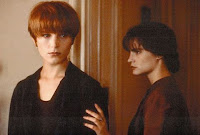
Then, on different ends of the evolutionary and endearment scales, there are the “hot mess” (a term only starting to gain wide currency around the time of this article) and “psychotic friend.” An example of the second kind can be found in the image accompanying this post, from the 1992 thriller Single White Female, with Bridget Fonda as the innocent and Jennifer Jason Leigh as said psycho.

I wonder how the DFF is faring psychologically these days in the COVID-19 era? On second thought, I thought. Her fate is surely both pitiful and terrifying for those in her orbit to experience.

Saturday, September 25, 2021

Quote of the Day (Judith Viorst, on ‘The Best of Friends’)

“The best of friends, I still believe, totally love and support and trust each other, and bare to each other the secrets of their souls, and run—no questions asked—to help each other, and tell harsh truths to each other when they must be told.

“But we needn't agree about everything (only 12-year-old girl friends agree about everything) to tolerate each other's point of view. To accept without judgment. To give and to take without ever keeping score. And to be there, as I am for them and as they are for me, to comfort our sorrows, to celebrate our joys.” —American essayist, journalist, poet, and psychoanalysis researcher Judith Viorst, “Friends, Good Friends—and Such Good Friends,” Redbook, October 1977

Monday, May 17, 2021

Photo of the Day: Good Advice on an Outdoor Table Sign

In my hometown of Englewood, NJ, I glimpsed this sign on one of those restaurant tables increasingly popping up with the weather getting warmer. 

But the advice it offers, I think, is evergreen—good at all times, no matter what the season, though remembered more forcefully now than at any other point in most of our lifetimes.

Sunday, May 2, 2021

Spiritual Quote of the Day (C.S. Lewis, on Friendship as an Instrument of God)

“Friendship is not a reward for our discrimination and good taste in finding one another out. It is the instrument by which God reveals to each the beauties of all the others. They are no greater than the beauties of a thousand other men; by Friendship God opens our eyes to them. They are, like all beauties, derived from Him, and then, in a good Friendship, increased by Him through the Friendship itself, so that it is His instrument for creating as well as for revealing. At this feast it is He who has spread the board and it is He who has chosen the guests. It is He, we may dare to hope, who sometimes does, and always should, preside. Let us not reckon without our Host.”—British novelist and religious author C.S. Lewis (1898-1963), The Four Loves (1960)

Friday, August 16, 2019

TV Quote of the Day (‘Downton Abbey,’ With the Dowager Countess on the Fine Art of Avoiding People)


Violet Crawley, Dowager Countess of Grantham [played by Dame Maggie Smith]: “There's nothing simpler than avoiding people you don't like. Avoiding one's friends—that's the real test!”—Downton Abbey, Season 5, Episode 1, original air date Jan. 4, 2015, teleplay by Julian Fellowes, directed by Catherine Morshead

Friday, May 17, 2019

TV Quote of the Day (‘The Big Bang Theory,’ In Which Sheldon Voices His Eternal Dilemma)


[Dr. Sheldon Cooper has been rehearsing his Nobel Prize speech.]

Dr. Amy Farrar Fowler [played by Mayim Bialik]: “Sheldon, why are you talking so fast?”

Sheldon [played by Jim Parsons]: “I'm trying to get my speech down to ninety minutes.”

Amy: “Nobody's going to be able to understand a word you're saying.”

Sheldon: “Welcome to my life.”—The Big Bang Theory, Season 12, Episode 24, “The Stockholm Syndrome,” original air date May 16, 2019, teleplay by 13 writers!, directed by Mark Cendrowski       

So, after 12 seasons, The Big Bang Theory is finally over. True, the show may have stayed on about three years too long and the finale a bit predictable. But at least showrunner Chuck Lorre wasn’t untrue to the spirit or premise of the show or make a hash of the whole thing, the way Seinfeld went out. 

Remarkable, too, isn’t it, that with roughly seven co-equal stars, Lorre does not seem to have a major problem with any of them—unlike his other megahit, Two and a Half Men, which had far fewer leads to handle, but one of them happened to be Charlie (“I got tiger blood”) Sheen.

(As you might be able to tell from the credits listing above, I am rather astounded that 13 writers contributed to the finale. I always thought it remarkable that eight screenwriters had a hand in the old Tom Hanks movie Turner and Hooch, about a man's relationship with his dog. But I guess that the necessity of ending this sitcom on--pardon me!--a bang required extreme measures.)

The Big Bang Theory ended with Sheldon’s resounding professional success, but even if he and Amy hadn’t ended up winning the Nobel, the series had already made plain, they and their friends had already succeeded—by finding personal happiness through mutual friendship and love. 

It’s an old message, maybe even a clichéd one, but in this time and culture celebrating winning at any personal cost, maybe it has to be taught and learned all over again.

Saturday, October 13, 2018

Quote of the Day (Emily Dickinson, Voicing My Thoughts on the Eve of My High School Reunion)


"My friends are my estate. Forgive me then the avarice to hoard them." – American poet Emily Dickinson (1830-1886), letter to Samuel Bowles, No. 193 (late August 1858?)

Thursday, June 1, 2017

Quote of the Day (Alexander Pope, on Old Friends)


“Content with little, I can piddle here 
On brocoli and mutton round the year; 
But ancient friends (tho’ poor, or out of play) 
That touch my bell, I cannot turn away.” —English poet Alexander Pope (1688–1744), Satires, Epistles, and Odes of Horace Imitated: The Second Satire of the Second Book of Horace