Showing posts with label Climate Change. Show all posts

Friday, July 24, 2026

Photo of the Day: Two Kinds of Toxic Environment

I took the image accompanying this post a week ago while I was still on vacation at the Chautauqua Institution, a lovely enclosed upstate New York community with numerous Victorian cottages that have helped make this picturesque place a National Historic Landmark.

As much as its cultural and intellectual atmosphere, habitual visitors glory in its physical environment. For the 30-odd years that I have come up here, I have made it a point, as long as the rain is holding off, to take daily brisk walks by Chautauqua Lake.

Until the last three days of this vacation, that is.

In the background, a particle-laden, milky uniformity had replaced sunlight streaks of the morning horizon. Never mind a wide view of what lay upon the waters: as you can observe in this image, nothing could be seen beyond the boats lined up at the marina.

Probably at no time, I suspect, since the height of COVID-19 up here, masks were being distributed and gratefully worn by many visitors on the grounds.

The first day of the wildfire, the designation was “Dangerous for Certain Groups”; the following day, the label became simply “Dangerous”: and by the third, the bad air quality had turned sufficiently dreadful to earn the term “Hazardous.”

This photo renders in literal terms a toxic physical environment. But it symbolizes what has increasingly become a toxic diplomatic one, as well.

At this moment, Donald Trump has chosen to do what he does best: make a bad situation worse. He’s taking literally the satirical South Park song “Blame Canada,” but without an iota of logic. Our nation up north is responsible for not maintaining its forests properly, he claims.

That’s pretty rich, coming from a President who has already laid off thousands of U.S. Forest Service workers and whose 2027 budget includes cuts of more than 70% to the agency. But his rationale would be hideous in any case because he refuses to accept the reality of human-caused climate change.

Super-hot temperatures in the areas around the wildfires, together with dry vegetation, resulted in “functioned like a chimney, a super long chimney shooting smoke into the upper atmosphere and then the jet stream” and then found its way to the US, according to Ava Berger’s NPR report last week.

This is a situation that calls for international cooperation to address causes, not finger-pointing—unless you’re Trump. Then he tells citizens of a country that he has not-so-jokingly called to be annexed into the U.S. that he’s going to levy “a big tariff” on their nation for the wildfires crossing the border.

Trump has turned the Ugly American stereotype of the Vietnam War era into an actuality. His default reflex—to blow smoke every time he finds himself in a difficult situation—has become literal this time, and it’s losing the U.S. a neighbor and friend it could always count on.

The smoky air has cleared from beautiful Chautauqua Lake, as well as other areas affected in the northern part of the U.S. last week. But before the end of this second Trump term, you can count on it coming back, perhaps at more hazardous levels.

And Americans had better accept that it’s going to take longer before the effects of Trump’s careless, toxic rhetoric dissipate.

From now on, traditional allies like Canada are entitled to wonder what got into Americans that they put in the White House a charlatan like Trump twice—and whether the Republican Party he has remolded in his image will nominate as his successor someone equally wedded to his agenda of environmental callousness and diplomatic exploitation.

Wednesday, October 22, 2025

Photo of the Day: All-Out for Halloween, in a Big Way

Over the last 30 to 40 years, Halloween decorations have increasingly filled the lawns where I live in Northern New Jersey. It’s been a way for baby boomers Gen Xers (and, I guess now, Millennials and Gen Z) to relive their childhoods, and on a scale that their budget-conscious ancestors, after being raised during the Great Depression, would never have dreamed of embracing.

Recently I took this photo several miles from my home. What you see here is only half of all of the figures on the lawn and front porch of this suburban house.

Nor does this photo convey the sounds coming from this ghoulish assembly. Just passing on  the street—not even stepping on the lawn—is enough to elicit the witch on the right-hand side, for instance, to cackle, “Lost your way? Don’t be afraid—I’ll show you! Heee-heee-haaa-haaa!”

This year, Halloween splurging on decorations, masks, makeup, costumes, and candy has continued, despite the threat of tariffs. According to the National Retail Federation, Halloween spending is expected to reach $13.1 billion this year, breaking its prior record of $12.2 billion.

Omar Villafranca’s CBS News report from a month ago indicates that consumers are hitting discount stores and merchants are absorbing as many of the tariff costs (5% to 19% on costumes manufactured overseas) as possible, but there’s only so much they can do. A fog machine sold by a Fort Worth merchant mentioned in the article, for instance, sold for $58 last year but $74 now.

And chocolate candy? The price of the cocoa used for this has more than doubled since the beginning of 2024, a casualty of changing weather patterns (heavy rains followed by El Nino-induced droughts leading to black pod disease and crop rot, according to a USA Today report earlier this month by Betty Lin-Fisher and Carlie Procell).

Friday, July 18, 2025

TV Quote of the Day (‘WKRP in Cincinnati,’ on Innovative Weather Forecasting and Traffic Reporting)

Andy Travis [played by Gary Sandy]: “Now, you have this thing you call ‘Eyewitness Weather.’ What is that?”

Les Nessman [played by Richard Sanders]: “Well, I just look out the window and witness the weather.”

Andy: “Uh-huh. And what about this station's traffic helicopter?”

Les: “We don't have one.”

Andy: “So why do we have helicopter reports?”

Les: “Well, that's just me. See, I just get on the air and do this..”[standing at attention, beating his chest to make propeller sounds] "…The traffic today is light to heavy..."—  WKRP in Cincinnati, Season 1, Episode 1, “Pilot: Part 1,” original air date Sept. 18, 1978, teleplay by Hugh Wilson, directed by Jay Sandrich

The way things are going in this country with federal budget cuts—including at the National Weather Service—that “Eyewitness Weather” in which Les takes such pride might be spreading across the country.

Gee, I wonder how he would account for climate change?

Sunday, September 15, 2024

Quote of the Day (David Wallace-Wells, on Global Warming’s Impact on the Oceans)

“More than 90 percent of all the excess heat trapped in the atmosphere by the greenhouse effect goes into the oceans, and while climate-conscious humans may regard this as a lucky break for life on land, the math implies a different and less narcissistic emphasis: that the planet’s water, home also to a majority of its life, has absorbed nine times as much global warming as the world above the surface we know so well — and worry over so much.”—Science writer David Wallace-Wells, “The Impacts of Global Warming Are Invisible, But They’re Unimaginably Vast—With Long-Term Consequences That Will Be Hard to Predict,” The New York Times Magazine, June 30, 2024

The image accompanying this post of David Wallace-Wells was taken Sept. 28, 2019, at the 2019 Göteborg Book Fair (talking about his book The Uninhabitable Earth) by Vogler.

Sunday, July 28, 2024

Quote of the Day (Helen Czerski, on Being ‘Citizens of an Ocean World’)

“Marine heat waves and hot spots can have severe local effects, as ocean life struggles to survive the increasing temperatures or moves to find cooler water, disrupting the ecosystems in those places. But the bigger picture is that any change to the ocean engine will matter, because the way this engine hums dictates conditions for the rest of life on Earth. Living on a blue planet isn't about the color, lovely though it is. The ocean is the dominant feature of Earth, and we live in its shadow. This is about our identity as citizens of an ocean world, which is broadcast to the universe, written in blue light.”— British physicist and oceanographer Helen Czerski, “The Shifting Flows of Our Overheating Oceans,” The Wall Street Journal, Sept. 30-Oct. 1, 2023

I took the image accompanying this post while on vacation in Hilton Head, S.C., in November 2014.

Tuesday, June 18, 2024

Quote of the Day (John Neal, on the Insurance Industry and Climate Change)

“You'll never find an insurer saying, ‘I don't believe in climate change.' The frequency and severity of weather-related losses are exponential. The US had the highest number of convective thunderstorms in 10 years last year, and it's already worse this year.”—Lloyd’s of London CEO John Neal quoted by Rana Foroohar in “Lunch With the FT: ‘You’ll Never Find an Insurer Saying ‘I Don’t Believe in Climate Change,’” The Financial Times, June 15-16, 2024

Saturday, March 30, 2024

Quote of the Day (Margaret Renkl, on an ‘Exquisite Sort of March’)

“We don’t deserve a March like this. We have tortured the earth so thoroughly and for so long that we deserve only the hungry lions of March. We are having the exquisite sort of March anyway. I glory in every tiny, iridescent green bee waking to feed on the first vanishing bloodroot flower, the first ephemeral spring beauty, the first woodland violet and cutleaf toothwort. Soon there will be trilliums and trout lilies, too. Any day now, toadshade trilliums and trout lilies! If you tell me I don’t deserve this joy, you are telling me nothing I don’t already know. The world is on fire, and I’m the one who struck the first match. I did it, and you did it….

"I am in love with the mild light of springtime even so.”—Essayist Margaret Renkl, “Spring Brings Joy, Even in a World on Fire,” The New York Times, Mar. 10, 2022

I don’t know if Ms. Renkl gloried in March this year down where she lives in Tennessee the way she did back in 2022. At least in my neck of the woods here in the Northeast, it was more or less par for the course, seasonally: one week of pretty warm temperatures, but all in all, brisk and/or rainy, with no late snow.

I would be worried if up here we did experience anything like what Ms. Renkl had two years ago. From what I see of extreme summer heat, climate change is continuing. If plenty of those “tiny, iridescent green bees” in Tennessee start showing up here at this time of year, then global warming, I am certain, would not just be proceeding but galloping.

Sunday, March 3, 2024

Quote of the Day (John Gapper, on Weakening ‘Old Empires of Coffee, Cocoa and Tea’)

“[T]he old empires of coffee, cocoa and tea are getting fragile amid climate change and the interruption of global trade routes. The price of their weakness is already becoming obvious, and the supermarket shelves may not always stay full.”—Business columnist John Gapper, “How Cocoa, Coffee and Tea Empires Became Fragile,” The Financial Times, Feb. 24-25, 2024

The image accompanying this post, of John Gapper, was taken Oct. 15, 2010, by The Financial Times. 

Friday, August 25, 2023

TV Quote of the Day (Jim Gaffigan, Channeling What’s Been Ticking Off God Lately)

“I miss the days when you could send a plague and people would listen.”—Comedian Jim Gaffigan, imagining God frustrated over human beings’ indifference to climate change, in the Prime Video special Dark Pale (2023)

This photo of Jim Gaffigan, at the "An Evening With Stephen Colbert and Jim Gaffigan" event, was taken June 24, 2023, by Neil Grabowsky, and made available by Montclair Film.

Thursday, July 13, 2023

Quote of the Day (Simon Kuper, on Climate Change’s Impact on European Summers)

“Since the heatwaves of 2019, summer has morphed from something to crave into something to fear. Europe, which is heating twice as fast as the global average, had its hottest ever summer in 2022, breaking the record set in 2021 — all of which was before the world re-entered the hotter El Niño climate cycle. No beach is fun at 40C with wildfires on the horizon.”—Journalist Simon Kuper, “How Will Climate Change Affect the Holiday Map?” The Financial Times, July 1-2, 2023

Will this go down as the summer when Planet Earth finally awakens to the threat of climate change, when voters finally demand that politicians stop denying its existence and start spelling out what they’ll do about it?

If only!

Even so, it is remarkable the extent to which there are few places on this planet—and, more to the point, few places in the United States—that are not affected by the rising heat and humidity. Statistics don’t persuade people of much, but maybe TV footage of relatives—or, God forbid, direct experience with the consequences of a climate in the midst of a perfect storm of factors—might convince some.

At some point, I’d like to write an analysis that, jigsaw-like, puts all the pieces of together from different parts of the globe to depict what’s happening. But Simon Kuper’s recent column that I quoted from above illuminates, in concise form, what is happening in Europe.

I didn’t know until I read him, for instance, that a particularly popular European pastime—sunbathing on the French Riviera—was invented 100 years ago this summer by Gerald and Sara Murphy, the models for the expatriate couple at the heart of F. Scott Fitzgerald’s novel Tender Is the Night.

Nor, until I read Kuper, had I thought of how unbearable temperatures could alter European tourism patterns—and have a direct (and more often than not, unhappy) effect on this element of the continent’s economy.

The image accompanying this post is based on a 2022 European Investment Bank survey, showing an even wider implication of climate change: that more than a quarter of Europeans believe they may need to move to another region because of the phenomenon.

From my childhood, I distinctly recall a margarine commercial with the tagline, “It’s not nice to fool Mother Nature.” But for at least the past couple of decades, in our refusal to face up to climate change, Americans have been the fools, not the other way around. 

Maybe now, as we survey the damage, we can only hope that clown time is over.

Tuesday, May 17, 2022

Quote of the Day (Jorie Graham, on Missed Warnings of Climate Change)

“It was time
she said, to move on, her gaze
looking out at the avenues and smaller streets,
at the silk dresses on the mannequins in
storefronts, all of them, across the
planet, the verandas poking out under the
hemlocks, violin strings crossing from
one century to another, although now I could hear they were
sirens all along,
invisible and desperate the warnings
in their rise and fall.”—Pulitzer Prize-winning poet Jorie Graham, “Time Frame,” London Review of Books, Apr. 21, 2022
 
The image accompanying this post shows Jorie Graham at a poetry reading at the Library of Congress, Dec. 6, 2007.

Friday, May 6, 2022

Quote of the Day (John Gapper, on a Crucial Event in ‘Carbon Lock-In’)

“There was a period in the early 20th century when electric (or steam) batteries nearly emerged as the dominant form of propulsion for cars, before the gasoline-powered combustion engine triumphed.

“We are still trying to overcome the destructive environmental impact of this historic event, although improvements in battery technology, regulatory initiatives and changes in consumer preferences are progressing. It’s a great example of what’s known as carbon lock-in – the entrenchment of carbon-emitting industries and technologies in everyday life.”— Business columnist John Gapper, “Debit Cards, Electric Cars and Ghosts of the Technological Past,” The Financial Times, Jan 22-23, 2022

The image accompanying this post, of John Gapper, was taken Oct. 15, 2010, by The Financial Times.


Friday, April 1, 2022

Quote of the Day (Samantha Montano, on the Scientific Opportunity Lost During COVID-19)

“In early 2020 some thought the pandemic would be just the sort of focusing event that wakes up world leaders to the risks of sleeping on the climate crisis. Maybe they would use this ‘window of opportunity’ to draw obvious parallels, so that one global crisis inspired action on the other. Perhaps the U.S. Congress would finally admit the need to reform—and massively expand—our emergency management system to one that prioritizes risk reduction rather than reactionary measures. One that meets the needs of frontline and marginalized communities who experience disproportionate disaster impacts and are kept from accessing adequate aid.

“None of this has happened. Not only is the government not applying the lessons of the pandemic response to other disasters, but even within the pandemic itself, many elected officials have failed to apply the lessons learned at the beginning.”— Samantha Montano, assistant professor of emergency management at Massachusetts Maritime Academy, "We Didn't Get Serious About the Climate Crisis," Scientific American, March 2022

Friday, December 31, 2021

Quote of the Day (Jeffrey Schlegelmilch, on How Megadisasters ‘Permanently Alter the Course of History’)

“Megadisasters are those that have society-altering potential. These are the ones that can overwhelm the very systems designed to respond to disasters. History has given us plenty of examples. Think of the Black Death in the Middle Ages, which wiped out as much as a third or more of Western Europe’s population and reshaped its economic and political systems, or the Irish Potato Famine, which caused the largest mass exodus in the nation’s history. Megadisasters don’t have a temporary impact on society: they permanently alter the course of history.”— Jeffrey Schlegelmilch, the director of Columbia University’s National Center for Disaster Preparedness, quoted in Kevin Krajick and David J. Craig, “How to Prepare for a ‘Megadisaster,’" Columbia Magazine, Spring/Summer 2021

I’m sorry to close out this year on a downer note, but this interview with Jeffrey Schlegelmilch is important for explaining in such clear terms what the world has been witnessing, not just this year but so far in the 21st century.

Immediately after the above quote, Schlegelmilch points to the source of these large-scale disasters that are happening more often: human activities:

“We are pumping pollutants into the atmosphere at unprecedented rates, leading to more extreme weather events. At the same time, we are building in flood zones, in forested regions susceptible to wildfires, and in other hazard-prone areas. This dynamic is not unique to climate change. Other disasters, like pandemics, have components where societal development is increasing both the threat and our vulnerability. New diseases are emerging because we’re encroaching into wildlife areas and coming into closer contact with animals that harbor exotic pathogens, and the diseases are spreading faster through human populations because of our global connectedness.”

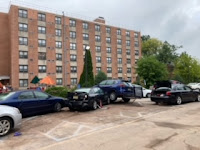
It's one thing when this happens elsewhere in the nation on the evening news, and quite another when it occurs locally, even on your own street. Such was the case at the start of September, when Hurricane Ida struck my hometown of Englewood, NJ.

Across the street from me, several residents of a housing project were evacuated when an adjacent creek overflowed and surged through their apartments. They were not able to move back in until the end of September.

The situation was—and remains—worse at a senior citizens’ project at the end of the block. The picture accompanying this post, taken a day or so after the waters from the brook had receded, only hints at what happened in and around this complex.

Not only were multiple cars damaged (or even lost), but the flood damaged electrical systems in the basement of the building, including the elevator controls and hot water. As a result, residents were hurriedly moved to CareOne facilities, then to area hotels.

Initially told to take only enough to last them a few weeks, these seniors didn’t have enough time even to take winter coats. It turned out they needed these, as their time away now looks like it will take many more months. (This article from the Bergen Record just before Christmas tells of their plight, as well as the commendable effort of the NAACP to alleviate it by collecting coats for them.)

Some of this situation was the unforeseen consequence of one of the “human activities” cited by Schlegelmilch: building in a floodplain. Nearly 50 years ago, these two projects were constructed along the brook, in an attempt to deal with urgent housing problems of the time.

To make the projects possible, bulldozers rechanneled and tamed the brook by scooping out hundreds of rocks and pebbles, with walls built higher and fences erected to prevent the flood damage that had occurred regularly in previous years.

And that’s how it was for nearly the following half-century. But Hurricane Ida, with its force of historic proportions, overwhelmed defenses deemed close to impregnable back then.

The citizens displaced by the storm face an uncertain future, exacerbated by the disruption of routine, isolation and loneliness prevalent during the COVID-19 pandemic.

But one also has to ask: If a disaster such as Hurricane Ida (or, for that matter, COVID-19) can happen once, what’s to prevent it happening again,  particularly when so many deny that interlocking crises like this even exist?  No matter how high and strong our barriers are and how much we spend, will it be enough if there is a next time?

Or, maybe I should say: when there is a next time.

Thursday, December 2, 2021

Quote of the Day (Carl Safina, on Early December in Eastern Long Island)

“With a real frost in the air and a mad-dog bite to the wind, winter is no longer just a concept. A new moon has the tide kicked way up. Waves acting like winners at a poker table greedily pull piles of beach into their lap. On the south side, waterfront home owners are finding the water much closer. Many have lost up to a staggering twenty feet of land this autumn, and in places, sloping dunes that once led gently toward the beach have become ten-foot-high bluffs. Swept-away beach stairs and walkways have gotten hurled back at the crumbled dunes up and down the beach. And it’s not even officially winter yet; such has been the strange tantrum of a mostly warm autumn.”—American ecologist, nature writer—and MacArthur “genius” Fellow—Dr. Carl Safina, The View from Lazy Point: A Natural Year in an Unnatural World (2011)

(Photo of Carl Safina taken by Carl’s Crew on Feb. 7, 2011.)

Thursday, February 18, 2021

Song Lyric of the Day (George Strait, Anticipating the Current Texas State of Mind)

“Amarillo by morning
Up from San Antone
Everything that I've got
Is just what I've got on.” —Country music singer George Strait, “Amarillo By Morning,” written by Terry Stafford and Paul Fraser, covered by Strait and released on his LP Strait from the Heart (1982)

Just before I wrote this, I googled current weather conditions in Texas and found it was 32 degrees in San Antonio and 10 degrees in San Antonio. And that’s Fahrenheit, not Celsius.

Over the last few weeks, my neck of the woods, in northern New Jersey, has been pelted with one snowstorm after another. (Come to think of it, that’s exactly what’s happening right now.) But Texas is another matter. Nobody expected what they’re getting now, so nobody prepared for it.

So yesterday, we had front-page headlines from both The New York Times and The Wall Street Journal about the deep freeze that has massively disrupted the state’s electricity grid, forcing many out of their homes in search of a warm place to stay. The mayor of Colorado City in the Lone Star State has even felt the need to resign, after constituents took serious offense to his Facebook post disclaiming the local government’s responsibility to help in the emergency, climaxing with the Darwinian suggestion that “Only the strong will survive and the weak will parish (sic)."

In the 1970s, many state drivers, disdaining speed limits as a means of energy conservation, sported the bumper sticker, “Drive 80 and freeze a Yankee.” How many ever dreamed that they themselves might freeze?

So, I guess Strait, singing the above lyric by Terry Stafford and Paul Fraser, anticipated the privation and even desperation produced by the current crisis. There’s one thing he didn’t expect, however: in this auto-centric state, the man in his song might not even be able to get on the road with all the traffic accidents. Who would ever expect the Texas Department of Transportation to issue a winter storm advisory to stay off the roads?

It is hard not to read all the news articles and social media chatter without seriously worrying about what is going on down there. So pray for Texans—very much including those on the road from “San Antone” to Amarillo.

Saturday, September 5, 2020

Quote of the Day (Joshua Busby, on Climate Change in the U.S. and China)

“Humans have proved highly adaptable, but the collective effects of climate change on cities, food production, and water supplies present an enormous challenge for the planet. China and the United States will be central to the global response. Together, the two countries are responsible for more than 40 percent of global emissions. . . . Relations between China and the United States have soured recently, but the countries need to work together, as the world will be ill served by an all-encompassing rivalry between them. They will have to build a system that allows issues to be compartmentalized, in which they can jockey over regional security in Asia, for instance, but still cooperate on issues on which their fates are linked, such as climate change and pandemics.” —University of Texas Associate Professor Joshua Busby, “Warming World: Why Climate Change Matters More Than Anything Else,” Foreign Affairs, July/August 2018

Oh, my—it’s the last word in the above quote that really hurts. If we can’t cooperate on something as immediate (certainly more so than when this was published) as pandemics, what are we going to do about something longer-term such as climate change?


Wednesday, April 22, 2020

Quote of the Day (Bill McKibben, on Climate Change, ‘The Fight of Our Time’)


“If we do not solve this problem soon, we will not solve it. We are called upon to act with all that we have. It is the fight of our time — and we need you.”—Environmental author-activist Bill McKibben, on climate change, quoted in Jamie Landers, “Bill McKibben Calls for Individual Action and Collective Climate Change Reversal,” The  Chautauquan Daily, Aug. 15, 2019

At the moment, many would say that the coronavirus pandemic is “the fight of our time”—and I’m not sure I would quarrel with that assessment.

But I strongly believe that climate change has this in common with COVID-19: It is an emergency waiting to happen, a perfect storm resulting from authoritarian instincts that smother inconvenient bad news, our country’s unwillingness to make prudent investments that might stave off disaster, and—I might as well say it—a President who scoffs at science and even elementary facts while turning a real but by means insoluble problem into a massive catastrophe that didn’t have to happen. And it has similar potential to create a Darwinian struggle in which the haves are far, far more likely to survive than the have-nots.

Take a look around at all the people wearing masks today. In the not-so-distant future, given that President’s attitude toward the environment—and his diehard followers’ swallowing of nearly every word he says—it is not at all inconceivable that those masks may come into use again, even after this particular pandemic subsides, if our air becomes too polluted to breathe.

Saturday, December 28, 2019

Quote of the Day (Joyce Carol Oates, Imagining the Climate-Change Apocalypse)


“When they moved from West Seventy-Eighth street and Columbus Avenue to Hazelton-on-Hudson, in 1991, the air in the Hudson Valley was cleaner, the sky was a brighter and clearer blue–Luce is certain. The white oaks and birches did not shed their leaves prematurely, in September. That maddening chemical odor wasn't borne on the wind, and the soil on Vedders Hill seemed more solid, substantial. Mudslides were unknown, as were firestorms. An excess of pollen was a far more serious problem than a depletion of ozone was. True, there were reports of acid rain in the Adirondacks, and the Hudson River had been heavily polluted, like Lakes Ontario and Erie, upstate, but the media didn't make a fuss over it, and social media, that vehicle for channelling outrage, did not yet exist. Everyone sailed, canoed, kayaked on the Hudson River. Fished! The river's steely beauty prevailed.” — Joyce Carol Oates, “Sinners in the Hands of an Angry God,” The New Yorker, Oct. 14, 2019

This past weekend, on Meet the Press, the panelists, asked to list the most important stories of the last decade, named climate change as number two. Historian Doris Kearns Goodwin, who listed it as number one, explained her reasoning: “What are they going to say 50 years from now? And am I going to be right, 50 years from now?...If we're not taking a leadership role in this, the generations to come will know that we failed.”

That failure hangs heavily over “Sinners in the Hands of an Angry God,” which takes its title from the infamous 1741 sermon by Jonathan Edwards sermon. But, while the Congregationalist minister conjured up a personal and collective calling to account for assorted sins, the prolific fiction writer Joyce Carol Oates imagines an environmental catastrophe visited upon her characters, Luce and Andrew.

Not only is the circle of friends of this New York couple decimated by cancers before their time, but the two of them, gripped by confusion, anxiety and fear, grow more emotionally distant from each other, unable to express their emotions to each other. At the climax of the story, death is present not only outside the couple’s home, in the form of a raging firestorm, but inside, through the stricken fellow musicians in Luce’s “Little Quartet”: “Wheelchairs, walkers, canes. Little knitted caps on (bald) heads. A contingent of chemotherapy’s walking wounded.”

“Accusing others of ‘catastrophizing,’ even as the world is disintegrating and one’s own health has become tenuous, is a form of denial in which most/many of us indulge daily,” Oates explained in an interview with The New Yorker. Through fiction, she brings readers face to face with our ongoing individual and collective failure of environmental responsibility. 

The astonishingly prolific Oates has occasionally written horror stories, but I can’t imagine that she has written anything more terrifying than this grim tale. It gives powerful narrative form to the epic ecological change noted by J. R. McNeill in Something New Under the Sun: An Environmental History of the Twentieth Century

“With our new powers we banished some historical constraints on health and population, food production, energy use, and consumption generally….[I]n  banishing them we invited other constraints in the form of the planet's capacity to absorb the wastes, by-products, and impacts of our actions. These latter constraints had pinched occasionally in the past, but only locally. By the end of the twentieth century they seemed to restrict our options globally.”

(Photograph of Ms. Oates ©Larry D. Moore CC BY-SA 4.0 at the 2014 Texas Book Festival, Austin, Texas, Oct. 25, 2014.)