“Megadisasters are those that have society-altering
potential. These are the ones that can overwhelm the very systems designed to
respond to disasters. History has given us plenty of examples. Think of the
Black Death in the Middle Ages, which wiped out as much as a third or more of
Western Europe’s population and reshaped its economic and political systems, or
the Irish Potato Famine, which caused the largest mass exodus in the nation’s
history. Megadisasters don’t have a temporary impact on society: they permanently
alter the course of history.”— Jeffrey Schlegelmilch, the director
of Columbia University’s National Center for Disaster Preparedness, quoted in Kevin
Krajick and David J. Craig, “How to Prepare for a ‘Megadisaster,’" Columbia
Magazine, Spring/Summer 2021
I’m sorry to close out this year on a downer note, but
this interview with Jeffrey Schlegelmilch is important for explaining in such
clear terms what the world has been witnessing, not just this year but so far
in the 21st century.
Immediately after the above quote, Schlegelmilch points
to the source of these large-scale disasters that are happening more often:
human activities:
“We are pumping pollutants into the atmosphere at
unprecedented rates, leading to more extreme weather events. At the same time,
we are building in flood zones, in forested regions susceptible to wildfires,
and in other hazard-prone areas. This dynamic is not unique to climate change.
Other disasters, like pandemics, have components where societal development is
increasing both the threat and our vulnerability. New diseases are emerging
because we’re encroaching into wildlife areas and coming into closer contact
with animals that harbor exotic pathogens, and the diseases are spreading
faster through human populations because of our global connectedness.”
It's one thing when this happens elsewhere in the
nation on the evening news, and quite another when it occurs locally, even on
your own street. Such was the case at the start of September, when Hurricane
Ida struck my hometown of Englewood, NJ.
Across the street from me, several residents of a
housing project were evacuated when an adjacent creek overflowed and surged
through their apartments. They were not able to move back in until the end of
September.
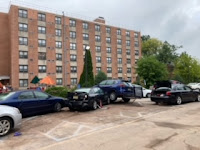
The situation was—and remains—worse at a senior citizens’
project at the end of the block. The picture accompanying this post, taken a
day or so after the waters from the brook had receded, only hints at what
happened in and around this complex.
Not only were multiple cars damaged (or even lost),
but the flood damaged electrical systems in the basement of the building,
including the elevator controls and hot water. As a result, residents were hurriedly
moved to CareOne facilities, then to area hotels.
Initially told to take only enough to last them a few
weeks, these seniors didn’t have enough time even to take winter coats. It
turned out they needed these, as their time away now looks like it will take
many more months. (This article from the Bergen Record just
before Christmas tells of their plight, as well as the commendable effort of
the NAACP to alleviate it by collecting coats for them.)
Some of this situation was the unforeseen consequence
of one of the “human activities” cited by Schlegelmilch: building in a
floodplain. Nearly 50 years ago, these two projects were constructed along the
brook, in an attempt to deal with urgent housing problems of the time.
To make the projects possible, bulldozers rechanneled
and tamed the brook by scooping out hundreds of rocks and pebbles, with walls
built higher and fences erected to prevent the flood damage that had occurred
regularly in previous years.
And that’s how it was for nearly the following
half-century. But Hurricane Ida, with its force of historic proportions, overwhelmed
defenses deemed close to impregnable back then.
The citizens displaced by the storm face an uncertain
future, exacerbated by the disruption of routine, isolation and loneliness prevalent
during the COVID-19 pandemic.
But one also has to ask: If a disaster such as
Hurricane Ida (or, for that matter, COVID-19) can happen once, what’s to prevent
it happening again, particularly when so
many deny that interlocking crises like this even exist? No matter how high and strong our barriers
are and how much we spend, will it be enough if there is a next time?
Or, maybe I should say: when there is a next
time.