Identified initially by Jeb Bush as the “Chaos Candidate,” Donald Trump has segued all too readily into the Chaos President.
The damage he has caused encompasses just about every sphere of Presidential
activity, but I think he has been especially egregious in the case of the
Republican Party, where his hold on members has exceeded even George W. Bush,
Ronald Reagan, and Dick Nixon—all re-elected to the Presidency—at the peak of their
popularity.
Events of the past few weeks—most recently, the
President’s nativist, even race-baiting, tweets and speeches about the
left-leading quarter of Democratic congresswomen known as “The Squad”—have led
concerned members of the GOP—and even those not remotely close to it—to cast
about for challengers within the party. The best candidate to pick up the
mantle—though, perhaps, not the most likely—is John Kasich.
I saw Kasich late last month at the historic
Amphitheater at Chautauqua Institution in southwestern New York. Even
for someone not a confirmed Republican such as myself, it is easy to see why Kasich
for so long enjoyed a long string of electoral successes. The last challenger
left standing against Donald Trump in the 2016 GOP Presidential primaries charmed
a predominantly liberal audience that, under normal circumstances, would
criticize, even abominate, a good part of his track record.
Many in the audience came out of curiosity,
wondering how much he would dare to deviate from his longtime baeven if he
might show signs of throwing down the gauntlet to Trump. A Yahoo column by Matt Bai nominated the former Ohio governor for the task, noting the
extreme need for it (a challenger who, by “primarying” the incumbent, can bleed
him enough to make him lose re-election) and why he’s best suited for the job
(he’s a longtime conservative, unlike the more libertarian William Weld).
Aside from Kasich, there are only two other
Republicans who still hold the appeal to the party’s longtime free-trade,
balanced-budget brand of conservatism: Mark Sanford and Mike Pence. But Sanford
is also the one who represents the most damaged goods. Whatever portion of the
party that didn’t reject him for his opposition to Trump in the House of
Representatives has still not forgiven him for his “hike in the Appalachians”
that was quickly exposed as a visit to this South American mistress.
'
Pence would very much like to succeed Trump—maybe
sooner than later—but through the first term, he has been mighty careful to
cover his tracks. He has to be: the President recalls how Pence carefully
sounded out reactions to Trump’s “Access Hollywood” tape in 2016, offering
something between a criticism and exculpation. The most interesting Trump
appointee who will be on the bubble after 2020 will be Pence. With his
usefulness as an emissary to the evangelicals at an end, how much longer can
the Veep survive?
As for Kasich, several considerable obstacles loom in the way of his candidacy. His popularity among Republicans, for instance, is not what
it was when he first ran for governor.
It is a sign of the madness now overtaking the GOP
that Kasich—with a record as a conservative dating back to the Nixon
Administration, a deficit hawk in his nine terms in Congress, and someone who
voted yes on all four impeachment counts against Bill Clinton—is now considered
an outlier in his own party. Google “John Kasich” RINO and you’ll come
up with more than 33,000 hits.
Kasich can’t even be counted to win Ohio, as many
residents hold it against him that he spent almost two years out of the state
running for the Presidency instead of minding his gubernatorial duties. (Chris
Christie, also in bad odor with New Jersey residents like me, surely can
relate.)
But a challenge from within the party must come against Trump,
no matter how dim its prospects may appear now.
There is one powerful practical reason for Kasich to
jump into the race, even at this late date: In Presidential politics, you
never know what will happen. After George H.W. Bush expelled Saddam Hussein
from Kuwait, his approval rating leaped, scaring off potential Presidential
challengers like Mario Cuomo and Sam Nunn. But when a recession hit, Bush’s
ratings didn’t stay high. Bill Clinton was perfectly placed to reap the benefit
of his audacity in challenging the President.
If Kasich can’t beat Trump as a Republican, would he
try as an independent? First, the effort
would involve building a viable third-party from the ground up, a step that
would have to be undertaken immediately to assure his appearance on as many
state ballots as possible. (Though lacking Kasich’s government experience, Ross
Perot more than made up for it in his 1992 campaign with his considerable
private wealth.)
On the other hand, Kasich could siphon off from both parties:
Republicans tired of Trump’s serial bullying and Democrats wary of their candidates' profligate
tendencies and tilt leftward. The odds are long, to say the least.
But in addition to a powerful practical reason for a
Kasich candidacy, there is another moral, admittedly quixotic, one: someone
must step into the breech to deny Trump’s kidnapping of the soul of the
Republican Party. The climate of fear generated by his daily tirades and tweets
has turned once-proud Capitol Hill titans into pathetic shells of themselves.
For a long time, I thought that Joseph McCarthy
posed the greatest danger ever to Capitol Hill in fanning anti-Communist
panic—and terror among colleagues afraid to stand up to him—through baseless
charges.
But now, with all the power and attention accorded the Presidency,
Trump has far surpassed him in his capacity for mischief and damage already
inflicted on both Republicans and the republic they ostensibly serve.
Recently, I came across Harold Macmillan’s
description of his Conservative Party leader, Neville Chamberlain, at the start
of his time as Prime Minister of the U.K.: “To question his authority was
treason: to deny his inspiration, almost blasphemy.” It could stand equally
well to describe Britain’s transatlantic allies three-quarters of a century
later, except that Trump’s government experience is far less than the British appeaser's and his hold on
party unity more mysterious.
It may be that a statesman is a defeated politician
and that only an unwelcome hiatus in his political career has freed Kasich’s
tongue at last and liberated him from a lockstep march with the right wing.
But, at this point, the party needs as many people like him as possible who
will attempt to awaken it from its age of unreason--and to question why its head not only remains in such inexplicable thrall to Vladimir Putin, but won't even support efforts to ensure that the 2020 race won't be influenced by the former KGB operative.
In addition, Kasich is one of the few Republicans with national
standing who called out the President, without equivocation, for
his “Squad” rants. Nor has he been shy
in taking on the GOP at large, noting, in a Washington
Post piece, that they are “in a
coma” right now, with no (new) ideas on how to proceed concerning workforce
training, education, or climate change.
In some ways, I found the most fascinating, loaded
utterance of Kasich at his Chautauqua appearance might have been an adverb:
“currently,” to describe his membership status in the Republican Party. At that point will calculated ambition or just plain moral disgust lead him to make a break?
Many
progressives in the Amphitheater that day either did not realize or were too polite
to bring up aspects of the former two-term Ohio Governor’s record that would
normally provoke them, including:
*loosening concealed-handgun regulations;
*signing more restrictive legislation resulting in
the closure of half of Ohio’s abortion clinics; and
*attempting to restrict collective bargaining for
public employees—an act repealed eight months later by a huge majority.
But, if Kasich is not
everything he would like an audience to believe he is (what politician is?), he
has demonstrated qualities in deeply short supply in Washington right now: an ability to
adjust to reality and compromise. Like Arnold Schwarzenegger in California, he
backpedaled from the more right-wing policies he first tried to enact when he
began his term and cooperated on bipartisan legislation that helped him win
re-election.
Charm comes so easily to Kasich that, after his Chautauqua
appearance, I was surprised he hadn’t done better with Republican voters in the
last election. At one point, he invoked 75-year-old Mick Jagger, and he seemed
to imitate the Rolling Stone frontman as he continually crossed the stage, even
descending into the audience.
He praised the sylvan setting of this lakeside
Victorian community, cracked jokes with a timing that only a professional
comedian could approach, picked out audience members to address, and briefly
took stances that the audience could agree with: more government funding of
Medicare, reduced drug prices, even a gesture toward what he called
“responsible gun control.”
What struck me, above all, was the difference
between his sense of humor and Trump's. When Kasich joked, 90% of the time it
was at his own expense. He invited the audience to laugh with him, in a
generous spirit that welcomed others into a circle that suggested, “Look, no
matter what our differences, we’re all friends here, right?”
Trump’s “humor,” if you want to use that term, is nothing
like that. Fundamentally, it is never directed at himself, because he’s not
only incapable of taking a joke but even making one at his own expense, because
that would suggest that he’s something other than the biggest and the greatest.
Neither quick like JFK’s nor genial like Reagan’s,
this style is mean-spirited at its core, an insult artist’s arsenal of
ridicule, degradation and humiliation. It's an overgrown middle-school crybully's
string of nicknames and taunts mixed in with protests against offenses to his
own tender ego, all of it shouted because he knows that, in front of carefully
chosen audiences, he can get away with it all.
Toward the end of his Chautauqua appearance, Kasich was asked
if he would run for President in 2020. He started out with the politician’s
usual disclaimer that he had learned never to close out his options, but then
allowed that, whatever happened, he would act as he always did: not move until
he could see “a path forward.” A Presidential campaign, he explained, was so
arduous that he could not foresee subjecting his family and followers to the
process unless he had a realistic chance of success.
It is, as Kasich implied, a tall order to ask
someone to enter a Presidential race with little or nothing to show for it at
the end. (Several Democratic candidates seem to hope a run will enhance their
prospects for a VP bid, a Cabinet post or—take your departing bow, Eric
Swalwell!—a semi-permanent MSNBC commentary gig.)
At the end of the day, it is highly likely
that Kasich could, for all his pains, end up deeply in debt; place strains on
his family; win few appreciable votes; or, most horribly, risk a bullet from an
assassin.
He could also end up a mere footnote, crushed
beneath an incumbent juggernaut, the way that liberal Pete McCloskey and
conservative John
Ashbrook were after running against Richard Nixon in the 1972 GOP primaries.
But there are worse fates. While these two Nixon challengers came from
completely opposite sides of the political spectrum, they each recognized, a
year after they were driven from the race, that the President they had defied
was a threat to the constitutional order, and they were among the first members
of their power to call for his removal from office.
In
the end, Kasich might have to go into the ring against the worst gutter fighter
in American politics now for the simplest of reasons: honor calls for exposing
Trump’s vulnerabilities, exploiting them to the fullest extent possible, and
weakening him enough so that if the former governor can’t beat him, the next person to come
along will do so.
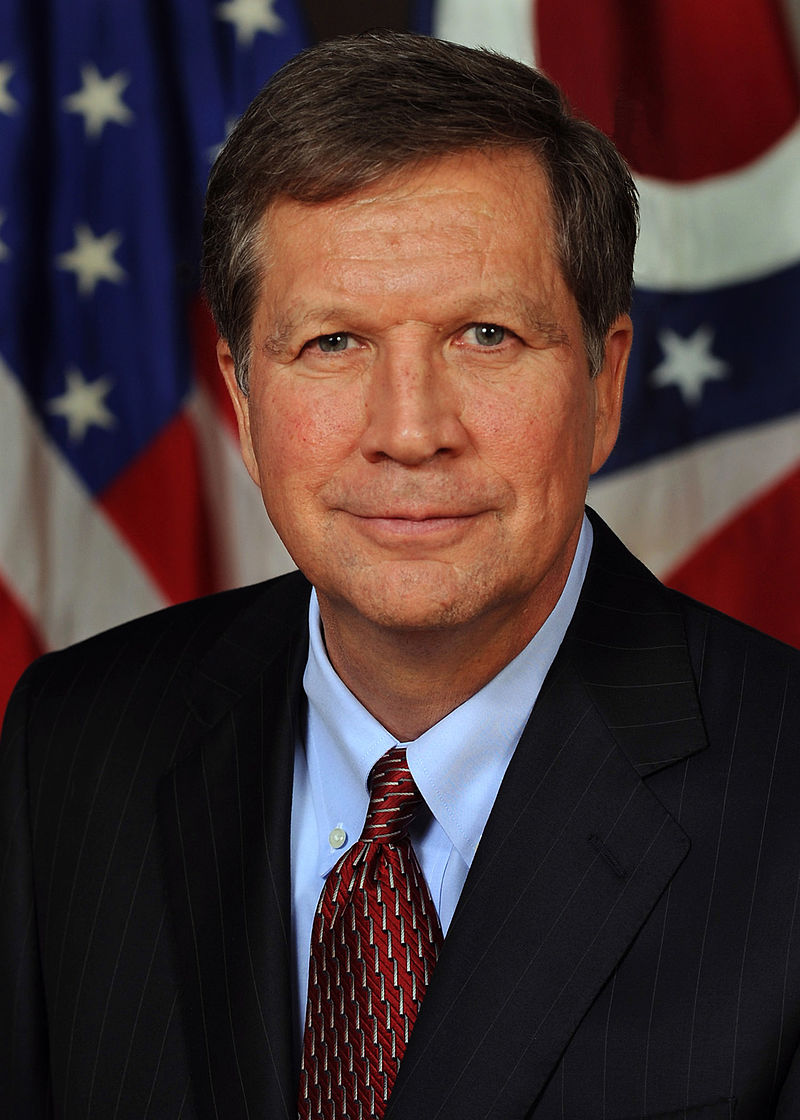
(The
image accompanying this post shows Governor Kasich in January 2011.)


 Over the last 25 years, I have frequently vacationed at the Chautauqua Institution, a National Historic Landmark in southwestern New York. This year,
with its traditional summer program of lectures, the arts, and entertainment
relegated to the virtual sphere, I have chosen not to visit.
Over the last 25 years, I have frequently vacationed at the Chautauqua Institution, a National Historic Landmark in southwestern New York. This year,
with its traditional summer program of lectures, the arts, and entertainment
relegated to the virtual sphere, I have chosen not to visit.