
Showing posts with label Christmas. Show all posts
Showing posts with label Christmas. Show all posts
Thursday, December 25, 2025
Spiritual Quote of the Day (Henri Nouwen, on Why God Sent Jesus to Us)


Monday, December 22, 2025
TV Quote of the Day (‘SNL,’ on Why Santa Might Have Been Watching the Show)

Michael’s
“12-year-old nephew,” Tyson
[played by Kam Patterson]: “I sure do, but Uncle Che, do you think Santa
is watching SNL?”
Michael: “I mean, I think Santa’s watching. He’s over 100 and white, so probably.”—Saturday Night Live, Season 50, Episode 9, original air date Dec. 20, 2025, “Weekend Update: Michael Che’s Nephew Threatens Santa”
Sunday, December 21, 2025
Spiritual Quote of the Day (Pope Leo XIV, Calling for ‘Hearts Attentive and Vigilant As We Await Jesus’)

Wednesday, December 10, 2025
Quote of the Day (Megan Nolan, on Going Home to Ireland for the Holidays)

The image accompanying
this post, showing mid-morning crowds on Grafton Street in Dublin, Ireland, was
taken Dec. 19, 2005, by Irish typepad.
Sunday, November 30, 2025
TV Quote of the Day (Venerable Fulton J. Sheen, on How ‘The Higher Life of Man is God’)

Monday, December 23, 2024
Quote of the Day (Lillian Stone, on Family Relations at Christmastime)

Monday, December 25, 2023
Spiritual Quote of the Day (St. Ignatius of Antioch, on Jesus and the Star over Bethlehem)

Sunday, December 24, 2023
Spiritual Quote of the Day (Fyodor Dostoevsky, on Children and ‘Christ's Christmas Tree’)

Friday, December 15, 2023
Quote of the Day (Joe Queenan, Imagining a Tourist Rating for the North Pole)

No wonder Santa wants to
get out of there every December!
Sunday, December 25, 2022
Photo of the Day: Christmas at St. Cecilia’s Church, Englewood NJ

Those memories continued to warm my heart even on a
hideously cold day outside.
Spiritual Quote of the Day (St. John Henry Newman, on the ‘Humble,’ ‘Ordinary’ Lot of Jesus at the Incarnation)
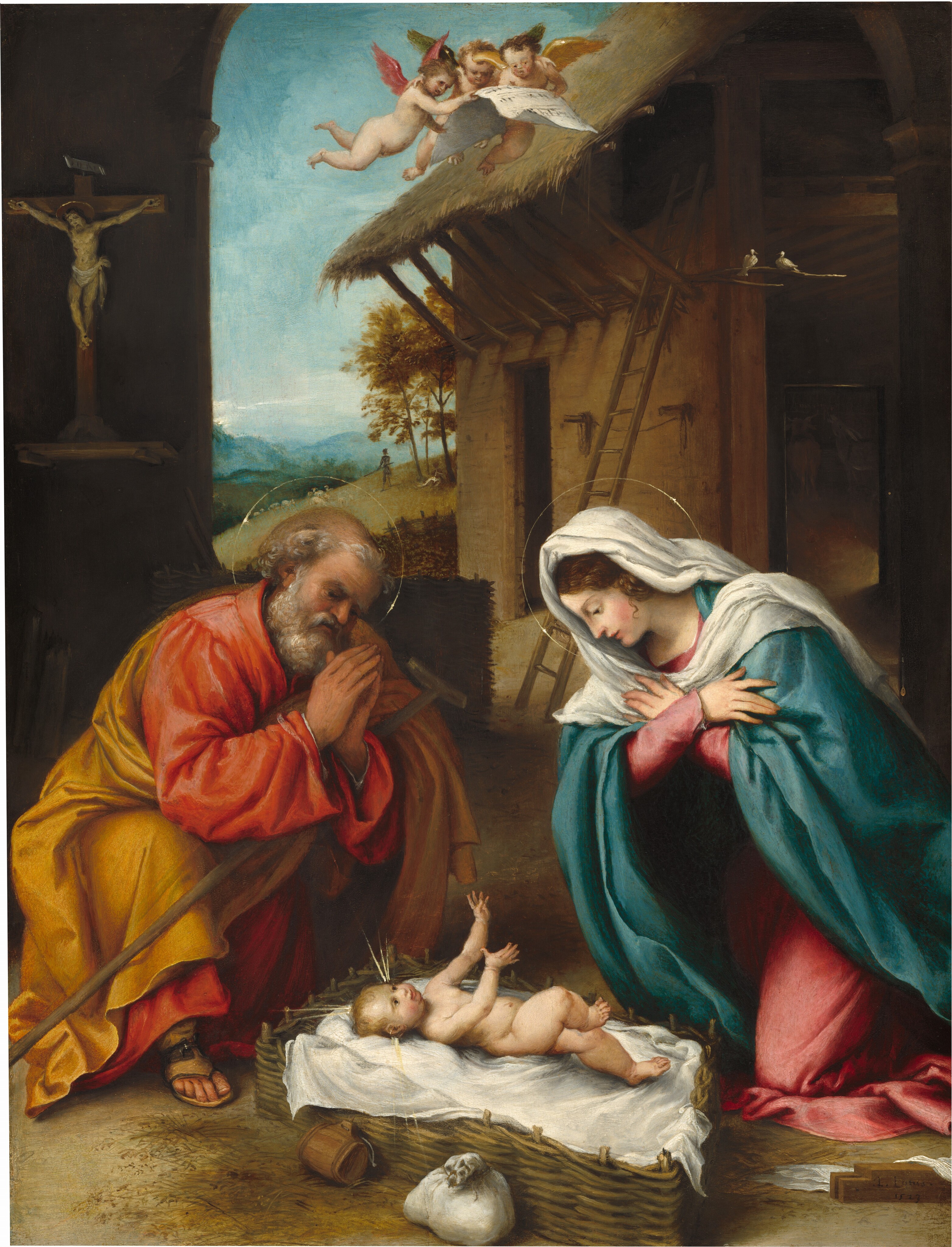
“Nor, again, need we go in quest of any of those
things which this vain world calls great and noble. Christ altogether
dishonoured what the world esteems, when He took on Himself a rank and station
which the world despises. No lot could be more humble and more ordinary than
that which the Son of God chose for Himself.”—English theologian, writer, and
Catholic convert St. John Henry Newman (1801-1890), “Sermon 17: Religious Joy,” in Parochial and Plain Sermons, Volume 8 (1908), in The
Newman Reader
The image accompanying this post, The Nativity,
is a 1523 oil on panel painting by Italian Renaissance artist Lorenzo Lotto (c.
1480-1556/1557).
Saturday, December 24, 2022
Appreciations: Robert Louis Stevenson’s ‘Markheim,’ on Christmas Crime and Conscience
.jpg)
Certain filmmakers gravitate towards projects that run
perversely counter to the traditional good cheer of Christmas. They don’t offer
the kind of well-made crime fiction that Dame P.D. James offered late in her
illustrious career in The Mistletoe Murder and Other Stories, nor even
the ghost stories that Canadian man of letters Robertson Davies offered Massey College students
each Christmas (later collected in High Spirits). Nor do these
dark cinematic visions turn towards redemption, as with A Christmas Carol
or It’s a Wonderful Life.
No, these films—“thrillers” or “horror films” would be
putting it mildly—have something infinitely more gruesome in mind. You can tell
by even by their titles: Violent Night; Silent Night, Deadly
Night; Christmas Evil; The Gingerdead Man; and—God help us!—
13
Slays Until X-Mas.
Robert Louis Stevenson (in the image accompanying this post, a painting by John Singer Sargent) might be regarded as the literary ancestor of this species of renegade auteur.
While he rejected the strict Calvinism and even Christian faith of his parents,
their pessimistic outlook on the sin-touched nature of mankind left its mark in such macabre masterpieces by their son as “Thrawn Janet,” “The Body
Snatcher,” and, of course, “The Strange Case of Dr. Jekyll and Mr. Hyde.”
Like “Dr. Jekyll and Mr. Hyde,” the lesser-known “Markheim” is a study
in dualism featuring a character riven by internal conflict and ultimately
driven to violence. But, while respectable Henry Jekyll finds his evil
doppelganger with a concoction from his chemistry lab, Markheim faces what may
be a considerably more sinister force from the outside.
The voice heard in the first paragraph is not
Markheim, however, but a curio dealer’s, heavy with dark insinuation:
"Yes," said the dealer, "our
windfalls are of various kinds. Some customers are ignorant, and then I touch a
dividend on my superior knowledge. Some are dishonest," and here he held
up the candle, so that the light fell strongly on his visitor, "and in
that case," he continued, "I profit by my virtue."
That “virtue,” it immediately becomes apparent,
consists not of benevolence, but candor about his sharp
practices—and a lifetime of insight about what could lead certain customers to
his door on this of all days:
"You come to me on Christmas
Day," he resumed, "when you know that I am alone in my house, put up
my shutters, and make a point of refusing business. Well, you will have to pay
for that; you will have to pay for my loss of time, when I should be balancing
my books; you will have to pay, besides, for a kind of manner that I remark in
you to-day very strongly. I am the essence of discretion, and ask no awkward
questions; but when a customer cannot look me in the eye, he has to pay for it."
Markheim, who has little to show for his investments in the stock market, counters that he’s seeking “a Christmas present for a lady” and intimates that “a rich marriage” may depend on the right gift.
But the state of mind of this unexpected customer is already murky:
while he’s brought a dagger with him, it is only after being unsettled by his
reflection in a mirror offered by the dealer (a "hand-conscience") that Markheim kills him and begins
to look for valuables he can rob from the shop.
Peter Straub, in the Library of America anthology
American Fantastic Tales, referred to a dominant theme of the horror genre: “the surrender or collapse of the individual will.” Once Markheim takes
the irreversible step of not merely robbing the dealer but murdering him,
Stevenson takes the reader on a journey through the “individual will” of this
killer that encompasses regret, panic, paranoia, and the workings of the individual
conscience.
First, Markheim must come to grips with the material
fact of the corpse. At first, what remains of the dealer is a rapid reduction
of what the robber-murderer confronted just a few minutes before: “both humped and sprawling,
incredibly small and strangely meaner than in life. In these poor, miserly
clothes, in that ungainly attitude, the dealer lay like so much sawdust.
Markheim had feared to see it, and, lo! it was nothing.”
“Sawdust” is an echo of the familiar Biblical warning,
“To dust you shall return.” But Markheim’s own actions are involved with this
particular state: sawdust is produced by cutting, and cutting the dealer to
death has produced Markheim’s current predicament.
But ultimately, the conflict in the story will turn on
the question of what a human life consists of. And immediately after Markheim
can only acknowledge the crumpled mass before him, far more comes to mind: “And
yet, as he gazed, this bundle of old clothes and pool of blood began to find eloquent
voices.”
Fear of discovery mingles with nostalgia
for the season, as he imagines those in nearby homes “sitting motionless and
with uplifted ear--solitary people, condemned to spend Christmas dwelling alone
on memories of the past, and now startlingly recalled from that tender exercise;
happy family parties struck into silence round the table, the mother still with
raised finger--every degree and age and humour, but all, by their own hearths,
prying and hearkening and weaving the rope that was to hang him.”
The physical world outside seems to conspire against
the killer, as the tolling of the clock outside leads Markheim to long “to be
home, girt in by walls, buried among bedclothes, and invisible to all but God.”
The decisive turn in the story comes with a mysterious
visitor to the shop. Perception and identity themselves now become fluid:
“The outlines of the newcomer seemed to change and
waver like those of the idols in the wavering candle-light of the shop; and at
times he thought he knew him; and at times he thought he bore a likeness to
himself; and always, like a lump of living terror, there lay in his bosom the
conviction that this thing was not of the earth and not of God.”
The visitor, who insists that he knows Markheim “to
the soul” and offers the kind of wheedling moral reasoning associated with
Satan, warns that the dealer’s servant is returning early to the shop and that she, too, must be murdered to assure his escape.
When Markheim flinches from this alternative, the visitor
delivers a devastating summary of his moral deterioration:
“For six and thirty years that you have been in
this world," said he, "through many changes of fortune and varieties
of humour, I have watched you steadily fall. Fifteen years ago you would have
started at a theft. Three years back you would have blenched at the name of
murder. Is there any crime, is there any cruelty or meanness, from which you
still recoil? Five years from now I shall detect you in the fact! Downward,
downward, lies your way; nor can anything but death avail to stop you."
But Markheim will go no further on his path toward
evil: “If my life be an ill thing, I can lay it down…. I
have still my hatred of evil; and from that, to your galling disappointment,
you shall see that I can draw both energy and courage."
The visitor’s features change yet again, softening “with
a tender triumph”—suggesting that he is not a demon but maybe a guardian angel.
With that, Markheim tells the incoming servant to call the police, as he has killed
her master.
At the time he wrote this tale, Stevenson was close in
age to his protagonist. Though never driven to the moral extremities of his
murderer, he must have recalled his own spiritual upbringing with residual regret
as he evokes Markheim, on this physically and morally cold day, imagining “the
somnolence of summer Sundays, and the high genteel voice of the parson (which
he smiled a little to recall) and the painted Jacobean tombs, and the dim
lettering of the Ten Commandments in the chancel.”
Stevenson recognizes that evil does not cease to
exist, even on one of the holiest days of the year. But neither do the operations
of the conscience.
Christmas, as Charles Dickens demonstrates in “A
Christmas Carol,” remains a time of year filled with regrets over bad choices
and resulting loss and loneliness. “Markheim” operates on the same premise, but
shows that some acts are too awful not to leave at least some damage. The best
that can be hoped for, then, is a refusal to follow the nihilistic path that
beckons.
It is that wintry recognition that has probably limited the number of times that “Markheim” has been dramatized, even though it is as powerfully atmospheric as any Stevenson tale.
In 1953 Sir Laurence Olivier recorded it for the NBC Radio Anthology Series “Theatre Royal,” and three years
later Fred Zinnemann presented it as a half-hour “Screen Director Showcase” 1956 episode starring Ray Milland as Markheim, Rod Steiger as the Visitor, and Jay
Novello as the Dealer. (In the UK, it was remade in 1974, with Derek Jacobi as
Markheim.)
Song Lyric of the Day (Dr. Seuss, on That ‘Mean One, Mr. Grinch’)

You really are a heel
You're as cuddly as a cactus
You're as charming as an eel, Mr. Grinch
You're a bad banana with a greasy black peel.”—“You’re a Mean One, Mr. Grinch,” lyrics by Theodor "Dr. Seuss" Geisel, music by Albert Hague, performed by Thurl Ravenscroft, from the animated TV special How the Grinch Stole Christmas!, original air date Dec. 18, 1966
Friday, December 23, 2022
Quote of the Day (John Updike, on ‘A Man of No Plausible Address’ at Christmas)

The accompanying image, of a man dressed as
Santa Claus on his sleigh aboard a holiday train in Chicago, was taken on Nov.
23, 2012.
Thursday, December 22, 2022
Quote of the Day (Poet Patrick Kavanagh, With a Memory of an Irish Christmas)

Outside at our gate;
There were stars in the morning east
And they danced to his music.
To Lennons and Callans.
As I pulled on my trousers in a hurry
I knew some strange thing had happened.
Made the music of milking;
The light of her stable-lamp was a star
And the frost of Bethlehem made it twinkle.”—Irish poet and novelist Patrick Kavanagh (1904-1967), “A Christmas Childhood,” from Collected Poems (2004)
Wednesday, December 21, 2022
TV Quote of the Day (‘Mad Men,’ on What a Top Client Can Expect for Christmas)

Quote of the Day (Thomas Mann, on Christmas Season in 19th Century Germany)

Tuesday, December 20, 2022
Quote of the Day (Charles Dickens, on ‘The Christmas Spirit’)

“Therefore, as we grow older, let us be more thankful
that the circle of our Christmas associations and of the lessons that they
bring, expands! Let us welcome every one of them, and summon them to take their
places by the Christmas hearth.”—English novelist Charles Dickens (1812-1870),
“What Christmas Is As We Get Older,” in Christmas Stories (1871)
Monday, December 19, 2022
TV Quote of the Day (‘Alfred Hitchcock Presents,’ on Unusual Entertainment at an Office Christmas Party)

[shows off the display]
Self - Host:
“…the office party. However, we had this room designed especially for the party…”
[looks back briefly]
Self - Host:
“…by the girls in the office. It has no corners. I am in charge of the
entertainment, which all should enjoy. After most of the hors d'oeuvres have
been eaten, we're going to throw a company director to the lions. I realize it
isn't much, but the lions are a great deal cheaper than the string quartet we
had last year. They don't drink as much, either. And now, for the party.” [pours
himself a drink]— Alfred Hitchcock Presents,
Season 3, Episode 15, “Together,” original air date Jan. 12, 1958,
teleplay by Robert C. Dennis, based on the story by Alec Coppel, directed by Robert
Altman
Saturday, December 25, 2021
Quote of the Day (A.N. Wilson, on How ‘A Christmas Carol’ ‘Invented the Modern Christmas’)

The image accompanying this post is one of the original
1843 illustrations by the Victorian cartoonist John Leech (1817-1864) in A
Christmas Carol—in this case, one of the happier memories of Ebenezer
Scrooge’s youth: Mr. Fezziwig’s ball. It comes from this post from The
Victorian Web. (Scanned image by Philip V. Allingham.)
Subscribe to:
Posts (Atom)


