Showing posts with label William Shatner. Show all posts

Wednesday, July 31, 2019

This Day in Television History (Birth of France Nuyen, ‘Star Trek’ Vixen)


July 31, 1939—France Nuyen, whose exotic Eurasian looks enabled her to carve out a small but precious niche in Hollywood from the Fifties to Seventies, was born in Marseille, France, to a French mother and Vietnamese father.

The striking actress-model came to my attention in a show I recall from my impressionable youth: Star Trek.  Several years ago, when I rediscovered this particular episode, “Elaan of Troyius,” from the sci-fi series’ third and final season, what struck me were its seriocomic allusions to Shakespeare’s Taming of the Shrew and Antony and Cleopatra, Shaw’s Pygmalion, and, of course, in its title (a sound-alike of Helen of Troy, the world’s most beautiful woman), The Iliad.

In the series’ characteristic way, its depiction of the title character looks backward (to the above literary sources that dramatize a young woman, often a foreign princess, intent on getting her way against an older male from outside her environment) and forward (it would provide a major theme of spinoffs The Next Generation, Deep Space Nine and Voyager—the crew tasked to transport foreign dignitaries amid intergalactic peril). 

But what struck me as a youngster was not any of this literary or pop-culture analysis, but the way that Elaan turned square-jawed, resolute, brave Capt. James T. Kirk into a hopeless puddle of passion through the drop of a tear.

“Oh, oh, here we go again. The old juice...stronger than any acid,” Spencer Tracy snorted at wailing wife Katharine Hepburn in Adam’s Rib. But ol’ Spence might have reacted differently in the presence of Ms. Nuyen’s hot-tempered but comely alien.

Several Internet sites (notably, the Internet Movie Data Base) suggest that Ms. Nuyen might have been the first person of Vietnamese descent to appear on American television. I am unable to prove or disprove that assertion. But I think it would certainly be correct to say that she was the first actress with such ancestry to make her mark on the big screen and TV. 

She came along during a post-WWII atmosphere in which Americans thought back to their recent encounters with Asians—with a strong undercurrent of male wish fulfillment about females of this race, in particular.

In an interview for a TCM film festival discussion on “Race and Hollywood,” a now-middle-aged Nuyen reflected, “I think those films are popular because the American people like to feel that they have overcome their racism, that they have overcome their blind, cruel prejudices, and that they are no longer of that society.”

Indicative of that would certainly be the 1958 movie adaptation of South Pacific, in which Ms. Nuyen played Liat, or I Spy, the popular series of the mid-to-late Sixties, where she acted and fell in love with her eventual second husband, Robert Culp.

But she made a more enduring impression through her Star Trek appearance—not only because the series has played somewhere all the time all over Earth in the half-century since NBC canceled it, but also because sci-fi fans—and especially aficionados of this show—are so obsessive. 

It’s indisputable that, amid the murky, fight-for-survival vibes of the show’s last season, “Elaan of Troyius” cannot be ignored. In a post on “The Movie Blog,” “Darren” speaks for a not-inconsiderable portion of the show’s fan base offended by the perceived sexist and racist teleplay by John Meredyth Lucas.

But if you look at many comments on a YouTube segment from this episode, there is an equally large component of the fan base who could care less about any of that. Elaan’s alien tears might have been the functional equivalent of the love potion from Tristan and Isolde

But the (overwhelmingly male) YouTube commentators I read thought that was an unnecessary plot device. Captain Kirk was so randy, they figured, that, once he got a good luck at Elaan’s skimpy outfit, he’d be a goner for her, anyway. 

(In an interview for StarTrek.com four years ago, Ms. Nuyen remembered that her costumes only finished being sewed on her just before she went on camera, and her heavy Cleopatra-style wig, because it didn't turn at the same speed as her head, could end up with half of it on the wrong side of her face.)

Unconsciously but certainly, I absorbed one overwhelming lesson from this episode even at this early age: When in the presence of an attractive woman, a male authority figure is unlikely to think with his brain.

All the pushing, grabbing, throwing around, and—oh yes, passionate clinches—between Kirk and Elaan must have required a certain level of comfort between William Shatner and Ms. Nuyen. Indeed, they had acted together a decade before filming this show, during the Broadway run of The World of Susie Wong, and they would appear together again as a sea captain and his wife in a 1974 episode of Kung Fu, and in The Horror at 37,000 Feet

I wonder, over the years, if Ms. Nuyen ever had occasion to share thoughts with another person of Asian descent associated with Star Trek, George Takei, on the trials and tribulations of landing acting jobs and fighting racial stereotypes at that point in Hollywood history? The whole struggle may have gotten to Ms. Nuyen, who, aside from a role in the 1993 film The Joy Luck Club, has not been as prominent onscreen in the last 40 years.

The actress has certainly accomplished much in her second career, in family practice counseling, working mostly with abused children, abused and battered women and women in prison. Even so, I can’t help but wonder how many more prominent roles that someone with her looks, vibrancy and talent might have enjoyed in today’s embarrassed “Oscars So White” environment in Hollywood.

Friday, December 21, 2018

Quote of the Day (William Shatner, on How He Tried to ‘Change the Direction’ of Holiday Music)


“I made it my business to change the direction of many of the songs.”—Actor-“singer” William Shatner, about an album he recommends for the holiday season, “Shatner Claus,” quoted in Chris Kornelis, “Beyond Bing,” The Wall Street Journal, Dec. 20, 2018

What direction might that be? The South Pole?

Just imagine if he does to "Blue Christmas" what he did to "Mr. Tambourine Man."

Be afraid. Be very afraid!

Thursday, September 8, 2016

Quote of the Day (Gene Roddenberry, With Hand Firmly on the ‘Star Trek’ Helm)


“Toss these pages in the air if you like, stomp off and be angry, it doesn’t mean that much since you’ve driven me to the edge of not giving a damn. No, William, I’m not really writing this to Leonard and just including you as a matter of psychology. I’m talking to you directly and with an angry honesty you haven’t heard before. And Leonard, you’d be very wrong if you think I’m really teeing off at Shatner and only pretending to include you. The same letter to both; you’ve pretty well divided up the market on selfishness and egocentricity.”—Star Trek creator Gene Roddenberry, in an Aug. 17, 1967 letter to stars William Shatner and Leonard Nimoy, quoted in Edward Gross and Mark A. Altman, “An Oral History of ‘Star Trek,’” Smithsonian Magazine, May 2016

Yeah, Wise Guy, I know I had a post five years ago about the premiere of Star Trek. I even had a second post related to the series, on “The Trouble With Tribbles” episode. So what’s it to you? Listen: If I do nothing to commemorate the debut of the show on NBC 50 years ago today, I’m going to have more than a few readers ready to send me to the transporter room, about to be launched where no man has gone before.

But anyway, I have an excuse for writing about it again: the great oral history article from which today’s quote comes. Particularly eye-opening was Roddenberry’s scalding shape-up-or-ship-out screed to Shatner and Nimoy, as they competed for lines, screen time, and fan attention.

The tough love worked. The unlikely friendship between impetuous Captain Kirk and cerebral Vulcan Mr. Spock became not only one of the most deeply valued aspects of this pioneering sci-fi series, but also of the film franchise that relaunched the Enterprise a decade after NBC yanked the show off the air.

Saturday, February 28, 2015

TV Quote of the Day (‘The Big Bang Theory,’ Showing the Full Dimensions of Spock Worship)


Leonard Hofstadter (played by Johnny Galecki): “Hey, where you been?”

Sheldon Cooper (played by Jim Parsons): “I'll tell you where I've been. You boys may have had gelato with Stan Lee and gotten autographed comics, but I saw the inside of his house and got an autographed application for a restraining order.”

Howard Wolowitz (played by Simon Helberg): [sarcastically] “Sweet.”

Sheldon: “Plus, I get to hang out with him again... at the hearing. This is going to look great, hanging next to my restraining order from Leonard Nimoy.”— The Big Bang Theory, “The Excelsior Acquisition,” Season 3, Episode 16, original air date March 1, 2010, teleplay by Bill Prady, Steve Holland and Maria Ferrari, directed by Peter Chakos

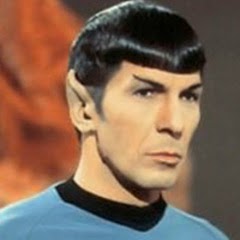
I imagine that there were many real-life cases of insane hero-worship that must have bedeviled Leonard Nimoy enough to make him title his first attempt at an autobiography I Am Not Spock. With the passage of time, however, the actor who created Mr. Spock of Star Trek could look at the role not as a spur to crazy fans or as a creative straitjacket but as an assurance that he would remain a part of popular culture. Perhaps not surprisingly, then, he wrote a sequel: I Am Spock.

Fond memories of Nimoy—who died in Bel Air yesterday at age 83—that came from all corners of the globe, were not something that he or anyone else could have expected when Star Trek (marketed to network brass as, in effect, a space western) premiered on NBC nearly 50 years ago. (See my prior post on the 45th anniversary of the premiere.) Nor was the idea believable at that point that a friendship would not only blossom between Capt. James T. Kirk and his cerebral chief science officer aboard the Enterprise, but also between William Shatner and Nimoy—a fact especially unusual since, as an aghast Shatner himself confessed in Star Trek Movie Memories, other cast  members regarded him as a jerk.

Fans of the series relished the scenes when Dr. McCoy spluttered in rage over his fellow ship officer's stone-cold logic. It’s appropriate, then, that the contours of Sheldon in The Big Bang Theory are modeled, in a sense, after his hero, Mr. Spock. Sheldon can seem every bit as infuriatingly logical as the Vulcan—even more so than his friends, only somewhat less socially awkward fellow Caltech geniuses Leonard, Howard and Raj (let alone than Penny, the blonde they gravitate toward).

Yet Sheldon, like the alien born of a human mother, has an emotional side that comes out when he least expects it—a circumstance that endears him, as it did Mr. Spock and Nimoy himself, to audiences.

Saturday, December 29, 2012

This Day in TV History (Kirk, Crew Have ‘Trouble With Tribbles’)


December 29, 1967—The first comic episode of Star Trek, “The Trouble With Tribbles,” aired on NBC. The Season 2 teleplay, about tiny, furry creatures that multiply aboard the Enterprise, became among the most memorable in the sci-fi show’s three-year run.

When I say “comic,” I mean more than the bristling dialogue between coolly logical Vulcan Mr. Spock and the irascibly human Dr. Leonard McCoy. I mean more than the stentorian recital of the U.S. Constitution by William Shatner in the “Omega Glory” episode later in that second season (which, come to think of it, served as excellent preparation when the hammy actor turned his energies to covering recent pop hits such as “Mr. Tambourine Man” and “Lucy in the Sky With Diamonds”). I mean more than the unintentionally hilarious motif of Shatner’s Captain James Kirk hitting on every intergalactic babe he comes in contact as he (oh, dear!) boldly goes “where no man has gone before.” (Why none of them didn’t at least hint that his ensemble—black pants and yellow shirt—couldn’t fit a more bit comfortably—i.e., loosely—is beyond me.)

The surprising thing—well, to me, anyway—is that the original version of the script, by David Gerrold, wasn’t supposed to be comic, either. It drew its inspiration from the 19th-century introduction of rabbits into Australia by British aristocrats desiring a little recreation. The result: a vast multiplication of the little animals, producing the decline or extinction of many native species.

Some funny things happened on the way to the script’s air date, however.  For one thing, Star Trek creator Gene Roddenberry and his creative crew noticed that the submission in several ways resembled Robert A. Heinlein's 1952 novel The Rolling Stones, which featured massively multiplying “flat cats.” But Heinlein wasn’t too bent out of joint, as he told Gerrold that the two of them were probably heavily influenced by yet a third source: Ellis Parker Butler’s turn-of-the-century short story, “Pigs is Pigs.” (I guess space might be nearly limitless, but not the human imagination.)

Somehow, in this whole process of fretting and massaging Gerrold’s material, the dark environmental implications of his original got lost and tongue-in-cheek was in. (Even Lucille Ball, whose production company, Desilu, had signed off on this most un-Lucy-like show, might have gotten some chuckles for a change.) Perhaps that’s why the episode has not spawned, tribble-like, all sorts of sociological and metaphysical explanations.

Now, I would have thought that this show might have referred, not so obliquely, to the way that McDonald’s and its fast-food imitators were spreading tribble-fashion, until—like the furry creatures crowding out the Enterprise—they were leaving less and less room for human habitation, let alone fine cuisine, in the United States.

But others have drawn more prosaic (and, frankly, not as unique!) interpretations. One, taking the religious view, sees tribbles as those cuddly, none-too-serious venial sins that human beings tolerate until they grow in geometric proportions. A more secular view sees tribbles as distractions from the work human beings should do.

There are all sorts of explanations for why they breed, starting with “Bones” McCoy’s perfectly plausible one that they’re not only bisexual but also born pregnant (“quite a time saver,” he allows).

But isn’t there a simpler explanation? What true human being can resist a cute little bundle of fur from the animal kingdom? Do you think we as a species are going to be in such a hurry to stem the growth of such creatures?

It’s a different matter entirely with the noisome, noisy critters that bedevil poor Sigourney Weaver in Aliens. They look dark and geeky. I don’t know how high the body count of these creatures reaches in James Cameron’s thriller, but I’m sure they don’t match the estimate that Spock, whom I trust implicitly in such matters, comes up with for tribbles (“1,771,561”). I’d say that the aliens had better work far harder if they hope to beat that total, which comes from exponential growth.

It turns out not only that there are over a million tribbles but that, judging by the enduring popularity of the episode, they have enormous staying power. In the IDW comic series derived from the series (and its recent film “reboot”) that started last year, a plotline has been hatched in which tribbles invade Earth.

Fan fondness for this episode has been something of a mixed blessing for Gerrold. How would you like to be remembered primarily for your first teleplay—especially when that rookie effort, for all its small charm, is not exactly Citizen Kane? Over the past several decades, Gerrold—23 at the time he submitted his script—has sought to come to terms with this, just as he has with his larger, even more ambivalent relationship with the Star Trek franchise, as he acknowledged five years ago in an interview with Thomas Vinciguerra of The New York Times.