Showing posts with label This Day in Baseball History. Show all posts

Tuesday, June 9, 2026

This Day in Baseball History (Ryne Duren Sets League Consecutive K’s Record)

June 9, 1961—With a new team and new pitching role, Ryne Duren—a right-handed hurler with a reputation for having as little control of himself as over his overpowering fastball—looked on the verge of turning over a new leaf, striking out an American League record seven consecutive Red Sox on his way to 11 in 6 2/3 innings, in the veteran’s first start in his major-league career.

An All-Star reliever with the New York Yankees, Duren had been traded the month before to the expansion Los Angeles Angels when his off-the-field behavior became increasingly erratic. His new manager, Bill Rigney, saw enough potential to convert him to a starter.

For a while, the experiment worked splendidly. Three weeks later, he earned some revenge against the Bronx Bombers, not only fanning a career-high 12 batters in eight innings on his way to a 5-3 victory but even uncharacteristically contributing to his own cause by singling in two runs.

But the emotional vulnerability afflicting Duren even when batters feared his fastball returned when he was at his zenith in 1961, while getting ready to play in his third All-Star game in four years. The news that his two-week old infant son Craig had died sent Duren on an alcoholic spree that ended his marriage and, four years and three teams later, his professional career.

In a way, Duren’s notoriously poor eyesight (his Yankee catcher, Yogi Berra, observed, “he had several pair of glasses, but it didn’t seem like he saw good in any of them”) was symbolic. 

An alcoholic in deep denial, he did not see how much his drinking was endangering his performance, his livelihood, his teammates, and his family for too long. Out of baseball after 1965, he was reduced to a series of dead-end jobs and living in a flophouse and made two suicide attempts.

Fortunately, the story of Ryne Duren doesn’t end there. After a 22-month treatment in DePaul Hospital in Milwaukee, he became sober, and from 1968 to his death at age 81 in 2011, served as an addiction counselor, advising not only youths about how to avoid or forsake alcohol and drugs but also many current and former major leaguers.

One, Yankee teammate Mickey Mantle, was in denial when Duren initially tried to coax him into recognizing his problem. But when the slugger finally embraced sobriety in 1994, his decision to publicly reveal his registration at the Betty Ford Clinic was influenced by his fellow ex-carouser’s public example.

“That guy [Duren] when he was playing ball, was a wreck and he whipped it,” he told friend Bill Hooten, according to Jane Leavy’s Mantle biography, The Last Boy. “He got around talking, and he does a lot of good. If I can go out there and come back and the fact that I’ve whipped the drinking can help somebody else, then sure, I want that known.”

Duren was one of a small but significant group of ex-ballplayers who, after recognizing their problem, went on to help others as substance abuse counselors, including, most prominently, Don Newcombe of the Brooklyn Dodgers, “Sudden Sam” McDowell of the Cleveland Indians, Dock Ellis of the Pittsburgh Pirates, and 1970s journeyman Michael Jackson. I am sure there are others who played different positions, but all of the people I just mentioned were pitchers.

I became interested in this subject for several reasons: a couple of friends who are substance abuse counselors, my long-time fascination with everything related to the New York Yankees, and my interest in baseball history.

In the case of the latter, I have thought often about another friend who, through his career, has become a mother lode of baseball history. He told me once that the incidence of alcoholism in America’s pastime was high. It was possible, he thought, that as many as one out of four Baseball Hall of Famers had drinking problems. 

One, “Big Ed Delahanty,” died from a fall into the Niagara River after a drunk-and-disorderly incident; other past members, such as Mantle, Babe Ruth, and Hack Wilson (whom I profiled in this 2010 post), are well known; and more recent ones have not been publicized, so to protect their privacy I will leave that to disclosures by themselves or their eventual biographers.

Quantifying substance abuse among past ballplayers is difficult, but my reading indicates that the problem was common. 

Any genetic susceptibility to alcohol was worsened by the environment of past decades: clubhouse drinking as a means of celebrating or even simply unwinding after games; late-night games followed by after-hours companionship; travel and isolation from family and friends on the part of young men who still feel invulnerable; and stressed-out managers in no condition to preach after leaving their own difficulties in the bar.

Today’s players struggling with addiction, though, benefit from changes in the game and society since Duren’s time in baseball:

*Alcoholics Anonymous has become a better known and recognized form of help;

*Awareness of fitness and nutrition includes substance abuse prevention and recovery, as well as liquid alternatives such as cherry juice, smoothies, and protein shakes;

*Baseball’s collective bargaining agreement has formalized the process of evaluation, treatment and recovery;

*High payrolls have increased the incentive for owners and general managers to become proactive about abuse, including some teams that have banned alcohol use in clubhouses and on planes;

*Social media decreases the likelihood that alcohol-fueled indiscretions will be hushed up and perpetuated;

*The stigma of admitting to substance abuse has lowered;

*Many players see marijuana as an acceptable alternative to alcohol.

Other Yankees had longer, more consequential careers than Duren, but even while playing—well before his great contributions to substance abuse awareness among athletes—he had impacted the game as a pitcher.

When he entered games, the slang used for his position was “fireman,” the relief pitcher designated to prevent or contain the damage from mound emergencies. Nowadays, with the use and responsibility of these hurlers refined and defined, they are called “closers.”

After being acquired from the Kansas City A’s midseason in 1957, Duren took over the fireman/closer niche that Joe Page had once occupied for the Yankees. He soon became a fan favorite, with his routine recounted vividly in Marty Appel’s Yankee history, Pinstripe Empire:

“…scaling the low right-field bullpen fence, glancing at the auxiliary scoreboard to check the situation, tossing the warm-up jacket to the waiting batboy, kicking the dirt off his spikes against the rubber, and then firing his first warm-up pitch into the backstop (to frighten the waiting hitter).”

Thursday, May 28, 2026

This Day in Baseball History (Willie Mays Clubs 1st HR)

May 28, 1951—Decisively ending an 0-12 hitless streak that seemed to confirm his initial fears about joining the major leagues, 20-year-old New York Giants rookie Willie Mays hit the first of his 660 career home runs.

In his first at-bat at the team’s home, the Polo Grounds, their newly installed center fielder smacked an offering from star Boston Braves southpaw Warren Spahn over the left-field fence, for what was also his first career hit.

My blog post from 10 years ago briefly reviewed the amazing career of the man that many have proclaimed the best all-around ballplayer of all time. But I think it’s worth spending a little time here on his introduction to the big leagues, as well as how it compared and contrasted with that of rookie and legendary Hall of Famer, Mickey Mantle.

These two were not the only future Hall of Famers to experience difficulties when first exposed to the big leagues. Others, such as Willie Stargell, Brooks Robinson, Pie Traynor, and Roberto Clemente, had relatively subpar campaigns even over their first five seasons, as demonstrated in this 2012 Jim McLennan post on the “AZ Snake Pit” blog.

But the spotlight shone more intensely in New York, the media and sports capital of America—and Mays wasn’t yet over his yips at the plate. He then proceeded to go on another hitless streak: 0-13. At this turning point in his career, as he sat sobbing in front of his locker, he found reassurance from a manager not otherwise known for being soft-hearted: Leo Durocher.

Though he had clashed with Jackie Robinson while managing the Brooklyn Dodgers, Durocher took a gentler approach with this less mature but still immensely talented player now under his wing.

When Mays repeated what he had told him previously while in the Giants’ top minor-league club, the Minneapolis Millers—i.e., that he doubted his ability to hit major-league pitching—Durocher answered, “As long as I’m the manager of the Giants, you are my center fielder. … You are the best center fielder I’ve ever looked at.”

Breathing a sigh of relief, and justifying his manager’s confidence, Mays went on a 14-for-33 tear. He sparked the team’s thrilling pennant run that season, winning Rookie of the Year honors with 20 home runs, 68 RBIs, and a .274 batting average in 121 games—not to mention playing dazzling defense.

There couldn’t have been a more dramatic contrast to another much-heralded outfielder that year, Mantle. Though some veteran New York Yankees like Hank Bauer sought to make him comfortable, the “Commerce [Oklahoma] Comet” was well aware that he was regarded as an interloper and ultimate threat to job security by the Bombers’ proud but fading superstar fixture in center field, Joe DiMaggio.

In contrast to Durocher, Yankee manager Casey Stengel—after successfully overriding the advice of general manager George Weiss that their hot young prospect was not ready for the majors—felt the need to send Mantle back to the minors when his strikeouts began to mount.

It’s now part of Bomber legend how a tough-love visit from Mantle’s father Mutt led his son to surmount his funk and for Stengel to call him back up—as the team’s current rightfielder and centerfielder-in-waiting—in late August. Mantle ended the season hitting .267 with 13 home runs, 65 RBIs, and a .792 OPS.

While Stengel managed Mantle for the first 10 years of his career, Durocher only benefited from having Mays in his lineup for three. (The “Say Hey Kid” served in the Army from May 1952 through March 1954, causing him to miss most of one season and all of another, and his manager was fired after a third-place finish in 1954.)

Nevertheless, that short period of time was enough to make the crusty Durocher speak glowingly about him for the rest of his life, as seen in this passage from his autobiography, Nice Guys Finish Last:

“If somebody came up and hit .450, stole 100 bases, and performed a miracle in the field every day, I’d still look you right in the eye and tell you that Willie was better. He could do the five things you have to do to be a superstar: hit, hit with power, run, throw and field. And he had the other magic ingredient that turns a superstar into a super Superstar. Charisma. He lit up a room when he came in. He was a joy to be around.”

If Durocher served as a kind of proud surrogate father to his young superstar, Stengel often acted as a demanding, frequently disappointed one to his. Early to see Mantle’s immense gifts, he also frequently grew frustrated with him for not paying attention to constructive construction and for not measuring up to a standard for what he could be.

The dissing of his best player may have reached a nadir in 1959, when Stengel listed Hank Bauer, Yogi Berra and Phil Rizzuto as his best players, according to Jane Leavy’s The Last Boy: Mickey Mantle and the End of America's Childhood. Pressed by Bauer about this noticeable exclusion, Stengel answered, “You gave 110 percent every time you were in the lineup.”

I couldn’t finish this post without looking at one particular aspect of this landmark game in the career of Mays.

The at-bat against Spahn was not only an indicator of his future greater greatness, but also a sign of his comfort at the plate against the Hall of Fame hurler. In 253 plate appearances against him, Mays hit 18 homers (the most he accumulated against any pitcher), while batting .305. with a .955 OPS.

Since the run he gave up to Mays was his only one in his 4-1 victory, Spahn took the first round-tripper by Mays in stride, joking later, “For the first 60 feet, that was a hell of a pitch."

I suspect that it was harder for him to accept another he yielded in July 1963, when, on the mound for the Milwaukee Braves, he lost his chance at outdueling the (now San Francisco) Giants’ Juan Marichal in the 16th inning when, after 16 innings and 201 pitches, he watched his chance at a complete-game shutout disappear through  Mays’ solo HR.

Sunday, May 17, 2026

This Day in Baseball History (Death of Harmon Killebrew, Unassuming But Feared Slugger)

May 17, 2011— Harmon Killebrew, as eager-to-please a personality as ever to step onto a baseball diamond, yet so feared for his home run prowess that he earned the nickname “Killer”—died at age 74 of esophageal cancer at his Scottsdale, AZ home.

For most of two decades, it was Killebrew’s misfortune to play—first in Washington, DC, then in Minnesota—for owner Calvin Griffith, who low-balled him at salary time. 

After he retired, misfortune often took a more dire financial form: car dealership and car leasing firms whose failure ultimately, despite his healthy sums from sports memorabilia appearances, pushed him towards bankruptcy in 1993.

Killebrew was honest enough to admit feeling stressed by all of this, but he soldiered on, demonstrating why he was liked and respected not just by fellow baseball players but by sportswriters, who finally elected him to Cooperstown, after three missed tries, in 1984.

Though nothing like the versatile “five-tool player” (hitting for average, hitting for power, speed, arm strength, fielding ability) held up as the beau ideal of everyday players, Killebrew possessed one skill in abundance: slugging home runs.

The 573 round-trippers he amassed at the end of his 22-season career ranked fifth at the time of his retirement. Even that statistic doesn’t indicate the frequency, consistency and force with which he punished the ball.

Starting with the Washington Senators, then moving when the team became the Minnesota Twins before closing out his career after one season with the Kanas City Royals, Killebrew recorded eight 40-home run seasons and 44 multiple home run games. He led the AL in home runs six times, walks four times and RBI three times. 

Named to 13 All-Star teams, he was selected Most Valuable Player for the American League in 1969, when he led the Twins to the American League West Division championship.

Ossie Bluege, the farm system director who scouted and signed him for the Washington Senators, observed: "He hit line drives that put the opposition in jeopardy. And I don't mean infielders, I mean outfielders." 

Griffith took note of these tape-measure homers: “He would hit the ball so blooming high in the sky, they were like a rocket ship going up in the air.”

That bat was what kept Killebrew in the lineup game after game, year after year, despite a glove that most observers of the game thought was suspect. But in his defense, he never spent enough time at one position to master it. 

According to Mark Armour’s post shortly after Killebrew’s death, “he was repeatedly shifted between three defensive positions throughout his career, getting 44% of his starts at first base, 33% at third base, and 22% in left field.”

Off the field, Killebrew’s benevolence sprang from a belief that “The most important reason that we're here on Earth is to love and help one another.” To that end, he became involved in several charitable activities, including:

*helping to establish, in Sun Valley, ID, the Danny Thompson Memorial Golf Tournament (named after a Twins teammate who died of leukemia);

*creating the Harmon Killebrew Signature Classic Golf Tournament to benefit the American Red Cross; and,

*starting the Harmon Killebrew Foundation, a fund-raising charity.

Friday, July 4, 2025

This Day in Baseball History (Yankees’ Pennock Outduels A’s Grove Over 15 Innings)

July 4, 1925—The 50,000 fans who took advantage of the Independence Day holiday to throng Yankee Stadium thought they were watching an extra-innings pitchers’ duel between the Bronx Bombers and the Philadelphia Athletics. But actually, they were present at the creation of two mini-dynasties whose rivalry would play out over the next half-dozen years, with the two competing to dominate the American League.

When it was over two hours and 50 minutes later, the A’s highly touted, 25-year-old rookie, Robert "Lefty" Grove, lost on a sacrifice fly in the 15th inning by the New York Yankees’ catcher Steve O'Neill, while 31-year-old veteran Herb Pennock (pictured) used guile to survive and come away with the 1-0 win in the first game of a double-header.

(If you want to know: the second game that day was shorter and less eventful: a 2-hour, 8-5 loss for the Yankees.)

Fans have witnessed some remarkable Independence Days at Yankee Stadium over the years—notably Dave Righetti’s 1983 no-hitter against the Boston Red Sox and a dying Lou Gehrig’s “Luckiest Man on the Face of the Earth” in what was, in effect, the first Old Times Game. But two Hall of Fame pitchers matching zeroes had to be extra special.

I have no idea of the full extent of what Grove and Pennock endured that afternoon because I can find no record for the temperature and pitch counts then. Even so, the two lefthanders had to surmount considerable frustration, knowing that their offenses could give them no breathing room.

True to form, the cool, unflappable Pennock pitched to contact and painted the corners, finishing the day with five strikeouts, four hits and, equally important, no walks. Grove notched 10 strikeouts—every one of them a necessity to get out of jams, as he yielded five walks and 14 hits.

Powerhouses that had formerly won World Series, both the Yankees and the A’s were being retooled by their front-office executives, Ed Barrow with New York and Connie Mack (who doubled as manager) for Philadelphia.

The Yankees, having won three straight pennants from 1921 through 1923 and a World Series in the latter year, fell to second place in the American League in 1924. In the first half of 1925, they had to deal with two months without Babe Ruth, with a medical ailment dubbed the "Bellyache Heard Around the World." After sitting on the bench for two years, the promising Lou Gehrig did not replace Wally Pipp at first base until June 1. 

The team that became immortalized as “Murderers’ Row” was making do, as much as they could, with pitchers that Barrow had acquired since coming over from the Red Sox, such as Pennock, George Pipgras, and “Sad Sam” Jones.

The A’s had gone through a fallow period after their 1910-14 pennants, but Mack was now assembling a talented young squad that included future Hall of Famers Al Simmons, Mickey Cochrane, and Jimmie Foxx. 

But, as I wrote in this post from 2011, the most ferociously competitive of this bunch was Lefty Grove—so volatile that, after (another) hard-luck 1-0 loss that deprived him of a chance for a 17th-consecutive victory, he wrecked the A’s stall lockers, not to mention his uniform.

Neither the A’s (88-64-1, good for second place in the AL) nor the Yankees (69-85, seventh place) gave their fans much to cheer about in 1925. But they would return to form the following year, with the Yankees winning three straight pennants and two World Series from 1926 through 1928 and the A’s doing likewise from 1929 through 1931. Both teams have fair claims for being considered among the greatest of all time. 

Friday, July 7, 2023

This Day in Baseball History (Future Hall of Famer Pie Traynor Hits for Cycle)

July 7, 1923—Midway through his second full season in the major leagues, Pie Traynor gave his strongest indication yet that he would be one of the most consistent, productive hitters of the Roaring Twenties, as the 24-year-old third baseman hit a single, double, triple, and home run—“hitting for the cycle”—in leading the Pittsburgh Pirates to a blowout 18-5 victory in an away game against the Philadelphia Phillies.

Over the years, I had heard in passing, in histories of baseball, about Baseball Hall of Famer Harold Joseph Traynor. But I had no idea, until I listened to “The Life of Pie” episode of the “This Week In Baseball History” podcast hosted by Mike Bates and Bill Parker, just how good Traynor was at his peak, and his surprising afterlife once his career as a premier player began to wound down.

Most of all, I hadn’t realized that many considered him baseball’s best third baseman until the arrival of Eddie Mathews in the 1950s.

Since then, with Brooks Robinson, George Brett, Mike Schmidt, and Chipper Jones now also in the mix, Traynor’s preeminence at “the hot corner” has fallen several notches further. Baseball historian and stat maven Bill James dropped him down to #15. The blog “The Hall of Miller and Eric” even gave an entire post over to Traynor in a post provocatively titled, “How the Hall Failed – Pie Traynor.”

I’m having none of the new revisionism. I could remind you that Traynor was the first third baseman elected to Cooperstown by writers rather than the Veterans Committee when he was inducted in 1946.

I could tell you that after being tried at shortstop and second base, he had adjusted so well to third that he was considered perhaps the best defensively at the position for the rest of the 1920s. (One quote I love, from longtime Yankees GM Ed Barrow: “He looked like a real ballplayer, even though he seemed to be all arms and legs and [had] feet like violin cases.  He also had big hands and scooped up every ball hit at him.”)

But I would also tell you that Traynor (who, for the curious, got his nickname as a boy, when he consistently requested a slice of pie after a game) was a money player, one of the essential cogs on a Pirate team that won the World Series in 1925 and the National League pennant in 1927.

Even after back, shoulder, and eye problems eroded his defensive skills in the 1930s, Traynor retained his offensive consistency, finishing his career with a .320 batting average. Remarkably, he only struck out 278 times in his entire career—an average of only 23 strikeouts for a 162-game average.

His offensive production bought Traynor time as the Pirates pondered where to put him in the infield. The year 1923 was when he erupted as a force at the plate.

A tip from righthanded batting wizard Rogers Hornsby—use a heavier bat—led Traynor away from being a strict pull hitter into one who could send line drives into right field and right center, too. That year, he cracked 208 hits, leading the league with 19 triples, with a career-high 12 HRs, 101 RBIs and a .338 batting average.

In hitting for the cycle against the Phillies (the only time that comparatively rare offensive feat was recorded in the majors in 1923), Traynor had 6 RBIs—the most for a game that golden season. It was one of five 4-hit games he’d have that year, and came amid a blistering 24-game hitting streak.

As great a player as he was, Traynor was unsuccessful when he took over as the Pirates’ manager in 1934. Just as his wife predicted, his tendency to worry as a player was magnified when he had to mind an entire squad, and he was simply too nice a guy to discipline players when they needed it.

For several years in the late Thirties and early Forties, Traynor stayed within the Pirate organization as a scout. Then, for two decades, he served as a radio sportscaster with his own show. Most surprising, after that gig ended in 1966, he served several years as the voice of Studio Wrestling.

As a co-owner for two years of a sporting-goods store with Honus Wagner and a friend to younger stars Roberto Clemente, Willie Stargell and Richie Hebner, Traynor served as living link across the generations for the Pirates. The sadness at his passing in 1972 was massive and genuine. A couple of weeks later, at their home opener, the club he had served so faithfully posthumously retired his uniform number 20.

Friday, May 19, 2023

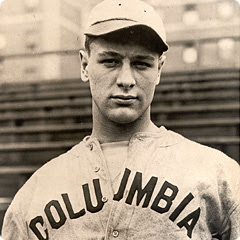
This Day in Baseball History (Gehrig’s Columbia Clout Starts Lou Lore)

May 19, 1923—Not yet in Yankee pinstripes, Columbia University sophomore sensation Lou Gehrig gave evidence of the power that would make him one of the greatest baseball players of all time with a home run that became the stuff of legend.

Fans of the future Hall of Famer and the screen idol who played him nearly two decades later, Gary Cooper, will recall the scene from the popular 1942 film The Pride of the Yankees that focused on this moment. 

It’s a real-life version of the bust-the-fixtures highlights that occur so often in The Natural, except that in this case it didn’t occur in a fictional major-league ballpark but on Columbia’s real-life South Field, where it was reported to be the longest homer hit there to that time.

But did Gehrig’s blast really knock out a window in the School of Journalism? What got me interested in this question was Leslie Zukor’s article in the new Spring/Summer issue of Columbia Magazine.

Contemporary accounts, Zukor indicated, varied in where they said the homer landed. My old newspaper, The Columbia Daily Spectator, pointed to “in front of [the School of] Journalism.” Similarly, The New York Times reported that the ball came down “in the small campus surrounding the School of Journalism building.” The Hartford Daily Courant, which covered Columbia’s opponent that day, Wesleyan University, claimed that “the sphere went over the center field stands and hit the School of Journalism building.”

What do we have here? A Bunyanesque blast that flew 400 feet and destroyed the psyche of Wesleyan pitcher Joseph Layton “Layt” Moore that day. But it doesn’t seem to have destroyed any windows. So where did this notion come from?

Maybe eyewitnesses simply misremembered the end point of the home run, or maybe, from so far away, they took their best guess about where it should have gone. But, if tracing the legend to a single source or sources is difficult, it’s easier to cite what gave the story “legs”: The Pride of the Yankees.

In that box-office smash, the reporter who will become Gehrig’s great advocate and friend (Walter Brennan’s “Sam Blake”) is talking to the phenom’s football coach (Gehrig was on a football rather than baseball scholarship to the school) when the sound of breaking glass interrupts their talk at the same time it puts an exclamation point on it.

In a way, that scene is typical of so much about the film and its tendency towards sharpening and shining up actuality. 

A major truth of Gehrig’s career is at the core of this scene: he was already an athlete of raw but astonishing skill just waiting to be discovered by the wider baseball world. He did indeed give observers something to talk about that day: not just his plate productivity—that homer, a single and two walks—but his three-hit throttling on the mound. (The same thing had happened a month earlier, in a game against Ivy League rival Cornell, when Gehrig hit--you guessed it--"a towering and legendary home run, possibly the longest in Hoy Field’s history," according to Jeff Stein's 2015 article in the Ithaca Voice.)

But it’s far more questionable whether Gehrig busted the window at Columbia's School of Journalism. And he didn’t need a sportswriter to boost his status: Yankee superscout Paul Krichell (who would go on to alert the team to, among others, Phil Rizzuto and Whitey Ford) had discovered him over a month before at a game against Rutgers, and by the time of the Wesleyan game had persuaded Gehrig to sign with the Bronx Bombers. As a matter of fact, there wasn’t a “Sam Blake” (the closest equivalent in Gehrig’s life was probably sportswriter Fred Lieb).

There’s another aspect of this scene that is not so immediately apparent: this astounding feat occurs, in effect, off the field. 

Before being cast, Cooper had no interest in baseball, and he had to undergo intense training by coach and former player Lefty O’Doul in the art of hitting. The star’s lack of ease with the bat probably contributed to the odd fact that, in a movie of roughly 2 hours and 10 minutes about a tremendous baseball player, less than 10 minutes feature any action on the diamond.

Even the follow-up to the Columbia sequence (Gehrig disappointing his mother’s wish that he graduate with an engineering degree by signing with the Yankees) misattributes his motivation: it wasn’t to pay for her medical care, but his father’s.

Nobody should be surprised by such departures from history: Hollywood has always been uninterested in fidelity to fact, and Pride of the Yankees producer Samuel Goldwyn had no interest in a film about baseball (or even the subject of Gehrig) until he was told about "The Iron Horse's" “Luckiest Man on the Face of the Earth” speech on the day held in his honor in 1939.

As sportswriter Paul Gallico (who wrote the “story” for the Oscar-nominated film) wrote to Gehrig’s widow Eleanor during filming: “No matter what I know, we are going to catch hell from the sports writers so we might as well face it. None of the boys will ever understand what we were up against in trying to make baseball fit into a Sam Goldwyn movie.” (Not even the screenplay, co-written by fellow Columbia alum Herman Mankiewicz, seems to have improved its commitment to reality.)

In short, much of the early going in the movie consists of facts changed for no particular reason; characters or situations sandpapered from rough reality (Gehrig's possessive mother didn't have an ambivalent relationship to her daughter-in-law but a positively warlike one); or concern about a global reality that hangs over the portrayal of its driven subject (Gehrig's success was a demonstration to a world at war that America was a place where virtue and hard work was rewarded).

In the end, it didn’t matter. Whatever offenses against the truth occur in the first half of the film, from the moment that Lou and Eleanor notice the first distressing signs of the ALS that will end his livelihood and even his life, all of that is forgotten and forgiven.  

The poignant interplay between Cooper and Teresa Wright as Eleanor in the closing scenes underscores a larger truth that the testimony of his teammates and subsequent biographical research confirmed: that with the love and support of his vivacious wife, this shy, often insecure superstar faced a mystifying disease with an undaunted courage that inspired millions around the world, all the way down to the present day—including many with no real interest in what may have happened on his Ivy League campus 100 years ago today.

As for me: Gehrig ranks, together with Jackie Robinson, as my favorite baseball player. This blog post I wrote 14 years ago, on the 70th anniversary of the end of his extraordinary 2,300-consecutive game streak, goes a long way to explain why, I hope.  

But ultimately, the novelist Thomas Wolfe put it far more poetically than I ever could: the Yankee great, he wrote in You Can’t Go Home Again, embodied “the faultless velvet of the diamond.”

Tuesday, April 27, 2021

This Day in Baseball History (Birth of Rogers Hornsby, Irascible ‘Rajah’ of Hitting)

Apr. 27, 1896— Rogers Hornsby, still considered a century after his prime to be the greatest right-handed hitter in baseball history—and a certain part of any all-star lineup of the sport’s surliest characters—was born in Winters, Texas.

Like virtually all baseball fans, I was first intrigued by Hornsby through a number associated with him: .358, giving him a lifetime batting average second only to Ty Cobb.

But my attention was gripped by him even more when I came across Fay Vincent’s Wall Street Journal piece from a few weeks ago. The former baseball commissioner had a tough time restraining his scorn for one of those new-school metricnomes who suggested that Jeff Kent might be the best righthand-hitting second baseman of all time.

Not a chance, Vincent countered, pointing to a stat that, he thought, was about as unlikely to be broken as Joe DiMaggio’s 56-game consecutive hitting streak: Hornsby’s five-year stretch from 1921 to 1925, when the St. Louis Cardinal compiled a collective .402 batting average.

That achievement would have amazed Hughes’ teammates when he came to the majors in September 1915, when the thin youngster hit only .246 in less than a month. After the season, the young shortstop asked St. Louis Cardinals manager Miller Huggins what he should do. Huggins said, “Kid, you’re a little light, but you’ve got the makings.  I think I’ll farm you out for a year.”

Hornsby took Huggins’ colloquial advice more literally than was intended, immediately going to his uncle’s house, where during the offseason he performed as much farm labor, ate fried chicken and steak, and drank as much milk as he could stand.

When he returned to the Cardinals in the spring, Hornsby had added 30 pounds to his thin 135-pound frame, all of it muscle (and with none of it subverted by the common banes of that era, drinking and smoking). The strategy was the exact opposite of the one employed over this past winter by the Toronto Blue Jays’ first baseman Vladimir Guerrero Jr., who, after an aggressive conditioning program, has sweated off 42 pounds since last July. But the results were the same: a higher batting average (.313 for Hornsby, .338 for Guerrero at this point in the season).

Power would come in time: 301 homers during his 23-year career, to go along with two Triple Crowns, two MVP trophies, and seven National League batting titles.

What accounted for this power surge? The aforementioned muscle, along with standing back more in the batter’s box, abandoning choking up on the bat, and benefiting from the end of the “dead ball” era that saw the fadeout of the spitball.

But nobody could overlook Hornsby’s volcanic intensity and commitment to the game. "People ask me what I do in the winter when there's no baseball,” Hornsby once drawled. “I'll tell you what I do. I stare out the window and wait for spring."

"The greatest right-handed hitter?" fellow Hall of Famer Ralph Kiner asked Marty Noble in a 2013 article. "Doesn't it have to be him? Who else did what he did?"

Who else indeed?

Unfortunately, that’s not the end of the story for “The Rajah” (a nickname meant as a counterpart to Babe Ruth’s “Sultan of Swat,” and, of course, a play on his first name). Baseball historian Bill James picked him for “the biggest horse’s ass in baseball history.” In the mega-contract, steroid era of the last three decades, Hornsby has gained some stiff competition for the title, but the following characteristics continue to keep him ahead of the pack:

*Superstitious: Hornsby refused to go to movies because he believed cinemas’ flickering lights would damage his eyesight, and offered the same reason for why he professed to read nothing more than newspaper headlines. As former commissioner Vincent noted waggishly in his Hornsby piece: “Genius often comes wrapped in eccentricities.”

*Cocky: He came by it early. Complimented as a 15-year-old about his play at second base, he responded, “Yeah, and there are eight other positions I can play just as good,” according to an article for the Society of American Baseball Research by C. Paul Rogers III.

*Irascible: Spelling his first name without the "s" was the least thing guaranteed to set the player off. “Hornsby knew more about baseball and less about diplomacy than anyone I ever knew,” one sportswriter observed about Hornsby. Calling his teammates “stool pigeons” one season was among the milder of his insults. The tactlessness was even worse when directed publicly towards individual players.

*Aloof: He didn’t bother communicating to players, fleeing the clubhouse as soon after a game as he could.

*Unhygienic: His quickness out of the clubhouse was enhanced by his speed in the showers—on the occasions when he deigned to take any.

*Unfaithful: With his cold personality, I’m not sure how Hornsby managed to get any woman at all, but he wed three—and, after his playing days were over, employed a mistress as his secretary. After being named in a divorce suit by an irate husband, he married the woman involved, Jeannette Pennington Hine. (Andrew Martin described the litigation—as well as the driving and gambling issues that also surrounded the slugger—in a 2011 article, "The Troubled Life of Rogers Hornsby.") I don’t think you’ll be surprised to learn that, over the course of three decades with Hornsby, Jeannette took to drink.

*Antisemitic: While managing the Cincinnati Reds in 1952, Hornsby—unaware that Gabe Paul was Jewish—made an antisemitic remark to the general manager. After the season, Hornsby told a reporter he believed this was the real reason he was fired. Possibly—plus the fact that Hornsby never apologized.

*Racist: Veteran sportswriter Fred Lieb claimed that Hornsby had admitted to membership in the Ku Klux Klan. That assertion has never been verified. But Hornsby did occasionally boycott playing against black teams. That could not have eased his embarrassment when a young Satchel Paige struck him out five times in a barnstorming game.

*Toxic: Though he managed the Cardinals to a memorable World Series win over the New York Yankees in 1926, Hornsby continually wore out his welcome in the clubhouse. At the major-league level, he managed—and was fired from—six different ballclubs. He gambled so heavily on horses and accumulated such a frightening amount of debt that he was traded from the Cardinals after the 1926 season and fired as player-manager of the St. Louis Browns in 1937. In 1952, hired again by the Browns, he lasted only 51 games before he was terminated by Bill Veeck. The grateful players gave the owner a three-foot trophy that they had inscribed, “To Bill Veeck: For the greatest play since the Emancipation Proclamation.” 

Hornsby remained committed to his hard-bitten style all the way to the end of his life. Only he could have written, a year before his death in 1963, a memoir entitled, My War With Baseball.

Saturday, November 21, 2020

This Day in Baseball History (Birth of Stan Musial—Batter of Consistency, Model of Decency)

Nov. 21, 1920— Stan Musial, who through 22 seasons with the St. Louis Cardinals earned the respect of teammates and opponents alike with consistent ferocity at the plate and unwavering kindness to those in contact with him, was born in Donora, Pa.

The son of a Polish immigrant who died from breathing fumes from a local zinc factory, Musial was used to personal setbacks. That might be why, when he damaged his left shoulder as a young pitching prospect in the Cardinal minor-league system, he accepted his manager’s advice and transitioned, like Babe Ruth two decades before, into becoming an outfielder.

In St. Louis, Musial became the linchpin in the best years of the franchise between the Dizzy Dean’s “Gas House Gang” of the 1930s and the Bob Gibson-led team of the 1960s. From the early-to-mid 1940s, that squad won four National League pennants and three World Series titles. During those appearances, Musial established a reputation for clutch hitting, batting .315,.357, .347 and .365 in the “Fall Classic.”

Even as he established a reputation for geniality in St. Louis, Musial filled opposing fans with dismay for the way he crushed the hopes of their hometown heroes. That was especially the case in Brooklyn, where Dodger diehards groaned at what “that man” was doing to their pitchers. That gave rise to the affectionate nickname he kept for the rest of his life: “Stan the Man.”

(Such was the reverence felt in St. Louis for “Stan the Man” that in 2012, the mainstay of the franchise for the prior decade, Albert Pujols—now relocated to the California Angels—objected to the title bestowed by his new team’s marketing department: “El Hombre.” "No, I'm not comfortable with that, because I believe there's one Man and, believe it or not, it's God," Pujols said in an ESPN “SportsCenter” interview. "God is the Man and there's another Man, Stan 'The Man' Musial in St. Louis. I know six years ago, when people first started making jerseys, I wasn't comfortable with that because of the respect I have for Stan Musial.")

In The New Bill James Historical Baseball Abstract, the statistics maven compared Musial with Carl Yastrzemski, another All-Star of Polish descent who spent two-thirds of his career in left field and the rest at first base. But the most interesting similarity between the two Hall of Famers is that they began as contact hitters before experiencing power surges at age 27, when they achieved career highs in home runs. Each remained a power hitter throughout the rest of their long careers.

Time—and let’s be frank, players’ increased use of performance-enhancing drugs—has decreased the number of major league records (55) held by Musial upon his retirement in 1967. But the following statistics testify to his extraordinary consistency:

*His 3,630 hits (still fourth overall, behind only Pete Rose, Ty Cobb and Hank Aaron) were divided exactly between home and the road;

*He walked more than twice as much as he struck out (696 times vs. 1,599 times)—and most contemporary players would kill to strike out so little while hitting his number of home runs (475);

*Even when not clubbing homers, Musial made outfielders sweat, as he earned more than 900 doubles and triples (a total exceeded only by Tris Speaker);

*His 24 All-Star Game selections are second only to Hank Aaron;

*He was named Most Valuable Player three times and was among the top five in the vote counts another five times.

His inside-out swing and “corkscrew” stance (in which his back actually faced the pitcher) were, to say the least, unusual. But it didn’t matter: As teammate Joe Garagiola once joked, “Musial could hit .300 with a fountain pen.”

Nobody could play like this without a burning rage to compete, but Musial never took it out on opponents or umpires. (Astonishingly, he was never thrown out of a game.)  He was held in such high regard by teammates that second baseman Julian Javier named his son Stan after him.

Yet even rivals benefited from his kindness. Chuck Connors recalled how, during his 1951 season with the Chicago Cubs, he followed up on teammates’ suggestion that he ask Musial for advice on how to break out of a slump.

“I was a bum of a hitter just not cut out for the majors,” Connors—later famous as a TV actor— remembered. “But I will never forget Stan’s kindness. When he was finished watching me cut away at the ball, Stan slapped me on the back and told me to keep swinging.”

In 2011 Barack Obama awarded Musial the Presidential Medal of Freedom, the highest honor the United States can bestow on a civilian. The great slugger passed away in 2013, mourned by true aficionados of the National Pastime.

(For the best short treatment I have come across on “Stan the Man,” I urge you to read this November 2012 post by blogger Joe Posnanski on Medium.)

Wednesday, September 9, 2020

This Day in Baseball History (Hall of Famer Foxx Clubs Last HR)

Sept. 9, 1945— For one last, shining moment—after his skills had diminished through injuries and the self-medication he used to deal with the resulting pain—Jimmie Foxx reminded baseball fans of the awesome power that made him one of the game’s greatest players, hitting a home run and double while driving in five runs in a game for the city where he became a star.

But the circumstances had changed greatly since he had started his career as a prized prospect 20 years before, with a Philadelphia A’s team building towards two World Series trophies and three American League pennants. This time he was a part-time player with the crosstown Phillies, a 42-94 squad—and this seventh homer of the season would be the 534th and last of his career.

In the 1930s, no player could match Foxx for either power (415 HRs, 1,403 RBIs) or versatility on the diamond (though he primarily played first base, he also cheerfully filled in at third base and catcher if his team needed him there). His speed even astonished those who judged him solely on his bulk. Not surprisingly, he earned three Most Valuable Player Awards in the decade, and twice hit more than 50 home runs.

Long before the advent of the “tape-measure” home run, Foxx sparked gasps at how far he could hit the ball. In the late 1960s, the retired Yankee pitching great Lefty Gomez joked that astronauts had discovered on the Moon a ball that Foxx had hit off him three decades before.

By September 1940, when he reached the 500th home run of his career at only age 32 with the Boston Red Sox, many observers—including his worshipful younger teammate, Ted Williams—thought it entirely possible that he might surpass the once-unthinkable 714 HRs compiled by Babe Ruth.

But few baseball superstars have descended as rapidly as Foxx. In an article for the Society for American Baseball Research, Bill Jenkinson plausibly argues that the effects of a beaning in a 1934 barnstorming tour began to catch up with this superb athlete. His drinking, previously moderate, increased sharply in 1941 as the problems with vision and sinuses resulting from the beaning led him to drown out his pain.

On June 1, 1942, the Red Sox, believing he’d been fatally slowed by injury, placed him on waivers. His performance for the team that picked him up, the Chicago White Sox, was so poor (a .205 batting average) that the discouraged slugger sat out the entire 1943 season.

With WWII depleting major league rosters and with an acrimonious and costly divorce impacting his finances, Foxx was convinced to give the major leagues another try. He played a handful of games as a player-coach for the Chicago Cubs and also became interim manager of Portsmouth in the Class B Piedmont League.

In 1945, Phillies manager Ben Chapman had come to believe that Foxx’s vision was so poor that he could no longer be a viable everyday player, so his time at first base would be limited. But Foxx had performed so well in a brief stint as, of all things, a pitcher when he was coaching the minor-league Portsmouth squad that Chapman decided to press him into service in that role in the big leagues, too—even though the last time Foxx had done so with any regularity had been as a teenager.

Chapman first tried Foxx on the mound in two July games. “Double XX” performed creditably enough that Chapman took the next logical step, naming him as his starter against the seventh-place Cincinnati Reds on August 19. After having difficulty with his location, Foxx improbably won the game. After that, he pitched six more times for the Phils, all but once in relief.

Whether watching Foxx bamboozle batters on the mound or take an opposing pitcher deep, as he did in his final homerun at Forbes Field against the Pirates, fans had come to savor these infrequent flashes of glory from a player who had displayed much more in the prior two decades. He continued to attract hordes of autograph seekers and just plain well-wishers when he retired for good at the end of the season, and in 1951 he was elected to the Baseball Hall of Fame. 

The most notable aspect of Foxx’s post-major league career might have been his 1952 stint as manager of the Fort Wayne Daisies, a team in the All-American Girls Professional Baseball League. 

But unlike Jimmy Dugan, the washed-up alcoholic skipper played by Tom Hanks in A League of Their Own, Foxx was a genial sort who would never dream of barking at a tearful young woman, “There’s no crying in baseball!”

(The image accompanying this post is how most people associated with baseball in his time preferred to see Foxx--in his youthful prime with the Philadelphia A's. This figure, not the broken-down one of 1945, ranks #29 on Bill James’ Top 100 baseball players, behind Mel Ott and ahead of George Brett.)

Friday, July 26, 2019

This Day in Baseball History (Yanks’ Bill Dickey Clubs 3 HRs)


July 26, 1939—In perhaps the greatest offensive performance of his career, catcher Bill Dickey belted three home runs, leading the New York Yankees to a 14-1 run of the St. Louis Browns, continuing a turnaround for the Bronx Bombers that would lead to victory that fall in the World Series.

When I mentioned to a friend that I would be blogging about Dickey, he laughed and said, “Oh, you mean the OTHER Number 8!” It was Dickey’s misfortune to be overshadowed by another catcher who surpassed him in career home runs, World Series rings, and hold on the popular imagination: Yogi Berra. The two wore the same uniform number, and with both going to the Baseball Hall of Fame, the team eventually retired the number as a way of honoring each.

As it happened, Berra might not have developed into what he became without Dickey. But more on that shortly…

The first half of July 1939 had been rough for the Yankees in general and Dickey in particular, marked by the devastating medical diagnosis that ended the career of the catcher’s road roommate and best friend, Lou Gehrig, and the team’s tribute to the slugger on July 4—“the most emotional day I’ve had in my life,” Dickey would remember. 

After a five-game losing streak just before the All-Star Game, the Yanks lost a July 13 game they led 4-1 going into the bottom of the eighth inning, then saw their pennant lead over the Boston Red Sox shrink to just 5½ games. Then they righted the ship, winning seven straight away games against the Cleveland Indians and St. Louis Browns.

Back in New York on the 26th, traps set through Yankee Stadium caught 5,000 Japanese beetles that had mysteriously invaded the ballpark. Maybe the Browns were nettled by what had gotten into the field that afternoon, because they were utterly powerless to stop a Yankee onslaught that included at least one run in every inning.

Leading the way was Dickey—but then again, nobody was particularly surprised. At 32, Dickey was, like Gehrig, mature in age and manner—a necessity on a team with its share of brash young players—and, thus, a model on how to comport one’s self.

At the same time, he was still in the prime of his career. Dickey was probably only surpassed at his position in the 1930s by Mickey Cochrane and Gabby Hartnett. He may have taken special satisfaction in his offensive explosion on this day because he’d been advised by his first manager, Miller Huggins, to concentrate on making contact rather than hitting the long ball, as the team already had someone who specialized in the latter department (Babe Ruth).

Dickey would finish the 1939 campaign by batting .302—the last time his average would be over .300—with 24 homers and 105 runs batted in. That fall, he would cap it all by clubbing two home runs and 5 RBIs in the World Series against the Cincinnati Reds.

Moreover, he remained sterling on defense. He had mastered the art of adapting to conserve his physical skills as long as possible (notably, adopting a one-handed catching technique, saving his right arm from wear and tear), while the years had only deepened his savvy in the linked arts of knowing how to get opposing batters out and how to get the best out of his own pitching staff, a lineup ranging from strong, silent Red Ruffing to ebullient but erratic Lefty Gomez. 

(Once, facing muscular slugger Jimmie Foxx, Gomez shook off all Dickey’s called pitches till the catcher walked to the mound to ask what he did want to throw Foxx. “Nothing,” Gomez responded: “Let’s wait a while. Maybe he’ll get a phone call.”)

The last link to the Ruth-Gehrig team of the late 1920s, Dickey served as the bridge to the Joe DiMaggio-led dynasty of the late 1930s and 1940s. Remarkably, though, his influence extended into the mid-Sixties. It happened like this:

In 1946, with his own playing days winding down, Dickey took over as manager from Joe McCarthy, who, after clashing with new general manager Larry MacPhail, parted ways with the team. But Dickey had his own differences with MacPhail and quit with 14 games left in the season.

Before the 1949 season, however, a new GM, George Weiss, asked Dickey to serve as a coach under new manager Casey Stengel, with one special assignment: take young catching prospect Yogi Berra under his wing. The team had no doubt about his ability to hit, but his defense was suspect. 

So Dickey got to work—as Berra put it, “learning me all his experience.”  It involved fouls, pop-ups, plays at the plate, controlling the pitcher and the game, knowing everything on the diamond—in effect, acting as the on-field stand-in for the manager. Dickey would do the same for Elston Howard, the 1963 American League MVP.

"Bill Dickey isn't just a catcher,” wrote sportswriter Dan Daniel. “He's a ball club."