Showing posts with label New York Yankees. Show all posts

Friday, August 21, 2026

Quote of the Day (Brian Cashman, on His First George Steinbrenner Trauma)

“I told him [the late New York Yankees principal owner George Steinbrenner, pictured], ‘This way is faster.’” [Incorrect: The “shortcut” to a haircut appointment, the Third Avenue Bridge, was closed for renovations.] “And he starts going ballistic: ‘’You effing idiot. Take me back to the effing stadium.’ He’s crushing me from the back seat. I mean, my hair was blowing forward because of his bellowing from the back. It was relentless, because that’s how he was. If somebody told me the same story and said they crawled up into the fetal position, I could understand it.”—New York Yankee General Manager Brian Cashman, on “the worst experience of my life” (with then-boss George Steinbrenner, naturally) as a summer intern in the mid-‘80s, quoted by Bruce Schoenfeld, “‘I Feel the Pain More Than I Feel the Joy,’” The New York Times Magazine, Aug. 16, 2026

Good God, wasn’t George Costanza available to take The Boss around?

This incident must have been pretty bad. Now, most people would call losing a loved one “the worse experience of my life.” Maybe even losing a job.

In the case of the Yankee GM, I might plop for a divorce that exposed an extremely messy private life to tabloid and late-night talk show ridicule. Maybe even the anecdote in this September 2019 Ian O’Connor profile relating how Steinbrenner humiliated his young charge into personally collecting players' spring training rental car keys before they headed north.

But no, Brian Cashman says this incident driving The Boss around was the worst. Between the sheer physical sensations (the high-decibel insults! the hair blowing! the pushing from the backseat!) and the full-on exposure to baseball’s most impulsive, truculent owner, maybe it was.

If you listen to New York sports radio or podcasts to any extent, you might find some Yankee fans who wish that Steinbrenner was even tougher on Cashman.

Bronx Bomber fans are like Notre Dame football fans: success early in team history has only increased the fury over the lack of a title in recent years, though there’s a good excuse: the games have changed radically since the glory days of The Gipper and Babe Ruth.

So, from now until some point in mid-fall, Yankee fans are on The Cashman Watch: Will George’s son Hal stick by him, or will he be given his walking papers? Many will be venting on sports talk radio if manager Aaron Boone is let go for his squad’s underperformance but that great Houdini Cashman survives yet again.

Until then, just remember the wisdom of Annie Savoy in Bull Durham: “It's a long season and you gotta trust it.”

(The image of Brian Cashman that accompanies this post was taken on Oct. 7, 2012, at the American League Divisional Series Game 1 between the Yankees and Baltimore Orioles, by Keith Allison.)

Tuesday, August 18, 2026

Quote of the Day (Mark Kramer, on Baseball’s Tommy John)

“Tommy John is an American hero in his own right, esteemed by millions of baseball fans. He has entered a kind of timeless boyhood that seems especially appropriate to the clockless game of baseball. He's not the oldest pitcher pitching; he's not in the teary final months of a long career; he continues to be good and never was the best; he's neither outrageous nor electrifying during interviews. What he has done is endure and gather admiring fans through 20 seasons of play, while sharing with the public his religious convictions and dramatic off-field struggles—the surgical repair of his injured pitching arm, the near death of Travis. He is a hero for the age of the born again and the silent majority. Blessed with athletic talent and a picture-book family, driven by self-discipline and piety, given to forthrightness and modesty, abstemious among colleagues sometimes given to excess, he has become a national demonstration that around these parts, love of church, country and family is still what gets rewarded.”—American sportswriter Mark Kramer, “The Timeless Boyhood of an American Hero,” The New York Times, Sept. 11, 1983

I can count on the fingers of one hand my encounters with current or retired baseball players, but one was Tommy John. I saw him in early 1982 in a restaurant-bar in Fort Lee, NJ called Clams Casino—something of a hangout for alumni of my high school, as a friend worked as a bartender there.

It was still relatively early in the season, before John was traded from the New York Yankees, and he was at the restaurant a bit late in the evening following a game. Fans quickly gathered around the star pitcher, with many asking after his two-year-old son Travis, who the prior year had been in a coma for 19 days following an accident. 

John was gracious to everyone giving him their best, even though it was interrupting time I’m sure he would have preferred with his family.

I think many people saw the pitcher on multiple other occasions reacting similarly: with modesty, grace and gratitude for what he’d been given.

I flashed back to that evening over a week ago, when I read John’s farewell and thank-you to Yankee fans. He was unable to attend the annual Old Timers’ Game that weekend because he was in hospice care.

So it was no surprise that he died at age 83 this past weekend from bladder cancer, nor that tributes poured in for him from those he thrilled while on the mound or touched in personal encounters.

I can think of only one other Yankee, Lou Gehrig, whose name is tied so closely to modern medicine. The Hall of Fame first baseman gave his name to the neuromuscular disease that took his life; John, to a career-saving medical specialty that helped him—and later, countless other pitchers—return to the mound.

All credit to Dr. Dr. Frank Jobe, the Los Angeles Dodgers team surgeon who developed and performed the innovative technique in 1974. 

But John was not merely a passive recipient of another’s genius. He took the risk of this surgery, then put in the long, countless hours to make sure he could not only return to baseball, but with the same or greater mastery than he had before.

In this respect, John was a revolutionary figure in the evolution of the game. But I chose the quote that leads off this post to illustrate that paradoxically, he was also a throwback.

The two people mentioned in this article as the southpaw’s heroes, Billy Graham and Richard Nixon, illustrate his religious and political conservatism.

But John came of age before the dawn of the 24-hour news cycle or social media when athletes, no matter what their personal beliefs, did not go out of their way to proclaim them, and when fans could care less what their heroes thought so long as they helped the team win a championship.

As a starter who managed to excel even without a 100-MPH fastball, John was a throwback in another sense. His career is confounding to modern pitching coaches and sabermetricians who urge starters to throw as hard as they can for five or six innings before turning the ball over to a battery of relievers expected to hold the lead with similar hummers.

In contrast, John believed in going deep into games and, when possible, even completing them. He didn’t have to throw overwhelming heat; he could make his admittedly underwhelming fastball drop like a sinker, and his curve bit the inside or outside corner. More often than not, hitters swore at their ineffectuality in grounding out.

John’s death has left many of his baseball contemporaries arguing with greater urgency the case for his eventual enshrinement in Cooperstown. If that push is like others posthumously propelling Dick Allen and Ron Santo into major league baseball’s Valhalla, he might have a real chance this time.

(The source of the image accompanying this post, of Tommy John around 1981, is the New York Yankees via tradingcarddb.com.)

Tuesday, June 9, 2026

This Day in Baseball History (Ryne Duren Sets League Consecutive K’s Record)

June 9, 1961—With a new team and new pitching role, Ryne Duren—a right-handed hurler with a reputation for having as little control of himself as over his overpowering fastball—looked on the verge of turning over a new leaf, striking out an American League record seven consecutive Red Sox on his way to 11 in 6 2/3 innings, in the veteran’s first start in his major-league career.

An All-Star reliever with the New York Yankees, Duren had been traded the month before to the expansion Los Angeles Angels when his off-the-field behavior became increasingly erratic. His new manager, Bill Rigney, saw enough potential to convert him to a starter.

For a while, the experiment worked splendidly. Three weeks later, he earned some revenge against the Bronx Bombers, not only fanning a career-high 12 batters in eight innings on his way to a 5-3 victory but even uncharacteristically contributing to his own cause by singling in two runs.

But the emotional vulnerability afflicting Duren even when batters feared his fastball returned when he was at his zenith in 1961, while getting ready to play in his third All-Star game in four years. The news that his two-week old infant son Craig had died sent Duren on an alcoholic spree that ended his marriage and, four years and three teams later, his professional career.

In a way, Duren’s notoriously poor eyesight (his Yankee catcher, Yogi Berra, observed, “he had several pair of glasses, but it didn’t seem like he saw good in any of them”) was symbolic. 

An alcoholic in deep denial, he did not see how much his drinking was endangering his performance, his livelihood, his teammates, and his family for too long. Out of baseball after 1965, he was reduced to a series of dead-end jobs and living in a flophouse and made two suicide attempts.

Fortunately, the story of Ryne Duren doesn’t end there. After a 22-month treatment in DePaul Hospital in Milwaukee, he became sober, and from 1968 to his death at age 81 in 2011, served as an addiction counselor, advising not only youths about how to avoid or forsake alcohol and drugs but also many current and former major leaguers.

One, Yankee teammate Mickey Mantle, was in denial when Duren initially tried to coax him into recognizing his problem. But when the slugger finally embraced sobriety in 1994, his decision to publicly reveal his registration at the Betty Ford Clinic was influenced by his fellow ex-carouser’s public example.

“That guy [Duren] when he was playing ball, was a wreck and he whipped it,” he told friend Bill Hooten, according to Jane Leavy’s Mantle biography, The Last Boy. “He got around talking, and he does a lot of good. If I can go out there and come back and the fact that I’ve whipped the drinking can help somebody else, then sure, I want that known.”

Duren was one of a small but significant group of ex-ballplayers who, after recognizing their problem, went on to help others as substance abuse counselors, including, most prominently, Don Newcombe of the Brooklyn Dodgers, “Sudden Sam” McDowell of the Cleveland Indians, Dock Ellis of the Pittsburgh Pirates, and 1970s journeyman Michael Jackson. I am sure there are others who played different positions, but all of the people I just mentioned were pitchers.

I became interested in this subject for several reasons: a couple of friends who are substance abuse counselors, my long-time fascination with everything related to the New York Yankees, and my interest in baseball history.

In the case of the latter, I have thought often about another friend who, through his career, has become a mother lode of baseball history. He told me once that the incidence of alcoholism in America’s pastime was high. It was possible, he thought, that as many as one out of four Baseball Hall of Famers had drinking problems. 

One, “Big Ed Delahanty,” died from a fall into the Niagara River after a drunk-and-disorderly incident; other past members, such as Mantle, Babe Ruth, and Hack Wilson (whom I profiled in this 2010 post), are well known; and more recent ones have not been publicized, so to protect their privacy I will leave that to disclosures by themselves or their eventual biographers.

Quantifying substance abuse among past ballplayers is difficult, but my reading indicates that the problem was common. 

Any genetic susceptibility to alcohol was worsened by the environment of past decades: clubhouse drinking as a means of celebrating or even simply unwinding after games; late-night games followed by after-hours companionship; travel and isolation from family and friends on the part of young men who still feel invulnerable; and stressed-out managers in no condition to preach after leaving their own difficulties in the bar.

Today’s players struggling with addiction, though, benefit from changes in the game and society since Duren’s time in baseball:

*Alcoholics Anonymous has become a better known and recognized form of help;

*Awareness of fitness and nutrition includes substance abuse prevention and recovery, as well as liquid alternatives such as cherry juice, smoothies, and protein shakes;

*Baseball’s collective bargaining agreement has formalized the process of evaluation, treatment and recovery;

*High payrolls have increased the incentive for owners and general managers to become proactive about abuse, including some teams that have banned alcohol use in clubhouses and on planes;

*Social media decreases the likelihood that alcohol-fueled indiscretions will be hushed up and perpetuated;

*The stigma of admitting to substance abuse has lowered;

*Many players see marijuana as an acceptable alternative to alcohol.

Other Yankees had longer, more consequential careers than Duren, but even while playing—well before his great contributions to substance abuse awareness among athletes—he had impacted the game as a pitcher.

When he entered games, the slang used for his position was “fireman,” the relief pitcher designated to prevent or contain the damage from mound emergencies. Nowadays, with the use and responsibility of these hurlers refined and defined, they are called “closers.”

After being acquired from the Kansas City A’s midseason in 1957, Duren took over the fireman/closer niche that Joe Page had once occupied for the Yankees. He soon became a fan favorite, with his routine recounted vividly in Marty Appel’s Yankee history, Pinstripe Empire:

“…scaling the low right-field bullpen fence, glancing at the auxiliary scoreboard to check the situation, tossing the warm-up jacket to the waiting batboy, kicking the dirt off his spikes against the rubber, and then firing his first warm-up pitch into the backstop (to frighten the waiting hitter).”

Thursday, May 28, 2026

This Day in Baseball History (Willie Mays Clubs 1st HR)

May 28, 1951—Decisively ending an 0-12 hitless streak that seemed to confirm his initial fears about joining the major leagues, 20-year-old New York Giants rookie Willie Mays hit the first of his 660 career home runs.

In his first at-bat at the team’s home, the Polo Grounds, their newly installed center fielder smacked an offering from star Boston Braves southpaw Warren Spahn over the left-field fence, for what was also his first career hit.

My blog post from 10 years ago briefly reviewed the amazing career of the man that many have proclaimed the best all-around ballplayer of all time. But I think it’s worth spending a little time here on his introduction to the big leagues, as well as how it compared and contrasted with that of rookie and legendary Hall of Famer, Mickey Mantle.

These two were not the only future Hall of Famers to experience difficulties when first exposed to the big leagues. Others, such as Willie Stargell, Brooks Robinson, Pie Traynor, and Roberto Clemente, had relatively subpar campaigns even over their first five seasons, as demonstrated in this 2012 Jim McLennan post on the “AZ Snake Pit” blog.

But the spotlight shone more intensely in New York, the media and sports capital of America—and Mays wasn’t yet over his yips at the plate. He then proceeded to go on another hitless streak: 0-13. At this turning point in his career, as he sat sobbing in front of his locker, he found reassurance from a manager not otherwise known for being soft-hearted: Leo Durocher.

Though he had clashed with Jackie Robinson while managing the Brooklyn Dodgers, Durocher took a gentler approach with this less mature but still immensely talented player now under his wing.

When Mays repeated what he had told him previously while in the Giants’ top minor-league club, the Minneapolis Millers—i.e., that he doubted his ability to hit major-league pitching—Durocher answered, “As long as I’m the manager of the Giants, you are my center fielder. … You are the best center fielder I’ve ever looked at.”

Breathing a sigh of relief, and justifying his manager’s confidence, Mays went on a 14-for-33 tear. He sparked the team’s thrilling pennant run that season, winning Rookie of the Year honors with 20 home runs, 68 RBIs, and a .274 batting average in 121 games—not to mention playing dazzling defense.

There couldn’t have been a more dramatic contrast to another much-heralded outfielder that year, Mantle. Though some veteran New York Yankees like Hank Bauer sought to make him comfortable, the “Commerce [Oklahoma] Comet” was well aware that he was regarded as an interloper and ultimate threat to job security by the Bombers’ proud but fading superstar fixture in center field, Joe DiMaggio.

In contrast to Durocher, Yankee manager Casey Stengel—after successfully overriding the advice of general manager George Weiss that their hot young prospect was not ready for the majors—felt the need to send Mantle back to the minors when his strikeouts began to mount.

It’s now part of Bomber legend how a tough-love visit from Mantle’s father Mutt led his son to surmount his funk and for Stengel to call him back up—as the team’s current rightfielder and centerfielder-in-waiting—in late August. Mantle ended the season hitting .267 with 13 home runs, 65 RBIs, and a .792 OPS.

While Stengel managed Mantle for the first 10 years of his career, Durocher only benefited from having Mays in his lineup for three. (The “Say Hey Kid” served in the Army from May 1952 through March 1954, causing him to miss most of one season and all of another, and his manager was fired after a third-place finish in 1954.)

Nevertheless, that short period of time was enough to make the crusty Durocher speak glowingly about him for the rest of his life, as seen in this passage from his autobiography, Nice Guys Finish Last:

“If somebody came up and hit .450, stole 100 bases, and performed a miracle in the field every day, I’d still look you right in the eye and tell you that Willie was better. He could do the five things you have to do to be a superstar: hit, hit with power, run, throw and field. And he had the other magic ingredient that turns a superstar into a super Superstar. Charisma. He lit up a room when he came in. He was a joy to be around.”

If Durocher served as a kind of proud surrogate father to his young superstar, Stengel often acted as a demanding, frequently disappointed one to his. Early to see Mantle’s immense gifts, he also frequently grew frustrated with him for not paying attention to constructive construction and for not measuring up to a standard for what he could be.

The dissing of his best player may have reached a nadir in 1959, when Stengel listed Hank Bauer, Yogi Berra and Phil Rizzuto as his best players, according to Jane Leavy’s The Last Boy: Mickey Mantle and the End of America's Childhood. Pressed by Bauer about this noticeable exclusion, Stengel answered, “You gave 110 percent every time you were in the lineup.”

I couldn’t finish this post without looking at one particular aspect of this landmark game in the career of Mays.

The at-bat against Spahn was not only an indicator of his future greater greatness, but also a sign of his comfort at the plate against the Hall of Fame hurler. In 253 plate appearances against him, Mays hit 18 homers (the most he accumulated against any pitcher), while batting .305. with a .955 OPS.

Since the run he gave up to Mays was his only one in his 4-1 victory, Spahn took the first round-tripper by Mays in stride, joking later, “For the first 60 feet, that was a hell of a pitch."

I suspect that it was harder for him to accept another he yielded in July 1963, when, on the mound for the Milwaukee Braves, he lost his chance at outdueling the (now San Francisco) Giants’ Juan Marichal in the 16th inning when, after 16 innings and 201 pitches, he watched his chance at a complete-game shutout disappear through  Mays’ solo HR.

Saturday, May 9, 2026

Flashback, May 1966: Floundering NY Yankees Replace Keane With Houk

Only a year and a half from managing the St. Louis Cardinals to a seven-game World Series championship over the New York Yankees, then resigning to take over the team he defeated, Johnny Keane (pictured) was fired 60 years ago this month after enduring a sixth-place finish in the American League in 1965 and a 4-16 start to the next season.

The Bronx Bombers may have felt confident that replacement Ralph Houk—who had managed the squad to three straight pennants and two world championships before becoming general manager for two seasons—would turn the club around. Indeed, the team proceeded to win 13 of the first 17 games after the return of “The Major” (a reference to his World War II service).

It was all a mirage, however. By the end of the year, the team had fallen into last place—a finish predicted by fading slugger Mickey Mantle in a private conversation with a reporter in spring training—and the first time the team had sunk to this level since 1912.

That ugly denouement was in keeping with the way the team’s top brass terminated Keane (not to mention his predecessor, beloved icon Yogi Berra, dropped after losing the 1964 World Series). 

It happened on a Friday—within 24 hours of now-minority owner Dan Topping scorning the rumors of the skipper’s departure as ridiculous—and, following a loss in Anaheim, Calif., conveniently timed so that most fans would not hear the bad news until they opened their Sunday papers.

Nobody realized that the team’s precipitous slide was not a temporary blip but the start of a decade in the wilderness before it returned to the postseason.

The days when the team’s fans could rely on seeing their team in October—when fans in other cities would grumble that cheering for them was like rooting for U.S. Steel—were long gone. “A sequence of historic events and bad decisions in 1964 changed the course of baseball history, ending four decades of Yankee dominance,” wrote sportswriter Leonard Koppett.

Those multiple, interlocking forces included:

*A bad managerial fit: In his memoir Uppity, St. Louis Cardinals first baseman (and future Yankee broadcaster) Bill White bluntly stated that Keane, the former manager he had come to admire, “tried to apply a National League hard-work ethic to an American League team of complacent, aging superstars and was resented for it.” The Yankees saw what White and others recognized—that he demanded much from players—and missed, beneath his strait-lacked, religious exterior, what they well knew: that he respected and rewarded effort. The team was particularly incensed when Keane fined clubhouse leader Mantle for showing up to a game hung over. Despite the players’ pro-forma statements to the press after Keane’s termination that they felt their underperformance had let him down, they admitted years later that he’d effectively lost control of the locker room.

*Injuries: It was bad enough that the team’s cornerstones in pitching (Whitey Ford, blocked artery in his pitching arm) and the plate (Mantle, hurt shoulder and pulled hamstring; Roger Maris, broken right hand) were sidelined for much of 1965 and still adversely affected in 1966. But the squad was also reeling from ailments that debilitated shortstop Tony Kubek, starting pitcher Jim Bouton, and catcher Elston Howard—and the team was on notice that second baseman Bobby Richardson, though still young at 31, would retire by the end of the season.

*A lost advantage in the new amateur draft system: The draft gave underperforming teams a better chance at picking prized prospects, undercounting powerhouse franchises like the Yankees.

*New ownership in the Kansas City Athletics: In the 1950s and early 1960s, the Yankees and A’s engaged in several trades that were so lopsided in the Bombers’ favor that many observers suspected something nefarious, even charging that the Midwestern team was, in effect, a “farm team” for the Bombers, giving them key players like Maris, Ralph Terry, and Clete Boyer. Whatever the truth of the arrangement, new A’s owner Charles O. Finley was so annoyed by what he heard that, in February 1961, he had a “Shuttle Bus to Yankee Stadium” burned as a not-so-subtle indication that the old ways were over.

*New ownership in the Yankees: In 1964, owners Dan Topping and Del Webb sold an 80% share in the Yankees to CBS. The transaction, shifting control of the club to the number-one television network, signaled a shift from a sportsman model of ownership to one owned by a conglomerate. (David Halberstam’s October 1964 is especially good at explaining the shock this represented to the baseball establishment.) As it happened, CBS had not done as much due diligence as they should have into the problems associated with the most famous franchise in sports.

*Corporate disinvestment in baseball operations: In trying to maximize the worth of the ball club in the late 1950s in preparation for an eventual sale, Topping and Webb had been told that, to stay on top, the team had spent heavily in several areas. The partners then cut their expenses in areas such as the farm system, scouting, and roving instructors. After a year or two, the realization dawned on CBS that Topping and Webb that, with their top stars aging—and even younger ones unexpectedly hurt—they had few options coming up who could replace them.

The nadir of the Bombers came on September 22, when only 413 fans showed up at Yankee Stadium for a drizzly weekly makeup game with the Chicago White Sox. Announcer Red Barber lost his job for highlighting the empty stands during the game.

The visual impact of all of this might have been embarrassing, but not any more so than the Yankees’ fall from contention and grace. The team would not appear in the postseason again until two more seismic forces appeared in the Seventies: free agency and the new owner who exploited it, George Steinbrenner.

Friday, July 4, 2025

This Day in Baseball History (Yankees’ Pennock Outduels A’s Grove Over 15 Innings)

July 4, 1925—The 50,000 fans who took advantage of the Independence Day holiday to throng Yankee Stadium thought they were watching an extra-innings pitchers’ duel between the Bronx Bombers and the Philadelphia Athletics. But actually, they were present at the creation of two mini-dynasties whose rivalry would play out over the next half-dozen years, with the two competing to dominate the American League.

When it was over two hours and 50 minutes later, the A’s highly touted, 25-year-old rookie, Robert "Lefty" Grove, lost on a sacrifice fly in the 15th inning by the New York Yankees’ catcher Steve O'Neill, while 31-year-old veteran Herb Pennock (pictured) used guile to survive and come away with the 1-0 win in the first game of a double-header.

(If you want to know: the second game that day was shorter and less eventful: a 2-hour, 8-5 loss for the Yankees.)

Fans have witnessed some remarkable Independence Days at Yankee Stadium over the years—notably Dave Righetti’s 1983 no-hitter against the Boston Red Sox and a dying Lou Gehrig’s “Luckiest Man on the Face of the Earth” in what was, in effect, the first Old Times Game. But two Hall of Fame pitchers matching zeroes had to be extra special.

I have no idea of the full extent of what Grove and Pennock endured that afternoon because I can find no record for the temperature and pitch counts then. Even so, the two lefthanders had to surmount considerable frustration, knowing that their offenses could give them no breathing room.

True to form, the cool, unflappable Pennock pitched to contact and painted the corners, finishing the day with five strikeouts, four hits and, equally important, no walks. Grove notched 10 strikeouts—every one of them a necessity to get out of jams, as he yielded five walks and 14 hits.

Powerhouses that had formerly won World Series, both the Yankees and the A’s were being retooled by their front-office executives, Ed Barrow with New York and Connie Mack (who doubled as manager) for Philadelphia.

The Yankees, having won three straight pennants from 1921 through 1923 and a World Series in the latter year, fell to second place in the American League in 1924. In the first half of 1925, they had to deal with two months without Babe Ruth, with a medical ailment dubbed the "Bellyache Heard Around the World." After sitting on the bench for two years, the promising Lou Gehrig did not replace Wally Pipp at first base until June 1. 

The team that became immortalized as “Murderers’ Row” was making do, as much as they could, with pitchers that Barrow had acquired since coming over from the Red Sox, such as Pennock, George Pipgras, and “Sad Sam” Jones.

The A’s had gone through a fallow period after their 1910-14 pennants, but Mack was now assembling a talented young squad that included future Hall of Famers Al Simmons, Mickey Cochrane, and Jimmie Foxx. 

But, as I wrote in this post from 2011, the most ferociously competitive of this bunch was Lefty Grove—so volatile that, after (another) hard-luck 1-0 loss that deprived him of a chance for a 17th-consecutive victory, he wrecked the A’s stall lockers, not to mention his uniform.

Neither the A’s (88-64-1, good for second place in the AL) nor the Yankees (69-85, seventh place) gave their fans much to cheer about in 1925. But they would return to form the following year, with the Yankees winning three straight pennants and two World Series from 1926 through 1928 and the A’s doing likewise from 1929 through 1931. Both teams have fair claims for being considered among the greatest of all time. 

Tuesday, April 29, 2025

This Day in Yankee History (Impulsive ‘Boss’ Fires Livid Yogi)

Apr. 29, 1985—After promising as late as spring training that he would let Yogi Berra manage the New York Yankees for the entire season, principal owner George Steinbrenner abruptly fired him before the first month had even ended.

The cause was not misconduct, a breakdown in relations with players, or defiance of the man the media had nicknamed “The Boss,” but a 6-10 record following an 87-75, second-place 1984 finish.

Berra’s replacement, Billy Martin—hired for the fourth time—didn’t produce the desired result, either, going 91-54, good for an overall 97-64 season—leaving the Bronx Bombers second once again in the American League East division. Forget about a pennant, the minimum that the Boss expected: Martin couldn’t even get the team into the playoffs.

Though Berra did not express anger initially (“He’s the boss, he can do what he wants”), at some point his dismissal began to gnaw at him. It wasn’t until years later that his grievance was aired: after 30 years with the organization, he felt that Steinbrenner owed it to him to deliver the bad news himself rather than to entrust the dirty job to General Manager Clyde King.

And so, the Yankee great—a Hall of Fame catcher, coach, and manager beloved by teammates, players, and fans—vowed to boycott all Yankee-related functions for as long as Steinbrenner remained in charge of the organization.

Fourteen years passed before Berra relented. In the process, he accomplished something remarkable: He became perhaps the only employee in the Steinbrenner Era to get the better of the Boss.

With each passing year—even with the team winning World Series again after a decade without even being in the playoffs—Steinbrenner suffered a public-relations embarrassment for his cavalier treatment of the most visible remaining link to the DiMaggio-Mantle dynasty.

At last, with Yankee radio announcer Suzyn Waldman as a diplomatic go-between, the standoff concluded with Steinbrenner showing up at the opening of the Yogi Berra Museum and Learning Center in Montclair, NJ. All the way over from the Bronx to the museum, the owner had never looked so nervous, an associate recalled later, according to this 2015 article by the New York Times’ Harvey Araton.

But in a short meeting behind closed doors, Berra got what he wanted: an apology.

Think of it: a powerful man forced to travel abjectly to the turf of the one who had brought him to heel. How often does that happen?

Quite apart from the shabby treatment of the lovable Berra, was his removal warranted? Did the results justify it? To both questions, I would answer no, for these reasons:

*The three most important Yankees that year—Don Mattingly, Dave Winfield, and Rickey Henderson—were, at that point, still not at full strength because of injuries. In other words, this team had not yet started to fire on all cylinders, but it would do so shortly—if only Steinbrenner had given it a chance. In short order, they were about to become an offensive powerhouse this season.

*One complaint that Steinbrenner had voiced about the squad in the past few weeks—a “lack of discipline” on the field—was spurious. In addition to the three players mentioned previously, this Yankee team featured veterans like Don Baylor, Ken Griffey Sr., Ron Guidry, and Phil Niekro. Motivation and self-discipline were not problems for this group.

*The removal continued to destabilize a team in desperate need of a calming influence. This was the 12th managerial change since Steinbrenner had taken over the club in 1973. The players liked and got along with Yogi.

*Speaking of “destabilizing,” Martin was about to fall into familiar habits. Martin favored a fast, aggressive style of play that had become known as “Billy Ball.” But sometimes his non-traditional style of play could backfire. That’s what happened late in the year, when he sent third baseman Mike Pagliarulo to the plate to bat right-handed, late in a crucial September game against the Detroit Tigers—even though “Pags” was not a righty, or even a switch-hitter. The move failed. Worse, as Steinbrenner’s carping predictably picked up again, the alcoholic Martin got into one of the barroom fights that had come to mark his career as player and manager, this time with his own pitcher, Ed Whitson. While Martin ended up with a broken ulnar bone in his right arm, his inconsistent but high-priced starter came away with a broken rib and fractured hand.

*If Martin was overrated as a manager, Berra was underrated. Martin’s insistence on complete games by his starters effectively killed on the best young rotations in baseball when he managed the Oakland A’s following the 1981 season. He might have produced immediate improvements for the teams he managed, but the gains were temporary, as he exhausted the patience of owners and players alike. On the other hand, Berra had already managed two pennant-winning teams that probably shouldn’t have even made it that far. In 1964, he had managed a proud but aging team of Yankee sluggers to the seventh game of the World Series before they fell to the St. Louis Cardinals. In 1973, with Rusty Staub—a productive but not traditional cleanup hitter—batting fourth, he took the Mets to the World Series, too—even knocking off the powerful Cincinnati Reds in the playoffs before falling to the Oakland A’s in the Fall Classic.

With his 10 championship rings, Berra had long been loved by Yankee fans not just as an important contributor to the team’s success but also as a colorful character famous for malapropisms—sometimes real, sometimes invented by others—that became known as “Yogisms.” His often basic, awkward communication skills led sportswriters particularly to underestimate his knowledge of pitchers and feel for the game.

But the long cold war with Steinbrenner enhanced the respect with which he was held. For years, it had been the pugnacious Martin who had garnered sympathy for his fights with the owner, even though it had often been manifested in boorish, self-defeating antics.

But, by standing stubbornly on principle without acting out, it was now Berra who had become an object of sympathy, as well as a stand-in for anyone who had to endure a bumptious, bullying boss. When the dust had settled, though no longer working on baseball, he had become the beloved elder statesman of the Yankees, a position he retained until his death 10 years ago.

(The image accompanying this post, of Yogi Berra in 1984, was made available by the New York Yankees via tradingcarddb.com.)

Tuesday, September 17, 2024

This Day in Yankee History (Mantle Summons Fading Magic in Last Days of Dynasty)

Sept. 17, 1964— Mickey Mantle reached his 2,000th career hit in the same game he recorded his 450th home run, a 6-2 victory over the Los Angeles Angels that kept momentum going in a pennant race for the proud but aging veteran core of the New York Yankees.

With a sixth-inning single to go with a double and his milestone home run, Mantle was just a triple shy of hitting for the cycle. His bat and leadership by example were proving more essential than it ever had been before, as the Bronx Bombers, in a grim portent of the future, was fending off a younger, hungrier Baltimore Orioles squad.

In third place and 4 ½ games out in mid-August—and having endured a much-publicized bus “harmonica incident” between infielder Phil Linz and manager Yogi Berra—the Yankees would go 30-13 through the rest of the season to secure their fifth straight World Series berth. But they won the pennant by only one game.

Mantle was not the only reason the team was able to survive: rookie pitcher Mel Stottlemyre, for instance, was virtually lights out when called up in October, and Roger Maris’s return to something like peak offensive form and late-season replacement for Mantle in centerfield took much of the burden off his power-hitting teammate.

But Mantle’s consistency and dominance (35 homers, 111 RBIs, .303 batting average, 1.015 OPS) throughout the season were recognized by sportswriters now in a way that finally matched how his admiring teammates had felt for years. When the season was over, he finished second in the voting for Most Valuable Player, surpassed only by Orioles third baseman Brooks Robinson.

Just as the team fed off Mantle’s offensive brilliance in 1964, they collapsed when their string of injuries began to mirror his own the following season. Maris, catcher Elston Howard, shortstop Tony Kubec, and starting pitcher Jim Bouton would join Mantle on the injured list in 1965. The team would not make it back to the World Series again until 1976.

It turned out that 1964 would be the last great year for the 32-year-old Mantle. His power, batting average, and speed steadily declined over the following four seasons, only staying on because the Yankees implored him to lend his leadership to a team transitioning to youth. When he retired following the 1968 season, he was mortified that his career batting average had dipped below .300. 

Thursday, July 18, 2024

Quote of the Day (Roger Angell, on Pro Sports Teams and Their Fans)

“It is foolish and childish, on the face of it, to affiliate ourselves with anything so insignificant and patently contrived and commercially exploitative as a professional sports team. What is left out of this calculation, it seems to me, is the business of caring — caring deeply and passionately, really caring — which is a capacity or an emotion that has almost gone out of our lives.” —Baseball writer and chief New Yorker fiction editor Roger Angell (1920-2022), Five Seasons: A Baseball Companion (1977)

I took the image accompanying this post at a night game at Yankee Stadium in late August 2014. That season, the Bronx Bombers finished second in the American League East, with their worst record since 1992.

But fans like me came out that night because we knew this would be one of our final opportunities to see “The Captain,” Derek Jeter, in the last of his 20 seasons as a Hall of Famer with the Yankees.

Professional sports have grown even more “commercially exploitative” in the half-century since Roger Angell wrote the above. The miracle is that they still retain such a powerful hold on their fan base.

It just goes to show that, in its imperviousness to reason, rooting for one’s favorite team is a form of faith. With baseball resuming following the All-Star break, teams still in the hunt for the postseason hope to reward those fans in their staunch belief.

Friday, April 26, 2024

This Day in Yankee History (Peterson, Chambliss Swapped in ‘Friday Night Massacre’)

Apr. 26, 1974—In a multi-player trade derided at the time as “The Friday Night Massacre,” the New York Yankees sent a former All-Star pitcher who had deeply embarrassed the club to the Cleveland Indians for a quiet first baseman who helped return them to glory after 12 years away from the postseason.

The reports two weeks ago that Fritz Peterson died last October reminded me of the scandal that engulfed the pitcher a half-century ago—then, after a few minutes’ reflection, of the subsequent trade involving him that became one of the building blocks in the revived Yankee dynasty of the Seventies.

If you thought you saw a pun in the headline for this post, you are correct.  The Bronx Bombers had sat stony and red-faced when veteran lefty Peterson and younger starter Mike Kekich admitted in separate March 1973 press conferences that they had swapped wives and children the prior summer.

Three months after the scandal exploded, the Yankees had no compunctions in unloading Kekich, who had seldom mastered the requisite control to go with his fastball. But it was another matter for Peterson, who won 20 games in 1970 and, if he could overcome a back injury incurred in spring training in 1974, could have returned to form.

In a 2015 interview for the “Bleeding Yankee Blue” blog, Peterson recalled that he had told Yankee President and General Manager Gabe Paul that he wouldn’t mind if he ended up being traded, as long as it wasn’t to the Philadelphia Phillies or the Cleveland Indians. The executive assured him he had nothing to worry about.

So much for promises, especially those made in baseball’s pre-free agent era. 

Paul wound up dealing Peterson to the Indians along with righthanded starter Steve Kline and relievers Fred Beene and Tom Buskey. In return, the Yankees received righthanders Cecil Upshaw and Dick Tidrow, as well as the trade's linchpin, Chris Chambliss (pictured).

(Perhaps Paul's only concession to Peterson's feelings was that the trade occurred one month after Cleveland bid goodbye to Kekich, which meant that any clubhouse awkwardness with the onetime great friends would be eliminated.)

No matter how much about Peterson’s role in the wife-swapping scandal may have angered the Yankee brass, he remained a favorite in the clubhouse, which valued his on-field pinpoint control and delighted in his off-field pranks.

Most of all, teammates like Thurman Munson, Bobby Murcer, and Mel Stottlemyre wondered publicly about the wisdom of getting rid of 40% of the pitching staff during a transition year for the team—its first since 1964 without manager Ralph Houk.

With Richard Nixon’s abrupt firing of Watergate special prosecutor Archibald Cox still on the minds of many, the farewell to Peterson and the three other Yankee pitchers inevitably became known as “The Friday Night Massacre.”

The 1971 American League Rookie of the Year, Chambliss had followed up with a combined .281 his next two seasons. 

But, with a subpar .243 BA with the Yankees in that first season after the trade—and with Buskey performing creditably coming out of the Indians’ bullpen—it looked like the Yankees had gotten the worst of the transaction. There was no telling how long he’d last with impulsive owner George Steinbrenner calling the shots.

Within a couple of years, all these concerns would fall by the wayside. If the trade wasn’t as lopsided as, say, the St. Louis Cardinals receiving Lou Brock for Ernie Broglio, it still, in the long run, decisively benefited the Yankees.

After two seasons with the Indians, Peterson would be traded to Texas in 1976, then retire. The careers of Kline and Beene would also flame out.

As their stars fell, the long-term advantage of the deal for the Yankees became more apparent. Although Upshaw would be traded after his 1-5 season, Tidrow—whose nickname “Dirt” mirrored his blue-collar grit—became a dependable long reliever and spot starter.

Chambliss was even better, rebounding in 1975 with a .304 batting average. Through the end of the 1970s, he proved a model of consistency, with his BA ranging from .274 to .293.

Although Reggie Jackson, the slugger who replaced Chambliss in the cleanup role in 1977, may have been the self-styled “straw that stirs the drink” for the Yankees, Chambliss helped cement the team being cobbled together by Paul.

In the field, Chambliss was smooth, earning a Gold Glove in 1978. At the plate, if he did not hit prodigious home runs in batches, he rarely slumped, laying off bad pitches enough to wear down opposing pitchers and easing the way for the rest of the lineup. (He would successfully preach the same gospel of plate discipline as the Yankees’ hitting coach in the 1990s.) 

In a clubhouse that became increasingly dominated by large egos, Chambliss presented an unassuming but necessary contrast.

But this quietest of men became known for one particularly loud at bat: his dramatic, ninth-inning walk-off homer in the 1976 American League Championship Series off Kansas City Royals reliever Mark Littell—sending the Yankees on to the World Series for the first time since 1964.

When Paul pulled off another trade that brought rookie second baseman Willie Randolph to the Yankees from the Pittsburgh Pirates, the Bombers had solidified the right side of their infield with intelligent, consistent players who, by rarely making mistakes, contributed mightily to their late Seventies dynasty.

Thursday, September 28, 2023

Quote of the Day (Michael Chabon, on How Life is Like Baseball)

“And in that moment he felt for the first time that optimistic and cheerful boy allowed himself to feel- how badly made life was, how flawed. No matter how richly furnished you made it, with all the noise and variety of Something, Nothing always found a way in, seeped through the cracks and patches. Mr. Feld was right; life was like baseball, filled with loss and error, with bad hops and wild pitches, a game in which even champions lost almost as often as they won and even the best hitters were put out 70 percent of the time.”—Pulitzer Prize-winning American novelist Michael Chabon, Summerland (2002)

This week, fans of the two New York major league baseball teams—so often at odds—share a common emotion: misery. Within days of each other, the Mets and Yankees—two squads with the highest payrolls in the game—were officially eliminated from post-season contention, even with a playoff roster swollen to laughably lengthy size over the past four decades.

From Opening Day to the fadeout of “The Summer Game,” this season became for our hometown anti-heroes like Michael Chabon’s Mr. Feld observed: “filled with loss and error, with bad hops and wild pitches”—not to mention one freakishly disastrous injury after another.

Forget about Mudville—these days, there’s no joy in Metville or Yankeeville, either.

Tuesday, June 20, 2023

This Day in Yankee History (Bobby Murcer Retires, Just Short of Greatness)

June 20, 1983— Bobby Murcer, saddled with the burden of succeeding superstar Mickey Mantle as the great hope of the New York Yankees—and one of the few bright spots in the Bronx during the wilderness years out of the postseason from 1965 to 1974—was released by the team and took up duties in the broadcast booth.

As a youngster in the late Sixties and early Seventies, I was just a little too young to experience the Yankees in the golden era of Mantle, Maris, and Ford. I became interested in the team when a trio of young players gave them a glimmer of hope of a return to glory: Thurman Munson, Roy White, and Bobby Murcer. It was Murcer, above all, who became my childhood baseball idol.

I listened breathlessly on the radio on June 24, 1970, when he tied a major league record by clubbing four consecutive home runs in a doubleheader against the Cleveland Indians. I thrilled when, during his first two full seasons with the team (not shortened by injury or military service) in 1969 and 1970, he took advantage of the short rightfield fence at Yankee Stadium by swatting 49 homers.

I imitated that slight crouch at the plate that helped earn Murcer five All-Star berths. In my greatest delusions, I dreamed that, like him, I would win a Gold Glove and succeed him in centerfield at Yankee Stadium, in the same hallowed ground once also patrolled by Mantle, Joe DiMaggio and Earle Combs—all Baseball Hall of Famers.

And I mourned in late October 1974, when Murcer was traded straight up for another star saddled with outsized expectations: Bobby Bonds, who had been hailed as the next Willie Mays for the San Francisco Giants.

No matter the electrifying all-around play that Bonds flashed in his single season with the Yankees, he could never replace Murcer for me. I was angry with the Yankees for exiling this leader who sparked the club on the field and won over teammates in the clubhouse with his easygoing manner.

And I was absolutely delighted 4½ years later when the Yankees arranged a trade that brought him back to the team he had dreamed of joining as a child and never wanted to leave. As much as he gave all to the San Francisco Giants and Chicago Cubs in his time away, it was obvious he never really felt at home away from the Bronx.

The three words that may have best defined Murcer’s career were “just short of.” In the first, most substantial part of his career, he fell just short of the postseason, as the team continually lost to the more powerful Baltimore Orioles. In his return, now as a part-time role player with eroding skills, he made it only once to the World Series, recording just one hit in 11 at-bats over two postseasons.

Ultimately, missing out on the postseason in his prime may have meant Murcer fell short of overall greatness. His career statistics over 17 years—252 homeruns, 1,043 RBIs, .277 batting average, .802 OPS—could not match Mantle’s stellar 536 homeruns, 1,509 RBIs, .298 batting average, and .977 OPS. But repeated, excellent play in the postseason during his best years might have earned him more serious consideration as a Hall of Fame candidate.

Comparisons with Mantle cropped up from the moment Murcer arrived at the Yankees’ training camp in 1965, as they both:

*hailed from Oklahoma;

*were signed by the great scout Tom Greenwade;

*started as shortstops before their erratic arms convinced the team they were better suited for center field;

*earned the affection of teammates through their country-boy charm.

Yet, though these comparisons were inevitable, they were also superficial because they obscured significant differences during their careers in the game and afterward. Murcer lacked Mantle’s gasp-inducing natural skills, especially his almost unparalleled power-speed explosiveness.

On the other hand, once their playing days ended, Murcer was not dogged by Mantle’s inner demons. Wondering if he could have been even better if he’d taken care of himself, unsure what to do in retirement, Mantle took refuge in womanizing and alcoholism that depressed those who knew him, while Murcer earned three Emmy Awards as live broadcaster for the Yankees and enjoyed a stable, happy family life.

Murcer’s return to the Bronx in 1979 came during a lost season for the Bombers: not just the only time that the club would miss the playoffs from 1976 through 1981, but one darkened by the tragic death of Munson in a plane crash.

It was a season painful for the Yankees and their fans alike except for August 6, when, after delivering a stirring eulogy at Munson’s funeral, Murcer flew back to the Bronx for a nationally televised game against the Baltimore Orioles. With the Yankees down 4-0 in the seventh inning, he brought the crowd to its feet with a three-run homer, then won the game with a two-run single in the ninth. (See this YouTube clip for footage of his heroics.)

With other lefty-hitting outfielders on the squad in Reggie Jackson, Oscar Gamble, and Ruppert Jones, Murcer found his playing time limited, and after the 1980 season he never played a position again, finding himself confined to pinch hitting. The emergence of the smooth-hitting 22-year-old first baseman-outfielder Don Mattingly meant that the Yankees needed to clear space on the roster for him, and Murcer accepted George Steinbrenner’s offer to become a broadcaster.

The title of Murcer’s memoir, Yankee for Life, testified to his steadfast loyalty to the team. It also proved sadly prophetic, as he died of complications from brain cancer only two months after publication.

Former Yankee publicist Marty Appel spoke for many in explaining how gracefully Murcer adjusted to the mantle of greatness thrust upon him:

"He had an easy, Oklahoma politeness and a modesty that isn't normally associated with elite athletes. He was a fans' player and he was a players' player.

"He was just a terrific kid who was handed an oversized assignment and he handled it with grace and honesty and dignity, as he did everything until the very end....He made you a better person just to know him. No man ever wore the New York Yankee uniform better.”

Friday, May 19, 2023

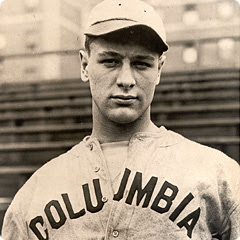
This Day in Baseball History (Gehrig’s Columbia Clout Starts Lou Lore)

May 19, 1923—Not yet in Yankee pinstripes, Columbia University sophomore sensation Lou Gehrig gave evidence of the power that would make him one of the greatest baseball players of all time with a home run that became the stuff of legend.

Fans of the future Hall of Famer and the screen idol who played him nearly two decades later, Gary Cooper, will recall the scene from the popular 1942 film The Pride of the Yankees that focused on this moment. 

It’s a real-life version of the bust-the-fixtures highlights that occur so often in The Natural, except that in this case it didn’t occur in a fictional major-league ballpark but on Columbia’s real-life South Field, where it was reported to be the longest homer hit there to that time.

But did Gehrig’s blast really knock out a window in the School of Journalism? What got me interested in this question was Leslie Zukor’s article in the new Spring/Summer issue of Columbia Magazine.

Contemporary accounts, Zukor indicated, varied in where they said the homer landed. My old newspaper, The Columbia Daily Spectator, pointed to “in front of [the School of] Journalism.” Similarly, The New York Times reported that the ball came down “in the small campus surrounding the School of Journalism building.” The Hartford Daily Courant, which covered Columbia’s opponent that day, Wesleyan University, claimed that “the sphere went over the center field stands and hit the School of Journalism building.”

What do we have here? A Bunyanesque blast that flew 400 feet and destroyed the psyche of Wesleyan pitcher Joseph Layton “Layt” Moore that day. But it doesn’t seem to have destroyed any windows. So where did this notion come from?

Maybe eyewitnesses simply misremembered the end point of the home run, or maybe, from so far away, they took their best guess about where it should have gone. But, if tracing the legend to a single source or sources is difficult, it’s easier to cite what gave the story “legs”: The Pride of the Yankees.

In that box-office smash, the reporter who will become Gehrig’s great advocate and friend (Walter Brennan’s “Sam Blake”) is talking to the phenom’s football coach (Gehrig was on a football rather than baseball scholarship to the school) when the sound of breaking glass interrupts their talk at the same time it puts an exclamation point on it.

In a way, that scene is typical of so much about the film and its tendency towards sharpening and shining up actuality. 

A major truth of Gehrig’s career is at the core of this scene: he was already an athlete of raw but astonishing skill just waiting to be discovered by the wider baseball world. He did indeed give observers something to talk about that day: not just his plate productivity—that homer, a single and two walks—but his three-hit throttling on the mound. (The same thing had happened a month earlier, in a game against Ivy League rival Cornell, when Gehrig hit--you guessed it--"a towering and legendary home run, possibly the longest in Hoy Field’s history," according to Jeff Stein's 2015 article in the Ithaca Voice.)

But it’s far more questionable whether Gehrig busted the window at Columbia's School of Journalism. And he didn’t need a sportswriter to boost his status: Yankee superscout Paul Krichell (who would go on to alert the team to, among others, Phil Rizzuto and Whitey Ford) had discovered him over a month before at a game against Rutgers, and by the time of the Wesleyan game had persuaded Gehrig to sign with the Bronx Bombers. As a matter of fact, there wasn’t a “Sam Blake” (the closest equivalent in Gehrig’s life was probably sportswriter Fred Lieb).

There’s another aspect of this scene that is not so immediately apparent: this astounding feat occurs, in effect, off the field. 

Before being cast, Cooper had no interest in baseball, and he had to undergo intense training by coach and former player Lefty O’Doul in the art of hitting. The star’s lack of ease with the bat probably contributed to the odd fact that, in a movie of roughly 2 hours and 10 minutes about a tremendous baseball player, less than 10 minutes feature any action on the diamond.

Even the follow-up to the Columbia sequence (Gehrig disappointing his mother’s wish that he graduate with an engineering degree by signing with the Yankees) misattributes his motivation: it wasn’t to pay for her medical care, but his father’s.

Nobody should be surprised by such departures from history: Hollywood has always been uninterested in fidelity to fact, and Pride of the Yankees producer Samuel Goldwyn had no interest in a film about baseball (or even the subject of Gehrig) until he was told about "The Iron Horse's" “Luckiest Man on the Face of the Earth” speech on the day held in his honor in 1939.

As sportswriter Paul Gallico (who wrote the “story” for the Oscar-nominated film) wrote to Gehrig’s widow Eleanor during filming: “No matter what I know, we are going to catch hell from the sports writers so we might as well face it. None of the boys will ever understand what we were up against in trying to make baseball fit into a Sam Goldwyn movie.” (Not even the screenplay, co-written by fellow Columbia alum Herman Mankiewicz, seems to have improved its commitment to reality.)

In short, much of the early going in the movie consists of facts changed for no particular reason; characters or situations sandpapered from rough reality (Gehrig's possessive mother didn't have an ambivalent relationship to her daughter-in-law but a positively warlike one); or concern about a global reality that hangs over the portrayal of its driven subject (Gehrig's success was a demonstration to a world at war that America was a place where virtue and hard work was rewarded).

In the end, it didn’t matter. Whatever offenses against the truth occur in the first half of the film, from the moment that Lou and Eleanor notice the first distressing signs of the ALS that will end his livelihood and even his life, all of that is forgotten and forgiven.  

The poignant interplay between Cooper and Teresa Wright as Eleanor in the closing scenes underscores a larger truth that the testimony of his teammates and subsequent biographical research confirmed: that with the love and support of his vivacious wife, this shy, often insecure superstar faced a mystifying disease with an undaunted courage that inspired millions around the world, all the way down to the present day—including many with no real interest in what may have happened on his Ivy League campus 100 years ago today.

As for me: Gehrig ranks, together with Jackie Robinson, as my favorite baseball player. This blog post I wrote 14 years ago, on the 70th anniversary of the end of his extraordinary 2,300-consecutive game streak, goes a long way to explain why, I hope.  

But ultimately, the novelist Thomas Wolfe put it far more poetically than I ever could: the Yankee great, he wrote in You Can’t Go Home Again, embodied “the faultless velvet of the diamond.”