Showing posts with label Lou Gehrig. Show all posts

Friday, May 19, 2023

This Day in Baseball History (Gehrig’s Columbia Clout Starts Lou Lore)

May 19, 1923—Not yet in Yankee pinstripes, Columbia University sophomore sensation Lou Gehrig gave evidence of the power that would make him one of the greatest baseball players of all time with a home run that became the stuff of legend.

Fans of the future Hall of Famer and the screen idol who played him nearly two decades later, Gary Cooper, will recall the scene from the popular 1942 film The Pride of the Yankees that focused on this moment. 

It’s a real-life version of the bust-the-fixtures highlights that occur so often in The Natural, except that in this case it didn’t occur in a fictional major-league ballpark but on Columbia’s real-life South Field, where it was reported to be the longest homer hit there to that time.

But did Gehrig’s blast really knock out a window in the School of Journalism? What got me interested in this question was Leslie Zukor’s article in the new Spring/Summer issue of Columbia Magazine.

Contemporary accounts, Zukor indicated, varied in where they said the homer landed. My old newspaper, The Columbia Daily Spectator, pointed to “in front of [the School of] Journalism.” Similarly, The New York Times reported that the ball came down “in the small campus surrounding the School of Journalism building.” The Hartford Daily Courant, which covered Columbia’s opponent that day, Wesleyan University, claimed that “the sphere went over the center field stands and hit the School of Journalism building.”

What do we have here? A Bunyanesque blast that flew 400 feet and destroyed the psyche of Wesleyan pitcher Joseph Layton “Layt” Moore that day. But it doesn’t seem to have destroyed any windows. So where did this notion come from?

Maybe eyewitnesses simply misremembered the end point of the home run, or maybe, from so far away, they took their best guess about where it should have gone. But, if tracing the legend to a single source or sources is difficult, it’s easier to cite what gave the story “legs”: The Pride of the Yankees.

In that box-office smash, the reporter who will become Gehrig’s great advocate and friend (Walter Brennan’s “Sam Blake”) is talking to the phenom’s football coach (Gehrig was on a football rather than baseball scholarship to the school) when the sound of breaking glass interrupts their talk at the same time it puts an exclamation point on it.

In a way, that scene is typical of so much about the film and its tendency towards sharpening and shining up actuality. 

A major truth of Gehrig’s career is at the core of this scene: he was already an athlete of raw but astonishing skill just waiting to be discovered by the wider baseball world. He did indeed give observers something to talk about that day: not just his plate productivity—that homer, a single and two walks—but his three-hit throttling on the mound. (The same thing had happened a month earlier, in a game against Ivy League rival Cornell, when Gehrig hit--you guessed it--"a towering and legendary home run, possibly the longest in Hoy Field’s history," according to Jeff Stein's 2015 article in the Ithaca Voice.)

But it’s far more questionable whether Gehrig busted the window at Columbia's School of Journalism. And he didn’t need a sportswriter to boost his status: Yankee superscout Paul Krichell (who would go on to alert the team to, among others, Phil Rizzuto and Whitey Ford) had discovered him over a month before at a game against Rutgers, and by the time of the Wesleyan game had persuaded Gehrig to sign with the Bronx Bombers. As a matter of fact, there wasn’t a “Sam Blake” (the closest equivalent in Gehrig’s life was probably sportswriter Fred Lieb).

There’s another aspect of this scene that is not so immediately apparent: this astounding feat occurs, in effect, off the field. 

Before being cast, Cooper had no interest in baseball, and he had to undergo intense training by coach and former player Lefty O’Doul in the art of hitting. The star’s lack of ease with the bat probably contributed to the odd fact that, in a movie of roughly 2 hours and 10 minutes about a tremendous baseball player, less than 10 minutes feature any action on the diamond.

Even the follow-up to the Columbia sequence (Gehrig disappointing his mother’s wish that he graduate with an engineering degree by signing with the Yankees) misattributes his motivation: it wasn’t to pay for her medical care, but his father’s.

Nobody should be surprised by such departures from history: Hollywood has always been uninterested in fidelity to fact, and Pride of the Yankees producer Samuel Goldwyn had no interest in a film about baseball (or even the subject of Gehrig) until he was told about "The Iron Horse's" “Luckiest Man on the Face of the Earth” speech on the day held in his honor in 1939.

As sportswriter Paul Gallico (who wrote the “story” for the Oscar-nominated film) wrote to Gehrig’s widow Eleanor during filming: “No matter what I know, we are going to catch hell from the sports writers so we might as well face it. None of the boys will ever understand what we were up against in trying to make baseball fit into a Sam Goldwyn movie.” (Not even the screenplay, co-written by fellow Columbia alum Herman Mankiewicz, seems to have improved its commitment to reality.)

In short, much of the early going in the movie consists of facts changed for no particular reason; characters or situations sandpapered from rough reality (Gehrig's possessive mother didn't have an ambivalent relationship to her daughter-in-law but a positively warlike one); or concern about a global reality that hangs over the portrayal of its driven subject (Gehrig's success was a demonstration to a world at war that America was a place where virtue and hard work was rewarded).

In the end, it didn’t matter. Whatever offenses against the truth occur in the first half of the film, from the moment that Lou and Eleanor notice the first distressing signs of the ALS that will end his livelihood and even his life, all of that is forgotten and forgiven.  

The poignant interplay between Cooper and Teresa Wright as Eleanor in the closing scenes underscores a larger truth that the testimony of his teammates and subsequent biographical research confirmed: that with the love and support of his vivacious wife, this shy, often insecure superstar faced a mystifying disease with an undaunted courage that inspired millions around the world, all the way down to the present day—including many with no real interest in what may have happened on his Ivy League campus 100 years ago today.

As for me: Gehrig ranks, together with Jackie Robinson, as my favorite baseball player. This blog post I wrote 14 years ago, on the 70th anniversary of the end of his extraordinary 2,300-consecutive game streak, goes a long way to explain why, I hope.  

But ultimately, the novelist Thomas Wolfe put it far more poetically than I ever could: the Yankee great, he wrote in You Can’t Go Home Again, embodied “the faultless velvet of the diamond.”

Thursday, March 26, 2020

Quote of the Day (Michael Lewis, on Baseball, Continuity and Nostalgia)


“There’s money to be made off exploiting other people’s nostalgia. Baseball, unlike other sports, is selling its connection to the past. I think that’s why baseball is nostalgic. People naturally associate baseball not just with childhood but with their father....The interesting thing is that baseball is so unmodern. The modern world is all about embracing change and disrupting. The truth about baseball is if there's no continuity, it's kind of boring. It's slow; it's not the pace of modern life. Basketball is the pace of modern life.” —Moneyball author Michael Lewis quoted in “Soapbox—The Columnists: WSJ. Asks Six Luminaries to Weigh in on a Single Topic. This Month: Nostalgia,” WSJ.com, October 2019

Today would have marked opening day in baseball. It’s lamentable, if not downright tragic, that the coronavirus has disrupted this tradition. The closest I got to the game these past 24 hours was filling out a crossword puzzle on this theme. 

Baseball, when it functions normally, offers fans like me a point in common with other people whom we would share little else with. It is a diversion from the tumult of life.

Baseball might be the summer game, but it begins in spring, in hope. Maybe that is why, though the consequences of the coronavirus are far more far-reaching than a mere game, so many of us mourn the delay of the sport.

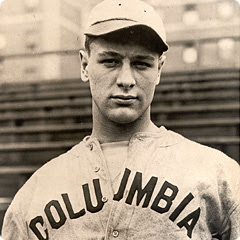
(The image accompanying this post shows mu favorite player of all time, New York Yankee first baseman Lou Gehrig—a powerful slugger struck down by a medical malady that, like the one now raging across the world, was utterly mysterious when it first appeared.)

Friday, July 26, 2019

This Day in Baseball History (Yanks’ Bill Dickey Clubs 3 HRs)


July 26, 1939—In perhaps the greatest offensive performance of his career, catcher Bill Dickey belted three home runs, leading the New York Yankees to a 14-1 run of the St. Louis Browns, continuing a turnaround for the Bronx Bombers that would lead to victory that fall in the World Series.

When I mentioned to a friend that I would be blogging about Dickey, he laughed and said, “Oh, you mean the OTHER Number 8!” It was Dickey’s misfortune to be overshadowed by another catcher who surpassed him in career home runs, World Series rings, and hold on the popular imagination: Yogi Berra. The two wore the same uniform number, and with both going to the Baseball Hall of Fame, the team eventually retired the number as a way of honoring each.

As it happened, Berra might not have developed into what he became without Dickey. But more on that shortly…

The first half of July 1939 had been rough for the Yankees in general and Dickey in particular, marked by the devastating medical diagnosis that ended the career of the catcher’s road roommate and best friend, Lou Gehrig, and the team’s tribute to the slugger on July 4—“the most emotional day I’ve had in my life,” Dickey would remember. 

After a five-game losing streak just before the All-Star Game, the Yanks lost a July 13 game they led 4-1 going into the bottom of the eighth inning, then saw their pennant lead over the Boston Red Sox shrink to just 5½ games. Then they righted the ship, winning seven straight away games against the Cleveland Indians and St. Louis Browns.

Back in New York on the 26th, traps set through Yankee Stadium caught 5,000 Japanese beetles that had mysteriously invaded the ballpark. Maybe the Browns were nettled by what had gotten into the field that afternoon, because they were utterly powerless to stop a Yankee onslaught that included at least one run in every inning.

Leading the way was Dickey—but then again, nobody was particularly surprised. At 32, Dickey was, like Gehrig, mature in age and manner—a necessity on a team with its share of brash young players—and, thus, a model on how to comport one’s self.

At the same time, he was still in the prime of his career. Dickey was probably only surpassed at his position in the 1930s by Mickey Cochrane and Gabby Hartnett. He may have taken special satisfaction in his offensive explosion on this day because he’d been advised by his first manager, Miller Huggins, to concentrate on making contact rather than hitting the long ball, as the team already had someone who specialized in the latter department (Babe Ruth).

Dickey would finish the 1939 campaign by batting .302—the last time his average would be over .300—with 24 homers and 105 runs batted in. That fall, he would cap it all by clubbing two home runs and 5 RBIs in the World Series against the Cincinnati Reds.

Moreover, he remained sterling on defense. He had mastered the art of adapting to conserve his physical skills as long as possible (notably, adopting a one-handed catching technique, saving his right arm from wear and tear), while the years had only deepened his savvy in the linked arts of knowing how to get opposing batters out and how to get the best out of his own pitching staff, a lineup ranging from strong, silent Red Ruffing to ebullient but erratic Lefty Gomez. 

(Once, facing muscular slugger Jimmie Foxx, Gomez shook off all Dickey’s called pitches till the catcher walked to the mound to ask what he did want to throw Foxx. “Nothing,” Gomez responded: “Let’s wait a while. Maybe he’ll get a phone call.”)

The last link to the Ruth-Gehrig team of the late 1920s, Dickey served as the bridge to the Joe DiMaggio-led dynasty of the late 1930s and 1940s. Remarkably, though, his influence extended into the mid-Sixties. It happened like this:

In 1946, with his own playing days winding down, Dickey took over as manager from Joe McCarthy, who, after clashing with new general manager Larry MacPhail, parted ways with the team. But Dickey had his own differences with MacPhail and quit with 14 games left in the season.

Before the 1949 season, however, a new GM, George Weiss, asked Dickey to serve as a coach under new manager Casey Stengel, with one special assignment: take young catching prospect Yogi Berra under his wing. The team had no doubt about his ability to hit, but his defense was suspect. 

So Dickey got to work—as Berra put it, “learning me all his experience.”  It involved fouls, pop-ups, plays at the plate, controlling the pitcher and the game, knowing everything on the diamond—in effect, acting as the on-field stand-in for the manager. Dickey would do the same for Elston Howard, the 1963 American League MVP.

"Bill Dickey isn't just a catcher,” wrote sportswriter Dan Daniel. “He's a ball club."

Thursday, June 2, 2011

Quote of the Day (Thomas Wolfe, on Lou Gehrig)

“What visions burn, what dreams possess him, seeker of the night? The packed stands of the stadium, the bleachers sweltering with their unshaded hordes, the faultless velvet of the diamond, unlike the clay-baked outfields down in Georgia. The mounting roar of eighty thousand voices and Gehrig coming to bat…”—Thomas Wolfe, You Can’t Go Home Again (1940)


Seventy years ago today, Lou Gehrig passed away, just weeks shy of his 38th birthday, mysteriously robbed of the power that had once made him perhaps the premiere slugger of the 1930s. Death came on the 16th anniversary of the day his 2,130-consecutive-game streak began for the New York Yankees. The two events might have been related.

The man Gehrig replaced at first base, Wally Pipp, had been taken out of the lineup in 1925 after complaining about a terrific headache (he took “the two most expensive aspirin in history,” Pipp noted wryly later).

It would take far, far more than that to dislodge “The Iron Horse.” Here’s what he endured, without complaint, for 14 years:


* A broken thumb
* A broken toe
* Back spasms
* 17 different fractures in his hands
* Lumbago
* Multiple concussions

That last item led neurologists last year to a surprising conclusion: Lou Gehrig might not have died of the disease named for him, after all.

Because he was cremated rather than embalmed, the body tissues that would allow a definitive judgment on this can’t be examined. But doctors found last year that the brain trauma associated with concussions can mimic amyotrophic lateral sclerosis, a.k.a. Lou Gehrig’s Disease. And Gehrig is known not only to have had at least four concussions while playing for the Yankees, but may also have experienced head traumas during off-season barnstorming tours and while playing as a running back for Columbia University.

Gehrig died nearly two years after his famous farewell speech at Yankee Stadium. In the time between his retirement and death, when he wasn’t going to his job in lower Manhattan on the New York Parole Commission, he would listen to Mel Allen broadcast Yankee games. The year after he retired, when he came back one day to visit the stadium, he told the “Voice of the Yankees”: "Mel, I never got a chance to listen to your games before because I was playing every day. But I want you to know they're the only thing that keeps me going."

I like to think that the sustaining magic in Allen’s voice was what fellow Southerner Thomas Wolfe also conveyed: an ability to summon, without visual aids, “the faultless velvet of the diamond.”

Saturday, May 2, 2009

This Day in Yankee History (Lou Gehrig’s Consecutive-Game Streak Ends)


May 2, 1939— Leaving the Book-Cadillac Hotel for their game with the Detroit Tigers, the New York Yankees encountered in the lobby a Grand Rapids, Mich. businessman who happened to be an old teammate: Wally Pipp.

A couple of hours later, the man who took Pipp’s place in the lineup and never left, Lou Gehrig, walked out to the umpire with the team lineup card. The stadium announcer informed the 11,400 fans in attendance that the Yankee captain would not play that day.

The crowd responded with a two-minute ovation for a hero who had, in the prior World Series and all through spring training and the first month of the season, inexplicably struggled to maintain the record of power and consistency he’d established through an extraordinary 2,130-game playing streak.

Later, in the clubhouse, the exhausted Yankee trudged over to a water fountain and wept. When he returned to face a horde of reporters who’d grown increasingly critical of his play in the last few weeks, he was his normal gracious, composed—but now, nonplussed—self. “I just can’t understand,” Gehrig said. “I’m not sick.”

Little did he know that he was. Within six weeks, the entire sports world would be rocked by the news that Gehrig’s physique had been catastrophically drained of its strength through a mysterious neuromuscular disease. Within another two years, that same disease would claim the life of this greatest of home-run heroes and gentlemen.

It was Gehrig’s misfortune to be overshadowed for all but one of his seasons by two more charismatic teammates—first, by a manchild who became the most prodigious home run hitter in the history of the game, then by the first five-tool (i.e., a player who could hit for power, hit for average, run, throw, and field) superstar.

The consecutive-game streak, however, was one that neither Babe Ruth nor Joe DiMaggio, for all their undisputed greatness, could reach, and as time went on Gehrig battled to maintain the streak with grim determination. Few outside the Yankee dugout could imagine the toll that record took on his body: a broken thumb, broken toe, back spasms, and 17 different fractures.

Two of the finer recent chroniclers of Gehrig, Richard J. Tofel (A Legend in the Making: The New York Yankees in 1939) and Jonathan Eig (Luckiest Man) have expressed some surprise that, throughout his life, such an accomplished hitter was, in Tofel’s words, “limited as a person”—i.e., “shy, sensitive, insecure, none too bright, and all too earnest.”

Maybe the decision to cast taciturn Gary Cooper as the doomed hero in Pride of the Yankees colored the authors’ initial impressions of what Gehrig was like—and magnified their shock upon discovering when he wasn’t the stoic, Hemingway-style hero Coop played in A Farewell to Arms and For Whom the Bell Tolls.

Yet insecurity is hardly unique to high-achieving athletes, even now. In Last Night of the Yankee Dynasty, Buster Olney reveals how Paul O’Neill, even at the height of his career, would stalk off the field after failing to get on base, muttering, in all seriousness, “I’ll never get another hit, I can’t hit anymore.”

Gehrig’s need to prove himself stemmed from a similar drive to meet his own standards—but plus a whole lot more:

* As the only surviving son of four children—and as a counterbalance to an often drunken, improvident father—Gehrig was the repository of all the hopes of his doting mother.

* As the son of German immigrants, he was an adolescent at a time—World War I—when war fever had whipped up national resentment against those of his heritage.

* At Columbia University, he not only wondered about his ability to survive academically, but also felt socially inferior to fellow fraternity brothers who did not have to work their way through school.

The insecurity created by his background spurred Gehrig to a record that, even with his truncated career, puts him on the short list of baseball’s greatest all-time hitters: a Triple Crown, the career leader in grand slams, nearly 200 hits and 100 walks in the same season seven times—the list goes on and on.

But, if achievement put him in the record books, character made Gehrig an American legend. I will discuss his “Luckiest Man” speech in the first Old-Timers’ Game later this year. But for now, I’d like to focus on a less well-known aspect of his life—his post-baseball appointment by New York Mayor Fiorello LaGuardia to the Municipal Parole Commission.

Gehrig took this responsibility seriously, and, while his fragile health permitted, visited facilities to interview at-risk youths. One such involved a meeting of one sports legend whose story would be adapted by Hollywood with a future one who’d have the same experience.

The meeting with 19-year-old Thomas Rocco Barbella, was ironic, for a start, in that one of Gehrig’s few vices was a penchant for chewing gum, while Barbella’s first contact with the long arm of the law came when he tried to tamper with a gum machine. Things quickly got more serious after that. By the time he met Gehrig, Barbella was stealing anything not nailed down, including equipment from Yankee Stadium.

In 1940, arrested while on probation for statutory rape, Barbella was brought before Gehrig. The young tough heeded some advice from friends and told the new parole commissioner that his favorite sport was baseball. Gehrig grinned, perhaps recognizing that the youngster, who’d already shown skill in boxing, was pulling a fast one.

After asking if he realized all the trouble he’d given his mother (an especially important concern, as we’ve seen, for the slugger), Gehrig told the young man that he’d have to go to reform school. Barbella didn’t take too kindly to this, cursing the Yankee out before being led away by guards.

Years later, however, after reform school had given him the opportunity to get away from his old associates and practice his boxing skills, Barbella said he would have shaken Gehrig’s hand for straightening him out—but by that time the slugger had died.

Eventually, Barbella entered the professional boxing ranks and became a champion. Hollywood made a movie of his life called Somebody Up There Likes Me, starring Paul Newman. When he died, boxing fans knew him by another name—Rocky Graziano—but believed he possessed the same quality in the ring that his old parole commissioner had in facing death: as a eulogist for Graziano put it, “all the guts in the world.”