Showing posts with label Robert Redford. Show all posts

Saturday, September 27, 2025

Flashback, September 1975: Redford Paranoid Thriller ‘Three Days of the Condor’ Opens

Three months after the Rockefeller Commission released its report documenting abuses by the Central Intelligence Agency (CIA), Three Days of the Condor was released 50 years ago this week, further heightening audiences’ fears about a secret government agency run amok.

The movie, which starred Robert Redford, brought in $27 million in box-office revenues on a budget of $20 million, cementing the actor’s status as the premier leading man of the mid-1970s after it had been temporarily disrupted by the underperforming The Great Gatsby.

The film was an adaptation of the James Grady novel Six Days of the Condor. Though there were numerous changes from page to screen (itemized in Allan MacInnis’s 2011 post from the “Alienated in Vancouver” blog), the most significant might have been the time compression indicated by the title.

Peter Yates, who worked with Redford three years before on The Hot Rock, was originally set to direct. But he was replaced by Sydney Pollack, who had collaborated with the star on The Way We Were and would make a total of seven films with him.

Pollack’s “great gift,” Redford said in a Time Magazine interview after his friend’s death in 2008, was “to cover what could have been just sort of crass commercial filmmaking with a whole artistic [approach] that was more abstracted and was more hip and was more offbeat.”

In Pollack’s filmography, the movie resembling this the most might be The Pelican Brief, another slick thriller featuring the biggest box-office star of the time (Tom Cruise) and the requisite love interest (Jeanne Tripplehorn).

Redford’s character, Joe Turner, goes out to pick up lunch for his colleagues at the fictitious American Literary Historical Society (a CIA cover), only to discover upon his return that all his coworkers have been slaughtered. Following a planned attempt to “come in from the cold” that nearly ends with his own assassination, he goes on the run to save his life and ferret out the truth

Reflecting in some manner the film’s plot, the atmosphere on the set was “tense,” according to this recollection by photographer Terry O’Neill, “mainly because the film was very topical, New York City was a bleak place in 1974, the President [Nixon] had just resigned, and the former head of the CIA [Richard Helms] was supposedly on set talking to Robert Redford.” 

That turned out to be the case, as the actor was, with as little fanfare as possible, eliciting from Helms inside tips about his former agency.

Redford’s Turner is supposed to be bookish and slightly naïve as he pores over books in his unsecured office.

But Redford being Redford, he doesn’t look the slightest bit nerdy, an impression enhanced by his stylishly casual apparel: flared denim, a gold and gray wool tie, and a gray tweed herringbone jacket that fostered such a fashion trend that “all menswear guys have tried to copy this jacket,” said French designer Nicolas Gabard, according to Charles Teasdale’s retrospective on the film this month in The Financial Times.

I guess the filmmakers needed something to make it plausible that Faye Dunaway’s Kathy would fall for this stranger who abducts her in his frantic attempt to stay alive—not normal behavior for most women in similar circumstances.

But for all that, the plot was taut and the conspiracy details not especially far-fetched—especially so for 1970s audiences who were learning daily, through the evening news, to distrust whatever the government was telling them. 

Though Dunaway did not experience with Redford or Pollack the animosity she had encountered with Roman Polanski on Chinatown, her role was also hardly as complex or extensive as in that classic neo-noir. Nor was she able to rehearse or emotionally bond much with Redford, who was already busy with pre-production on All the President’s Men.

That adaptation of the Bob Woodward-Carl Bernstein bestseller about how they broke the Watergate story was a real-life version of the “paranoid” or “conspiracy” thriller genre that became so prominent in the Seventies.

Such movies as The Parallax View, The Conversation, Klute, and Winter Kills marked a sharp turn away from nail-biters from a few decades before, when—at least on film—the U.S. government protected its citizens from foreign agents infiltrating the U.S. (Additionally, two Godfather movies and Chinatown evinced cynicism about Law and Order, American style.)

Now, with revelations of Presidential deceit about Watergate and Vietnam—not to mention the assassinations of the Kennedys and Martin Luther King Jr.—the American government and private companies with access to high-tech equipment and secrets were being depicted as nefarious.

Unlike wartime and later “conspiracy” movies, Three Days of the Condor was neither blithely optimistic nor pessimistic. Its “open” ending about Turner’s fate was, however, deeply disquieting—in effect, leaving it up to the public to defend against attacks on the liberty of institutions as much as on individuals, from whatever quarter.

Thursday, September 18, 2025

Quote of the Day (Richard Russo, on Half of a Movie Buddy Team)

“[Actor William] Nolan was the reliable, competent American Everyman, the Nick Carraway who would never understand or accept or like himself half as much as Gatsby did. The Milton of my fourteen pages was a lot like me, a man cautious by nature and experience, who knew himself too well to be much of a fan and, as a result, was often too grateful for the good opinion of others.”—American Pulitzer Prize-winning novelist and screenwriter Richard Russo, “Milton and Marcus,” in Trajectory: Stories (2017)

The news of Robert Redford’s passing this week prompted me to read at last the novella “Milton and Marcus,” in the story collection Trajectory by Richard Russo. Somehow I had never gotten around to perusing the book after buying it eight years ago, even though I’d heard it was a roman a clef (i.e., a story about real people or events, but overlaid by thinly fictionalized names and details) about his adventures as a screenwriter for Paul Newman and Robert Redford.

Once I started reading it, it turned out to be every bit as dishy as I’d been led to expect—and every bit as funny, compassionate, and rueful as the fiction that has brought Russo critical and popular acclaim.

The novella’s narrator (only referred to by the nickname “Hotshot” by one of the two movie stars in the story) is a less successful alter ego of Russo: a novelist and screenwriter whose career is on the wane. I knew that Russo had worked several times with Newman (called here Wendell Pierce, or “Wendy”) but I’d been unsure of any Russo collaboration with Newman’s two-time co-star and longtime friend, Redford (called “William Nolan” in this story).

Then, according to this 2012 Albany Times-Union article, I discovered that Russo had been working on the screenplay for the 2015 Redford film A Walk in the Woods. Yet final writing credit for the movie went to Michael Arndt (under the pseudonym “Rick Kerb”) and Bill Holderman, rather than Russo.

Clearly, at some point, Russo’s and Redford’s views on the first draft had diverged and the novelist was no longer associated with the project.

Until the appearance of either a Russo reminiscence or a full-scale Redford biography appears, all we have about what transpired during the script’s development is conjecture.

But “Milton and Marcus” offers a clue: Redford had a fragment of a script early on, solicited Russo’s ideas for expanding it some years after Newman had died, but chose to use the contributions of other writers whose services he had engaged in the meantime.

Ultimately, “Milton and Marcus” becomes a story of charisma, loyalty, self-absorption, and desire—sometimes on the part of writers as much as actors. “Wendy” is depicted more affectionately than “Regular Bill” (the nickname for the Redford character, who was called “Ordinary Bob” by many in the film industry).

But much of the intrinsic interest in the tale also comes from inferring the parallels between its characters and their real-life counterparts:

*Wendy and “Regular Bill” score huge successes in their younger years with a few “buddy” movies, as did Newman and Redford with Butch Cassidy and the Sundance Kid and The Sting (in the image accompanying this post, of course);

*Wendy engages in a fruitless, decades-long attempt to find another script for himself and Nolan to work with, as Newman did with Redford;

*Wendy thought before his death that the script idea by “Hotshot” (his nickname for the Russo alter ego) might appeal to Nolan’s “left-wing” tendencies; Redford was similarly a longtime progressive, particularly as it related to environmentalism;

*An associate of “Regular Bill” chuckles about the star’s penchant for fast driving; and yesterday’s New York Times obit noted that Redford in one year, the star received eight tickets for speeding in a Utah canyon;

*Nolan lives in Utah, as did Redford;

*To the surprise of many, a decade after Newman’s death, Nick Nolte replaced him on A Walk in the Woods; Nolan’s eventual co-star for “Milton and Marcus,” Gene Handy, possesses a similar gravelly voice, reputation as a dedicated actor, and tendency towards hard living that landed him in rehab;

*“Regular Bill” convenes his group to talk about “Hotshot’s” script while in post production on Desperation Alley, “which was rumored to be overbudget and behind schedule”; similar speculation swirled around a 2007 film that Redford directed, Lions for Lambs, whose $15 million in US and Canadian gross revenues fell well short of its $35 million budget.

As Wendy aged, Russo implies, he took increasingly riskier roles, while for Nolan, the notion of leading a “regular” existence, or even taking roles of “regular” people, had become unattainable.

I believe that in the case of Redford, this was largely true—by the mid-Seventies, he had stopped taking the edgy parts he had often taken as a younger, hungrier actor (as in Inside Daisy Clover, where he played a bisexual character). As a director, however, the opposite was true. The Milagro Beanfield War, for instance, was the first big-budget Hollywood production with a largely Hispanic cast, while his establishment of the Sundance Institute boosted the production of independent films.

Following Redford’s death, tributes have flowed in for the star, from both film colleagues and from people whose lives were touched by his activism. Moviegoers, unlike entertainment industry professionals, are less familiar with idols’ complex personalities and working methods. “Milton and Marcus” is an insightful reminder of how those who enter their turbulent orbit experience them at close range.

Monday, October 16, 2023

This Day in Film History (‘The Way We Were’ Scores After Off-Screen Script Struggles)

Oct. 16, 1973— The Way We Were, a bittersweet, through-the-years drama starring Barbra Streisand and Robert Redford, premiered at last in New York City, after undergoing multiple rewrites and backstage bickering that, miracle of miracles, resulted in a box-office hit and placement among the American Film Institute’s list of the top romantic movies.

The film also firmly established Redford—whose career had been inexorably building momentum for a decade—as the male romantic idol of his generation—ironically, for a role that, in its initial incarnation, he saw as such a “Ken doll” that he had rejected it.

More than a few fans of this classic might be surprised to learn that its heterosexual couple were a projection of the relationship between screenwriter Arthur Laurents and his lover of the late Forties and early Fifties, actor Farley Granger.

In both cases, a Jewish screenwriter with outspoken leftist sympathies (Laurents in real life, Streisand as the film’s Katie Morosky) falls in love with a WASP of startling good looks (Granger, and Redford’s Hubbell Gardiner), only to see the relationship founder. 

Streisand, committed to the project from the start, recognized that the film needed a male co-star of unusual magnetism. She thought she saw it in Redford, “an intellectual cowboy…a charismatic star who is also one of the finest actors of his generation.”

“What intrigued me most about Bob was his complexity,” Streisand recalls in her upcoming memoir, My Name Is Barbra (excerpted in the November issue of Vanity Fair). “You never quite know what he’s thinking, and that makes him fascinating to watch onscreen. Like the greatest movie stars, Bob understands the power of restraint. You’re never going to get it all…and that’s the mystery…that’s what makes you want to keep looking at him.”

To Streisand’s disappointment, Redford initially rejected the role as being little more than a love object. But she wouldn’t take no for an answer, beginning a process where as many as 10 screenwriters were enlisted (most crucially, Alvin Sargent, David Rayfiel, and even Paddy Chayefsky and Francis Ford Coppola) to make Katie more appealing and, more important, Hubbell a figure of substance and complexity.

With every rewrite, Laurents saw less of his original, and it infuriated him, particularly on what he saw as the softened subplot involving the Hollywood blacklist. Streisand and, to a lesser extent, Redford also objected to the de-emphasis on politics.

But director Sydney Pollack, already under enormous pressure from balancing the contrasting acting styles of his stars (Streisand loved constant rehearsals and additional takes; Redford felt he grew more stale the longer it lasted), battling with producer Ray Stark, and making sense of all the different scripts, was also getting static from Columbia Pictures, which desperately needed a hit to stave off bankruptcy.  

It all come to a head after a disastrous Friday night preview. Frustrated by his inability to integrate the passion and the politics, Pollack decided to cut five scenes—all with political overtones.

Nearly a decade later, Pollack would engage in another clash about the meaning of a movie with a significant figure: Dustin Hoffman, who saw Tootsie as being about what an actor would go through for his craft while the director conceived it as how a male could become a better man.

Both movies became enormous hits, but The Way We Were left a far more bitter residue. The outspoken Laurents remained bitter to the end of his life about the violence Pollack did to his script. For his part, the director felt that at the end of the day, the movie was a love story.

For all the battle over the movie’s words, a crucial contributor to its eventual success—in a way that audiences may not fully appreciate—is its theme music. I’m not talking simply about the fact that the song, with its nostalgia-tinged lyrics by Alan and Marilyn Bergman, won an Oscar for Best Original Song as well as the Grammy for Song of the Year.

No, I’m also referring to how it opened up audience tear ducts during the film’s ending. Composer Marvin Hamlisch, thinking the audience would grow tired of his theme after two hours, had used different music for the goodbye scene between Katie and Hubbell. At first, he couldn’t understand why audiences didn’t react the way he wanted.

When he realized the problem—they needed to hear that theme music again!—Columbia Pictures wouldn’t come up with the $15,000 cost of redoing the scene. So Hamlisch took it out of his own paycheck.

Did the studio suits ever recompense him? You got me. Maybe they thought that Oscar and Grammy were all the rewards he needed. In any case, that soaring ballad got a lot of people’s minds off a script that had given countless people agita.

(See Sarah Jae Leiber's interesting discussion on the Jewish Women's Archive about how The Way We Were concludes that "civility alone cannot sustain loving relationships where core principles are misaligned.")

Tuesday, August 23, 2022

Quote of the Day (Edna Ferber, on an Adonis in a Dirty Baseball Uniform)

“Any man who can look handsome in a dirty baseball suit is an Adonis. There is something about the baggy pants, and the Micawber-shaped collar, and the skull-fitting cap, and the foot or so of tan, or blue, or pink undershirt sleeve sticking out at the arms, that just naturally kills a man's best points. Then too, a baseball suit requires so much in the matter of leg. Therefore, when I say that Rudie Schlachweiler was a dream even in his baseball uniform, with a dirty brown streak right up the side of his pants where he had slid for base, you may know that the girls camped on the grounds during the season.”—American novelist, short-story writer, and playwright Edna Ferber (1885-1968), “A Bush League Hero,” in Buttered Side Down: Stories (1912)

If the name “Edna Ferber” is recognized nowadays, it’s less because of her once-wildly-successful novels and plays than how often Hollywood saw them as hot properties worthy of adapting to the screen—works like Giant, Cimarron, Saratoga Trunk, Dinner at Eight, Show Boat, and the Pulitzer Prize-winning So Big. Many of these are regional works, ranging from Texas to Alaska.

That’s why I was astonished to find that Ferber had written a much less sprawling work—a short story—and even, God help me, a short story about baseball. I’d have understood it about her contemporary, Ring Lardner, who started out as a sportswriter, but Ferber is a different matter.

I still don’t know enough about Ferber to tell you whether she was a fan, but judging from this excerpt from her work, she sure noticed things (like that “Micawber-shaped collar”).

I suspect that the allure of an Adonis, even in a dirty business uniform, remains compelling to many a female fan more than a century after Ferber wrote these words. That would account for the matinee-idol status accorded, at least for a while, for Yankee shortstops Bucky Dent and Derek Jeter.

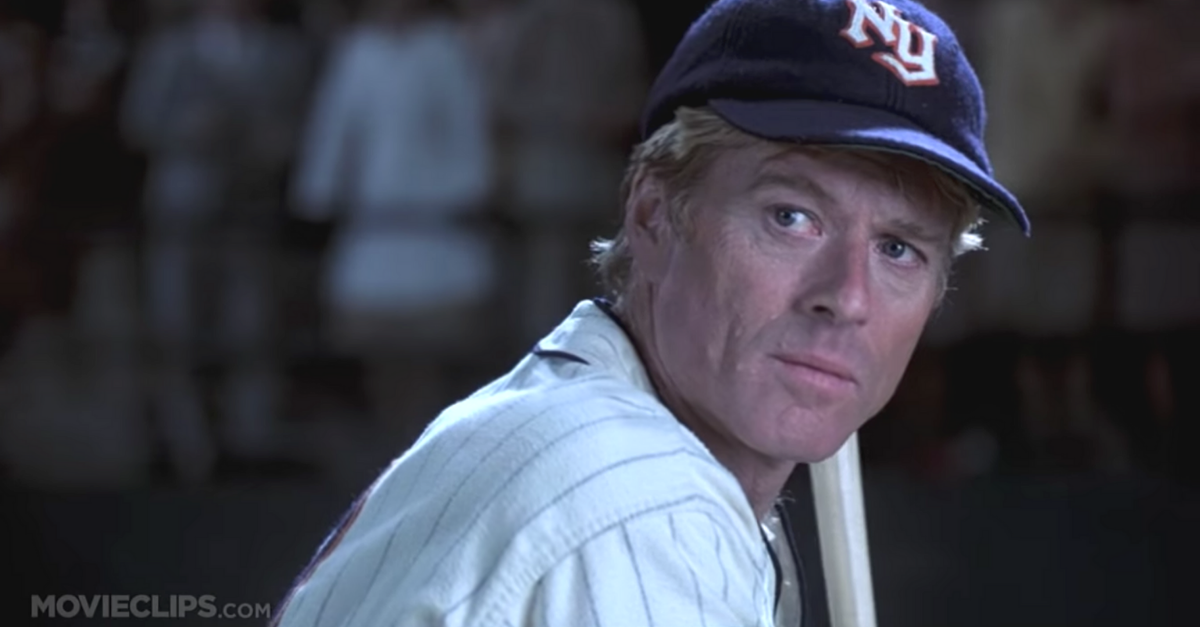
It’s even more the case for a movie baseball player: Robert Redford’s Roy Hobbs in The Natural (in the image accompanying this post)..

I couldn’t find a shot of Hobbs’ uniform beginning to seep with blood from a terrible past wound reopened, but I’m presenting the next best thing for my female readers: his face dirty, sweating and tense, as he awaits a pitch that can redeem a season and even his own life.

Saturday, July 24, 2021

Quote of the Day (Stephen Jay Gould, on the Stability Underlying ‘The Mythology of Baseball’)

“Nothing nourishes the mythology of baseball more than the stability that allows us to grasp the accomplishments of past legends because they played the same games under the same rules. I don’t know how to read the records of early basketball heroes who played in the age of the two-handed dribble and the center jump after each basket (and no slam dunks). But when Roger Maris chased and surpassed the greatest of all records in 1961, Babe Ruth’s 1927 mark of sixty home runs in a season, the whole nation watched during a summer of fascination—and understood. Moreover, although baseball is a team sport, all its actions can be dissected into components of personal contest (batter against pitcher, runner against fielder)—and individual performance therefore obtains an irreducible and measurable meaning. By contrast, achievements in other sports have no separable status, and myths about personal heroes cannot take similar root. Wilt Chamberlain once scored one hundred points in a basketball game—but only because his teammates decided to try the peculiar strategy, a grand joke really, of letting him take all the shots. (Does this theme of personal contest and achievement also help to explain why such a brutal activity as boxing also enjoys a substantial literature?)"—American geologist, biologist, historian of science—and lifelong baseball fan—Stephen Jay Gould (1941–2002), “Dreams That Money Can Buy,” The New York Review of Books, Nov. 5, 1992

Unless it was under a different title, I did not see this piece in Triumph and Tragedy in Mudville, the posthumous collection of baseball essays by Stephen Jay Gould. The above paragraph is a good example of the author’s clear, even lively writing style and deep knowledge of his subject.

But its romanticism—a term that Gould did little to disclaim—may have already sounded dated by the time of his death, because of the use of the designated hitter in the American League and, we know now, the widespread prevalence of steroids in the 1990s and early ‘oughts.

Many fans like me have been watching other trends of the last two decades with concern bordering on disgust, including work-stoppage threats, batters’ lack of shame over strikeouts, defensive shifts, and the stress on strikeouts that may be taxing pitchers’ arms.

But in the last two seasons, COVID-19 has introduced new elements into games, such as placing men on second base during extra innings. To use an example that Gould might have appreciated: Under these conditions, how, then, can Gerrit Cole be compared with, say, Christy Mathewson?

More so than ever, I think, because of such changes, player statistics can only be compared with their immediate contemporaries rather than those in the past.

(Speaking of baseball “mythology”: the image accompanying this post shows Robert Redford as Roy Hobbs in the 1984 film The Natural. Though the movie adaptation changed quite a bit from Bernard Malamud’s 1952 novel, the Hobbs character drew on elements of Babe Ruth, Bob Feller, Shoeless Joe Jackson, Ted Williams, Sal Maglie, and Eddie Waitkus, a Philadelphia Phillies first baseman shot and wounded in a hotel by a crazed female fan.)

Saturday, September 30, 2017

Quote of the Day (Bernard Malamud, on the Awesome Power of ‘The Natural’)


“Wonderboy flashed in the sun. It caught the sphere where it was biggest. A noise like a twenty-one gun salute cracked the sky. There was a straining, ripping sound and a few drops of rain spattered to the ground. The ball screamed toward the pitcher and seemed suddenly to dive down at his feet. He grabbed it to throw to first and realized to his horror that he held only the cover. The rest of it, unraveling cotton thread as it rode, was headed into the outfield.”— Bernard Malamud, The Natural (1952)

This past summer marked the 65th anniversary of the first novel by Bernard Malamud. When it was turned into a vehicle for Robert Redford in 1984, The Natural was given a happy ending.

I’m normally a stickler for staying as close to original source material as possible, but I didn’t mind in this case. At the time, baseball had been hit with a series of drug scandals. No, not performance-enhancing drugs, but a performance-detracting one: cocaine, which afflicted several members of the Kansas City Royals in the early 1980s and, in 1985, burst out, in even more spectacular fashion, at the Pittsburgh Drug Trials, which ensnared such stars as Keith Hernandez, Tim Raines, and Dale Berra.

So, I was in an acquiescent mood in the 1980s when Malamud’s dark warning of the corruption of innocence was turned into the kind of optimistic, life-affirming film that Frank Capra once made. Since then, it has become not only one of my two favorite baseball films (vying with Bull Durham), but also one of my favorite movies, period.

I was surprised, then, as I began to write this post, to discover that, in nearly an entire decade of blogging, I had written only glancingly about The Natural before. One day, perhaps on the 35th anniversary of its release, I may well write about the movie at the length it deserves.

But the book itself weaves its own magic, and one of the ways it does so, as seen in the quote I used here, is in evoking the mythological aspects of baseball. 

“Wonderboy”— the bat of Roy Hobbs, desperate to make the most of perhaps his only shot at the big leagues—endows the improbable 35-year-old rookie with the same kind of astonishing power that Excalibur afforded King Arthur.  He has, to his team’s amazement, obeyed the offhand command of his manager Pop to “rip the cover off the ball.” Through one swing of the bat, he has changed the entire climate of the game—even the New York “Knights” miserable season to date—with his Thor-like presence.

I thought of Hobbs’ amazing highs and lows in the ensuing season as I followed the fortunes of Aaron Judge (pictured) this year. It’s appropriate that the New York Yankee rookie occupies right field, once the domain of Babe Ruth—perhaps as close to a mythological figure as baseball has ever produced. 

As of this writing, Judge has not only surpassed the major league rookie record for home runs, but also The Bambino’s mark for the most HRs in franchise history at home for a single season. Judge has even been heavily associated with a phrase evocative of the Thor-like Hobbs: “exit velocity.”

Slumping is another way that Judge resembles Hobbs. Malamud is very shrewd on the utter helplessness that the best baseball minds feel in the wake of a slugger’s doldrums, which can consume a contender as much as a power surge can lift them. Judge had his own epic meltdown after the All-Star Game, when Yankee fans such as myself worried that pitchers had discovered and exploited a fatal flaw at the plate.

More recently, Judge has righted himself, resuming something like his home run pace of the first half. It’s going to be interesting to see if he can keep carrying the team (like Hollywood’s Hobbs) or if he will falter in the end (like Malamud’s). Baseball prodigies, like Greek deities, sometimes prove all too humanly fallible in the end.

(Photo of Aaron Judge in a Yankee game against the Baltimore Orioles, taken Sept. 7, 2017, by Keith Allison from Hanover, Md.)

Friday, May 29, 2015

Quote of the Day (Robert Redford, on How ‘Happiness is Sporadic’)


"Life is essentially sad. Happiness is sporadic. It comes in moments, and that's it. Extract the blood from every moment."—Robert Redford quoted in Matthew Belloni, “Robert Redford: What I've Learned,” Esquire, January 2011 issue

(Photograph of actor-director Robert Redford taken by Steve Jurvetson at the premiere of the documentary The New Heroes, in 2005.)