Showing posts with label New York (City). Show all posts

Saturday, April 18, 2026

Photo of the Day: Swings at Lincoln Center

This past Wednesday, heading over to a matinee event at Lincoln Center, I was surprised to see this set of bright-red swings across the plaza. I didn’t recall ever seeing it before. Indeed, it was only just installed and is temporary.

"Mi Casa, Your Casa 2.0" is an interactive artwork, a series of open, house-shaped frames, each roughly 8 feet wide and nearly 10 feet tall. Designed by Mexico-based studio Esrawe + Cadena, it’s open to the public as part of Lincoln Center’s Big Umbrella Festival.

The piece only lasts as long as the festival, through April 26. On the warm, sunlit afternoon when I took this photo, many visitors were taking advantage of the installation while they still could at this New York entertainment and cultural mecca.

Thursday, April 16, 2026

Photo of the Day: Better the Sax Man Than the Tax Man

Yesterday, having paid my debt to Uncle Sam, I happened to be in New York’s Duffy Square when I came upon the fellow you see here.

In contrast to the costumed characters that have come to populate (or, if you prefer, litter) this center of the Manhattan entertainment world, this musician was intent not on sight but on sound, blowing sweet notes into the rapidly warming air. 

It felt like such a blessing and relief, amid the high temperatures and the annual presence of the IRS, that I just had to take his photo.

Thursday, January 1, 2026

This Day in New York City History (‘Beau James’ Walker Inaugurated Mayor)

Jan. 1, 1926—In a pattern that held true for his attendance at major public meetings for the next seven years, Jimmy Walker was late—by 90 minutes—for his own inauguration as New York mayor.

This time, he had a valid excuse: he and wife Allie were helplessly mired in the traffic that had come to clog the streets of Gotham with the rise of the automobile—a problem he intended to alleviate once he took the oath of office.

As he becomes the focus of the same ceremony, Zohran Mamdani maintains a relationship with the electorate significantly different from Walker’s, going beyond the fact that the former is an insurgent with democratic socialist sympathies while the latter was a product of the Tammany Hall political machine.

No, those who cast their ballots for Walker (and even many of those who didn’t) couldn’t help liking him; Mandami’s voters believe in him. If that trust is ever broken, God help him.

Sharing a hotel room with Walker on a trip to Albany, Gov. Alfred E. Smith, remarking on his protégé’s slender form in multicolored pajamas, compared him to a candy cane. In time, the wisecrack assumed a double meaning. Like that confection, Walker was fun to take in but not as substantive as might be wished.

By the conclusion of his time in office—induced by a wide-ranging corruption probe by Judge Samuel Seabury—Walker earned several nicknames, including “Gentleman Jimmy,” “The Night Mayor,” “The Jazz Mayor,” and, inevitably, given an incurable tendency to tardiness that even delayed him from meeting with President Calvin Coolidge for 40 minutes, “The Late Mayor.”

But I prefer the one I heard nearly half a century ago, the title of a 1957 biopic starring Bob Hope: “Beau James,” a moniker that underscored his reputation as a dandy.

If you want a more complete idea of Walker’s colorful personality, then I urge you to read my blog post from nearly 16 years ago that took as its point of departure Red Smith’s dazzling reminiscences.

But the post you’re reading now focuses on several of the flamboyant politician’s policies—and the extent to which his managerial strengths and weaknesses, along with the contemporary environment, affected his ability to implement them.

In the attached blog post from nearly five years ago, longtime NYC archivist Kenneth Cobb paid Walker the compliment of taking his work seriously—something that the mayor all too often did not. 

Similar to Bill O’Dwyer at City Hall 20 years later, Walker was a glad-handing pol with great ability to maneuver others toward a desired outcome, but often beset by stress and ill health and disposed towards delegating matters to energetic but hard-pressed staffers.

In contrast to O’Dwyer, Walker’s ailments were more severe and self-induced. His epic nocturnal partying required him to sleep it all off, exacerbated his allergy towards handling difficult problems early in the morning, and drove him towards frequent vacations, including to Europe and Palm Springs—a total of 143 days in his first two years alone. 

The result: for seven years, New York not only had a “night mayor,” but a part-time one.

The place to start in assessing Walker is his inaugural address, where he outlined several key areas of concern: health, business conditions, housing, transportation, education, parks and recreation, child welfare, and police and fire protection.

This is the kind of speech almost any New York mayor would give. In fact, its surprising aspects, considering Walker’s prior reputation as a witty party leader in the State Senate and his subsequent bantering with the press, are its lack of memorable lines and overall seriousness.

It turned out that Walker did achieve some of his goals, including:

*establishing the Department of Sanitation—implementing “the first major improvement in the city’s sewage problem in its history,” according to Donald Miller’s history of Jazz Age Manhattan, Supreme City;

*creating a City Committee on Plan and Survey that ended up watered down by Democratic borough sachems and eventually eliminated through budget cuts in the Depression, but not before advancing the ideal of an objective master plan for the city;

*expanding parks and playgrounds by purchasing thousands of acres;

*enhancing public health by consolidating 26 municipal hospitals under a single commissioner, authorizing massive hospital construction and modernizing Bellevue’s psychopathic division;

*supporting civic aviation by initiating construction of Floyd Bennett Field, the city’s first municipal airport;

*maintaining the five-cent subway fare;

*presided over the opening of the first section of the Independent (IND) subway system; and,

*spearheaded construction of the West Side Highway.

Ironically, the beginning of the end for Walker began within only a few days of his greatest political triumph: a reelection victory in November 1929, as he took 60% of the vote compared with 25% for Republican Fiorello LaGuardia and 12% for Socialist Norman Thomas.

But the stock-market crash that occurred on “Black Tuesday” at the end of October meant that the mayor could no longer count on a vigorous private sector to fund his ambitious new programs—and that there would be less patience for stunts like signing into law a pay raise for himself as the first order of business in his second term.

Franklin Roosevelt, now in charge in Albany and with his eye on the White House, instigated the Seabury inquiry that turned up the heat on Walker through the spring and summer of 1932. 

But in the end it was Walker’s mentor Al Smith—no longer in office but out of patience with the "candy cane's" blatant philandering and laziness—who delivered the coup de grace, bluntly telling him, “You’re through.” That night, at the beginning of September, Walker wrote his letter of resignation, effective immediately.

Charm and generosity have enabled many politicians to survive all kinds of disasters, and Walker demonstrated those attributes to an unusual degree.

You will find no argument from me that he was fiscally fraudulent. (Herbert Mitgang’s history of the Seabury investigation, Once Upon a Time in New York, leaves no doubt on that score.) 

But his corruption pales next to the current Presidential administration, and unlike the present Oval Office incumbent he spurned attempts at naming after himself initiatives he had championed. “The mayor of New York still believes himself to be a public servant and not a potentate,” he said.

Moreover, for everyone who rightly recalls the bribes and what Walker termed “beneficences” that came his way for those courting favors, you will discover someone else with ancestors who survived in difficult times through charity arranged or personally distributed by him.

Monday, December 15, 2025

TV Quote of the Day (‘Barney Miller,’ As Fish Receives a Stupefying Retirement Gift)

Det. Phil Fish
[played by Abe Vigoda] [opens his present]: “What is it?”

Det. Stan “Wojo” Wojciehowicz [played by Max Gail]: “It's a New York City municipal bond.”

[All the cops in the precinct stand silently aghast, until…]

Det. Sgt. Nick Yemana [played by Jack Soo] [horrified]: “Oh, my God.”

Fish [still trying to comprehend this]: “A New York City municipal bond?”

“Wojo”: “Yeah. Hey, it's worth a thousand dollars when it matures.”

Fish: “If it matures... in 1997... I would have been 83.”—Barney Miller, Season 4, Episode 2, “Good-Bye, Mr. Fish: Part 2,” original air date Sept. 22, 1977, teleplay by Reinhold Weege, directed by Danny Arnold
 
For reasons related to my school workload and the series’ prime-time schedule, I seldom saw Barney Miller during its eight-year run. With (somewhat) more leisure time now to catch its syndicated reruns, I finally caught up with this two-part episode on the retirement of Det. Fish.
 
Many baby boomers like myself are now facing the future confronting the lovable grouch of the NYPD 12th Precinct. I was fully prepared for the poignancy of his goodbye (necessitated by Vigoda’s departure for a short-lived spinoff series involving Fish and his wife).
 
What I didn’t expect was Wojo’s going-away present for his comrade and friend. That inappropriate gift provoked a roar of laughter from the studio audience at the time, too.
 
No wonder: Less than two years before, New York’s plunge toward a bankruptcy filing—and the notorious New York Daily News headline it inspired (“Ford to City: Drop Dead”)—put Gotham on a brink from which it only narrowly stepped back from, though not without massive cuts in services and a sharp falloff in quality of life.
 
Nor did it help that only two months before this episode premiered, New York received another black eye: a nearly 24-hour blackout that led to a massive outbreak of looting.
 
The very survival of the city, then, was at stake when Wojo presented Fish with this gift—which meant, of course, that with no city, no maturity on that bond.
 
Barney Miller lasted nearly my whole time in high school and college, a period when New York struggled to climb out of its deep hole. The crazies that came like an unstoppable tide into the 12th Precinct were just a sample of the collective insanity gripping the city.
 
At various points, it seemed like Barney and his staff were the only bulwarks against what Fish called “the trouble this city is in." In this retirement episode, the pressures of that fight seemed to get to Fish at last, as he came perilously close to abusing a suspect until Barney stepped in.
 
Three years after the sitcom went off the air, showrunner Danny Arnold was honored with the Writer’s Guild of America’s Paddy Chayefsky Award for his lifetime achievement in TV. 

While his sitcom was usually more genial than Chayefsky’s dyspeptic screen satires, the daily dilemmas of this stationhouse reminded me of a line from the latter’s Oscar-winning screenplay for The Hospital: “Among us middle class, love doesn't triumph over all—responsibility does.”

Wednesday, June 25, 2025

Flashback, June 1965: Conservative Bill Buckley Launches Long-Shot NYC Mayoral Bid

The three-way New York City mayoral race among Republic nominee Curtis Sliwa, surprise Democratic primary winner Zohran Mamdani, and incumbent Eric Adams is already shaping up to be one for the ages. But it will be hard to top the 1965 campaign, if only for the independent candidate that year.

Even with no realistic chance to win the race for New York City mayor in the fall, William F. Buckley, Jr. announced that he would campaign as the candidate of the Conservative Party 60 years ago this week.

The National Review editor and newspaper columnist entered the race hoping to deny victory in November to the Republican nominee, John Lindsay. He didn’t achieve that goal, but the 13% he did pull indicated a strong rightward drift in the New York GOP that eventually forced Lindsay to seek reelection as the Liberal Party candidate four years later—and, eventually, to leave the Republican Party altogether.

Buckley also hopped his run would be “fun,” and so it proved, especially for reporters delighted by the copy provided by a candidate never at a loss for words—especially big ones.

It all started with his initial press conference, when his response to a question on what he would do if elected became an instant classic in the annals of campaigning: “Demand a recount.”

A self-styled “radical conservative,” Buckley disagreed with virtually every major liberal initiative of the prior three decades, from the New Deal’s economic measures to civil-rights legislation, and regarded with horror Republican efforts to move to the center to accommodate these.

A prominent campaign of his read, “He has the guts to tell the truth: WILL YOU LISTEN?”

At the end of three terms under Mayor Robert F. Wagner Jr., not to mention three decades under the increasing control of urban planner and neighbor destroyer Robert Moses, New York was entering a spiral of urban decay that would climax in its bankruptcy crisis in the autumn of 1975. Crime, inner-city unrest, and busing proposals were fueling a white backlash against civil rights.

An initial, positive response from cops encouraged Buckley to run. But his support widened after that to the outer New York boroughs, where residents felt their concerns were ignored. He could be coy in how he exploited such appeals. Though he refused to grant that racial superiority had a biological basis, he had written National Review editorials criticizing federal attempts to end segregation.

During his mayoral campaign, he said whites supporting the candidacy of segregationist Governor George Wallace were not motivated by racism but by dislike of African-American figures like author James Baldwin and activist Bayard Rustin who “despise the American way of life and our civilization,” and “challenge root and branch the American approach to ­free civil order.”

His brilliance lay in how he could press hot-button issues in the coolest possible manner: with polysyllabic vocabulary delivered with a posh, mid-Atlantic pronunciation and coruscating wit, concluding with a sly grin and a flick of his reptilian tongue.

In spite of the liberal leanings of many reporters, even they couldn’t help but chuckle at his best sound bites (e.g., on his two rivals, the tall Republican Lindsay and the short Democrat Abraham Beame: “The differences between Mr. Beame and Mr. Lindsay are biological, not political”).

Not having compiled a record in public office that needed to be defended, Buckley found himself on ground ideally suited to a skill he had cultivated since his Yale days, particularly after a newspaper strike left a print information vacuum for many voters: debates.

Buckley was free to stake out unusual positions on issues. As future biographer Sam Tanenhaus discussed in an October 2000 New York Times Magazine article on “The Buckley Effect,” one of these turned out to be nearly four decades ahead of its time: bicycle paths as an alternative means of transportation throughout the city, similar to what he had seen in major European cities.

Other positions turned out to be a good deal less mainstream—certainly in the context of his time, and even more so now:

* “either lock up teenage felons or make their parents legally responsible for them”;

* cut off welfare for everyone but invalids and mothers "looking after children 14 years or younger"’

*“relocating chronic welfare cases outside the city limits”;

*legalize drugs for adults—but have…

*“great and humane rehabilitation centers” for drug addicts;

*encourage emigration;

Tanenhaus says that Buckley was an arguer rather than a thinker—never able to finish what he hoped would be his magnum opus, The Revolt of the Masses. But arguing, in the form of forensic skills, was indisputably what he had developed as far back as his undergraduate days at Yale.

Just as his much-publicized two faceoffs with African-American novelist and activist James Baldwin served as an appetizer to his mayoral campaign, the latter race led in the following year to the start of a three-decade stint hosting his public television show, Firing Line.

During the campaign, Buckley increasingly absorbed the lesson that he could blunt opponents’ threats better through genial wit than with harsh rhetoric. More than a decade later, he would back a Republican candidate for President with even greater skills of this kind: Ronald Reagan.

In his new biography of Buckley, Tanenhaus notes that, for all their differences in style, it would be a mistake to think that Donald Trump has little in common with the conservative movement that Buckley helped coordinate in the postwar period. In an article last year for The American Prospect, Rick Perlstein seconds that idea, noting that “new scholarship suggests that Trump’s rise was not a reversal of what Buckley was up to, but in many ways, its apotheosis.”

I believe it is more appropriate to believe that the nature of Buckley’s forays into the public arena will never be seen again. He belonged to a group that Mitchell Ross, in a provocative 1978 book, called The Literary Politicians—figures who “practice politics by writing books” rather than continually running for public office.

Whether in newspaper columns, extended television interviews, and especially entire books, Buckley and other figures in the book such as John Kenneth Galbraith, Arthur Schlesinger, and Gore Vidal preferred to advocate positions at length.

They did not always fit comfortably into the party orthodoxy of their time and, though they could toss out epigrams with the best of them, their arguments rested on logical propositions rather than 30-second soundbites. The nature of American political discourse is poorer for the absence of the forums where they could appear to best advantage.

Saturday, June 7, 2025

Quote of the Day (William Simon, on an ‘Elitist Approach to Government’)

“The American citizen must be made aware that today a relatively small group of people is proclaiming its purposes to be the will of the People. That elitist approach to government must be repudiated.”—American businessman, philanthropist, and Treasury Secretary William Simon (1927-2000), A Time for Truth (1978)

Twenty-five years ago this week, William Simon died at age 73. In both the public and private sectors, he appealed to a generation of free-market conservatives with warnings like the.

At the time, Simon identified this group as liberals who were threatening the foundations of America with a leviathan central government. But, nearly a half-century after the peak of his influence, with this bestseller, it is more apparent that this “elite” consists of financial sector titans who possess the arrogance of Gilded Age robber barons but all too little of the physical infrastructure they built.

I was reminded of Simon this past week after watching Drop Dead City, the recent documentary about New York City’s 1975 bankruptcy crisis. As Gerald Ford’s Treasury Secretary, Simon vehemently opposed bailing out the city, then, after the President reversed his earlier decision refusing aid, held out for more punitive terms, with treasury loans carrying an interest rate of 1 percent higher than the market rate.

All of this was pretty rich considering that, before entering government service in the Nixon Administration, Simon had been an extremely well-compensated bond trader—and he hadn’t raised a peep then about the extremely flimsy financial instruments and budget tricks used by New York City and Governor Nelson Rockefeller, then on a construction spree so wild that he was said to have an “edifice complex.”

It was all of a piece with the position maintained by the financial industry in general in these years, noted Village Voice investigative reporter Jack Newfield:

“The banks never warned the public about excessive borrowing, because they were busy making millions of dollars in commissions on underwriting the city's paper. The bankers made a pusher's profits, while the city slipped into addiction like a junkie. Then the banks suddenly ordered the city to withdraw cold turkey, or mug its own citizens."

A year after leaving the Ford administration to become a consultant for an investment‐banking house, Simon wrote A Time for Truth, part of a boomlet in conservative economics bestsellers that found receptive readers as the GOP sought a return to power, such as Milton Friedman’s Free to Choose and George Gilder’s Wealth and Poverty.

He reputation for straight talking with observations that shaded from being outspoken to outrageous (e.g., the “the hostile collectivism unleashed in the 60's” set the stage for Watergate, not Nixon’s paranoia). Some of his more ardent admirers even hoped that Ronald Reagan would select him as his running mate for the 1980 Presidential campaign.

It’s too bad that Simon’s penchant for straight talking wasn’t matched by straight dealing.

No, I’m not saying Simon was a swindler. But it was more than a little disingenuous that, in the 1980s, the treasury secretary who had denounced using other people’s money and debt financing made staggering amounts of money with the same two practices in the private sector.

In 1982, Simon and his partner, using only $330,000 each of their own money, borrowed $79 million from Barclays Bank and General Electric to engineer a leveraged buyout (LBO) of Gibson Greeting Cards. Eighteen months later, they flipped the company, taking it public again and selling it for $270 million.

This transaction was a key moment in the Reagan era upsurge of private equity, the investment strategy of acquiring ownership stakes or control in companies not publicly traded. From a mere 24 in 1980 in the US, it has grown to more than 17,000 today. It was all part of an era of laissez-faire capitalism that, in many ways, has lingered on to today.

The problem was that the U.S. economy moved decisively away from manufacturing, according to Bad Money, by the late political and economics commentator Kevin Phillips. “LBOs and debt speeded manufacturing’s ebb, inasmuch as goods producers constituted a disproportion of companies affected, and when they were stripped of some assets and loaded up with debt, blue-collar jobs and futures were usually at risk.”

You could also call it “Simonomics,” to signify the influence of this conservative icon who hailed the genius of the marketplace. The influence of private equity on politics spread beyond Republicans to Democrats, with donors from these companies contributing to candidates who aligned with conservative positions on taxation, regulation, and economic growth.

Away from his work, Simon was a devout Catholic active in philanthropy, and a foundation he established continues to provide scholarships for inner-city students. One wishes he would have given more prayerful consideration to papal encyclicals such as Rerum Novarum and Mater et Magistra that advocated for social progress and justice.

Friday, May 2, 2025

Photo of the Day: ‘Jean-Marc’ Statue, New York City

A little over a week ago, heading toward a film at the Museum of Modern Art, I was struck by this image—a permanent sculpture at the northeast corner of 53rd Street and Avenue of the Americas.

Jean-Marc was created in 2012 by the Parisian artist Xavier Veilhan. For this, his first permanent outdoor work in the US, he used stainless steel and polyurethane paint to create this unusual image of fellow French artist Jean-Marc Bustamante.

Sunday, December 1, 2024

Photo of the Day: Julia Gabriel People’s Garden, Morningside Heights, NYC

Late this past summer, after meeting for lunch old friends from Columbia University, I walked around the Morningside Heights neighborhood and came across this small garden at the intersection of West 111th Street and Amsterdam Avenue.

(With temperatures dropping in the Northeast these last few days, I experience vicarious warmth just looking at this picture I took then.)

The volunteer-run Julia Gabriel People’s Garden is named for an area resident who saved the garden and its adjacent apartment buildings in the 1960s and 1970s—a victory over redevelopment by no means assured in that era.

Thursday, September 5, 2024

Quote of the Day (Ian Frazier, on The Bronx When It Felt Like Paradise)

“In photographs of the Bronx from that period [the 1920s], the new pavements gleam, mostly car-free. So much in the borough was new and splendid and gleaming. In 1923, Jacob Ruppert, the brewer, and his partner, Cap Huston, built Yankee Stadium on 161st Street by the Harlem River. No other ballpark in America was called a stadium or rose to its nosebleed altitude of three tiers. About Ruth and Gehrig and DiMaggio, and their fellow-Yankees of that heroic era, the poets have already sung. And at the Kingsbridge Armory, then the largest indoor space in the city, you could see car shows or boat shows or rodeos—bucking broncos and steer ropers in the Bronx! Just a five-cent bus or streetcar ride away! Meanwhile, on any day, you had your local movie theatre. Everybody, practically without exception, went to the movies. You could bowl a few frames at the Paradise Lanes, on the Grand Concourse at East 188th Street, and then cross the street to see a double feature at Loew’s Paradise Theatre, which seated four thousand dazzled moviegoers. After the evening's feature ended and the lights came up, a date night could adjourn to Krum's, the chocolate shop also known for its delicious sodas, which also was on the Concourse, just one block north.”— American essayist and humorist Ian Frazier, “Our Local Correspondents: Paradise Bronx,” The New Yorker, July 22, 2024

Periodically, my mother’s twin brother would pull out a book called The Beautiful Bronx and peer lovingly at its abundant photos, recalling the borough that meant so much to him and his family in their youth and early middle age.

The New Yorker, the magazine to which Ian Frazier has contributed for half a century, ran an excerpt from his just-published book, Paradise Bronx: The Life and Times of New York’s Greatest Borough. How my uncle and my mother would have loved that subtitle!

I wish that this excerpt might have talked about how, attracted by the extension of subway lines to the borough, immigrants and their children—mostly Germans, Italians, Jewish, and my mother’s family, Irish—made The Bronx their home. But perhaps the full book has more on that story.

Frazier has nicely complemented what he picked up from 15 years of walking a cumulative 1,000 miles around the borough with the kind of historical research highly in the above passage.

The Bronx might have been, as he emphasizes, originally shaped by its unique geography (“The Bronx is a hand reaching down to pull the other boroughs of New York City out of the harbor and the sea”). 

But it was mis-shaped by the erroneously titled “master builder,” Robert Moses, whose mad road-building project, the Cross-Bronx Expressway, ended up displacing thousands of families, at a cost of millions in compensation and far more in mourning for their short-lived urban Eden.

Monday, September 2, 2024

Photo of the Day: Late Summer, Riverside Park, NYC

Stretching four miles from 72nd Street to 158th Street, Riverside Park is a welcome oasis from the worst of New York’s heat and humidity. But I have to admit that, when I first encountered it more than four decades ago, much of its verdant loveliness was lost on me.

What I felt, when I took a jogging course called “Fitness and You” as a Columbia University undergrad freshman, was misery.

It was the third class, when we ran a 2½-mile loop in the park, that nearly did me in. More specifically, it was the hills leading from Riverside Drive to the Hudson River shoreline below.

It didn’t help to hear our instructor scream “Charge up that hill!” to me and a couple of other laggards.

So three weeks ago, when I found myself back on Morningside Heights to meet school friends, I basked in the sun and breathed in the fresh air of the park. But I was far more inclined to join the couple on the bench in this photo I took than the fellow maintaining his conditioning.

Saturday, August 31, 2024

Photo of the Day: Grotto, Church of Notre Dame, Morningside Heights, NYC

A couple of weeks ago, at lunch with three college friends, I heard about the Church of Notre Dame. With most of my activities confined to the cluster of buildings around the central quadrangle of Columbia University in my college days decades ago, I never had occasion to see what this Roman Catholic Church just off the campus was like.

So, 46 years after coming to Morningside Heights, I decided to rectify the omission. At the time of the day when I passed by, the church was closed, but I was able to take this photo of its picturesque grotto.

The grotto began life as a chapel in 1910. The architectural firm Dans and Otto developed both the chapel and a replica of the grotto where the Virgin Mary appeared to St. Bernadette of Lourdes in France in 1858.

Soon, a larger church needed to be built—an expansion carried out by another architectural firm, Cross and Cross. But the grotto remains standing behind the church’s main altar, a continuing reminder of the first altar and chapel at the Church of Notre Dame.

Thursday, May 2, 2024

Quote of the Day (O. Henry, on Dixie in The City That Never Sleeps)

“While Coglan was describing to me the topography along the Siberian Railway the orchestra glided into a medley. The concluding air was ‘Dixie,’ and as the exhilarating notes tumbled forth they were almost overpowered by a great clapping of hands from almost every table.

“It is worth a paragraph to say that this remarkable scene can be witnessed every evening in numerous cafés in the City of New York. Tons of brew have been consumed over theories to account for it. Some have conjectured hastily that all Southerners in town hie themselves to cafés at nightfall. This applause of the ‘rebel’ air in a Northern city does puzzle a little; but it is not insolvable. The war with Spain, many years' generous mint and watermelon crops, a few long–shot winners at the New Orleans race–track, and the brilliant banquets given by the Indiana and Kansas citizens who compose the North Carolina Society have made the South rather a ‘fad’ in Manhattan. Your manicure will lisp softly that your left forefinger reminds her so much of a gentleman's in Richmond, Va. Oh, certainly; but many a lady has to work now—the war, you know.

“When ‘Dixie’ was being played a dark–haired young man sprang up from somewhere with a Mosby guerrilla yell and waved frantically his soft–brimmed hat. Then he strayed through the smoke, dropped into the vacant chair at our table and pulled out cigarettes.”—American short-story writer William Sidney Porter, aka “O. Henry” (1862-1910), "A Cosmopolite in a Café," in The Four Million (1906)

Recently, I have taken to dipping into more of the short stories of the writer we know as “O. Henry.” I don’t know how much the younger generation has been exposed to him in high school or college, but when I was growing up he was nearly inescapable, cropping up constantly in anthologies (especially his Christmas tale “The Gift of the Magi,” which I discussed in this post from over 13 years ago).

As a matter of fact, more certainly than the presence of a New Yorker-style short story, there is an O. Henry one: i.e., one featuring an ironic, usually witty, reversal.

Those surprise endings became a trademark for the writer. The problem, such as it is, boils down to this: When read in bulk, the novelty wears off.

And when I write “bulk,” I mean bulk. The collection I’m reading now is called 100 Selected Stories. This paperback is substantial, totaling more than 700 pages.

But even here, it only begins to tap the writer’s astonishing output. Estimates of the number of his short stories that I’ve seen on the Internet range from 300 to “more than 600”—all collected in nine volumes published from 1904 to 1909, the year before his death.

So yes, after reading one of these stories after another in rapid succession, you are so sure a surprise is coming that it ceases to be surprising.

But, as I’ve been discovering by reading him in a collection as well as in viewing a DVD of a largely forgotten 1957 TV series, The O. Henry Playhouse, starring the great character actor Thomas Mitchell, other traits of the author besides the surprise twist come to the fore.

The quotation at the start of this current post, for instance, brought me up short. It highlights one of his less remarked upon but equally rare skills, as a social historian.

While plying his trade as a short-story writer in the early 1900s, O. Henry set many of his tales where he lived, in Manhattan—or, as he put it, “Bagdad-on-the Subway.”

The city was coming into its own as an international melting pot, and the writer was there to chronicle it all, from society swells in elegant restaurants and hotels to fleabag dumps on the Bowery.

O. Henry depicted all these characters without snobbery. He would have felt himself the least inclined of anybody to judge: After all, he carried with him the secret stigma of serving three years for embezzling from a bank in Austin, Texas, in the 1890s.

One last point: this passage also reveals O. Henry as a Southern writer. Such fiction is more than just novels and short stories written by and/or about people who live below the Mason-Dixon line, or in the states comprising the vanished Confederacy. The other quintessential element of such works is storytelling.

O. Henry’s yarns came from sitting around listening wherever he went. But, as a longtime resident of Texas who started using his pseudonym in New Orleans while briefly on the lam for his crime, he also had an affinity for Southerners.

Being too young to have fought in the Civil War for his native state of Ohio, he would not have heard the “Mosby rebel yell” emitted by the “dark-haired young man” with a shudder, but with curiosity, and maybe even affection.

(For more on O. Henry as a social historian with a Southern affinity, I urge you to read David Madden’s August 2014 article in the Citizen-Times of Asheville, NC—the city, incidentally, where O. Henry is buried, near his second wife and daughter from his first marriage.)

Wednesday, February 28, 2024

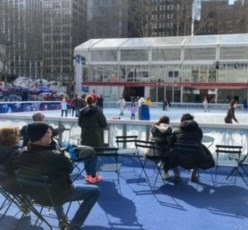
Photo of the Day: End-of-Winter Dreams, Bryant Park, NYC

Late yesterday morning, I was passing Bryant Park when I took the accompanying picture. I was surprised that so many people came out for this ultimate winter scene—we’re still only two-thirds through the season, but it has been so mild (the 3.2 inches of snow that fell in Central Park on Feb. 13 were the most since 2022) that it feels like spring will come early this year.

The organizers of the park’s “Winter Village,” organized by Bank of America, seem to be acknowledging this: Activity on this 17,000- sq. ft. rink will cease after March 3.

With ongoing climate change, the moments when children and their parents can enjoy skating and just hanging out are passing, like the sweet dreams of youth and innocence, always too evanescent.

Wednesday, January 3, 2024

Photo of the Day: Manhattan School of Music, NYC

I took the attached photo in mid-November, when I met a friend for lunch just off the Columbia University campus. Afterward, I walked around the Morningside Heights neighborhood.

Eventually I saw a sign for Manhattan School of Music (MSM). Curious, at least partly because my high school friend Mike went on to graduate from there, I ambled over to the school’s location at 122nd Street and Claremont Avenue in New York.

Mike was, and remains, a highly talented musician, and this private music conservatory sounds just like the place for him. It offers bachelor's, master's, and doctoral degrees in classical and jazz performance and composition, as well as a bachelor's in musical theater.

Besides Mike, MSM graduates have included jazz/pop musicians or singers Harry Connick Jr., Herbie Hancock, Max Roach, Jane Monheit, Rupert Holmes, and Nellie McKay, and classical music professionals such as John Corigliano and Dawn Upshaw.

Oh, yes—and how can I forget my favorite, the peerless Yankee outfielder and ace guitarist, Bernie Williams?

MSM has changed its name, location, and size in a bit more than a century of existence. It was founded by pianist-philanthropist Janet Daniels Schenck in 1918 as an outgrowth of her work volunteering at the Union Settlement at East 104th Street, with young musicians offering music lessons to the immigrant population of the neighborhood. It became known by its current name in 1938, and around the same time moved to a new building and concert hall on 105th Street.

With the Julliard School going to Lincoln Center, MSM purchased and moved into its Morningside Heights building in 1969. Its growth has not stopped since then, however. A residence hall adjacent to the school opened in 2001, and MSM has continued to add programs.

Today, it numbers more than 950 college students from over 50 countries, and each academic year it offers nearly 800 performances by students and faculty, many of which are free and open to the public. Anyone interested in catching these can click on this performance calendar.

Monday, December 11, 2023

Photo of the Day: ‘Railrider's Throne,’ Columbia University Subway Station, NYC

Several weeks ago, before meeting a friend for lunch in the Morningside Heights neighborhood of Manhattan, I passed through a spot extremely familiar to me from my days as a commuting student at Columbia University.

This time, on the 116th Street downtown subway platform, I noticed a quirky sculpture. Believe me, this was the last thing I would have expected to see when Columbia was still trying to recover its equilibrium a decade after the 1968 student takeover of the university—or, even more recently (and disastrously), when city services were still reeling from New York’s narrow escape from bankruptcy in the fall of 1975.

In other words, it was a gray, dingy atmosphere, where the idea of people smiling over public art was more a matter of satire than satisfaction.

So you can imagine my surprise when I saw this artwork in steel on the platform, depicting an oversized chair. "I wanted to create a whimsical environment that allows the commuter to feel special as opposed to alienated," observed sculptor Michelle Greene.

In my case, mission accomplished, as I took out my iPhone to photograph this piece of public art.

But that wasn’t the end of my surprise. I found out from the Website for the Metropolitan Transit Authority that Railrider's Throne was created in 1991. I had passed through this station a number of time in the three decades since then, but somehow hadn’t noticed it till now.

Go figure. I can’t.

Saturday, December 9, 2023

Photo of the Day: Bella Abzug Park, NYC

I took the photo accompanying this post a few weeks ago, when I had a few minutes to spare before boarding a Megabus for a short Thanksgiving vacation in Pittsburgh.

Oddly enough, though I had been in Hudson Yards a few times since it opened several years ago, I had never noticed Bella Abzug Park. 

New York residents who are Gen Xers or younger are likely to have little memory of the local politician this urban park honors, and the knowledge of tourists coming upon it by happenstance at Hudson Boulevard between West 37th and 33rd Streets is likely to be thinner still.

But, for almost a decade and a half from the mid-Sixties to late Seventies, Bella Abzug (1920-1998) attracted a great deal of attention, even beyond the borders of New York State.

This colorful and controversial feminist would have garnered at least some national attention anyway, because of the way she demanded respect from her male colleagues on Capitol Hill. But she became an especially outsized figure in New York, the media capital of the world, at a time when the anti-war, feminist, and gay rights movements were coming into their own.

News image creators from that time—newspaper and magazine editors, TV crews, and cartoonists—latched onto Abzug’s penchant for enormous hats (which she began to wear as a young lawyer, she later recalled, because “working women wore hats; it was the only way they would take you seriously”).

Then there was that voice—regarded as assertive by supporters and abrasive by critics.

Abzug would claim that her critics were, all too often, guilty of male chauvinism. There was more than a little truth to her view (she was frequently shunned by all-male committees and mocked for her weight—criticisms that most male colleagues never had to endure). 

But it is also true that her anger management issues could lead her to lash out even at supporters and her own staffers. The nickname "Battling Bella" might have been a badge of honor she wore proudly, but also pointed to the stereotype that would ultimately limit how far she would go in politics.

Nobody, however, could deny that Abzug was a conviction (as opposed to convicted) politician—a figure who displayed incisive intelligence and a steely will in labor, civil rights, and civil liberties cases undertaken as a young lawyer associated with the National Lawyers Guild, an organization of progressive attorneys denounced during the Fifties by the House Un-American Activities Committee.

Abzug was part of the Manhattan-based Democratic reform movement of the late Fifties and early Sixties that helped overthrow the Tammany Hall machine. In 1970, she was elected to the House of Representatives, and five years later became the first woman to hold a job as party whip. 

Unfortunately, her time in the corridors of power was short, as she lost her seat when she tried unsuccessfully to move up the Senate, only to be beaten by Pat Moynihan in the 1976 Democratic primary.

But Abzug left her mark in advocating for unions, the peace movement, and civil rights, civil liberties and LBGQ rights. And now, this park, part of a six-block-long greenway in Hell’s Kitchen, will remind future generations of her contributions.

Ironically, a park that offers weary urban walkers a chance to rest has taken its name from an activist politician who rarely if ever rested throughout her career.

Thursday, November 16, 2023

Photo of the Day: Riverside Park, NYC, Mid-November

This past weekend, before having lunch with a college friend where we first met in the late 1970s—Morningside Heights, the home of Columbia University—I also took a walk to other sites in the neighborhood, including Riverside Park.

As a college freshman taking a jogging course to fulfill my phys ed requirements, I came to realize, on many an exhausting run, the size—and hilliness!—of this vast tract, though I was in no condition to appreciate its beauty. 

But I was on Sunday, with many of the autumn leaves still clinging to the trees and the rest forming a multi-colored natural carpet in this officially designated scenic landmark in New York—one of only eight in the city.

Wednesday, September 27, 2023

Quote of the Day (Saul Bellow, on a ‘Great, Great Crowd’ Thronging Midcentury Broadway)

“On Broadway it was still bright afternoon and the gassy air was almost motionless under the leaden spokes of sunlight, and sawdust footprints lay about the doorways of butcher shops and fruit stores. And the great, great crowd, the inexhaustible current of millions of every race and kind pouring out, pressing round, of every race and genius, possessors of every human secret, antique and future, in every face the refinement of one particular motive or essence - I labor, I spend, I strive, I design, I love, I cling, I uphold, I give way, I envy, I long, I scorn, I die, I hide, I want. Faster, much faster than any man could make the tally.”— American novelist Saul Bellow (1915-2005), Seize the Day (1956)