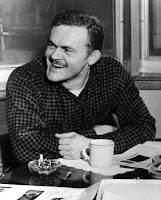
As he recalled what he was doing that dawn 80 years
ago in World War II: A Chronicle of Soldiering:
“On Sunday mornings in those days there was a bonus
ration of a half–pint of milk, to go with your eggs or pancakes and syrup, also
Sunday specials. Most of us were more concerned with getting and holding onto
our half–pints of milk than with listening to the explosions that began
rumbling up toward us from Wheeler Field two miles away. ‘They doing some
blasting?’ some old–timer said through a mouthful of pancakes. It was not till
the first low–flying fighter came skidding, whammering low overhead with his
MGs going that we ran outside, still clutching our half–pints of milk to keep
them from being stolen, aware with a sudden sense of awe that we were seeing and
acting in a genuine moment of history.”
Three decades later, Jones still remembered a Japanese
pilot’s toothy grin showing through goggles as he strafed the base; Battleship
Row, a “living inferno” where men, “precipitated into full–scale war without previous
experience and with no preparation, performed feats of incredible heroism and
rescue that seemed unbelievable later”; and, from a distance, Pearl Harbor
itself, with “the huge rising smoke columns high in the clear sunny Hawaiian
air for miles.”
A 20-year-old assistant clerk with aspirations of becoming a writer, Jones gained enough material from his wartime experience for a three-decade career. But his rookie effort was the one that brought him the greatest success, not only netting him the National Book Award in 1952 but becoming the basis of the Oscar-winning film that has continued to keep his characters in the public eye.
Despite having read Jones’ first novel and being generally familiar with the outlines of his subsequent career, I was unaware of many details of his Army experience until I read Roy Morris’ fine article, “Before Eternity,” in the Autumn 2021 issue of MHQ.
I did not know, for instance, that Jones not only based many of his characters in the novel on soldiers in his own unit but also that in several cases, he used only minimal means of veiling their identities (e.g., not even bothering to change their surnames, in some cases).
I was midway through high school when I read Jones’ blockbuster. It was the time of my life when, with the magic combination of the fewest responsibilities and the most energy, I could spend time with many, often long, books.
Even so, I felt my attention severely strained by a novel that, for more than 800 pages, qualifies as a true doorstop. In fact, it could be argued that, for all its concessions to the censorship code of the early 1950s, Daniel Taradash’s screenplay effectively channeled the essentials of Jones’ sprawling plot.
For all the honesty and ambition of Jones’ first published work of fiction—his attempt to depict an entire complex community—it lost much in terms of economy and artistic control. This might have been part of the reason why his best-known literary achievement has not had the same staying power of Ernest Hemingway’s influential novel of World War I, A Farewell to Arms.
In a profile I wrote for my college newspaper years ago, Frank MacShane joked that he had been labeled “the biographer of the stepchildren of literature” for writing about critically underrated authors. Although his reclamation efforts have borne some fruit in the case of John O’Hara and considerably more for Raymond Chandler, he did not produce a similar widespread revival of interest with his 1985 biography of Jones, Into Eternity.
Nevertheless, From Here to Eternity retains considerable value. Readers prepared to look beyond the pair of romances involving Sgt. Milt Warden, Karen Holmes, Private Robert E. Lee Prewitt, and Alma Burke will find both a visceral picture of the peacetime army before America became a world power and a shocking treatment of a military establishment rife with institutional corruption and abuse of power
Jones would have none of the “Good War” mythology already taking place in the postwar period. He was intent on delivering a decidedly unromantic rendering of the caste system in the military. This novel and the two others that formed his “World War II Trilogy,” The Thin Red Line and the unfinished Whistle, reflected his belief that “In every war there were two wars, the war of the officers and the war of the enlisted men.”
Thus, while officers in that pre-war period might attend clubs where they would even present calling cards, enlisted men would face overwhelming pressures to conform and arbitrary discipline that could land them in brutal stockades.
In the latter respect, From Here to Eternity functions as what today might be seen as a dissection of toxic masculinity. Females are cheated on and exploited; officers look the other way or even encourage bullying (including pressure by Karen Holmes’ husband, the commanding officer in the unit, to induce Prewitt to join the boxing team); and enlisted men endure tedium that can suddenly transform into after-hours barroom fisticuffs and back-alley knife fights.
Within a year, Jones would be not just a witness to war but also a combatant, participating in the Guadalcanal campaign. His experience there—killing with a bayonet two Japanese soldiers—unsettled him. Wounded in early 1943, he underwent extensive medical treatment at a military hospital before being honorably discharged the following year.
Although Jones’ physical wounds were visible, his psychic ones—what we would call today post-traumatic stress disorder—were less so. His alcoholism, his daughter Kaylie contended in her memoir Lies My Mother Never Told Me, combined with the malaria he contracted in the war to produce the heart condition that ended his life in 1977.
The school of realism to which Jones belonged may seem less attractive to modern readers than the surrealism of Joseph Heller’s Catch-22 and Kurt Vonnegut’s Slaughterhouse Five. But Jones is just as critical in his way of the military as a soul-killing institution that even destroys its most dedicated members than these two other World War II novels. Clumsy and even artless as From Here to Eternity can seem at points, it also remains vibrant because of Jones’ fierce commitment to truth.
One of Jones’ most eloquent advocates is Joan Didion. Though
her exacting, sometimes minimalist style can appear light years away from
Jones, she wrote a deeply moving appreciation of the veteran-turned-novelist not
long after his death in her essay “In the Island,” published in her collection The
White Album:
“A place belongs forever to whoever claims it hardest,
remembers it most obsessively, wrenches it from itself, shapes it, renders it,
loves it so radically that he remakes it in his image, and not only Schofield
Barracks but a great deal of Honolulu itself has always belonged for me to
James Jones.”


