Hooke’s achievements were so numerous, in so many different
fields, that he has been labeled “London’s Leonardo.” I will list these inventions
and discoveries shortly, for those readers (more than a few, I believe) unfamiliar
with them.
But right now, I should tell you why I wanted to write
about him in the first place.
No matter how staggering or monumental a scientist’s
advances might be, these do not interest me in and of themselves. When I was
young, you could look these up in a print encyclopedia—and now, even more
swiftly, through a Google search. But a few minutes after your research, you
would be likely to remember none of what you read.
No, it’s not the cool, objective man in a lab that
draws my attention, but another figure in the field of science: the compulsive
searcher for knowledge, doggedly and sometimes foolishly pursuing what may seem
like dead ends—and then, when he makes his startling discoveries, in a proud
defense of his work, revealing that he is subject to the same quirks,
jealousies, anxieties, and pettiness as anyone without his brilliance.
Students may not realize it from the dull science texts
they have to read, but Hooke was definitely a genius of this latter type.
Possessed of abundant curiosity, he became a curious figure in his own right—not
just during his own lifetime, but for historians of science who have tried ever
since to puzzle out the background of a titan who ranged across physics, astronomy,
chemistry, biology, geology, even architecture and naval technology.
Among his accomplishments were:
*improving the design of the compound microscope;
*discovering, observing, and naming the “cell,” the
fundamental unit of life;
*writing Micrographia (1665), the first
textbook in English to feature observations made under a microscope, beautifully
illustrated by Hooke himself;
*inventing the balance spring, the used in mechanical
watches, alarm clocks, kitchen timers, marine chronometers, and other
timekeeping mechanisms;
* inventing the universal joint, the iris diaphragm,
and an early prototype of the respirator;
*formulating Hooke’s Law, which states that the amount
of force applied to an elastic object is proportional to how far it stretches;
*theories about fossils and the possibility of long-lost
species nearly two centuries before Darwin;
*serving as assistant to the pioneering chemist Robert
Boyle, including experiments on air pumps;
*collaborating with Sir Christopher Wren on problems
of longitude and comets;
* serving as Chief Surveyor and helping rebuild London
after the Great Fire of 1666.
But Hooke was all too human—just how much, though, not
known until his diaries were published in 1935. He wrote as quickly as his
active worklife allowed, about virtually all aspects of his existence—including
his liaisons, indicated by a special symbol, to prevent them from being easily
read and understood by prying eyes.
Quarrelsome and paranoid, Hooke was unfortunate enough
to make an enemy of a similarly choleric character: Sir Isaac Newton. Hooke,
habitually inclined to believe he had been insufficient credit by other scientists,
complained in a similar fashion about correspondence he had had with Newton
concerning gravity.
For a reader trying to find a modern equivalent of the
feud between Newton and Hooke, consider the bitter relationship between NBA Hall of Famers Michael Jordan and Isiah Thomas—in each pair, a legend whose fame
extended beyond his field to the wider culture, but who continues to denigrate a rival decades later.
Newton was unlike scientists such as Christian Huygens
or Johannes Hevelius that Hooke had contended with: he could carry a grudge forever,
displayed what biographer James Gleick has described as “implacable
ruthlessness” towards scientific foes, and wielded enormous institutional
authority as president of the Royal Society.
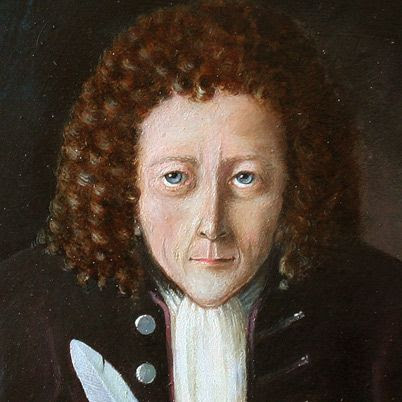
(One common explanation for why no portraits of Hooke were
made during his life is that Newton ensured that one was removed and destroyed
at the Royal Society—a rumor that Dr. Felicity Henderson discussed in a fine2010 blog post for that organization. Thus, the image accompanying this
post is an imagined one, from this century, with no certainty that it is like
the original.)
Newton also outlived Hooke by nearly a quarter century,
ensuring that his fame shone all the brighter, to Hooke’s disadvantage. It was
no accident that Alexander Pope would write the epitaph, “Nature and Nature’s
Laws lay hid in Night:/God said, ‘Let Newton be!’ and all was light.”
Far from achieving similar celebrity, Hooke came in
for mockery on the stage, even during his lifetime. Thomas Shadwell’s 1676
farce The Virtuoso mocked the “new world” that Hooke had announced in Micrographia,
leading the scientist to carp in his diary about the reaction of other
playgoers who recognized him as the object of the ridicule: “Damned Doggs.
Vindica me Deus. People almost pointed."
Far all his brilliance and the distance he had
travelled from his humble origins, Hooke could never shake his hyper-sensitivity.
Some of it may have derived from his appearance. A sickly child, Hooke developed
curvature of the spine at the age of 16 that only worsened with time.
Maybe that was the reason for one of the discoveries about
his private life made in his diaries: he had no intimate relationships with adult
women of his class, instead consorting with house maids, as well as with his
niece Grace.
The latter’s death at age 27 in 1687 was a blow from
which Hooke never recovered. His intake of experimental drugs to deal with his
mounting maladies (e.g., double vision, near-delusions) grew apace, leaving him
essentially bedridden for the last year of his life.


