“It matters that the
overall magnitude of the African diaspora is now quite definitely known: that…eleven
million Africans were forcibly carried abroad, more than nine million of them
to the Americas. It matters—it stretches the imagination to visualize—that at
the height of the British slave trade, in the 1790s, one large slave vessel
left England for Africa every other day. It matters that slave rebellions occurred
on approximately 10 percent of all slave ships, that 10 percent of the slaves
on such voyages were killed in the insurrections (which totals 100,000 deaths,
1500–1867), and that the fear of insurrection increased shipboard staffing and
other expenses on the Middle Passage by 18 percent, costs that if invested in
enlarged shipments would have led to the enslavement of one million more
Africans than were actually forced into the system over the course of the long
eighteenth century. It matters that the incidence of revolts did not increase
with the decline in crew size, hence that slave-centered factors determined the
uprisings. It matters that shore-based attacks on European slave ships were
twenty times more likely in the Senegal and Gambia River areas than elsewhere
in Atlantic Africa. It matters that shipboard mortality (only 50 percent of all
slave deaths—the rest occurred in Africa or at embarkation) did
not increase
with the length of the voyages or with the number of slaves per ship (‘tighter
packing’) but did vary according to African ports of departure. It
matters that French slave ships left Africa with an average load of close to 320
captives; that one such vessel sailed with 900 slaves; that another lost 408
Africans on a single Atlantic voyage; that 92 percent of the ‘cargo’ on another
French vessel were children; and that the average number of captives on French
vessels rose from 261 in the seventeenth century to 340 at the end of the
eighteenth century. It is astonishing simply to attempt to visualize the
consequences of the fact that in one year, 1790, French ships landed at least
40,000 slaves on the small island of St. Domingue, 19,000 of them (equal to the
entire population of contemporary Boston) at the small port of Cap Français—and
to consider the profound effect that fact must have had.”—Pulitzer
Prize-winning American historian Bernard Bailyn (1922-2020), “Considering the
Slave Trade,” in Sometimes an Art: Nine Essays on History (2015)
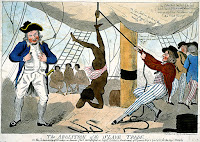
The image accompanying
this post, “The Abolition of the Slave Trade,” an engraving by Isaac Cruikshank,
shows British Captain John Kimber on the deck of the Recovery, with
the girl he was alleged to have whipped to death.
More than two centuries
after it was published, the picture still has the power to shock—but, in
another sense, how could it have been worse than the above facts cited by Bailyn--or, for that matter, the resistance of so many in the United States to educating students why slavery was so horrendous and yet so persistent?
Kimber was acquitted of
the girl’s murder after a trial in 1792, but the case was instrumental in
mobilizing public opinion behind William Wilberforce’s campaign to outlaw the
slave trade in the British Empire. It would take a bloody civil war to end
slavery in the United States, but we are living still with its consequences.


