
Showing posts with label African American History. Show all posts
Showing posts with label African American History. Show all posts
Monday, August 28, 2023
Quote of the Day (Taylor Branch, on MLK and the March on Washington)


Saturday, May 27, 2023
Quote of the Day (Theodore Roosevelt, on a ‘Square Deal’ for All Americans)

One hundred and twenty years ago today, Theodore Roosevelt tried out the same phrase for different audiences to describe his
vision of an executive who would mediate the divisions roiling America: the “square
deal.” The term proved so popular that several successors in the Oval Office adapted
it to characterize their own domestic programs.
Over the past 20 years, while other White House
occupants have risen appreciably (Ulysses S. Grant) or plunged just as
drastically (Andrew Jackson) in C-Span’s Presidential Historians Survey, Roosevelt has remained consistently at #4, placing him among the “near
great” among those holding our nation’s highest office. Crucial to his success was
his use of what he called his “bully pulpit.”
Few Presidents have surpassed TR as a phrasemaker. Mark
Mancini’s 2018 Mental Floss article identified 11 of them, including “square
deal”—his shorthand for a fair arrangement.
When he came to the mining town of Butte in May 1903 on a cross-country tour,
Roosevelt vowed to deal even-handedly between the claims of union workers and
capitalists—a position that had won him considerable acclaim when he helped achieve
a settlement in the anthracite coal strike crisis the prior fall.
That is why he told the Silver Bow Labor and Trades
Assembly of Butte that day that he was “one who tries to be an American
president, acting upon the principle of giving a square deal to each and every
one.”
But during his visit, the President also acknowledged a gift from Butte’s
black minority: a pair of silver scales. At a time when Jim Crow legislation
was abridging voting rights and African-Americans were subjected to rampant lynching,
he pointed out his personal debt to the group for their part at San Juan Hill
in the Spanish-American War, the battle that made him a national celebrity—"In
Santiago I fought beside the colored troops of the 9th and 10th Cavalry”—before
the sentence in this “Quote of the Day.”
As this account in Dickinson State University’s Theodore Roosevelt Center indicates, TR, finding that the phrase was gaining
traction with audiences, began to use it in other speeches and his private correspondence.
It soon came to describe the hallmarks of his domestic policies: consumer protection,
corporate regulation, and conservation.
When he began to stake out his opposition to successor
William Howard Taft in 1910, Roosevelt came up with another phrase: the “New
Nationalism.” TR and Taft's successful Democratic opponent in the Presidential campaign
two years later, Woodrow Wilson (no mean phrasemaker himself), implicitly drew
a contrast with the phrase “The New Freedom.”
Subsequent Presidents with similar ambitious
legislative goals then used variations on these:
·
“The New Deal”: Samuel Rosenman floated four different possibilities for the pledge that Franklin Roosevelt
made when he accepted the nomination at the 1932 Democratic Convention. The
candidate placed no special importance on what Rosenman called the “two monosyllables,”
and the speechwriter disclaimed any intention of fusing the slogans of TR and
Wilson, according to Safire’s Political Dictionary. But the phrase
appealed to Progressives desperate for a return to activist government amid the
Great Depression.
·
“The Fair Deal”: The popularity of
FDR’s domestic program led successor Harry Truman to call for his own
comprehensive program in the 1949 State of the Union address. Whether he
intended to or not, “fair” also echoed TR’s “square.” Only some of Truman’s
proposals ended up being enacted. But his call for national health insurance would
lay the groundwork for Lyndon Johnson’s Medicare program.
·
“The New Frontier”: Just as FDR did a try run of “New Deal” when he accepted the Democratic nomination for President, John
F. Kennedy used a variant when he did so in 1960. JFK used it to describe what
he would do to meet the uncharted territory of new challenges facing Americans.
But, even as he sought to distinguish this program from its forebears, JFK
embodied the kind of youthfulness and energy that had characterized TR nearly
60 years before.
·
“The Great Society”: First deployed at Ohio University and the University of Michigan in the run-up to his 1964 Presidential campaign, Lyndon Johnson’s
phrase for his program contained no words that echoed any of these earlier
programs. But, in his civil-rights and anti-poverty legislation, he sought to
extend and surpass anything achieved by his predecessors.
·
“The New American Revolution”:
Speechwriter William Safire used this as the theme of a 1971 address in which
Richard Nixon called for revenue sharing. The idea, as historian Richard Norton Smith noted, was to reverse “the flow of power, dollars and
decisions to Washington that had commenced 40 years earlier with the New Deal.”
Yet, while the movement has informed much of conservative policy ever
since, the phrase itself never really caught on to describe the larger
administration program.
·
“The New Foundation”: “The New
Spirit” didn’t really catch on after Jimmy Carter’s 1977 inaugural address. Two
years later, his speechwriting team sought, with a notable lack of enthusiasm,
to take a different tack in evoking the programs of his predecessors, according
to Martin Tolchin’s account of the 1979 State of the Union address. But,
though the phrase may have struck a chord with the builder in Carter, it came
off as lukewarm and played out—a bad omen for his reelection campaign the
following year.
·
“The New Beginning”: Ronald Reagan,
an admirer of FDR as a young man, continually re-deployed phrases of the
three-term President, such as “rendezvous with destiny.” His echo of FDR’s “New
Deal” during his acceptance speech at the 1980 Republican National Convention
and in his inaugural address the following year was fully in keeping with that
rhetorical tendency. At the same time, while Reagan equaled TR’s success as a
vote-getter, his full-throated embrace of free-market, loosely regulated capitalism
was arguably a reversal of the Republican Roosevelt’s more ambivalent view of
big business.
Sunday, February 27, 2022
Quote of the Day (Frederick Douglass, on Education, Newspapers, and Slavery)
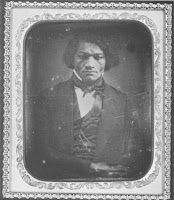
Several reasons led me to use this quote from
Frederick Douglass, arguably the most significant African-American before
Martin Luther King Jr.: Black History Month, this week’s History Channel
“Lincoln” documentary (in which Douglass played an important role), and the sheer dramatic power inherent in this scene.
But above all, I wanted to highlight the role of
newspapers in the African-American struggle for freedom.
The more pious slaveowners, like the plantation
“mistress” in the first of Douglass’ three autobiographies, might be willing to
teach slaves how to read the Bible. But even this practice became more limited by
Southern legislation after Nat Turner’s Rebellion in 1831.
Plantation owners feared that their slaves would take
literacy one step further to search out newspapers that would not only lead
them to think for themselves but also to exchange information that could help
overthrow the “peculiar institution.” (Indeed, the reaction of Sophia Auld, wife
of Douglass’ master, was so harsh because she discovered him in this
clandestine activity.)
But psychologically speaking, another concern could
have been lurking: the thought that, if a slave could master a discipline
entirely limited at this time to whites, it would immediately undercut the
belief in racial inferiority used to justify slavery (and, later, segregation).
Today, black newspapers face many of the same
challenges that their white-owned counterparts do—notably, the increasingly daunting
economics of fielding a print product in the digital age, and the popular
belief, propounded by a prior President, that the press is “the enemy of the
people.”
But, just as these papers’ longtime role as the voice
of their people should not be forgotten, so their future as an information
alternative for the same group should not be abandoned.
Douglass’ own experience with owning three newspapers
illustrates the importance of such alternatives and the difficulties in
maintaining them for the long term. His service as editor and part-owner of the
New National Era in the early 1870s proved such a money pit that swore off ever
to be involved with the media again.
But, no matter how negative an impression he came away
with, Douglass had during that time proved a key national voice during the
Reconstruction Era—and his departure left a vacuum just when white America was
starting its retreat from equal rights for freedmen.
More significant, when he founded the abolitionist
paper The North Star in Rochester in 1847, thrust to the forefront the
victims of slavery, in the belief that “that the man who has suffered the wrong
is the man to demand redress,—that the man STRUCK is the man to CRY OUT—and
that he who has endured the cruel pangs of Slavery is the man to advocate
Liberty.”
The black press continued to press the nation to pay attention through long, lonely years when many white politicians and even journalists, when they did not incite hatred against them, acted as if they were invisible. (That might explain why the former President named above could say--puzzlingly using the present tense, as if the object of his praise were still alive--that Douglass was "an example of somebody who’s done an amazing job and he’s being recognized more and more, I noticed.”)
In today’s Bergen (NJ) Record, Jim Beckerman paid
tribute to Douglass, anti-lynching crusader Ida B.Wells, pioneering editor T.
Thomas Fortune, and other luminaries in his article on “How the Black Press Changed America for the Better.”
Monday, March 1, 2021
Photo of the Day: A Black Reconstruction Senator’s Residence in Washington, DC

When I passed by while on vacation in November 2015,
I never could have anticipated that the life and times of Blanche Kelso Bruce—born on this date in 1841—might possess even more relevance now than
it did when I read the inscription explaining why his home had been selected as
part of the African American Heritage Trail in our nation’s capital.
Bruce was one of the most striking figures in the Reconstruction Era, the post-Civil War period when freedmen sought greater economic opportunities
and achieved fleeting political equality with whites. In an era of polarization,
with racism and reaction ever-present threats to his gains and those of the base
that propelled him to prominence, he was obliged to step carefully through multiple
political minefields.
This past week, I saw a meme on Facebook questioning the
need for Black History Month. The remarkable rise of Bruce—the second African
American to serve in the U. S. Senate and the first to be elected to a full
term—and his equally astonishing fall back into relative obscurity demonstrate
that there might be more need for this collective commemoration than many
Americans would care to admit.
A runaway slave from Virginia, fathered by his white
master, Bruce made his way west of the Mississippi, where during the Civil War
he taught black children in Kansas and Missouri. After the conflict he worked
as a steamboat porter out of St. Louis, then moved down to Mississippi in hopes
of finding more opportunity. His business sense proved acute, as he turned an
abandoned cotton plantation into a thriving property over the next decade.
Large, imposing, and gifted with a strong voice, Bruce
possessed a charisma that attracted the attention of the Republican Party.
Soon he was accumulating political IOUs along with his real estate fortune,
holding simultaneous Bolivar County offices as sheriff, tax collector and superintendent
of education. With the help of Black Republicans and Gov. Adelbert Ames, Bruce
was selected by the state legislature to serve a term in the U.S. Senate.
With both blacks and whites suffering in the economic
collapse brought on by the Civil War, Bruce sought to work in the interests of
both groups and forge a biracial electoral coalition. For whites, he advocated
for internal improvements and financial incentives, including federal funding
to control flooding and the creation of a channel and levee system for parts of
the Mississippi’s edge. For blacks, he ardently promoted black servicemen,
including pressing for integration of the armed forces.
But as an “aristocrat of color,” Bruce lost some favor
with his African American base, and whites were not generally inclined toward
him to begin with, even though even the likes of fellow Mississippian Lucius Q.
C. Lamar, a former secessionist, acknowledged his intelligence and moderation.
With Democratic forces gathering strength back at home in an attempt to
suppress the African American vote, Bruce didn’t even try for a second term,
stepping down in March 1881.
After several years of continuing participation in
Mississippi politics, Bruce returned to the nation’s capital. serving as register
of the U.S. Treasury and recorder of deeds for the District of Columbia. He and
wife Josephine—the first black teacher in the Cleveland public schools and the
daughter of a prominent mixed-race dentist before she wed the Senator—remained
fixtures on the local social scene, living at their R Street property from 1890
to 1898.
Bruce’s career is a reminder of how far all Americans
can rise when they are presented with adequate opportunities to match their own
drive and ambition. It is also evidence of how those gains may be lost when powerfully
entrenched forces mobilize to exploit fears of an uncertain new political and
social environment.
Subscribe to:
Posts (Atom)


