Showing posts with label Frank Capra. Show all posts

Saturday, December 18, 2021

This Day in Film History (‘Pocketful of Miracles,’ Capra’s Lesser Yule Tale, Opens)

Dec. 18, 1961—Pocketful of Miracles opened in American theaters almost 15 years to the day that It’s a Wonderful Life premiered, and likewise failed to meet expectations at the box office. But, while veteran director Frank Capra’s earlier film went on, through countless repeat TV showings, to become a holiday classic, his later production—also containing Yuletide elements—has never gained similar popular traction.

It’s not that Pocketful of Miracles is completely unknown: The comedy has, after all, been shown numerous times over the years on TCM, and its stars included the very recognizable Bette Davis, Glenn Ford, and, in her big-screen debut, Ann-Margret.

But even many fans of older movies don’t recognize it, as was borne out for me a few days ago, when another fan of such fare could not bring it to mind when I spoke to her. And lines from the film have not entered popular memory, as they have with It’s a Wonderful Life or a much more recent movie, A Christmas Story.

Making the movie, Capra admitted a decade later in his autobiography, The Name Above the Title, was a “miserable” experience. It soured him so much on how the industry had changed since his heyday at Columbia Pictures in the 1930s that it turned out to be his swan song.

Part of the reason why the production turned out to be so joyless and disappointing was that Capra had begun it with such high hopes. It was, after all, a remake of Lady for a Day, which had earned him the first of six Oscar nominations for Best Director back in 1934.

Among Capra’s generation of older directors, the idea of remaking their own black-and-white films of more than 20 years before had a certain appeal, as evidenced by Alfred Hitchcock’s The Man Who Knew Too Much (1934 and 1956), and Leo McCarey’s Love Affair (released first in 1939, then redone as An Affair to Remember).

The logic behind their reasoning seemed overpowering, even inescapable: If Hollywood was going to remake these (and it would), who better to do so than the original creative force who knew not only what aspects of it were worth preserving but also what could be corrected and what could be added that wasn’t around a generation before (notably, color and bigger screens)?

There were only a couple of problems with this in Capra’s case, but they were significant. First, although he was eager to adapt Damon Runyon’s Prohibition Era tale “Madame Le Gimp” for a later generation, Hollywood executives did not feel similarly, believing audiences would find it dated.

Second, Hitchcock and McCarey had, in James Stewart and Cary Grant, stars not only well-cast but also uninterested in throwing their weight around. But Capra had as his male lead Glenn Ford, who, as associate producer, had helped finance the film and was not shy about determining its direction.

In particular, Ford insisted that, as gangster moll Queenie Martin, his girlfriend Hope Lange should replace Shirley Jones, a recent Oscar winner for Elmer Gantry whom Capra had already promised the role. The reluctant director acceded to his star’s cast-her-or-I-quit threat, but it rankled.

One of the few fundamental deviations that Pocketful of Miracles made from Robert Riskin’s script for Lady for a Day was a larger presence for Queenie  (whom 1930s audiences would have recognized as a fictionalized stand-in for nightclub hostess Texas Guinan). It is hard not to see the hand of Ford in that decision.

Lange was hardly a disaster in her role. But her presence represented a mounting list of initial casting choices that weren’t turning out as Capra had wished.

Ford himself was not his preference for superstitious gangster “Dave the Dude.” But his desired choices—Steve McQueen, Jackie Gleason, Kirk Douglas, Dean Martin and Frank Sinatra—didn’t work out, for one reason or another. (Sinatra’s association with the production would, in the end, be limited to turning its theme song into a hit.)

Likewise, Bette Davis was not whom Capra had in mind for street peddler Apple Annie. But Shirley Booth felt she couldn’t improve on May Robson’s Oscar-nominated performance in Lady for a Day; Helen Hayes couldn’t find space in her schedule; and Katharine Hepburn and Jean Arthur (so memorable in Capra’s Mr. Deeds Goes to Town and Mr. Smith Goes to Washington) both turned down the role.

Davis, with increasingly lower-profile roles since her triumph a decade before in All About Eve, was eager for the work and the $100,000 salary, and agreed to take on the part when Capra offered it.

As great an actress as she was, Davis was, at 53, younger and less believable as woebegone Annie than the two-decades-older Robson. But Capra had a more immediate problem with her, caused by—yes, Ford.

The trouble began a week after Davis came to the set, when Lange requested a dressing room next to Ford. That room belonged to Davis, who was miffed about yielding her position to a younger, less-established actress. 

In a well-intended but clumsy attempt to smooth things over, Ford only made matters worse by saying in an interview that he was repaying Davis for giving him his start in films by putting her in this movie, hoping it would be a comeback vehicle for her.

“Who is that son of a bitch that he should say he helped me have a comeback!” Davis stormed. “That shitheel wouldn’t have helped me out of a sewer!”

From then on, the production was “shaped in the fires of discord and filmed in an atmosphere of pain, strain, and loathing," Capra wrote in The Name Above the Title.

Years later, he regretted that with Davis, he “didn’t see that needed consolation and reassurance after so long away.” But on set, he was not inclined to mediate the noticeable tension between her and Ford, and he developed increasing headaches.

It’s hard not to read Capra’s memoir without the sense that, over and above everything else, he resented Ford for undercutting his authority and creative freedom as the director: “My ‘one man, one film’ Hollywood had ceased to exist. Actors had sliced it up into capital gains.”

The results showed on the screen. It wasn’t so much in the performances of the supporting players. (Particularly wonderful are “It’s a Wonderful Life”’s Uncle Billy, Thomas Mitchell, here in his last movie role; Mickey Shaughnessy, given perhaps the funniest line of the film, “She's like a cockroach what turned into a butterfly!”; and Peter Falk, nominated for a Best Supporting Actor Oscar as Dave the Dude’s cranky right-hand man “Joy Boy”).

Rather, the trouble is apparent in the film’s pace—which, uncharacteristically for Capra, is uneven, even slack at points. Lady for a Day had a running time of an hour and 34 minutes—plenty of time to tell its story and be on its way. In contrast, Pocketful of Miracles clocks in at two hours and 16 minutes but feels like it could use a good half hour cut.

Capra received a Directors Guild of America nomination for this film. But overall, he agreed with reviewers like The New York Times’ A.H. Weiler, who noted, “Mr. Capra and his energetic troupe manage to get a fair share of laughs from Mr. Runyon’s oddball guys and dolls, but their lampoon is dated and sometimes uneven and lifeless.” 

A couple of years later, Capra expressed interest in directing an adaptation of the Broadway satire The Best Man, but creative differences with playwright Gore Vidal kept him from taking on that project, probably for the best.

Pocketful of Miracles was an exercise in nostalgia for a world that had passed. So had the studio system in which Capra had once flourished.

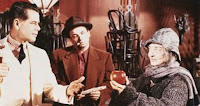
(The image accompanying this post shows Ford, Falk and Davis. Though it seemed imperative to have the two feuding co-stars in a still for my commentary, I couldn't resist including Falk, whose performances gives viewers as much pleasure as it did Capra.)

Thursday, December 24, 2020

Movie Quote of the Day (‘It’s a Wonderful Life,’ With George in Mr. Potter’s Spiderweb)

Mr. Potter [played by Lionel Barrymore] [to George Bailey]: “I'm offering you a three-year contract at $23,000 a year, starting today. Is it a deal or isn't it?”

George Bailey [played by James Stewart]: “Well, Mr. Potter, I... I... I know I ought to jump at the chance, but I... I just... I wonder if it would be possible for you to give me 24 hours to think it over?”

Potter: “Sure, sure, sure. You go on home and talk about it to your wife.”

George: “I'd like to do that.”

Potter: “In the meantime, I'll draw up the papers.”

George: “All right, sir.”

Potter [offering hand]: “Okay, George?”

George [taking his hand]: “Okay, Mr. Potter.”

[As they shake hands, George feels a physical revulsion. He drops his hand, then peers intently into Potter's face.]

George [vehemently]: “No... no... no... no, now wait a minute, here!  I don't have to talk to anybody!  I know right now, and the answer is no! NO!  Doggone it!” [Getting madder all the time] “You sit around here and you spin your little webs and you think the whole world revolves around you and your money. Well, it doesn't, Mr. Potter! In the... in the whole vast configuration of things, I'd say you were nothing but a scurvy little spider!”—It’s a Wonderful Life (1946), screenplay by Frances Goodrich, Albert Hackett, and Frank Capra, based on an original story by Philip Van Doren Stern, directed by Frank Capra

I haven’t watched It’s a Wonderful Life yet this year, but after multiple viewings, I don’t think I need to anymore. Over the last few weeks, this snatch of dialogue sprang to mind.

I think many of us have encountered a “scurvy little spider” at some point in our lives. I can think of at least one at the national level—maybe you can, too.

The message of Frank Capra’s film classic—and of this holiday season—is that such ceaseless schemers don’t win, and that for every Potter, there’s a George Bailey in our community—and maybe even our own family.

Merry Christmas, Bedford Falls—and beyond!

(By the way, for an absorbing look at one of the little-known aspects about the environment in which It’s a Wonderful Life was released, see this article from the Website “History Collection” about how the FBI initially regarded the film as Communist propaganda, even though Capra, a conservative Republican, not only loathed Marxism but even Franklin Roosevelt. It seems that, in J. Edgar Hoover’s paranoid organization, Mr. Potter was seen as an insidious reflection of the capitalist system as a banker—even though George and Peter Bailey also ran financial institutions.)

Monday, December 5, 2016

This Day in TV History (Jean Arthur Sitcom Fades Out, With Its Star)


Dec. 5, 1966—The 12th first-run episode was the final appearance, on the big or small screen, for one of the brightest but most tormented lights of Hollywood’s Golden Era. The Jean Arthur Show, by most accounts a formulaic sitcom, was unworthy of the talents of Jean Arthur, the raspy-voiced but endearing actress who made the likes of Gary Cooper, James Stewart, Cary Grant, and Joel McCrea appear to best advantage.

You can find many of Arthur’s approximately 80 sound and silent films on TCM, and they are among the best that Hollywood produced in the late Thirties and early Forties: Mr. Deeds Goes to Town, Easy Living, Only Angels Have Wings, Mr. Smith Goes to Washington, The Talk of the Town, and The More the Merrier. Though not a classic beauty, she possessed a vivacity and a froggy voice that made Depression-era audiences warm to this spunky career girl.

Robbie Fulks summed up perfectly how classic-movie aficionados like me have felt about this star: “She could light one cigarette/And smile while the world caught fire.” The country music star titled his tribute after the actress’ name, but he could have, with perfect justice, used the refrain of his song: “God’s Jean Arthur.”

Yet Arthur, a notably shy and private woman who abominated Tinseltown’s publicity machine, reacted with relief when her contract with Columbia Pictures expired in 1944. She made only two films thereafter: Billy Wilder’s A Foreign Affair and George Stevens’ Shane. After the latter was released in 1953, she became something of a recluse.

Fast forward to the mid-1960s. Lucille Ball, who cited Arthur as an inspiration for her own comic style, tried to cajole her friend into appearing on her first post-Desi Arnaz series, The Lucy Show. Astonishingly, though, Arthur’s agent somehow talked her into doing an entire series focused on her, not just a guest appearance on someone else’s. After a surprisingly successful “tryout” on Gunsmoke meant to gauge how well she adjusted to the grind of television, the green light was given for her own show.

The premise must have sounded perfectly fine to Arthur: a widowed lawyer who continually astonishes her partner, her straitlaced son, with her unconventional ways. The profession of that career would have appealed to an actress who specialized more in career women than housewives. And the notoriously press-averse star not only agreed to interviews with the media, but even promoted the show’s advertisers in commercials. (The sole episode I've come across is this YouTube clip.)

None of it did any good. The show could never get out of the bottom third of all TV shows. Nor did it ever enjoy a healthy afterlife in syndication: it didn’t even last half a season.

The cancellation of her show did nothing to encourage Arthur to return to her home. In fact, she decided to take an even bigger risk: a return to Broadway for the first time since she had appeared in Peter Pan in 1950, a show in which she not only had the starring role but had invested $50,000 of her own money: The Freaking Out of Stephanie Blake.

How bad was it? William Goldman, in The Season: A Candid Look at Broadway, called the comedy “the one legendary production” of that year—if you associate “legendary” with “a certain kind of Broadway show that by virtue of its birth agonies and the resulting publicity achieves an immortality most productions never dare aspire to.” Critic Peter Filichia, imagining a “Broadway Time Machine,” wished he could have seen Arthur’s final preview performance for this show: “A friend who was there told me that Arthur broke character and the fourth wall to tell the audience that she was leaving show business and giving away all her worldly possessions."

As I discussed in a prior post, Arthur had yet another unusual post-TV gid. A decade after the end of her sitcom, the actress—by now a septuagenarian—was prevailed upon to take the role of the first (fictional) female Supreme Court justice in the Cleveland opening of the Jerome Lawrence-Robert E. Lee play, First Monday in October. 

It was not a happy experience, as the stage fright that had afflicted Arthur three decades before in out-of-town tryouts for Garson Kanin’s Born Yesterday returned with a vengeance. She never acted again. The actress who had played fearless, wisecracking women fell victim to the most disabling fear that a stage performer can experience. No matter: Jean Arthur may have died in 1991, but she is still "God's Jean Arthur" to those who catch her film work.

Sunday, November 27, 2016

This Day in Film History (‘Network,’ Pitch-Black Prophecy of TV News, Debuts)


Nov. 27, 1976—Network, a Swiftian satire on the degradation of broadcast news, debuted to a critical reception that hailed its ensemble cast and savage screenplay by Paddy Chayefsky. Many in the news business, however, including on-air personalities like Walter Cronkite, John Chancellor and Edwin Newman, complained that the movie was exaggerated and far-fetched. 

In the end, while much of the creative talent associated with Network came away with Oscars, Hollywood bestowed Best Picture honors several months later on the Capraesque fairy tale of a Philadelphia palooka who ends up with a thousand-to-one shot in a heavyweight title bout, Rocky.

Even as I typed this last sentence, however, I realized how reductive, oversimplified and even condescending it was—not unlike Network itself at its worst. For most people, the term “Capraesque”—or, worse, “Capracorn”—evokes films by director Frank Capra filled with ultimate optimism about human beings and faith in American democracy, such as “It’s a Wonderful Life” and “Mr. Deeds Goes to Town.” But there is another entry in Capra’s filmography that could be a cousin of Network: Meet John Doe (1941).

In both movies, a threat to commit suicide (in one case, actual; the other, a hoax) becomes an unexpected media sensation, courtesy of an ambitious, ethics-challenged woman. Before long, a corporate magnate grasps this unfolding story as an opportunity for profits and power—then, when he sees the protagonist’s usefulness eroding, makes him expendable. 

Above all, the two films put under their uncomfortable glare an all-too-credulous American public that can quickly morph into a mob—and, according to a post by Lara G. Fowler on the classic-film blog “Backlots,” offer pointed “reminders of the power of journalism to influence and brainwash.”

Three years ago, on what would have been Chayefsky’s 90th birthday, I wrote a post on Network’s similarities to his earlier Oscar-winning satire of an institution, The Hospital. I thought of simply re-posting this to Facebook. But I watched portions of Network again a few weeks ago—enough to make me realize that I hadn’t even come close to capturing how much it has gained in prophetic witness through the years, even if at points he seems to be using his characters as none-too-subtle mouthpieces for his own views

Ryan Bort of Newsweek, for instance, has described nine Network motifs that figured into the astonishing campaign of Donald Trump (#s 1 and 2:“The latent rage of the American people” and “The allure of anti-establishment rhetoric”). All true enough. 

But at a more basic level, Chayefsky sensed how the ground was shifting under journalism, in ways that grandees such as Cronkite and Chancellor—not to mention once-prominent network execs such as Richard Salant and Richard Wald—were in no real position to appreciate, and that has only gathered momentum with the years:

*Corporate parents’ obsession with news division ratings and favorable demographics: The trigger for the plot of Network is news exec’s Max Schumacher’s reluctance disclosure to his old friend, anchor Howard Beale, that he is being sacked because of plunging viewership, particularly with the young. Now, the days when news divisions were not expected to be profit centers have long since passed, but one thing remains the same: advertisers still look to a desirable demographic segment among  a newscast’s viewership (except that now it is not the baby boomers but the millennials).

*The creation of a fourth news network, given over to sensationalism: Chayefsky may have invented a fourth network as a fictive device to get around questions of whether his nightmare scenario could really occur at CBS, NBC or ABC. But within four years, CNN had come to compete with them for viewers, and 20 years after Network’s premiere, Fox began to specialize in reality programming and, in its news programs, Beale-like shouting news personalities intent on inciting rage among listeners.

*Network vulnerability to a hostile takeover: The behind-the-scenes drama of Network is heightened by the prospect of a corporate acquisition. A decade later, Laurence Tisch’s takeover of CBS marked the point when nightmare became reality, inaugurating an era of mass layoffs, asset sales, and declining moral in the news division. And CBS was soon joined in the griddle with the rest of the "Big Three," with GE's Jack Welch and Bob Wright overseeing NBC and Capital Cities' Tim Murphy and Dan Burke exerting similar tight-fisted control at ABC.

*Exploitation of prime time by terrorists: Chayefsky was horrified by the massacre of Israeli athletes at the 1972 Summer Olympics in Munich. On September 11, 2001, Islamic terrorists pulled off an even more astonishing example of mass murder, also played out before the TV cameras. 

I couldn’t end this post without highlighting the importance of William Holden in holding the film together. None of the three actors who won Oscars for the movie—Faye Dunaway, Peter Finch, and Beatrice Straight—shared scenes with each other. But Holden interacted with all of them in his role as Schumacher, the troubled, complicated heart who dealt with, in order, their power plays, insanity, and marital rage.

David Lean, who directed him in Bridge on the River Kwai, praised his fearlessness, and there are few more sterling examples than his work here as Schumacher. 

Robert Mitchum, Walter Matthau, Glenn Ford and Gene Hackman were all considered at one point for the part, but it is difficult to imagine any of them improving on Holden’s embodiment of the character. Blogger Sheila O'Malley, in a characteristically perceptive post on the actor’s career, takes note of the “deep crags, blazing blue eyes, and the seriousness behind the straight-up all-American handsomeness” that was all too obvious at this point in his career. But even that only conveys a portion of how much he inhabited the character. 

One of the most bankable leading men of the Fifties, Holden had not taken care of himself—and, two decades later, it showed. But in this last significant role, the bags under the eyes and a whiskey baritone somewhat coarsened by cigarettes only underscored a character who had seen all too much. It was easy to imagine the actor, once the “Golden Boy” of the screen, playing someone who could have been among the golden youths once recruited by Edward R. Murrow, now grimly trying to navigate the shoals of a profession no longer guided by any sense of public spirit. 
  
Chayefsky was famously insistent on having his script filmed exactly to his specifications. But I wish that director Sidney Lumet could have urged him to tone down Schumacher’s haunted confession to Faye Dunaway’s pitiless younger lover, Diane Christiansen:

“I feel lousy about the pain that I've caused my wife and kids. I feel guilty and conscience-stricken, and all of those things you think sentimental, but which my generation calls simple human decency. And I miss my home, because I'm beginning to get scared shitless, because all of a sudden it's closer to the end than the beginning, and death is suddenly a perceptible thing to me, with definable features.”

Lumet could have argued convincingly that everything in that passage after “scared shitless” could have been left out, as the sight of Holden’s careworn face said far more about Schumacher’s fear of aging and mortality than Chayefsky’s script ever could.

Saturday, February 22, 2014

This Day in Film History (‘It Happened One Night’ Gives Rise to Screwball Genre)


February 22, 1934—When MGM and Paramount Pictures loaned Clark Gable and Claudette Colbert to Columbia Pictures for a single movie, nobody expected much to come from the results, especially the reluctant stars. But It Happened One Night—which premiered at Radio City Music Hall on this date—became a box-office hit, a multi-Oscar smash, and one of the most influential and beloved movies of all time.

Initial reaction to the film (which I touched on briefly in a prior post) was mixed: its run was not extended beyond its first week at Radio City, and a number of critics were quick to carp that this was the third movie in quick succession about a bus trip. Ultimately, of course, once word of mouth spread in the first month after its release, the film’s success triggered an entirely different trend, one of the most glorious genres in cinema history: the screwball comedy, often featuring a runaway/madcap heiress, with a plot that takes off in unexpected directions, and, above all, in what James Harvey, in his 1987 history of the genre, Romantic Comedy, calls "some new kind of energy": "slangy, combative, humorous, unsentimental--and powerfully romantic."

During its initial run, the movie made more than six times what it cost to produce, confirming that director Frank Capra, who had made it his special project, had his pulse on the audience. Its triumph at the Academy Awards the following year was even more resounding, as it became the first picture to sweep all the major categories: Best Picture, Best Actor, Best Actress, Best Director, and Best Screenplay. (In the eight decades since, only two other movies have matched that feat: One Flew Over the Cuckoo’s Nest and The Silence of the Lambs.)  

You would think that every major star in Hollywood would do anything to appear in such a hot property, including (but hardly limited to) willingness to beg, borrow, steal, take a salary cut, murder, or sleep with the producer. You would also be wrong.

Robert Montgomery, a talented actor with some flair for comedy, turned down the male lead before the script made its way to Gable. The only reason he took it was because MGM head Louis B. Mayer wanted to teach lessons in humility and obedience to the box-office star well on his way to becoming known as “The King of Hollywood.” Gable’s rejection of a script triggered a reaction from Mayer that was swift, decisive and self-defeating: If that’s what you want, fine—but I’m lending you out to Columbia Pictures.  

In late 1933, that was far, far worse than it sounds now. MGM had the reputation as the “prestige” studio, largely due to its unparalleled group of stars and production head Irving Thalberg; Warner Brothers, as a scrappy, ripped-from-the-headlines outfit specializing in gangster and socially conscious films; and Paramount, where Cecil B. DeMille, Josef von Sternberg and Ernst Lubitsch operated with comparatively little executive interference, as a “director’s studio.” On the other hand, Columbia, headed by obstreperous, penny-pinching Harry Cohn, still had not overcome its origins on “Poverty Row,” a row of offices specializing in cheap productions. Columbia had few if any A-list actors of its own, and the only way it could acquire any was if (as in Gable’s case) a star at another studio had demanded one raise or script-approval request too many.

According to Capra's marvelous and indispensable memoir, The Name Above the Title, Gable showed up at Capra’s office unshaven, drunk, and abusive enough to tell the director, in no uncertain terms, what he could do with himself and this project. Colbert, while more polite, was equally reluctant. She had not liked the results of their first collaboration several years before, and when Capra showed up on her doorstep, she announced that she would only make the movie if a) it could be completed in four weeks, in time for her planned Christmas vacation in Sun Valley, and b) her salary would be $50,000—double her normal amount at Paramount. Capra got Cohn to agree to the terms, and a visit that had begun on a rough note (Colbert’s dog had bitten Capra in the rear end) ended up better than expected.

You have to ask why the stars were so reluctant to shoot the film, aside from the fact that the initial title, Night Bus, was an unpleasant reminder of two prior box-office bombs. But other actors were equally reluctant to take on the job, particularly for Colbert’s role, the runaway heiress Ellie Andrews, which Myrna Loy, Constance Bennett, Margaret Sullavan, and Miriam Hopkins had all rejected. 

These women were not really acting like divas. In the original script, Ellie had simply been a spoiled brat—the Depression version of Kim Kardashian. At the suggestion of Capra’s friend, producer-screenwriter Myles Connolly, Ellie was rewritten not so much as a bratty heiress but as one bored by her stultifying lifestyle, a princess ready to flee from routine—sort of like Audrey Hepburn in Roman Holiday two decades later. The resulting rewrite, completed by Capra and screenwriter Robert Riskin within a week, went a long way toward making her more sympathetic to Depression audiences.

The evolution of Ellie—crucial not just to the success of the film, but to the creation of the whole screwball comedy genre—also owed something to a change in the depiction of female sexuality as a result of Hollywood’s newly enforced list of censorship norms, the Production Code. In the early 1930s, films had often featured what were deemed women of loose morals—if not outright hookers (Joan Crawford, in Rain), then kept women who had slept their way to the top or forced by circumstance into cohabitating with an exploiter (Capra’s own Bitter Tea of General Yen). All of that went by the wayside with the Production Code. Now, a madcap heiress—willful and rebellious against Daddy, like Ellie, but not promiscuous—would allow filmmakers to obey the dictates of the Production Code while still winking broadly at them.

And so occurred several of the more widely discussed elements in the movie: the glimpse of leg Ellie permits, immediately besting Gable’s Peter Warne in a hitchhiking bid; the makeshift “Walls of Jericho,” or clothesline erected by Warne in a motel room so Ellie need not fear “the big bad wolf” (i.e., him); and the naked torso revealed by Gable in the same scene. (The latter was an improvisation when Gable was having trouble maintaining the energy of the scene while removing his undershirt.)

As happens in Hollywood to this day, It Happened One Night spawned countless imitations, in an attempt to cash in on a good thing--some decidedly "B" level (The Golden Arrow), others top grade (My Man Godfrey, Bringing Up Baby). None, however (including the 1950s musical adaptation, You Can’t Run Away From It, starring Jack Lemmon and June Allyson) worked as well as the original. 

It all went back to the film's ineffable charm. Capra might have shot the film fast, but he really wasn’t interested in cutting its running time. In fact, he indulged here one of the tricks he would use repeatedly over the next dozen years of his prime: stage a scene that does not advance the plot, but makes you care about the characters. A prime example comes when the fired working-class reporter Warne teaches high-class Ellie the fine art of donut dunking.

Colbert refused to believe the film would work, even by the end of shooting (“Am I glad to get here,” she’s supposed to have told her Sun Valley friends. “I’ve just finished the worst picture in the world.”) She was initially a no-show at the Oscars, having to be called while waiting for a train to pick up her award.

A daffy, happy ending, featuring a lovely heroine who’s a bit of a bill. Not unlike the whole screwball genre itself.