


The $2 Bets That Ended a $5 Million Career
23 hours ago

Bill Nighy—born
75 years ago today in Caterham, Surrey, England—is proof that you don’t have to
have leading-man looks to have a long, distinguished career as an actor.
This versatile character actor has appeared in all
kinds of movies, including Notes on a Scandal and the Harry Potter,
Pirates of the Caribbean, and Underworld franchises. But he’s
likely to be best remembered by my readers for a romantic comedy that shows up
on the small screen repeatedly this time of year.
Let me state my position on Love Actually
right away: it is so eager to please that it’s like a St. Bernard that can’t
stop licking your face. It’s simply too, too much.
But Nighy (pictured here, from the film) manages to
rescue listeners from overdosing on all this sugar with his hilarious turn as
vintage rocker Billy Mack, hoping for a return to the charts with a new version
of his hit, "Christmas Is All Around."
Two years ago, in an interview with the British
paper The Independent, Nighy even thought that a quote from the film
would lead off his obituary:
“Hiya, kids! Here is an important message from your
Uncle Bill. Don’t buy drugs. Become a pop star, and they give you them for
free!”

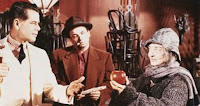
It’s not that Pocketful of Miracles is
completely unknown: The comedy has, after all, been shown numerous times over
the years on TCM, and its stars included the very recognizable Bette Davis, Glenn
Ford, and, in her big-screen debut, Ann-Margret.
But even many fans of older movies don’t recognize it,
as was borne out for me a few days ago, when another fan of such fare could not
bring it to mind when I spoke to her. And lines from the film have
not entered popular memory, as they have with It’s a Wonderful Life or a
much more recent movie, A Christmas Story.
Making the movie, Capra admitted a decade later in his
autobiography, The Name Above the Title, was a “miserable” experience.
It soured him so much on how the industry had changed since his heyday at
Columbia Pictures in the 1930s that it turned out to be his swan song.
Part of the reason why the production turned out to be
so joyless and disappointing was that Capra had begun it with such high hopes.
It was, after all, a remake of Lady for a Day, which had earned him the
first of six Oscar nominations for Best Director back in 1934.
Among Capra’s generation of older directors, the idea
of remaking their own black-and-white films of more than 20 years before had a certain
appeal, as evidenced by Alfred Hitchcock’s The Man Who Knew Too Much (1934
and 1956), and Leo McCarey’s Love Affair (released first in 1939, then redone
as An Affair to Remember).
The logic behind their reasoning seemed overpowering,
even inescapable: If Hollywood was going to remake these (and it would), who better
to do so than the original creative force who knew not only what aspects of it
were worth preserving but also what could be corrected and what could be added
that wasn’t around a generation before (notably, color and bigger screens)?
There were only a couple of problems with this in
Capra’s case, but they were significant. First, although he was eager to adapt
Damon Runyon’s Prohibition Era tale “Madame Le Gimp” for a later generation, Hollywood
executives did not feel similarly, believing audiences would find it dated.
Second, Hitchcock and McCarey had, in James Stewart
and Cary Grant, stars not only well-cast but also uninterested in throwing
their weight around. But Capra had as his male lead Glenn Ford, who, as
associate producer, had helped finance the film and was not shy about determining
its direction.
In particular, Ford insisted that, as gangster moll
Queenie Martin, his girlfriend Hope Lange should replace Shirley Jones,
a recent Oscar winner for Elmer Gantry whom Capra had already promised
the role. The reluctant director acceded to his star’s cast-her-or-I-quit
threat, but it rankled.
One of the few fundamental deviations that Pocketful
of Miracles made from Robert Riskin’s script for Lady for a Day was
a larger presence for Queenie (whom 1930s audiences would have
recognized as a fictionalized stand-in for nightclub hostess Texas
Guinan). It is hard not to see the hand of Ford in that decision.
Lange was hardly a disaster in her role. But her
presence represented a mounting list of initial casting choices that weren’t
turning out as Capra had wished.
Ford himself was not his preference for superstitious
gangster “Dave the Dude.” But his desired choices—Steve McQueen, Jackie
Gleason, Kirk Douglas, Dean Martin and Frank Sinatra—didn’t work out, for one
reason or another. (Sinatra’s association with the production would, in the
end, be limited to turning its theme song into a hit.)
Likewise, Bette Davis was not whom Capra had in
mind for street peddler Apple Annie. But Shirley Booth felt she couldn’t improve
on May Robson’s Oscar-nominated performance in Lady for a Day; Helen
Hayes couldn’t find space in her schedule; and Katharine Hepburn and Jean
Arthur (so memorable in Capra’s Mr. Deeds Goes to Town and Mr. Smith
Goes to Washington) both turned down the role.
Davis, with increasingly lower-profile roles since her
triumph a decade before in All About Eve, was eager for the work and the $100,000 salary, and agreed
to take on the part when Capra offered it.
As great an actress as she was, Davis was, at 53, younger
and less believable as woebegone Annie than the two-decades-older Robson. But
Capra had a more immediate problem with her, caused by—yes, Ford.
The trouble began a week after Davis came to the set, when Lange requested a dressing room next to Ford. That room belonged to Davis, who was miffed about yielding her position to a younger, less-established actress.
In
a well-intended but clumsy attempt to smooth things over, Ford only made
matters worse by saying in an interview that he was repaying Davis for giving him
his start in films by putting her in this movie, hoping it would be a comeback
vehicle for her.
“Who is that son of a bitch that he should say he
helped me have a comeback!” Davis stormed. “That shitheel wouldn’t have
helped me out of a sewer!”
From then on, the production was “shaped in the fires
of discord and filmed in an atmosphere of pain, strain, and loathing," Capra
wrote in The Name Above the Title.
Years later, he regretted that with Davis, he “didn’t
see that needed consolation and reassurance after so long away.” But on set, he
was not inclined to mediate the noticeable tension between her and Ford, and he
developed increasing headaches.
It’s hard not to read Capra’s memoir without the sense that, over and above everything else, he resented Ford for undercutting his authority and creative freedom as the director: “My ‘one man, one film’ Hollywood had ceased to exist. Actors had sliced it up into capital gains.”
The results showed on the screen. It wasn’t so much in
the performances of the supporting players. (Particularly wonderful are “It’s a
Wonderful Life”’s Uncle Billy, Thomas Mitchell, here in his last movie role; Mickey
Shaughnessy, given perhaps the funniest line of the film, “She's like a
cockroach what turned into a butterfly!”; and Peter Falk, nominated for a Best
Supporting Actor Oscar as Dave the Dude’s cranky right-hand man “Joy Boy”).
Rather, the trouble is apparent in the film’s pace—which,
uncharacteristically for Capra, is uneven, even slack at points. Lady for a
Day had a running time of an hour and 34 minutes—plenty of time to tell its
story and be on its way. In contrast, Pocketful of Miracles clocks in at
two hours and 16 minutes but feels like it could use a good half hour cut.
Capra received a Directors Guild of America nomination for this film. But overall, he agreed with reviewers like The New York Times’ A.H. Weiler, who noted, “Mr. Capra and his energetic troupe manage to get a fair share of laughs from Mr. Runyon’s oddball guys and dolls, but their lampoon is dated and sometimes uneven and lifeless.”
A couple of years later, Capra expressed interest in
directing an adaptation of the Broadway satire The Best Man, but
creative differences with playwright Gore Vidal kept him from taking on that
project, probably for the best.
Pocketful of Miracles was
an exercise in nostalgia for a world that had passed. So had the studio system
in which Capra had once flourished.
(The image accompanying this post shows Ford, Falk and Davis. Though it seemed imperative to have the two feuding co-stars in a still for my commentary, I couldn't resist including Falk, whose performances gives viewers as much pleasure as it did Capra.)

George Bailey [played by James Stewart]: “Well, Mr. Potter, I... I... I know I ought to jump at the chance, but I... I just... I wonder if it would be possible for you to give me 24 hours to think it over?”
Potter: “Sure, sure, sure. You go on home and talk about it to your wife.”
George: “I'd like to do that.”
Potter: “In the meantime, I'll draw up the papers.”
George: “All right, sir.”
Potter [offering hand]: “Okay, George?”
George [taking his hand]: “Okay, Mr. Potter.”
[As they shake hands, George feels a physical revulsion. He drops his hand, then peers intently into Potter's face.]
George [vehemently]: “No... no... no... no, now wait a minute, here! I don't have to talk to anybody! I know right now, and the answer is no! NO! Doggone it!” [Getting madder all the time] “You sit around here and you spin your little webs and you think the whole world revolves around you and your money. Well, it doesn't, Mr. Potter! In the... in the whole vast configuration of things, I'd say you were nothing but a scurvy little spider!”—It’s a Wonderful Life (1946), screenplay by Frances Goodrich, Albert Hackett, and Frank Capra, based on an original story by Philip Van Doren Stern, directed by Frank Capra
I haven’t watched It’s a Wonderful Life yet this year, but after multiple viewings, I don’t think I need to anymore. Over the last few weeks, this snatch of dialogue sprang to mind.
I think many of us have encountered a “scurvy little spider” at some point in our lives. I can think of at least one at the national level—maybe you can, too.
The message of Frank Capra’s film classic—and of this holiday season—is that such ceaseless schemers don’t win, and that for every Potter, there’s a George Bailey in our community—and maybe even our own family.
Merry Christmas, Bedford Falls—and beyond!
(By the way, for an absorbing
look at one of the little-known aspects about the environment in which It’s
a Wonderful Life was released, see this article from the Website “History
Collection” about how the FBI initially regarded the film as Communist propaganda, even though Capra, a conservative Republican, not only loathed
Marxism but even Franklin Roosevelt. It seems that, in J. Edgar Hoover’s
paranoid organization, Mr. Potter was seen as an insidious reflection of the
capitalist system as a banker—even though George and Peter Bailey also ran financial
institutions.)

Frank Cross
[played by Bill Murray]: “No, I don't have those... no.”
Preston: “Twenty-seven
million. Do you know how many dogs?”
Frank: “In America?”
Preston: “Forty-eight
million. We spend four billion dollars on pet food alone. Now I have here a
study from Hampstead University which shows us that cats and dogs are beginning
to watch television. Now if these scientists are right, we should start
programming right now. Within twenty years they could become steady viewers.”
Frank [trying
to hide his incredulity]: “Programming? For cats?”
Preston: “Walk with me,
Frank.”
Frank [Whispering to
his secretary, Grace, as they leave the office]: “Call the police!”
Preston: “Now I'm not
saying build a whole show around animals. All I'm suggesting is that we
occasionally throw in a little pet appeal. Some birds, a squirrel...”
Frank: “Mice.”
Preston: “...mice!
Exactly. You remember Kojak and the lollipops? What about a cop that dangles
string as his gimmick? Lots of quick random actions. Frank, wasn't there a
doormouse in Scrooge?”
Frank: “No, but now
that you say it... I always felt that it needed a doormouse.”
Preston: “Doormice.
Better.”
Frank: “Bingo.”— Scrooged
(1988), screenplay by Mitch Glazer and Michael O'Donoghue, directed by
Richard Donner
Many years ago, when I rented this holiday flick on
video, its jokes fell flat for me. Maybe I’ve grown more cynical with age, but
when I watched this update on A Christmas Carol again on cable TV this
week, I thought that it lost its energy about halfway through, but it hit its
satirical targets far more often at the beginning.
This scene especially scored. (I have no idea how
Mitchum and Murray managed to keep straight faces as they filmed this.) In
fact, I think even more people can relate to it now. (While revenues for pet
services—i.e., visits to the vet—have been challenged during the pandemic, pet
food sales have continued to hold on, at least till recently—especially online
pet sales.)


