Showing posts with label Damon Runyon. Show all posts

Friday, November 22, 2024

Quote of the Day (Damon Runyon, With a Female Example of ‘The Underworld Complex’)

“Waldo Winchester says the underworld complex is a very common complex and that Basil Valentine has it, and so has Miss Harriet Mackyle, or she will not be all the time sticking her snoot into joints where tough guys hang out. This Miss Harriet Mackyle is one of these rich dolls who wears snaky-looking evening clothes, and has her hair cut like a boy's, with her ears sticking out, and is always around the night traps, generally with some guy with a little mustache, and a way of talking like an Englishman, and come to think of it I do see her in tough joints more than somewhat, saying hello to different parties such as nobody in their right minds will say hello to, including such as Red Henry, who is just back from Dannemora, after being away for quite a spell for taking things out of somebody's safe and blowing the safe open to take these things.”—American short-story writer and sportswriter Damon Runyon (1880-1946), “Social Error,” originally printed in Furthermore (1938), republished in New York Stories, edited by Diana Secker Tesdell (2011)

If the name in that quote sounds very vaguely familiar, it’s because the socialite described here shows up as one of the characters in the not-terribly-well-known 1989 film Bloodhounds of Broadway, a mashup of several Damon Runyon short stories including “Social Error,” and featuring Julie Hagerty (pictured) as Miss Mackyle.

Runyon is best known for the musical Guys and Dolls, adapted from two of his other stories. He made a tidy sum in the Thirties and Forties with Hollywood transferring some of his properties to the screen, not always successfully.

I think you really must read his words on the page rather than seeing them on a screen to appreciate their unusual quality.  Films convey the funny patois of his characters but not the danger and menace that sneak up between the colorful phrases, like “tough joints,” “blowing the safe open” and “Dannemora” (for readers outside the tristate region, an upstate New York maximum security facility).

Runyon himself had something of an “underworld complex.”  Much of the considerable money he earned as a New York sportswriter and short-story writer was spent at the racetrack, where he met many gamblers and absorbed the speech patterns that later figured so prominently in his work.

Some of those people turned up as thinly disguised people in his stories, including:

*Bat Masterson, who became Sky Masterson;

*Walter Winchell (Waldo Winchester);

*Arnold Rothstein (Nathan Detroit);

*Texas Guinan (Miss Missouri Martin);

*Harry Morgan (The Lemon-Drop Kid);

* Otto Berman (Regret);

* Frank Costello (Dave the Dude);

*Johnny Broderick (Johnny Brannigan)

I haven’t been able to discover the original inspiration for Harriet or Red Henry, but they must have been something else.

Saturday, December 18, 2021

This Day in Film History (‘Pocketful of Miracles,’ Capra’s Lesser Yule Tale, Opens)

Dec. 18, 1961—Pocketful of Miracles opened in American theaters almost 15 years to the day that It’s a Wonderful Life premiered, and likewise failed to meet expectations at the box office. But, while veteran director Frank Capra’s earlier film went on, through countless repeat TV showings, to become a holiday classic, his later production—also containing Yuletide elements—has never gained similar popular traction.

It’s not that Pocketful of Miracles is completely unknown: The comedy has, after all, been shown numerous times over the years on TCM, and its stars included the very recognizable Bette Davis, Glenn Ford, and, in her big-screen debut, Ann-Margret.

But even many fans of older movies don’t recognize it, as was borne out for me a few days ago, when another fan of such fare could not bring it to mind when I spoke to her. And lines from the film have not entered popular memory, as they have with It’s a Wonderful Life or a much more recent movie, A Christmas Story.

Making the movie, Capra admitted a decade later in his autobiography, The Name Above the Title, was a “miserable” experience. It soured him so much on how the industry had changed since his heyday at Columbia Pictures in the 1930s that it turned out to be his swan song.

Part of the reason why the production turned out to be so joyless and disappointing was that Capra had begun it with such high hopes. It was, after all, a remake of Lady for a Day, which had earned him the first of six Oscar nominations for Best Director back in 1934.

Among Capra’s generation of older directors, the idea of remaking their own black-and-white films of more than 20 years before had a certain appeal, as evidenced by Alfred Hitchcock’s The Man Who Knew Too Much (1934 and 1956), and Leo McCarey’s Love Affair (released first in 1939, then redone as An Affair to Remember).

The logic behind their reasoning seemed overpowering, even inescapable: If Hollywood was going to remake these (and it would), who better to do so than the original creative force who knew not only what aspects of it were worth preserving but also what could be corrected and what could be added that wasn’t around a generation before (notably, color and bigger screens)?

There were only a couple of problems with this in Capra’s case, but they were significant. First, although he was eager to adapt Damon Runyon’s Prohibition Era tale “Madame Le Gimp” for a later generation, Hollywood executives did not feel similarly, believing audiences would find it dated.

Second, Hitchcock and McCarey had, in James Stewart and Cary Grant, stars not only well-cast but also uninterested in throwing their weight around. But Capra had as his male lead Glenn Ford, who, as associate producer, had helped finance the film and was not shy about determining its direction.

In particular, Ford insisted that, as gangster moll Queenie Martin, his girlfriend Hope Lange should replace Shirley Jones, a recent Oscar winner for Elmer Gantry whom Capra had already promised the role. The reluctant director acceded to his star’s cast-her-or-I-quit threat, but it rankled.

One of the few fundamental deviations that Pocketful of Miracles made from Robert Riskin’s script for Lady for a Day was a larger presence for Queenie  (whom 1930s audiences would have recognized as a fictionalized stand-in for nightclub hostess Texas Guinan). It is hard not to see the hand of Ford in that decision.

Lange was hardly a disaster in her role. But her presence represented a mounting list of initial casting choices that weren’t turning out as Capra had wished.

Ford himself was not his preference for superstitious gangster “Dave the Dude.” But his desired choices—Steve McQueen, Jackie Gleason, Kirk Douglas, Dean Martin and Frank Sinatra—didn’t work out, for one reason or another. (Sinatra’s association with the production would, in the end, be limited to turning its theme song into a hit.)

Likewise, Bette Davis was not whom Capra had in mind for street peddler Apple Annie. But Shirley Booth felt she couldn’t improve on May Robson’s Oscar-nominated performance in Lady for a Day; Helen Hayes couldn’t find space in her schedule; and Katharine Hepburn and Jean Arthur (so memorable in Capra’s Mr. Deeds Goes to Town and Mr. Smith Goes to Washington) both turned down the role.

Davis, with increasingly lower-profile roles since her triumph a decade before in All About Eve, was eager for the work and the $100,000 salary, and agreed to take on the part when Capra offered it.

As great an actress as she was, Davis was, at 53, younger and less believable as woebegone Annie than the two-decades-older Robson. But Capra had a more immediate problem with her, caused by—yes, Ford.

The trouble began a week after Davis came to the set, when Lange requested a dressing room next to Ford. That room belonged to Davis, who was miffed about yielding her position to a younger, less-established actress. 

In a well-intended but clumsy attempt to smooth things over, Ford only made matters worse by saying in an interview that he was repaying Davis for giving him his start in films by putting her in this movie, hoping it would be a comeback vehicle for her.

“Who is that son of a bitch that he should say he helped me have a comeback!” Davis stormed. “That shitheel wouldn’t have helped me out of a sewer!”

From then on, the production was “shaped in the fires of discord and filmed in an atmosphere of pain, strain, and loathing," Capra wrote in The Name Above the Title.

Years later, he regretted that with Davis, he “didn’t see that needed consolation and reassurance after so long away.” But on set, he was not inclined to mediate the noticeable tension between her and Ford, and he developed increasing headaches.

It’s hard not to read Capra’s memoir without the sense that, over and above everything else, he resented Ford for undercutting his authority and creative freedom as the director: “My ‘one man, one film’ Hollywood had ceased to exist. Actors had sliced it up into capital gains.”

The results showed on the screen. It wasn’t so much in the performances of the supporting players. (Particularly wonderful are “It’s a Wonderful Life”’s Uncle Billy, Thomas Mitchell, here in his last movie role; Mickey Shaughnessy, given perhaps the funniest line of the film, “She's like a cockroach what turned into a butterfly!”; and Peter Falk, nominated for a Best Supporting Actor Oscar as Dave the Dude’s cranky right-hand man “Joy Boy”).

Rather, the trouble is apparent in the film’s pace—which, uncharacteristically for Capra, is uneven, even slack at points. Lady for a Day had a running time of an hour and 34 minutes—plenty of time to tell its story and be on its way. In contrast, Pocketful of Miracles clocks in at two hours and 16 minutes but feels like it could use a good half hour cut.

Capra received a Directors Guild of America nomination for this film. But overall, he agreed with reviewers like The New York Times’ A.H. Weiler, who noted, “Mr. Capra and his energetic troupe manage to get a fair share of laughs from Mr. Runyon’s oddball guys and dolls, but their lampoon is dated and sometimes uneven and lifeless.” 

A couple of years later, Capra expressed interest in directing an adaptation of the Broadway satire The Best Man, but creative differences with playwright Gore Vidal kept him from taking on that project, probably for the best.

Pocketful of Miracles was an exercise in nostalgia for a world that had passed. So had the studio system in which Capra had once flourished.

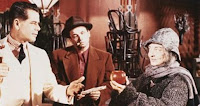
(The image accompanying this post shows Ford, Falk and Davis. Though it seemed imperative to have the two feuding co-stars in a still for my commentary, I couldn't resist including Falk, whose performances gives viewers as much pleasure as it did Capra.)

Friday, March 13, 2020

Quote of the Day (Damon Runyon, on the Problem With ‘Snatching’—i.e., Kidnapping)


“[I]f you are going to do any snatching, you cannot snatch just anybody. You must know who you are snatching, because naturally it is no good snatching somebody who does not have any scratch to settle with. And you cannot tell by the way a party looks or how he lives in town if he has any scratch, because many a party who is around in automobiles, and wearing good clothes, and chucking quite a swell is nothing but the phonus bolonus and does not have any real scratch whatever.”—Short-story writer and journalist Damon Runyon (1880-1946), “The Snatching of Bookie Bob,” in Guys and Dolls and Other Writings (2008)

I can think of one “phonus bolonus” right now. (I bet you can, too!)


Thursday, May 10, 2012

This Day in Sports History (Roller-Derby Queen Weston Dies)


May 10, 1997—Former roller-derby star Joanie Weston, whose immense athleticism was overshadowed by contests that stressed fan-pleasing fistfights and hair-pulling, died at age 62 at her Hayward, Calif., home of Creutzfeldt-Jakob disease, a rare brain disorder.

In the early 1970s, as I grew weary of the increasing demands of the upper grades in my elementary school (heavier homework loads, more advanced math), I looked forward to watching our TV on Saturday mornings. I had moved beyond the still-standard cartoon fare of that time of week. 

But I had inexplicably found a show that, like school, called for more attention (mine) and a higher skill set (someone else’s) than, say, Bugs Bunny, but which, in contrast with my academic pursuits, was decidedly entertaining.

Roller derby had attained a zenith from which it would fall precipitously. It was not only reaching 120 cities through syndication but it was being mentioned in publications such as Sports Illustrated (e.g., this classic 1969 overview of the sport by the great Frank Deford), songs by Jim Croce, and even a film, Kansas City Bomber (whose reason for being perhaps had less to do with the sport’s inherent skills than with the anatomical charms of star Raquel Welch).

Leo Seltzer had conceived roller derby as a continuation of the transcontinental roller-rink “marathons” common during the Depression—then picked up on rules suggested by the great sportswriter-fiction writer Damon Runyon to bring about the modern sport. Seltzer’s son Jerry raised the sport's profile in the Fifties and Sixties by arranging widespread television coverage. 

There seemed no reason why, like football in the same decades, this rough-and-tumble pastime might not become far, far bigger very soon.

The sport to which roller derby was compared was wrestling, mostly because of its inevitable brawls.

But while I could care less about guys with rolls of muscle alternating with fat thumping each other on the mat, I was fascinated by roller derby. It was, like ice hockey, all a matter of speed and movement, and like ice hockey in those years it also had its share of fights (hello, Derek Sanderson?).

But I loved how the two teams in their helmets and shorts circled the banked tracks in whip-fast phalanxes, as so-called “jammers” probed for an opening as they tried to “lap” the opposition. Charlie O’Connell, lean, strong and disdainful (think of the New York Mets’ Dave Kingman on skates), ruled the men’s side of the sport. Joanie Weston, as “pivot” (the controller of the action) of the San Francisco Bay Bombers, was queen of the women’s side.

Only a year or two after I had started watching it, roller derby had largely disappeared from the airwaves, a victim of financial troubles. I had gone on to other things—high school and adolescence—and hadn’t noticed its passing. 

It wasn’t until I picked up Deford’s appreciation of the life of Weston in the New York Times Magazine 14 years ago that I thought again about the sport, and its great female star.

Away from arenas, Deford revealed, Weston was a sweet, nun-educated, pretty young woman who, while traveling the exhibition circuit, loved to cuddle at night in one of those lonely Holiday Inns with a mixed-breed canine named Malia. 

But once she strapped on her skates and helmets, preparing for no-holds-barred action in which she might block one minute and sprint as the jammer in another, she was something else entirely:

“[O]n the banked track, she was transformed. Hear it now: No. 38 in your program, No. 1 in your hearts. The Blond Bomber --- 5 foot 10, 165 pounds, strong and agile, as superb a female athlete as ever there was. She kept her hair strawberry blond and a scarf knotted around her neck to make her as stylishly feminine as her (wonderfully) tacky orange and black attire permitted. Never mind. Swirling, pounding, commanding, she looked the best part of a Viking queen, sallying forth.”

Weston’s prime occurred before Title IX was passed 40 years ago. Who knows how many remunerative athletic doors it might have opened for her?

One sport other than roller derby in which she was undisputedly dominant was softball. The story goes that, in one game, Weston hit eight home runs for St. Mary’s College in Los Angeles—and was ready to try for another when she was told by the nuns running her school that if she hit it, she would be excommunicated!

Nowadays, if you want to see a blond Valkyrie wage uninhibited combat against all comers, you have to catch Laura Ingraham subbing for Bill O’Reilly on Fax News. What the spectacle gains in decibels, it loses in dynamic images—a sorry tradeoff, if you ask me.

I understand that roller derby has undergone something of a revival this past decade, only this time playing down the wrestling-like antics. I think Weston would have approved.

Monday, December 19, 2011

Movie Quote of the Day (‘Pocketful of Miracles,’ on Its ‘Lady for a Day’)

Junior (played by Mickey Shaughnessy), seeing boozy beggar Apple Annie (played by Bette Davis) transformed into a duchess: “She's like a cockroach what turned into a butterfly!”—Pocketful of Miracles (1961), written by Hal Kanter and Harry Tugend, based on an earlier screenplay by Robert Riskin and the Damon Runyon short story “Madame La Gimp,” directed by Frank Capra

Fifty years ago today, Frank Capra’s remake of his 1933 Gotham fairy tale, Lady for a Day, premiered, with a bigger budget, bigger stars, and longer running time, in New York City. Its failure this time around led the great director to decide that the thrill was gone out of moviemaking in an age when a star (to his aggravation, only a middling one like Glenn Ford) could force him into a compromised product. Partly as a result, this would be his last completed feature film: three years later, he pulled out of Marooned when he tired of incessant studio demands for script approval and budgets.

Capra was right in this respect: among his quartet of holiday movies (the others: Lady for a Day, Meet John Doe, and, of course, It’s a Wonderful Life), this one ranked last. I’m afraid that, like another holiday film, Love, Actually four decades later, the final product of Pocketful of Miracles failed to deliver on its tremendous promise. Miscast are Bette Davis and Ford, as, respectively, the street woman desperate that the daughter who has lived abroad for years not realize how far she has fallen, and the unexpectedly tenderhearted racketeer who decides to turn her into a duchess (or, at least, appear like one). Moreover, the extra 40 minutes gained since Lady for a Day puffed up what at heart is a comic fairy tale.

Not to say that there aren’t moments, even whole stretches, of pure enjoyment. When he wasn’t coping with cluster headaches over his feuding co-stars, Capra delighted in his terrific group of supporting players— not just Shaughnessy but also Sheldon Leonard, Edward Everett Horton, Thomas Mitchell (Uncle Billy of It’s a Wonderful Life), and especially Peter Falk, who was nominated for a Best Supporting Actor Oscar for his turn as Dave the Dude’s underling, the ironically named Joy Boy.

And then there is the dialogue. Much of the best of it sprang from unaccredited Jimmy Cannon (“superb slinger of Broadway’s argot,” Capra called him in his autobiography, The Name Above the Title). The sportswriter managed to blend seamlessly Runyon’s original lingo with his own, so it’s hard to tell the source of such lines as the above, or Joy Boy's exclamation upon seeing a room after a quarrel between Dave and girlfriend Queenie: “Look at this place, like the inside of a goat's stomach!"

For another Runyon Yuletide take, in undiluted form, you might want to turn to the short story “Dancing Dan’s Christmas,” in the Everyman Library anthology Christmas Stories. It now only features the colorful characters and hilarious dialogue that Hollywood and Broadway (Guys and Dolls) have long loved about Runyon, but also an O.Henry-style ending and a distinct undercurrent of danger downplayed on film and the stage (we are, after all, reading about people engaged in criminal enterprises).

Wednesday, November 24, 2010

Song Lyric of the Day (“Guys and Dolls,” on “The Horse Right Here”)

“I got the horse right here The name is Paul Revere And here's a guy that says that the weather's clear.”—Frank Loesser, “Fugue for Tinhorns,” from Guys and Dolls (1950) 

In his memoir My Prison Without Bars, Pete Rose described a childhood visit to a race track that would lead him, years later, to gambling on baseball. Many film and theater fans such as myself think he could have gotten the same adrenaline rush without such dire consequences by listening to “Fugue for Tinhorns” from Guys and Dolls, the Frank Loesser musical that premiered at the 46th Street Theater on this date in 1950. 

The infectious adaptation of work by Damon Runyon (based largely on his short story "The Idyll of Miss Sarah Brown)" ran for more than 1,200 performances and has been a staple of theaters around the country ever since. 

Other songs from the show are better known than “Fugue for Tinhorns” (e.g., “Luck Be a Lady”). But watch this YouTube excerpt from the 1955 film, featuring the wonderful Stubby Kaye (pictured here) as Nicely-Nicely Johnson, and tell me if any song in the vast world of the American musical surpasses this in bravura inventiveness and transmission of unbridled joy. 

Without Playbills distributed at theaters, most people would not, on a first listening, identify the title as “Fugue for Tinhorns.” Growing up, I knew it as “Can Do,” the snippet of the song used for a Gold Medal Flour commercial. I don’t know how often that TV ad was broadcast, but it wouldn’t have mattered: once the groove entered my head, I could never forget it. 

The last time I watched the film version of Loesser’s landmark musical was a quarter century ago. At the time, Nathan Detroit’s long-term relationship with Adelaide (14 years engaged!) reminded me an awful lot of someone I knew--a fact I couldn’t resist needling this guy about.

Frank Sinatra played Nathan onscreen, much to his chagrin. The role he really wanted--one he felt he owned, practically--was that of gambler Sky Masterson. But the part went instead to the nonsinging Marlon Brando, then, like a gambler, on a a major winning streak of his own. (He was nominated for a Best Actor Oscar every year from 1951 through 1954, when he finally won for On the Waterfront.)

Brando was not the Chairman of the Board’s favorite person, even before this film. When Brando was first offered, then rejected, the role of On the Waterfront’s Terry Malloy, Sinatra practically grabbed at the role. With his scrappy Hoboken upbringing, the singer-actor felt a deep affinity for the mobbed-up young man trying to avoid “a one-way ticket to Palookaville.” 

Years ago, when I saw On the Waterfront screenwriter Budd Schulberg at a book appearance at Fairleigh Dickinson University, he said Sinatra might have done very well with the role. But before filming started, the script made its way back into the hands of Brando, who had a change of heart. Sinatra had lost a very real chance for back-to-back Oscars (he had won Best Supporting Actor the year before for his comeback role in From Here to Eternity). 

So here Sinatra was, a couple of years later, still sore, and now peeved again over not getting the part of Sky Masterson. Still, he tried to swallow his disappointment--after all, enough money in a high-profile film would incline you, too, at least somewhat toward acting maturely and professionally. 

But filming, even with long-time pro Joseph Mankiewicz as director, wasn’t all that smooth. Brando’s numbers had to be spliced together from multiple takes--a fact that must have rankled Sinatra, since a) he knew he could have aced each the first time, and b) he hated multiple shots himself, because he was an instinctive actor who became progressively worse after, say, about the fifth take. (For more on this, see especially the awkward meshing of styles with co-star Edward G. Robinson during the filming of A Hole in the Head, as recounted by director Frank Capra in his memoir The Name Above the Title.) 

An episode on the set probably didn’t help matters. For the scene in which Masterson and Detroit first meet, Sinatra was required to eat cheesecake. This required multiple takes because Brando kept flubbing his lines. At last, Sinatra--who loathed cheesecake--had to call it a day because he couldn’t eat another bite. When filming began the next day, this scene was concluded on a single take.

What was Brando up to during the first set of takes? Was he trying out different ways of tackling the scene? For this actor who loved to experiment, that was possible. Did he have trouble remembering lines? That, too, was possible--an uncle of mine, who had occasion to observe the filming of On the Waterfront as a Port Authority cop, said the actor had to repeat scenes because he couldn’t remember lines.

Or was something else at play here? Did Brando, something of a practical joker, screw up the lines on purpose because he knew how much Sinatra disliked cheesecake?

That was the story that went the rounds of Hollywood. Maybe that helped account for why Sinatra began calling his co-star “Mumbles”--or why Brando, when asked years later about Sinatra, replied that he was “the kind of guy who, when he gets to Heaven, is going to give God a hard time for making him bald.”

Sunday, November 21, 2010

This Day in Football History (Grange Gallops to Final Collegiate Glory)


November 21, 1925—Harold “Red” Grange ended his college career in typical fashion, leading the University of Illinois to a 14-9 win over Ohio State. But the running back whose blazing speed earned him the nickname “The Galloping Ghost” was about to shake off traditional notions of celebrity and compensation for collegiate stars by signing on for a pro-football barnstorming tour within a week of his final triumph.

I’ve long wanted to write a post about Grange, partly because he remains something of a mythic figure, but also because, unlike so many other superstars in the so-called “Golden Age of Sports”—the Roaring Twenties—his star has dimmed somewhat in the popular imagination. I don’t think it should.

Someone on the scene in this era, who observed all these figures at their apogee, fully agreed with me on Grange’s importance to his time—and, implicitly, ours.

“This man Red Grange of Illinois is three or four men rolled into one for football purposes," wrote Damon Runyon, a sportswriter who would soon become famous for capturing a substratum of Manhattan in the short stories that would inspire the musical Guys and Dolls. "He is Jack Dempsey, Babe Ruth, Al Jolson, Paavo Nurmi and Man o' War. Put together, they spell Grange."

Grange wore the number 77 in his three-year college playing career, but it might just as well have stood for the miles per hour he generated as he blasted past opponents.
His achievements, though cumulatively magnificent, were spread out over those three years.
But, though leading his team to a national championship and being named All-American three times, what really stood out for those who witnessed his on-field mastery was the way he could dominate single games:

* In 1923, in his very first game, Grange scored three touchdowns, including a 66-yard punt return, against Nebraska.

* In 1924, against a Michigan defense that had only yielded four touchdowns across two seasons, he scored that many on runs of 95, 67, 56 and 44 yards within 12 minutes in the first quarter alone.

* In October 1925, on a muddy and miserable field in Philadelphia, he scored three TDs in a 24-2 upset of Penn.

That kind of charisma drew crowds, and that was what Chicago Bears owner-coach George Halas and the National Football League (NFL) badly needed at the time. The NFL did not start its great ascent as America’s favorite spectator sport until the 1960s, but without Grange’s acceptance of a playing offer from Halas, the organization might not have been around at all.

Grange’s on-field specialty was the broken-field run, a combination of feints and lightning bursts that left those around him gasping and bewildered. He was about to employ the same tactic against the collegiate powers-that-be.

The notion of student-athletes is as hard to maintain today among nationally ranked college powers as the possibility of a just, nonviolent, classless society in the waning years of the U.S.S.R. Grange was one of the first to expose the myth.

In the 1920s, college officials, believe it or not, thought they could determine not merely a player’s choices while he was with a school, but even after his playing days were over. Rumors were already flying, on the eve of the Ohio State game, that Grange was about to turn pro.

Only weeks before, the running back had assured the administration at the University of Illinois that he had done nothing to jeopardize his collegiate eligibility. But now that he had played his last game, all bets were off.

The university had forgotten about one elemental fact: Grange would be looking at more money than either he or his family had ever dreamed of. Grange’s father was not a millionaire who could send his son to college with no problem, only the chief of police at Wheaton. Red himself had had to help pay his way by working as a helper on an ice truck during the summer—a stint that won him his first nickname, “The Wheaton Ice Man.”

Three men changed Grange’s life and brought to the fore the inherent contradictions of the student-athlete ideal. In addition to Halas and partner Dutch Sternaman, there was C.C. (the initials stood for “Cash and Carry,” the joke went) Pyle, a theater manager from Grange’s native Champaign, Ill., who signed the star as his first client.

The deal that Pyle negotiated guaranteed Grange $3,000 per game along with a percentage of the gate. The former theater manager, a colorful type given to smooth talk and fancy clothes, also helped his client cash in by having him associated with movies, sweaters, shoes and even cigarettes (Grange, a non-smoker, got around a situation that could have marred his clean image by saying a particular cigarette brand was the type that he would smoke if he had been a smoker.)

The crowds did come out for Grange, as the trio had hoped. (In a case of—almost literally—crying all the way to the bank, Halas was said to have wept with joy as he counted receipts for the Bears game on Thanksgiving.) But the intense, 17-city barnstorming tour resulted in an injury to Grange—the first portent of a far more serious one that would keep him entirely sidelined during the 1928 season.

Grange’s quarrel with Halas over tour profits led the star to form a rival pro football league with Pyle for awhile, but by the end of the 1920s the Bears coach invited the former collegiate sensation back onto the team. By this time, injuries had robbed him of the speed that had made him a legend, but he continued to contribute, this time defensively—as New York Giants fans learned to their regret in 1933, when his tackle in the closing minutes of the NFL Championship Game prevented a touchdown and saved a victory for the Bears.