


Youth CND
5 days ago


Fortunately,
this Off-Broadway adaptation of the uproarious 1673 comedy by the French genius
actor-playwright Moliere—playing at New World Stages at 340 West 50th
Street through Sunday—will relieve the symptoms of any audience member who’s
badly in need of laughs.
The Red Bull,
in existence for roughly two decades, takes its name from a leading playhouse
of Shakespeare’s time that sorely tested the patience of the Stuart monarchy—and,
while delving into the Bard and his contemporaries through fully mounted plays
as well as staged readings, will also venture elsewhere in the realm of
classical theater, as, to great effect, here.
Working
from a new translation by Mirabelle Ordinaire, Red Bull artistic director Jeffrey Hatcher has
streamlined Moliere’s three-act structure to 80 minutes without an
intermission, rendered in colloquial English.
At the same time, Red Bull artistic director Jesse Berger has put together a show that remains true to the spirit of the original, including elements that appear repeatedly in Moliere’s work: a screen where characters hide and eavesdrop; doors opened and slammed as characters chase each other on and off stage; a saucy maid far smarter than her deluded employer; a daughter and her boyfriend who must convince her father not to give her away to a loathsome suitor; and, presiding over the madcap household, a paterfamilias not only cuckolded (and about to be swindled) by his much younger wife, but in the grip of an absolutely unreasoning obsession.
Moliere
used his last farce to poke at a longtime bugaboo: quack doctors. (He suffered
his fatal illness mid-performance in the lead role, leaving many in his
audience, much like Redd Foxx, thinking that coughing blood was part of his
act.)
Creating a
massive opening for such medical mountebanks is the aging Argan (with veteran
stage, film, and TV comic actor Mark Linn-Baker as masterful with
dialogue as with demanding physical comedy). So convinced is Argan that lack of
feeling in his buttocks foretells worsening health that he requires the
strenuous ministrations of a trio of doctors (all played, hilariously, by Arnie Burton, who deftly differentiates each).
Argan’s
plan: marry his daughter Angelique to a doctor so he’ll have free healthcare
for the rest of his life. The problem is that the lucky fellow (played with
panache by Russell Daniels), the son of one of Argan’s current
physicians, is an unprepossessing specimen—dressed in a child’s sailor uniform
barely able to contain his porky physique, and even less skilled (and far more
squeamish) than his father about the healing arts.
The cast not
only maintains a breathless pace but obviously delights in feeding off each
other’s energy while playing this assembly of deceivers, both well-intentioned
and, in the case of the doctors and lawyer on hand, out-and-out charlatans—sometimes
even breaking character by dissolving in laughter onstage at another character’s
antics. In addition to the above-named actors, also worthy of note are:
*Sarah Stiles, stealing scene after scene with merely a sly grin as the servant
Toinette;
*John Yi, lending musical accompaniment as well as generating chuckles as Angelique’s
handsome but dim-witted suitor, Cleante; and,
*Emily Swallow as Argan’s gold-digging second wife.
In the
enormous enemy dispenser brandished in this farce, properties designer Laura
Page Russell has fashioned the New York theater world’s most explosive weapon
of mass eruption.
I have
favorably reviewed other Red Bull productions before, notably Shakespeare’s Coriolanus,
Middleton and Rowley's The Changeling, and Ben Jonson’s Volpone.
But none were as rollicking from start to finish as this one.
I was thrilled
to watch this theater group for the first time since the pandemic. Argan is the
type who today would be gulled by Ivermectin and Hydroxychloroquine, not to
mention new medications approved by Robert Kennedy Jr.’s FDA.
Rather
than sink into dismay over the fools and frauds who are multiplying in the
current political environment, the Red Bull has adeptly supplied appropriate
therapy in the form of Moliere’s boisterous mockery.

Mary Richards
[played by Mary Tyler Moore]: “Mr. Grant, I am just... so sorry.”
Lou Grant
[played by Ed Asner]: “Please, there is no need to apologize. It's not
your fault. All I said to you was, 'get me a date.' I didn't specify what kind
of a date. How were you to know that I wanted somebody under 90?”
Mary: “Mr. Grant,
won't you please let me explain? You see, there are two Mrs. Dudleys.”
Lou: “Mary, there are
thousands of Mrs. Dudleys. Why this Mrs. Dudley?” —The Mary Tyler
Moore Show, Season 4, Episode 8, “Lou‘s First Date,” original air
date Nov. 3, 1973, teleplay by Ed. Weinberger and Stan Daniels, directed by Jay
Sandrich


Even with
no realistic chance to win the race for New York City mayor in the fall, William F. Buckley, Jr. announced that he would campaign as the candidate of the
Conservative Party 60 years ago this week.
The National
Review editor and newspaper columnist entered the race hoping to deny
victory in November to the Republican nominee, John Lindsay. He didn’t
achieve that goal, but the 13% he did pull indicated a strong rightward drift
in the New York GOP that eventually forced Lindsay to seek reelection as the
Liberal Party candidate four years later—and, eventually, to leave the
Republican Party altogether.
Buckley
also hopped his run would be “fun,” and so it proved, especially for reporters
delighted by the copy provided by a candidate never at a loss for
words—especially big ones.
It all
started with his initial press conference, when his response to a question on
what he would do if elected became an instant classic in the annals of
campaigning: “Demand a recount.”
A
self-styled “radical conservative,” Buckley disagreed with virtually every
major liberal initiative of the prior three decades, from the New Deal’s
economic measures to civil-rights legislation, and regarded with horror
Republican efforts to move to the center to accommodate these.
A
prominent campaign of his read, “He has the guts to tell the truth: WILL YOU
LISTEN?”
At the end
of three terms under Mayor Robert F. Wagner Jr., not to mention three
decades under the increasing control of urban planner and neighbor destroyer Robert Moses, New
York was entering a spiral of urban decay that would climax in its bankruptcy
crisis in the autumn of 1975. Crime, inner-city unrest, and busing proposals were
fueling a white backlash against civil rights.
An
initial, positive response from cops encouraged Buckley to run. But his support
widened after that to the outer New York boroughs, where residents felt their
concerns were ignored. He could be coy in how he exploited such appeals. Though
he refused to grant that racial superiority had a biological basis, he had
written National Review editorials criticizing federal attempts to end
segregation.
During his
mayoral campaign, he said whites supporting the candidacy of segregationist
Governor George Wallace were not motivated by racism but by dislike of
African-American figures like author James Baldwin and activist Bayard Rustin who
“despise the American way of life and our civilization,” and “challenge root
and branch the American approach to free civil order.”
His
brilliance lay in how he could press hot-button issues in the coolest possible
manner: with polysyllabic vocabulary delivered with a posh, mid-Atlantic
pronunciation and coruscating wit, concluding with a sly grin and a flick of
his reptilian tongue.
In spite
of the liberal leanings of many reporters, even they couldn’t help but chuckle
at his best sound bites (e.g., on his two rivals, the tall Republican Lindsay
and the short Democrat Abraham Beame: “The differences between Mr. Beame
and Mr. Lindsay are biological, not political”).
Not having
compiled a record in public office that needed to be defended, Buckley found
himself on ground ideally suited to a skill he had cultivated since his Yale
days, particularly after a newspaper strike left a print information vacuum for
many voters: debates.
Buckley
was free to stake out unusual positions on issues. As future biographer Sam Tanenhaus
discussed in an October 2000 New York Times Magazine article on “The
Buckley Effect,” one of these turned out to be nearly four decades ahead of its
time: bicycle paths as an alternative means of transportation throughout the
city, similar to what he had seen in major European cities.
Other positions
turned out to be a good deal less mainstream—certainly in the context of his
time, and even more so now:
* “either
lock up teenage felons or make their parents legally responsible for them”;
* cut off welfare
for everyone but invalids and mothers "looking after children 14 years or
younger"’
*“relocating
chronic welfare cases outside the city limits”;
*legalize
drugs for adults—but have…
*“great
and humane rehabilitation centers” for drug addicts;
*encourage
emigration;
Tanenhaus
says that Buckley was an arguer rather than a thinker—never able to finish what
he hoped would be his magnum opus, The Revolt of the Masses. But
arguing, in the form of forensic skills, was indisputably what he had developed
as far back as his undergraduate days at Yale.
Just as
his much-publicized two faceoffs with African-American novelist and activist
James Baldwin served as an appetizer to his mayoral campaign, the latter race
led in the following year to the start of a three-decade stint hosting his
public television show, Firing Line.
During the
campaign, Buckley increasingly absorbed the lesson that he could blunt
opponents’ threats better through genial wit than with harsh rhetoric. More
than a decade later, he would back a Republican candidate for President with
even greater skills of this kind: Ronald Reagan.
In his new biography of Buckley, Tanenhaus notes that, for all their differences in style,
it would be a mistake to think that Donald Trump has little in common with the conservative
movement that Buckley helped coordinate in the postwar period. In an article
last year for The American Prospect, Rick Perlstein seconds that idea,
noting that “new scholarship suggests that Trump’s rise was not a reversal of
what Buckley was up to, but in many ways, its apotheosis.”
I believe
it is more appropriate to believe that the nature of Buckley’s forays into the
public arena will never be seen again. He belonged to a group that Mitchell
Ross, in a provocative 1978 book, called The Literary Politicians—figures
who “practice politics by writing books” rather than continually running for
public office.
Whether in
newspaper columns, extended television interviews, and especially entire books,
Buckley and other figures in the book such as John Kenneth Galbraith, Arthur
Schlesinger, and Gore Vidal preferred to advocate positions at length.
They did
not always fit comfortably into the party orthodoxy of their time and, though
they could toss out epigrams with the best of them, their arguments rested on
logical propositions rather than 30-second soundbites. The nature of American
political discourse is poorer for the absence of the forums where they could
appear to best advantage.

At least
one more curse might have been bestowed on humanity since Zweig’s observation:
We are not only made aware instantly of a catastrophe, but our understanding of
the event is likely to be misinformed through lack of historical perspective,
disinformation, or both.


In 1945, McCullers moved into the house in this photo, which I took last month on my way to the Nyack Public Library in Rockland County, NY.
Here, for the next 22 years
until her death in 1967, under increasingly difficult physical and emotional
conditions, the author turned out additional novels, short stories, plays, poetry, and
autobiographical works filled with compassion for the misfits and dreamers of
the world—those similar to herself.
Here also, Marilyn Monroe, playwright husband Arthur Miller, and novelist Isak Dinesen came to lunch in February 1959 (an encounter I discussed in this blog post from 17 years ago).
From a
sign outside, it appears that her former home is being renovated by Aurell
Garcia Architects, so I did not step inside. It will be interesting to see how
it will be used and visited when the process is completed.

GORGIBUS. “What the devil
is this jargon I hear? That’s the grand style all right!”— French
playwright, actor, and theater manager Jean-Baptiste Poquelin, aka Moliere
(1622-1673), The Ridiculous Precieuses, in Tartuffe and Other Plays, translated by Donald Frame (1967)


Though there are picnic areas, pavilions, playgrounds, and athletic facilities, this pond, with its circular walking path, is the centerpiece of the 79-acre park.

The image
of Holmes Rolston III that accompanies this post was taken Apr. 4, 2008, by
David Keller.

Considering
Salinger’s output for the prior several years, “Hapworth 16, 1924” closed out
his career in an appropriate fashion: a letter by Seymour, the eldest son in
the Glass family, who had also figured in Franny and Zooey (1961), and Raise
High the Roof Beam, Carpenters and Seymour: An Introduction (1963).
Coming
from an upper-class environment, the Glass children grew up privileged,
precocious and dysfunctional, a tendency borne out in the 1948 short story, “A
Perfect Day for Bananafish,” in which a grown-up Seymour commits suicide.
A post of mine six years ago surveyed
most of the course of the enigmatic writer’s career, but I didn’t concentrate
on “Hapworth 16, 1924,” or what came after: silence.
If you
want to encounter this last published story to date by the author of The
Catcher in the Rye, you can’t find it in a collection of his work. You
can’t even find it in a New Yorker anthology. Instead, you have to go to
the actual physical issue of the magazine (June 21, 1965) online (if you have a
subscription to the magazine and its archives) or click this YouTube link
to listen to a reading.
In a
March 2010 article in New York Magazine, Roger Lathbury discussed how his hopes for publishing this
elusive title in book form were briefly fanned before dying.
He had
sent a letter to Salinger in 1988 proposing that his tiny company, Orchises
Press, issue the novella. After a quick note from the author saying he’d
consider it, Lathbury heard nothing more for eight years when, out of the blue,
he was contacted by Salinger’s
literary agency, Harold Ober Associates. If a book were to be issued, he was
told, it needed to be done “to exacting standards”—i.e., bound in buckram.
A cordial meeting at Washington’s National Gallery followed between publisher and novelist, with Lathbury acceding to Salinger’s unusual demands (e.g., limited distribution, the author’s name nowhere on the cover).
Then, the
deal came unraveled after Lathbury confirmed to the press that the book would
be published. Horrified by what he evidently felt was a betrayal of trust,
Salinger withdrew his approval.
Six years
ago, Salinger’s son Matt and widow Colleen indicated that they had since 2011 been
preparing to release for publication stories written by the legendary New
Hampshire recluse in the more than four decades after “Hapworth 16, 1924.” But
it was an arduous process, Matt told of
the British publication The Guardian:
“[My
father] wanted me to pull it together, and because of the scope of the job, he
knew it would take a long time. This was somebody who was writing for 50 years without
publishing, so that’s a lot of material. ... [But] there’s not a reluctance or
a protectiveness: When it’s ready, we’re going to share it.”
Since
then, silence—not unlike the sphinx who began it all.
.jpg)
Miss Jacobs
[played by Ivy Bethune]: "Both of you?”
Harris: “Uh, no, I meant
me.”
Miss Jacobs:
“Then say what you mean, for heaven's sake!”—Barney Miller, Season 5,
Episode 29, “Quo Vadis?” original air date Mar. 2, 1978, teleplay by Tony
Sheehan, directed by Alex March

Happy birthday to Tobias Wolff, born 80 years ago today in Birmingham, AL!
(The image accompanying
this post, showing Tobias Wolff at an event at Kepler's in Menlo Park for his
short story collection Our Story Begins, was taken Apr. 25, 2008, by
Mark Coggins from San Francisco.)

The kind
of person envisioned by Burke possesses not just “seasonable energy” but moral
stature to influence followers. In our cynical age, who wields such authority?
If there
is such a person, I hope he or she will step forward quickly.


It also seems pretty
close to complicity in an emerging American autocracy.

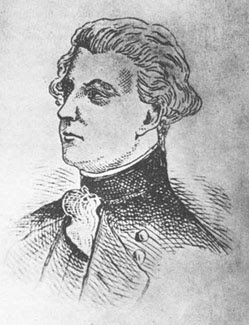
A trained
painter who, like the Marquis de Lafayette, left his native France in a burst
of youthful idealism to join the American colonies in their fight for freedom, L'Enfant
caught the attention of George Washington with his draftsmanship skills while
serving in the Continental Army Corps of Engineers. He not only endured the
brutal winter at Valley Forge but suffered a grievous leg wound at the Battle
of Savannah and spent six months as a prisoner of war after being captured at
the Battle of Charleston.
After the
war, L’Enfant worked on the insignia and diploma for the Society of Cincinnati
and the design for New York’s Federal Hall. In 1789, even before Congress had
formally approved a capital district for the nation, L’Enfant was lobbying
Washington with his proposal for creating it.
Only 11 months
after obtaining his prestigious architectural commission, L’Enfant was off the
project—depending on who you believe, having resigned or been fired. In a way,
the manner of his departure doesn’t matter, because, following continual
clashes with the three supervisory commissioners of the new federal District of
Columbia, he would have been gone in just a matter of time.
Perhaps
taking a cue from his adored commander in the war, Washington, L’Enfant had
neither requested nor been given a salary for his work in planning the
district. But, as the years went by and his income from other projects
dwindled, he felt the urgent need to press his claims.
It did not
help that when he had left, he had annoyed many with his egotism, his overbearing
ways, and his failure to adequately communicate his vision. He had ordered the
demolition of a property belonging to a prominent resident; delayed producing a
map for the sale of city lots; spoke and wrote English poorly; and, when he
walked away from the project in a huff, taken all the plans with him.
For his
last 15 years, the unmarried and childless L’Enfant lived as a charity case on
the estate of his benefactor, William Dudley Digges. Long before he was buried
in an unmarked grave on the plantation, he had haunted key figures in the city
he designed through rambling letters and appearances, wearing his blue
Continental Army uniform, in which he fruitlessly pressed his case for proper
remuneration for his work. (He wanted $95,000 for his architectural services;
Congress would go no higher than $3,800.)
The fulfillment
of L’Enfant’s vision for the city—and his honor for creating it—did not occur
until early in the 20th century. The centennial celebration of Washington’s
founding led the McMillan Commission—a panel of architects and planners
appointed by the U.S. Senate—to consider how to beautify a metropolis that had
fallen victim to decentralized, private land development.
The commission
members sought to adapt L’Enfant’s original scheme in the light of the “City
Beautiful” movement coming into being.
At the same
time, a parallel movement grew to remember L’Enfant in the fashion he craved
during life. His remains were exhumed, transported in in a casket draped with
the American flag to the U.S. Capitol (where he became the first foreign-born
man to lie in state) before being taken by military escort to Arlington National Cemetery. There he was buried overlooking the city he had created.
Some
aspects of L’Enfant’s plan, such as a waterfall flowing down Capitol Hill,
never came to fruition. But others eventually were adopted, including:
*the seat
of government on Capitol Hill;
*the mall
connecting Capitol Hill to what he called “The President’s House” and we call the
White House;
* a
four-quadrant grid, with north-south and east-west streets crossed by grand
diagonal avenues, creating public squares and beautiful buildings in what consisted
of hills, forests, marshes and plantations.

 Just when
music fans with indelible memories of the Sixties were getting used to the
death of Sly Stone, Brian Wilson followed him within 48 hours.
Just when
music fans with indelible memories of the Sixties were getting used to the
death of Sly Stone, Brian Wilson followed him within 48 hours.
The
conjunction of deaths had an all too sad symmetry: both gone at age 82, with
their heyday as pop trailblazers 50 to 60 years behind them, undone by drug
abuse, with occasional reappearances in the spotlight that started and
electrified admirers.
The
critical and commercial peak of each man lasted for about five years. At first,
to the wide public that snapped up their hits, most, if not all, of their
behavior seemed a matter of the kind of eccentricity that often accompanies
artistic genius, like Wilson wearing a fireman’s hat while directing a promo
video for “Good Vibrations” or Stone donning long wigs and hats.
For Wilson and Stone, the expectations generated by their success proved too immense to handle. Somewhere along the line eccentricity shaded into instability, then worse: mental illness (Wilson) or homelessness (Stone).
By 1975, canceled concerts and musician departures meant the effective end of Sly’s band. The Beach Boys carried on, even braving multiple changes in popular taste. But at roughly the same time that the Family Stone folded its tents, the Beach Boys became no more than Mike Love’s nostalgic troupe.

Eventually, reality fractured Wilson and Stone without destroying them.
That is
not what I remember them at their best, though. Then, while listening to their
best records—the Beach Boys’ entire Pet Sounds LP, “Good Vibrations,” “Fun,
Fun, Fun,” “Don’t Worry,” or Sly’s “Everyday People,” “Dance to the Music,” or “Everybody
is a Star”—I can only marvel at their effortless mastery of sounds and styles.
But, although
the Beach Boys and Sly and the Family Stone released records throughout the
calendar year, I—and, I suspect, many other fans—think of them overwhelmingly
in terms of summer.
Wilson ran
with his brother Dennis’ suggestion that the group record songs appealing to
the carefree, hot-rod-and-surf culture then springing up in California, giving
rise to a whole string of hits: “Little Deuce Coupe,” “Surfin’ U.S.A.,” “Surfin’
Safari,” “Surfer Girl.” Stone and his band became indelible parts of the
counterculture with their summer 1969 appearances at Woodstock and the Harlem
Cultural Festival.
During his
glory years, Stone created what sounds like a quintessentially Beach Boys tune:
“Hot Fun in the Summertime.” In fact, the Beach Boys, nearly three decades
after their time atop the charts, recorded a cover version for their Summer
in Paradise CD.
For fans
of the two groups, their peaks occurred during our summers, too—when our energy
seemed as endless as the world that beckoned to us.
But, for all the aural complexity of their masterpieces, they won the allegiance of listeners with simple, effervescent messages of joy and love.
Decades
ago, we could never imagine Wilson and Stone getting old, any more than we
could imagine we could. Their bodies may have died, crumbling as much from
their Dionysian excesses as from old age, but they live in the endless summer
of memory, where youth is forever golden.
(The image
of Sly Stone that accompanies this post was taken in Berkeley, CA, on Apr. 16,
1982, by Sarfatims.)

Dr. Niles Crane
[played by David Hyde Pierce]: “Frasier, I think that fever of yours is
making you delusional.”
Dr. Frasier Crane
[played by Kelsey Grammer]: “Oh, no! I filled in for you when you were
too sick to meet with your ‘Fear of Intimacy’ group!”
Niles [heading into
the bathroom]: “I wasn't sick. They were just getting too close.”—Frasier,
Season 1, Episode 23, “Frasier Crane's Day Off,” original air date May
12, 1994, teleplay by Chuck Ranberg and Anne Flett-Giordano, directed by James
Burrows

Ours is no longer “the
tempo of the motion picture,” or even the 24/7 news cycle, but instead TikTok. Fear
for any nation that not only no longer remembers the past but isn’t even
inclined to learn about it.

Lie Down in Darkness
brought the 26-year-old Styron notice as a novelist of abundant narrative gifts
and deep moral seriousness, working in Faulkner’s tradition of Southern
storytelling. He did not realize until his first bout of mental illness in the
mid-1980s that even the heroine of this early effort suffered from this affliction.
As part of
a cohort of writers who served in World War II and briefly spent time abroad after
its conclusion, he—as well as friends James Jones, Irwin Shaw, Norman Mailer,
and Peter Matthiessen—took cues from the “Lost Generation.”
They were,
Styron’s youngest daughter Alexandra wrote in her memoir Reading My Father, “Big Male Writers…[who] perpetuated, without apology, the
cliché of the gifted, hard drinking, bellicose writer that gave so much of
twentieth-century literature a muscular, glamorous aura."
Even as
Styron played the bon vivant during summer parties at Martha’s Vineyard, his poet-activist
wife Rose and their four children endured his moodiness, angry outbursts, and
frequent frustration over his inability to bring his work to as quick and
successful conclusion.
In middle
age, that age of homage, masking their own attempts to obliterate the shock of
their war, proved increasingly unsuccessful and counterproductive. Though Styron’s
career lasted four decades, his output was not that extensive—four full-length
novels, a book of short stories, a memoir, a play, and an essay collection—finding,
at the age of 65, that the “senior partner” to his writing, his drinking, no
longer satisfied or spurred his writing.
A
childhood in Tidewater region of Virginia was overshadowed by his mother’s
decline and death from breast cancer, a struggle that only worsened his father’s
melancholy. W.C. Styron’s second marriage left his son with a stepmother he
found chilly and unsympathetic.
I briefly
described in this post from 14 years ago the controversy surrounding
Styron’s Pulitzer Prize-winning account of the bloodiest slave uprising in
antebellum America, The Confessions of Nat Turner.
Many admirers
like myself of his forays into the darkest chapters of American life attributed
the long gaps between books to perfectionism, a tendency common among authors.
But with Darkness Visible, he described, in shattering detail, how his writer’s block was
bound up with a psychic condition that he likened to a storm in his brain.
This memoir
provided knowledge and help to others similarly afflicted. But, aside from the
trio of novellas collected in Tidewater Morning (1993), Styron was never
able to complete his World War II novel, The Way of the Warrior, after Sophie’s Choice in 1979, because his depression returned with a vengeance in the
spring of 2000, troubling him till his death six years later.


