Showing posts with label POCKETFUL OF MIRACLES. Show all posts

Saturday, December 18, 2021

This Day in Film History (‘Pocketful of Miracles,’ Capra’s Lesser Yule Tale, Opens)

Dec. 18, 1961—Pocketful of Miracles opened in American theaters almost 15 years to the day that It’s a Wonderful Life premiered, and likewise failed to meet expectations at the box office. But, while veteran director Frank Capra’s earlier film went on, through countless repeat TV showings, to become a holiday classic, his later production—also containing Yuletide elements—has never gained similar popular traction.

It’s not that Pocketful of Miracles is completely unknown: The comedy has, after all, been shown numerous times over the years on TCM, and its stars included the very recognizable Bette Davis, Glenn Ford, and, in her big-screen debut, Ann-Margret.

But even many fans of older movies don’t recognize it, as was borne out for me a few days ago, when another fan of such fare could not bring it to mind when I spoke to her. And lines from the film have not entered popular memory, as they have with It’s a Wonderful Life or a much more recent movie, A Christmas Story.

Making the movie, Capra admitted a decade later in his autobiography, The Name Above the Title, was a “miserable” experience. It soured him so much on how the industry had changed since his heyday at Columbia Pictures in the 1930s that it turned out to be his swan song.

Part of the reason why the production turned out to be so joyless and disappointing was that Capra had begun it with such high hopes. It was, after all, a remake of Lady for a Day, which had earned him the first of six Oscar nominations for Best Director back in 1934.

Among Capra’s generation of older directors, the idea of remaking their own black-and-white films of more than 20 years before had a certain appeal, as evidenced by Alfred Hitchcock’s The Man Who Knew Too Much (1934 and 1956), and Leo McCarey’s Love Affair (released first in 1939, then redone as An Affair to Remember).

The logic behind their reasoning seemed overpowering, even inescapable: If Hollywood was going to remake these (and it would), who better to do so than the original creative force who knew not only what aspects of it were worth preserving but also what could be corrected and what could be added that wasn’t around a generation before (notably, color and bigger screens)?

There were only a couple of problems with this in Capra’s case, but they were significant. First, although he was eager to adapt Damon Runyon’s Prohibition Era tale “Madame Le Gimp” for a later generation, Hollywood executives did not feel similarly, believing audiences would find it dated.

Second, Hitchcock and McCarey had, in James Stewart and Cary Grant, stars not only well-cast but also uninterested in throwing their weight around. But Capra had as his male lead Glenn Ford, who, as associate producer, had helped finance the film and was not shy about determining its direction.

In particular, Ford insisted that, as gangster moll Queenie Martin, his girlfriend Hope Lange should replace Shirley Jones, a recent Oscar winner for Elmer Gantry whom Capra had already promised the role. The reluctant director acceded to his star’s cast-her-or-I-quit threat, but it rankled.

One of the few fundamental deviations that Pocketful of Miracles made from Robert Riskin’s script for Lady for a Day was a larger presence for Queenie  (whom 1930s audiences would have recognized as a fictionalized stand-in for nightclub hostess Texas Guinan). It is hard not to see the hand of Ford in that decision.

Lange was hardly a disaster in her role. But her presence represented a mounting list of initial casting choices that weren’t turning out as Capra had wished.

Ford himself was not his preference for superstitious gangster “Dave the Dude.” But his desired choices—Steve McQueen, Jackie Gleason, Kirk Douglas, Dean Martin and Frank Sinatra—didn’t work out, for one reason or another. (Sinatra’s association with the production would, in the end, be limited to turning its theme song into a hit.)

Likewise, Bette Davis was not whom Capra had in mind for street peddler Apple Annie. But Shirley Booth felt she couldn’t improve on May Robson’s Oscar-nominated performance in Lady for a Day; Helen Hayes couldn’t find space in her schedule; and Katharine Hepburn and Jean Arthur (so memorable in Capra’s Mr. Deeds Goes to Town and Mr. Smith Goes to Washington) both turned down the role.

Davis, with increasingly lower-profile roles since her triumph a decade before in All About Eve, was eager for the work and the $100,000 salary, and agreed to take on the part when Capra offered it.

As great an actress as she was, Davis was, at 53, younger and less believable as woebegone Annie than the two-decades-older Robson. But Capra had a more immediate problem with her, caused by—yes, Ford.

The trouble began a week after Davis came to the set, when Lange requested a dressing room next to Ford. That room belonged to Davis, who was miffed about yielding her position to a younger, less-established actress. 

In a well-intended but clumsy attempt to smooth things over, Ford only made matters worse by saying in an interview that he was repaying Davis for giving him his start in films by putting her in this movie, hoping it would be a comeback vehicle for her.

“Who is that son of a bitch that he should say he helped me have a comeback!” Davis stormed. “That shitheel wouldn’t have helped me out of a sewer!”

From then on, the production was “shaped in the fires of discord and filmed in an atmosphere of pain, strain, and loathing," Capra wrote in The Name Above the Title.

Years later, he regretted that with Davis, he “didn’t see that needed consolation and reassurance after so long away.” But on set, he was not inclined to mediate the noticeable tension between her and Ford, and he developed increasing headaches.

It’s hard not to read Capra’s memoir without the sense that, over and above everything else, he resented Ford for undercutting his authority and creative freedom as the director: “My ‘one man, one film’ Hollywood had ceased to exist. Actors had sliced it up into capital gains.”

The results showed on the screen. It wasn’t so much in the performances of the supporting players. (Particularly wonderful are “It’s a Wonderful Life”’s Uncle Billy, Thomas Mitchell, here in his last movie role; Mickey Shaughnessy, given perhaps the funniest line of the film, “She's like a cockroach what turned into a butterfly!”; and Peter Falk, nominated for a Best Supporting Actor Oscar as Dave the Dude’s cranky right-hand man “Joy Boy”).

Rather, the trouble is apparent in the film’s pace—which, uncharacteristically for Capra, is uneven, even slack at points. Lady for a Day had a running time of an hour and 34 minutes—plenty of time to tell its story and be on its way. In contrast, Pocketful of Miracles clocks in at two hours and 16 minutes but feels like it could use a good half hour cut.

Capra received a Directors Guild of America nomination for this film. But overall, he agreed with reviewers like The New York Times’ A.H. Weiler, who noted, “Mr. Capra and his energetic troupe manage to get a fair share of laughs from Mr. Runyon’s oddball guys and dolls, but their lampoon is dated and sometimes uneven and lifeless.” 

A couple of years later, Capra expressed interest in directing an adaptation of the Broadway satire The Best Man, but creative differences with playwright Gore Vidal kept him from taking on that project, probably for the best.

Pocketful of Miracles was an exercise in nostalgia for a world that had passed. So had the studio system in which Capra had once flourished.

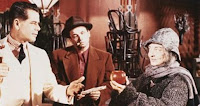
(The image accompanying this post shows Ford, Falk and Davis. Though it seemed imperative to have the two feuding co-stars in a still for my commentary, I couldn't resist including Falk, whose performances gives viewers as much pleasure as it did Capra.)

Monday, December 19, 2011

Movie Quote of the Day (‘Pocketful of Miracles,’ on Its ‘Lady for a Day’)

Junior (played by Mickey Shaughnessy), seeing boozy beggar Apple Annie (played by Bette Davis) transformed into a duchess: “She's like a cockroach what turned into a butterfly!”—Pocketful of Miracles (1961), written by Hal Kanter and Harry Tugend, based on an earlier screenplay by Robert Riskin and the Damon Runyon short story “Madame La Gimp,” directed by Frank Capra

Fifty years ago today, Frank Capra’s remake of his 1933 Gotham fairy tale, Lady for a Day, premiered, with a bigger budget, bigger stars, and longer running time, in New York City. Its failure this time around led the great director to decide that the thrill was gone out of moviemaking in an age when a star (to his aggravation, only a middling one like Glenn Ford) could force him into a compromised product. Partly as a result, this would be his last completed feature film: three years later, he pulled out of Marooned when he tired of incessant studio demands for script approval and budgets.

Capra was right in this respect: among his quartet of holiday movies (the others: Lady for a Day, Meet John Doe, and, of course, It’s a Wonderful Life), this one ranked last. I’m afraid that, like another holiday film, Love, Actually four decades later, the final product of Pocketful of Miracles failed to deliver on its tremendous promise. Miscast are Bette Davis and Ford, as, respectively, the street woman desperate that the daughter who has lived abroad for years not realize how far she has fallen, and the unexpectedly tenderhearted racketeer who decides to turn her into a duchess (or, at least, appear like one). Moreover, the extra 40 minutes gained since Lady for a Day puffed up what at heart is a comic fairy tale.

Not to say that there aren’t moments, even whole stretches, of pure enjoyment. When he wasn’t coping with cluster headaches over his feuding co-stars, Capra delighted in his terrific group of supporting players— not just Shaughnessy but also Sheldon Leonard, Edward Everett Horton, Thomas Mitchell (Uncle Billy of It’s a Wonderful Life), and especially Peter Falk, who was nominated for a Best Supporting Actor Oscar for his turn as Dave the Dude’s underling, the ironically named Joy Boy.

And then there is the dialogue. Much of the best of it sprang from unaccredited Jimmy Cannon (“superb slinger of Broadway’s argot,” Capra called him in his autobiography, The Name Above the Title). The sportswriter managed to blend seamlessly Runyon’s original lingo with his own, so it’s hard to tell the source of such lines as the above, or Joy Boy's exclamation upon seeing a room after a quarrel between Dave and girlfriend Queenie: “Look at this place, like the inside of a goat's stomach!"

For another Runyon Yuletide take, in undiluted form, you might want to turn to the short story “Dancing Dan’s Christmas,” in the Everyman Library anthology Christmas Stories. It now only features the colorful characters and hilarious dialogue that Hollywood and Broadway (Guys and Dolls) have long loved about Runyon, but also an O.Henry-style ending and a distinct undercurrent of danger downplayed on film and the stage (we are, after all, reading about people engaged in criminal enterprises).

Tuesday, June 28, 2011

Quote of the Day (Frank Capra, on Peter Falk)

“Peter Falk was my joy, my anchor to reality. Introducing that remarkable talent to the techniques of comedy made me forget pains, tired blood, and maniacal hankerings to murder Glenn Ford. Thank you, Peter Falk.”—Veteran director Frank Capra, on his 1961 film, Pocketful of Miracles, and its marvelous supporting actor, Peter Falk, in The Name Above the Title: An Autobiography (1971)

At the time of Capra’s memoir, Peter Falk was about to ascend to another level of stardom, as Columbo, TV’s premiere detective of the Seventies and, more rabid fans might insist, of all time. 

Within a few years, many people would forget that for two years in a row, at the beginning of the 1960s, the actor had been nominated for Best Supporting Actor Oscars, in Murder, Inc. and Pocketful of Miracles.

Those who worked with the actor—who, sadly, died of Alzheimer’s this past weekend—never could forget his prior work, though. 

They knew that Falk pulled off the same trick in the early Sixties that he would later in the decade: take two figures on the same side of the law and make of them vastly different human beings, each with their own highly individual, quirky lives.

In Murder, Inc., Falk’s portrayal of violent hitman Reles first caught the attention of Hollywood. 

But a year later, when Frank Capra was fuming over how star Ford was throwing his weight around, Falk managed to save the director’s faith in humanity (though not in Hollywood, as this turned out to be his last movie) as a gangster’s bodyguard, appropriately named Joy Boy, in Pocketful of Miracles.

The energy flags in parts of this remake of the director’s 1933 Lady for a Day (itself an adaptation of Damon Runyon’s short story "Madame le Gimp"), but never when Falk is on screen. 

The climax comes when he’s asked to masquerade as the rich husband of boozy street beggar Apple Annie, whom his boss, bootlegger Dave the Dude, is convinced brings him luck with her fabulous fruits.

In sputtering rage that reaches hilarious heights, Falk's Joy Boy declares, in no uncertain terms, that this is beyond the limit of even his loyalties: “I ain't gonna marry her! An' y'know why? 'Cause my wife don't like it when I go around marryin' people! She's funny that way!” 

This scene alone probably netted him the Oscar nomination.

As for Columbo: In my tween years, I never missed an episode—and, I’m convinced, neither did a number of classmates, who remarked that my raincoat of the time reminded them of the police lieutenant’s. 

We were all caught up on the multiple idiosyncrasies—not just the raincoat, but also the cigar, the car as worn as the raincoat, and the references to a wife who never appeared—that made Columbo as unlikely and memorable a master of crime ratiocination as Sherlock Holmes.

(It's hard to believe anyone else inhabiting this role, but Bing Crosby, of all people, had originally been offered the part. He rejected it, joking that it would interfere with his golf game!)

I was surprised to find out nearly a decade ago that Falk had had an earlier go at the detective show format, in a TV series called The Trials of O’Brien. 

He wasn’t a married police officer this time, but a divorced attorney who, despite constantly having to hustle because of his spendthrift ways, invariably found the killer. Yet the two characters shared the same crafty intelligence.

I watched an episode of this short-lived (one season, 1965-66) series--which mixed comedy with homicide--at the Paley Center for the Arts in Manhattan, and was delighted to see that Elaine Stritch played the lawyer's secretary. (The series came out on DVD a couple of years back, if you can get your hands on it.)

Besides his brilliance (the producer of Trials, Richard Alan Simmons, echoed Capra in calling Falk “a comedic genius”), co-workers remembered the actor for his generosity. 

One of the great guest stars of Trials, Faye Dunaway, found herself, by the early ‘90s, in a career trough. No longer receiving good offers on film, the Oscar-winning actress consulted her old friend about a TV series pitched to her.

Now on his second run as Columbo, Falk pulled out a script that he’d written himself some years ago and had put aside until he could find the appropriate actress. He offered it to Dunaway. The role, on an episode called “It’s All in the Game,” led to an Emmy for the actress--a bright point in a year that saw her own attempt at a sitcom end miserably.

Why was Columbo such a success? As a youngster, I was too caught up in the detective’s uncanny unraveling of the crime to notice the overwhelming pattern of the criminals he stalked: not street hoodlums, but mystery novelists, music maestros, fitness gurus, big-time lawyers--the rich and famous. 

TV analyst Jeff Greenfield noticed the pattern early on, writing in The New York Times in 1973 about “the most thoroughgoing satisfaction ‘Columbo’ offers us”: “the assurance that those who dwell in marble and satin, those whose clothes, food, cars and mates are the very best, do not deserve it.”

For the child of a blue-collar family coming to terms with the role of class in this world, then, watching Columbo offered a fun egalitarian fantasy, a kind of revenge on the nation's elite who brought a perfect storm of disorder and corruption on America in the late '60s and early '70s. Thank you, Peter Falk.