Showing posts with label Barrymore Film Center. Show all posts

Tuesday, June 16, 2026

Review: NT Theatre Live’s ‘Playboy of the Western World,’ by John Millington Synge

Part of the foundation of the Irish theater movement in the early 20th century, the dark comedy The Playboy of the Western World by John Millington Synge was staged over the winter in London’s Lyttelton Theatre. 

With a filmed record of that production available worldwide through National Theatre Live, I was curious to see how well the raucous but poetic speech of the playwright’s Western Ireland characters translated from the printed page to the stage.

Under the direction of Caitríona McLaughlin of Dublin’s famed Abbey Theatre, this performance was certainly faithful to its Celtic origins—in one sense, perhaps too much so. 

Even as the son of an immigrant from this same area of rural Ireland, I sometimes found it difficult to make out the words emitted from these brogues. I could only imagine how puzzled some listeners unused to these accents would feel.

With that said, the show—which I saw last week, four months after its run ended, onscreen at the Barrymore Film Center in Fort Lee, NJ—exhibited its same sprightly subversiveness, though not in the same pious and nationalistic environment that caused riots with a reference to female undergarments (“shifts”) at its Dublin premiere in 1907.

While the Protestant Synge threw some darts at the conservative Roman Catholic Church that held sway at the time over the countryside, he might be surprised to see that a different object of his ironic eye has struck an even louder chord with modern audiences: the lionization of bad boys, even one like his Christy Mahon who is believed to be a patricide.

Under the rapt gaze of his County Mayo listeners, the terrified young runaway Christy (played with elan by Éanna Hardwicke) magnifies his deed with each retelling, until he becomes what local barmaid Pegeen Mike calls “a fine, handsome young fellow with a noble brow."

Nicola Coughlan, who has attracted quite a following here in the US with her roles in Derry Girls and Bridgerton, infused Pegeen with an appropriate fire and spirit made restless by her milquetoast fiancé Shawn Keogh and other layabout local males. 

Siobhán McSweeney made her rival for Christy’s affections, the Widow Quin, a formidable competitor with her own distinct style, forthright and flirtatious.    

The actresses playing other local girls making a play for Christy—especially Marty Breen as Sara Tansey—were equally delightful. And Declan Conlon as Christy’s father, making an unexpected (and, for the newly idolized Christy, unwelcome) return in search of his son, was appropriately fierce and thunderstruck by the scene he beholds.

The acting was vigorous and Katie Davenport’s scene design vivid. But if you want to experience the full tart flavor of Synge’s dialogue, it’s better to have read it before on the page—or to watch the 1962 film adaptation starring Gary Raymond and Siobhan McKenna (now available on DVD).        

Monday, May 25, 2026

Review: The NT Live Production of Arthur Miller’s ‘All My Sons,’ at the Barrymore Film Center, Fort Lee NJ

Under the NT Live banner, Britain’s National Theatre has made available live productions to cinemas around the world. Last year, a movie house not far from me, the Barrymore Film Center in Fort Lee NJ, showed a startling production of Shakespeare’s Macbeth starring Ralph Fiennes and Indira Varma. As I am unlikely to visit the UK any time in the near future, I hoped for another such production soon.

It came a few days ago, as NT Live presented the play that started Arthur Miller in 1946 on his career as the bard of modern age tragedy: All My Sons.

Originally, the Barrymore had promoted a 2019 NT Live production starring Bill Pullman and Sally Field. I’m not sure why, but the theater ended up showing one from the 2025-26 season at Wyndham’s Theatre in London’s West End, with Bryan Cranston and Marianne Jean-Baptist in the same roles.

With all due respect to Pullman and Field, it’s hard to imagine how they could equal, let alone surpass, the two more recent leads for shattering impact.

Not all of director Ivo van Hove’s attempts to bring freshness to taken-for-granted classics are well advised, as I noted over the weekend about how he had (mis)handled Ibsen’s Hedda Gabler. 

As I began watching this performance, I wondered how the elements of this stage design—a large tree, fallen overnight; an unadorned house front; a lit overhead circular portal—would aid or detract from this viewing experience.

But his stripped-down production of Miller’s first Broadway success enables contemporary audiences to focus on his talented performers, in a way that theatergoers more than three-quarters of a century ago, fresh from reading about war profiteers and experiencing losses in the struggle against totalitarianism, were unlikely to have done.

For me, the revelation here was Marianne Jean-Baptiste, whom I had only seen previously in her Oscar-nominated turn in Secrets and Lies. As Kate Keller, she seems to find untapped reserves of fury and sorrow as a wife and mother unable to deal with the realizations that the crime of her munitions-manufacturer husband and the wartime disappearance of her beloved older son Larry might be linked in some way.

Though Bryan Cranston is familiar to TV viewers stateside from the long-running series Breaking Bad and Malcolm in the Middle, he shows further evidence here that the versatility he displayed onstage in Tony-winning roles in Network and All the Way was no fluke.

He masterfully strips away the thin membrane of respectability surrounding his protagonist, Joe Keller: Seemingly cleared of charges of having okayed a shipment of defective parts leading to the deaths of 21 pilots, he suddenly finds himself facing the unwelcome appearance on his doorstep of the two children of the business partner on whom he laid responsibility for the transgression.

The English actress-playwright Hayley Squires brings the requisite amount of sweetness and steel as Larry’s fiancee, Ann Deever, who, as the first step in turning the page with an engagement to the Kellers’ younger son Chris, must find a way to get Kate to stop denying that Larry is dead. 

And Tom Glynn-Carney is sullen and fierce as Ann’s brother George, who confronts the Kellers with the truth they can no longer avoid.

In some ways, Paapa Essiedu has the trickiest role as Chris, the surviving son at sea: drawn to but bashful about courting Ann, chafing at inheriting from his father a business that leaves him uninspired (“If I have to grub for money all day long at least at evening I want it beautiful”), and loving his father while struggling with the vague sense that something is wrong with the parent. He brings fire to his late moment of revelation and resolution.

The first in a quartet of Miller tragedies (followed by Death of a Salesman, The Crucible, and A View From the Bridge) that traced American socio-political dysfunction to a father’s failure to live up to a moral code, All My Sons has been served well by this production that highlights why we are still dealing with the playwright’s theme of corporate irresponsibility and the remorseless pressures of capitalism.

The Barrymore has also done well by bringing it to a select but appreciative audience. I look forward to its NT Live production next month: John Millington Synge’s tragicomedy of Irish country life, The Playboy of the Western World.

Wednesday, January 1, 2025

This Day in Classical Music History (Ingmar Bergman Stages Mozart's ‘Magic Flute’ for Swedish TV)

Jan. 1, 1975—To celebrate the 50-year anniversary of Swedish Radio, Ingmar Bergman premiered his adaptation of The Magic Flute on Swedish TV, reaching an estimated one-third of the nation that night.

Though made on a comparatively modest budget of only $650,000, it was still technologically innovative, featuring the first soundtrack ever recorded in stereo for a television broadcast. And, running counter to the movies-to-TV model of the prior two decades, its premiere in U.S. theaters came 11 months after it was exposed to Swedish TV audiences.

I had heard before that a movie had been made of this Wolfgang Amadeus Mozart opera, but I had never seen it before. And, I might as well confess now, I am hardly an opera aficionado, having attended less than 10 productions of any kind over the years.

But, when I saw that the movie would be played near me in northern New Jersey at the Barrymore Film Center over this past weekend, I was curious. The idea that Bergman, of all people, with his whole filmography of Scandinavian gray skies and gloom to match, might have tackled an opera—well, it struck me as a case of man bites dog.

In other words, this I had to see.

So, what was it like? As I watched, I thought that Bergman was mounting this production as a holiday from his usual anxiety and dread. And, with a new year around the corner, I experienced much the same thing—a revival of spirits that left me continually smiling.

The exterior establishing shot of a grassy outdoor scene led me to expect something naturalistic, shot on location. But those expectations were immediately overturned as the camera switched to the inside of a theater.

Instead of a long list of opening credits, the camera moves throughout the overture to close-ups of faces—and not to the conductor or orchestra musicians, but to featured audience members, especially a young blond girl continually highlighted.

To be sure, Bergman and cinematographer panned to audience members special to them, such as Bergman’s wife and son and actress-muse Liv Ullmann. But what was striking about this seven-minute sequence was the sheer variety of faces—men and women of all ages, ethnicities, and races, even individuals plucked off the street for the occasion.

By the end of the show, contemporary listeners would have appreciated that Mozart intended this work to be savored by people of all kinds.  In our time, with opera suffering from the perception that it caters to an aging, elite audience, the opening sequence can be read as a reminder of the genre’s fundamentally universal aspirations.

We see the cast and crew onstage and backstage, an injection of reality into a landscape of fantasy—with a singer, for instance, suddenly aware of his cue, rushing around, or performers reading another libretto (Wagner’s Parsifal) or far from it (a “Donald Duck” comic book).

How do you adapt a work meant for the opera house to very different audiences—television and movie theaters?

For starters, there is the matter of length. The Magic Flute has been known to stretch to nearly three and a half hours (counting intermission) in the opera house. Bergman trimmed it back to two hours and 15 minutes, including by omitting Act 2 trios and ignoring Mozart’s Masonic references.

As he recalled in Images: My Life in Film, Bergman was exposed to this opera as a child, when he "loved to roam around”:

“One October day I set out for Drottningholm (in Stockholm) to see its unique court theater from the eighteenth century. For some reason the stage door was unlocked. I walked inside and saw for the first time the carefully restored baroque theater. I remember distinctly what a bewitching experience it was: the effect of chiaroscuro, the silence, the stage. In my imagination I have always seen The Magic Flute living inside that old theater, in that keenly acoustical wooden box, with its slanted stage floor, its backdrops and wings. Here lies the noble, magical illusion of theater. Nothing is; everything represents. The moment the curtain is raised, an agreement between stage and audience manifests itself. And now, together, we'll create! In other words, it is obvious that the drama of The Magic Flute should unfold in a baroque theater."

In some ways, Bergman was like the title character in one of his films: “The Magician,” a manufacturer of illusions.  

He had hoped to film at Drottningholm Palace Theatre, one of the few surviving Baroque theatres in the world, but the scenery "was considered too fragile to accommodate a film crew.”

Upon learning this, the director set about meticulously reconstructing the stage—including wings, curtains, and wind machines—in the studios of the Swedish Film Institute. Moreover, the stage dimensions and the props color tones match the original 1791 premiere in Vienna.

In some ways, sound came in for as much care as image, with conductor Eric Ericson and the Swedish Radio Symphony Orchestra recording the score in in an old circus building. Bergman used the “playback” method, scrutinizing prerecorded music so that lip synchronization and performers met his exacting standards.

Even with material that was already light and fluffy, Bergman was unafraid to poke viewers in the ribs. The creature who chases Prince Tamino, for example, may well be the most sorry, silliest dragon ever put on celluloid; the three spirits are borne aloft in a flying machine more out of 19th-century sci-fi than 20th-century aircraft; and periodically, singers hold up cue cards to prompt audiences to chant along.

Kenneth Branagh attempted his own interpretation of the opera in 2006, but it was widely regarded as inferior to Bergman’s. The latter won a BAFTA TV Award for Best Foreign Television Programme and was nominated for a Golden Globe for Best Foreign Language Film and for an Academy Award for Best Costume Design.

That the great Scandinavian film director pulled it off is something of a miracle. His opera adaptation appeared in the same year as Ken Russell’s version of The Who’s rock opera Tommy. It’s hard to imagine more dissimilar approaches to the genre than these two men displayed. While Bergman’s was sprightly, Russell’s was positively surreal.

Friday, December 27, 2024

Exhibit Review: Classic Film Posters, Barrymore Film Center and Museum, Fort Lee, NJ

Film fans often take for granted the unique power of a movie poster. It must intrigue and lure potential audiences without misleading them about the content being advertised. If it’s lucky, it will also be aesthetically beautiful, and freeze the image of the film for ages to come.

I thought of this while viewing “Coming Attractions: Classic Film Posters from the Konstantino Spanoudis iKON Collection,” at the Barrymore Film Center and Museum in Fort Lee, NJ, not far from where I live in Bergen County. If you have a chance, rush to see this exhibit before it closes January 5. Even better, couple your trip with a ticket for one of the classic, independent, or art house movies playing in this burgeoning mecca for cinephiles in the tristate area.

The 70 items on display range from 1910, the dawn of the silent era (which began, this nonprofit center and museum will remind you, in Fort Lee) to 1981, concentrating mostly on the U.S. but with some foreign posters for a wider context.

As you look through the materials, you might be surprised to discover that issues that preoccupy Americans now had their genesis over a century ago. Censors back then, for instance, focused first on these posters—an inexpensive alternative to newspaper advertising.

Lithographers were the original creators of movie posters, and, like the other form they created—circus posters—highlighted, and sometimes exaggerated, lurid content. Opponents’ anger, then, often concentrated on the art itself, which would likely be seen by more passersby than the movies themselves.

As late as the 1930s, American movie posters were still seen as the products of hacks who labored in an industry more respected for the money it generated than as an art. So many motion pictures were being produced then that the useful life of a poster could be only days, leading to their trashing, recycling, or return to exchange.

French, German, and Italian artists often signed their work, enjoying greater recognition than their largely anonymous American counterparts. (A conspicuous exception: Saul Bass, who transformed the movie-poster industry with his art for Otto Preminger, Billy Wilder, and Alfred Hitchcock—and whose seminal work for Anatomy of a Murder is shown here.)

Konstantino Spanoudis, a Greek-born Fort Lee owner and curator of iKON Art Gallery, has amassed well over 6,000 movie posters since he began accumulating this art in the late 1980s.

What’s on display in the museum’s 1,800-sq.-ft. exhibition gallery reflects his fascination especially with classic Hollywood, B-westerns, Abbott and Costello comedies, sports, and “race films” (movies made by Black filmmakers for segregated movie houses).

Nearly 20 of the pieces relate to Bergen County, mostly Fort Lee, including for:

* Fighting Death (Solex Studio, Fort Lee, 1914)

* Silent “vamp” Theda Bara’s Carmen (made at Fort Lee’s Fox Studio, 1915); and

* The multi-part Lincoln epic, Son of Democracy (filmed in Ridgefield Park, 1917).

Among the other titles promoted by these posters:

* Sarah Bernhardt’s Queen Elizabeth (1912), one of the first silents to promote a specific film and star rather than “the movies” in general; and

* Gilda (1946, pictured), the film noir starring Rita Hayworth;

* La Dolce Vita (1960), by Federico Fellini, one of the imports that these posters advertised;

* A trio of James Bond films, from the Sixties dawn of the franchise (Dr. No, Thunderball, and You Only Live Twice);

* Jaws (1975), and;

* Raiders of the Lost Ark (1981).

The industry has progressed from an ephemeral advertising art to one whose most prized items can garner $40,000 to $50,000. The Barrymore exhibit provides a great way to appreciate two fine arts that nobody expected much from at their beginnings: the motion picture industry itself, and the posters that promoted it to a public that eventually couldn’t get enough of it.

Monday, July 8, 2024

Movie Review: ‘Coup de Chance,’ by Woody Allen

There was a time when the release of virtually any Woody Allen movie would be enough to lure me into a theater. But I began to feel queasy after the messy fallout from his relationship with Mia Farrow, over three decades ago. I became even more reluctant in the last decade, as his films grew wispier and less original.

When the MeToo movement made it harder for Allen to line up stateside investors and outlets for his work, he looked abroad for countries that asked fewer questions about filmmakers’ private lives. He settled on France (home to Roman Polanski, whose legal and ethical difficulties with young women have been even worse than Allen's).

As a result, the Brooklyn native has gone far beyond merely filming in France with a largely English-speaking crew (as occurred with Midnight in Paris). Instead, he has directed an entirely Francophone set of film professionals—and without knowing any French.

So I paid scant attention last year, when Coup de Chance was pulled from the Cannes Film Festival for fear that allegations that Allen had molested stepdaughter Dylan Farrow in 1992 would distract attention from the artistic merits of the entire lineup. 

Though it eventually premiered at the Venice Film Festival last September, viewers did not have a chance to see it stateside until this spring, either streaming or in selected theaters. Start-to-finish subtitles didn't help in breaking out to a wider audience.

(I saw it at the Barrymore Film Center, a haven for revival, art-house, and independent cinema aficionados like me in Bergen County, NJ. You would be very lucky to see it anywhere else; it has come and gone in selected theaters in the blink of an eye.)

Predictably, Allen’s notoriety has colored how his new film would be perceived even before most people have had a chance to look at it. “Did he have any 13-year-old girls in it?” a close relative snickered. (The answer: no.)

Coup de Chance, translated into English as “Stroke of Luck,” counterparts the different attitudes toward fate held by the two men who vie for the love of Fanny (played by Lou de Laâge), a beautiful auction house worker: Her middle-aged husband Jean (played by Melvil Poupaud) believes there is no such thing as luck, and his own status—an affluent financial adviser who won the hand of Fanny—seems proof enough for him.

In contrast, the writer Alain (played by Niels Schneider) has encountered Fanny years after developing a crush on her while they were high school classmates in New York. His spontaneity and openness to experience appeal to the long-dormant bohemian instincts of Fanny, who has become bored with the carefully scheduled urban parties and country weekends of Jean.

Much of the film contains the kind of quiet foreboding (e.g., Jean’s love for hunting, and the mysterious fate of his onetime partner) that also characterized Allen’s Crimes and Misdemeanors and Match Point. 

With few of the memorable lines that fill so much of Allen's other work, I grew concerned that he might be simply regurgitating motifs from these earlier entries in what might be called his “Desire, Murder and Guilt” trilogy.

Even within this film, Allen repeats images and references, as if he didn’t want the least attentive viewer to overlook any symbolism.

Once wishes that Allen might have worked with a collaborator on the screenplay, as he did with Marshall Brickman on Sleeper, Annie Hall, and Manhattan, to rescue him from such redundancy, as well as various implausible plot developments.

But, though the screenplay doesn’t glitter, the production moves nimbly, carried along by the cinematography of Vittorio Storaro, the highly competent French cast, and Herbie Hancock’s cool, understated jazz standard “Cantaloupe Island.” 

And the ending still goes to show that Allen, long fascinated with magicians, still knows how to pull a welcome surprise on audiences.

Coup de Chance may well be the last film that Allen completes. Though he told Roger Friedman, in an April interview, that he has two other projects just waiting for someone to finance it, he does not seem to be pressing hard for it.

If this 50th film in his nearly six-decade career onscreen does turn out to be Allen’s finale, it’s not a bad one to bow out on. Against the odds, he’s come up with a French souffle counterpart to Crimes and Misdemeanors and Match Point: light, delicate, and sensual.

Monday, November 6, 2023

Review: Orson Welles’ ‘The War of the Worlds,’ (Re)staged Live at Barrymore Film Center, Fort Lee NJ

In a way, it was natural that Barrymore Film Center would follow the 1953 movie adaptation of H. G. Wells’ novel The War of the Worlds with an even more unusual event: a live stage reading of the notorious 1938 radio broadcast that propelled its 23-year-old wunderkind director, Orson Welles, into the national consciousness.

Eighty-five years after radio listeners heard that Martians had landed in rural Grover’s Mill, NJ, would you believe it happened all over again in another part of the state Saturday night? Only this time it wasn’t millions of listeners unnerved, but a more select group of a few hundred attendees in suburban Fort Lee.

Over the years, several plausible reasons have been suggested for why the CBS broadcast became such a sensation, including an announcement at the start of the show noting that this was a dramatization of the Wells novel that was missed by listeners switching from another station, as well as the air of verisimilitude created by Welles through faux news reports on the invaders and the names of real New Jersey locations (instead of the British ones in Wells’ novel).

But, as I listened to the actors reading with gusto the original radio script by Howard Koch (who would secure even greater fame in a few years with his work on the movie Casablanca), I couldn’t help feeling that Welles had tapped into contemporary fears to an extent that he and his Mercury Theater company of actors didn’t remotely anticipate.

Director Ray Faiola, assuming Welles’ original role in setting the stage for the terror, somberly intoned that “Business was better; the war scare was over”—clear references to America finally easing out of the Great Depression and to the false “peace in our time” proclaimed a month earlier by British Prime Minister Neville Chamberlain after appeasing Adolf Hitler at Munich.

Within a few short years, terror was coming not from a fictional War of the Worlds but an actual World War II, with devastation engulfing entire nations rather than simply patches of the Garden State.

At the same time, I felt my own sense of unease about the script’s application to human beings of our time unaware of what they were doing to the climate as I heard the lines, “With infinite complacence people went to and fro over the earth about their little affairs, serene in the assurance of their dominion over this small spinning fragment of solar driftwood which by chance or design man has inherited out of the dark mystery of Time and Space.”

Throughout, Faiola—a retired director of audience services for CBS, and currently appearing on the small screen in “The Secret Diary of an Exchange Student,” “Darcy,” and “Confession”—ably read Welles’ lines from decades ago, even as he monitored the effects from technical supervisor Eldric Etra.

 (An extra thrill of the proceedings was hearing once again the incidental music of composer Bernard Herrmann, who would go on to score Welles’ Citizen Kane and much of Alfred Hitchcock’s best work from the Fifties and Sixties.)

At the end of the show, after all the terror of the events he narrated, Faiola seemed particularly amused as he read Welles’ non-apology apology after CBS urged him to make a statement on the hullabaloo:

“Of course we are deeply shocked and deeply regretful about the results of last night’s broadcast. It came as rather a great surprise to us that the H. G. Welles classic—which is the original for many fantasies about invasions by mythical monsters from the planet Mars—I was extremely surprised to learn that a story which has become familiar to children through the medium of comic strips and many succeeding novels and adventure stories, should have had such an immediate and profound effect on radio listeners.

Faiola and the quartet of actors with him onstage—Sean Marrinan, Wayne Pyle, Craig Marin and Kevin Miller—have had considerable experience with bringing back to life the world of radio drama, as they have been longtime participants in Halloween “Terror at the Mike” thriller series that have been staged in Ellenville, NY. The audience on Saturday night was the great beneficiary of their feeling and reverence for the medium.

It appears that this might have been the first time that the Barrymore—which opened a little over a year ago—has tried this kind of experiment. Judging from the healthy attendance and the appreciative response of the crowd, I wouldn’t be surprised if this kind of re-staged radio dramatization becomes an annual event—maybe even around Halloween again?

Sunday, August 27, 2023

Fairbanks and Pickford, Hollywood’s First ‘Power Couple,’ Recalled in Fort Lee Exhibit

Try to imagine, if you can, what the motion picture industry was like a century ago. Color film was decades away, and even talkies hadn’t arrived yet.

But the studio system had come into being, and, most important of all, the star system. Two stars in particular, married to each other, burned especially brightly, not only headlining their own movies but producing their own projects. And film fans couldn’t get enough of their love story.

The pair I’m talking about, Douglas Fairbanks and Mary Pickford, are the subject of an exhibit running through December at the Barrymore Film Center in Fort Lee, NJ.

Readers of this blog know that I’ve made it a point to catch several vintage movies in the theater at this relatively recent addition to the Bergen County cultural scene. But the museum space is also a must for movie aficionados.

Although the museum’s first exhibit, on John, Lionel, and Ethel Barrymore, featured a family with Bergen County connections, this current exhibit, “Power Couple: Douglas Fairbanks and Mary Pickford in Hollywood," is remarkable in its own way.

Unlike the Barrymores, Fairbanks and Pickford never lived in Fort Lee. But they worked in the borough during the early days of the silent film industry.

A forerunner of Errol Flynn, Harrison Ford, Arnold Schwarzenegger, and Tom Cruise, Fairbanks was Hollywood’s first great swashbuckling action hero, an actor who endowed costume dramas like The Thief of Baghdad, Robin Hood, and The Mark of Zorro with his enormous charisma and athletic ability, even performing his own stunts, in independent films he produced.

Pickford was, like Fairbanks, a producer in her own right—in fact, as the first woman to own her own movie company, as well as theaters themselves and a studio lot, the most powerful female in Hollywood.

That clout derived from her box-office success as “America’s Sweetheart,” with audiences flocking to see this actress in her twenties playing innocent, virginal, but spunky girls (an illusion enhanced by her 5-foot-tall frame, bashful glance, and blond curls).

The two stars met not long after Fairbanks came out to Hollywood in 1915. At first, because they had other spouses at the time, they tried to conceal their attraction from each other and, more important, the public.

But, while spearheading the drive for Liberty Bonds during WWI, the two not only found a way to cement Hollywood’s relationship to Washington decision-makers for the next century, but their own liaison. Married at last in 1920, they lived and threw parties in one of the most lavish estates in Beverly Hills, “Pickfair.”

Together with friends Charlie Chaplin and D.W. Griffith, Fairbanks and Pickford formed their own film studio in 1919, United Artists—a venture meant to ensure that the creative talent—directors and stars—rather than moguls or banks, would control the distribution network of films.

Although their popularity as the king and queen of Hollywood lasted for more than a decade, they became two of the casualties of the transition from silents to sound pictures. Both Fairbanks and Pickford chafed at the restrictions placed by limited microphone mobility on camera movements in the new era.

Additionally, they had trouble adjusting their old personas for audiences. Years of chain smoking left Fairbanks unable to exhibit the daredevil stunt work that had been his stock in trade. The aging Pickford found the ingenue roles that had made her the highest-paid actress in Hollywood to be golden handcuffs as she tried to transition to more adult roles. (Her decision to cut her trademark hair was not only front-page news but inspired an outpouring of protests from fans.)

The two would make only one film together—a 1929 adaptation of The Taming of the Shrew, the first time that the talkies had put Shakespeare onscreen—but it did little to recalibrate audience expectations of their onetime idols. With each facing disappointment, they became less active onscreen, with Pickford even retiring from screen acting (though not producing) in the early 1930s.

Inevitably the marriage crumbled, with the two divorcing and remarrying to different partners in the mid-1930s. Fairbanks died of a heart attack in 1939.

Pickford, though living four decades longer than her ex-husband, was not necessarily luckier in her passage into history. In 1976, millions of Oscar watchers (including me) were aghast when the producers of the shot presented the ailing, 83-year-old Pickford with a lifetime achievement award at Pickford.

The sight of the venerable star, outfitted with wig of blonde curls, false eyelashes, and gaudy lipstick, was shocking enough that columnist Mike Royko wrote, “"Mary Pickford, the one-time screen darling of America, has managed to offend people. She did it by growing old.”

I could not close this post without considering the two stars in their heyday—what they meant to each other and to the overall Hollywood dream factory. More than 200 items in the Fort Lee museum exhibit help in this regard.

They trace the evolution of the Fairbanks-Pickford relationship, including stills, posters, window cards, set and costume designs, boots and practice swords used by Fairbanks in career highlights like Robin Hood, and Pickford’s hairbrush set.

Most poignantly, there is a small sample of the many love letters that Fairbanks sent Pickford throughout their relationship—which, despite their eventual divorce, she kept in a box in Pickfair until the day she died.

Tuesday, March 21, 2023

Exhibit Review: ‘The Royal Family’ of Broadway, Hollywood—and Fort Lee, NJ

In the late 1920s, when the George S. Kaufman-Edna Ferber comedy The Royal Family played to packed audiences at the at the Selwyn Theater, audiences knew that the group in the title were not Britain’s Windsors but an American acting dynasty strongly resembling the Barrymores. When Paramount Pictures adapted the play for the big screen in 1930, the studio felt it best, considering the many non-theater aficionados outside the Big Apple, to tack “of Broadway” at the end of the title.

Over the last century, with siblings John, Lionel, and Ethel filming one classic after another—and with John’s granddaughter Drew making her own contribution to the industry as an actress-producer—the Barrymores could just as easily be called “The Royal Family of Hollywood.” Now, with an exhibit about the multi-generational thespians now running in a film center named for them in northern New Jersey, they could also be labeled “The Royal Family of Fort Lee.”

In a late January blog post of mine that related my discovery of the Barrymore Film Center, I promised that I would discuss a first-floor exhibit on the family that runs through the end of March. It really is must viewing for anyone interested in film and theater history—even, more broadly, New Jersey and Fort Lee history.

The exhibit curators have scoured far and wide for photos, posters, sculptures, props, and other materials associated with John, Lionel, and Ethel Barrymore. Separate walls tell the story of each sibling—all loaded with talent, looks, and money, but also with more than the normal share of offstage drama that actors often encounter.

The dynasty started not with this trio but with John Drew, who became an actor and theater manager after emigrating from Ireland in the 1830s. In turn, his daughter Georgiana, herself an actress, wed Herbert Blythe, an Indian-born British stage actor professionally known as Maurice Barrymore. It is he who, in effect, became the patriarch of “The Royal Family.”

A talented comic actor who became one of the first Broadway stars to star in vaudeville, Maurice did well enough financially to buy a summer cottage in what is now the Coytesville section of Fort Lee, several blocks from the film center. (Despite ardent efforts by film buffs, that house was demolished 22 years ago.)

As the museum chronicles, Fort Lee, because of its proximity to Broadway, the Hudson River and Palisades, became the de facto birthplace of the American film industry. It’s appropriate, then, that three of Maurice’s acting progeny, all of whom spent much of their youth in the town—Lionel, Ethel, and John Barrymore—came as close as you can get to being present at the creation of this narrative art form.

(Oddly enough, though the three had more than 300 screen appearances among them, they only appeared together once on the big screen—the 1932 film Rasputin and the Empress. A poster for that movie, part of the exhibit, is the image accompanying this post.)

Moviegoers of the past few decades are likely to be familiar with the four decade career, as actress, producer, talk-show host, and gossip-page fixture, of Drew Barrymore. But her triumphs and travails pale in comparison with the great sibling triumvirate who dominate the Barrymore Center exhibit.

Still, you’ll likely be in for something of shock when you first enter the exhibit room to see a photo of a young woman who bears a startling resemblance to the current best-known member of the family. But it’s not Drew but Ethel Barrymore—a similarity all the more surprising because Ethel was Drew’s grandaunt rather than, more directly, her grandmother.

Among the items that depict Ethel here are a photo, a portrait, a bust of the actress, and a poster from her first movie, The Nightingale, shot in 1914 right in Fort Lee.

Unlike her brothers, “The First Lady of the American Theater” worked primarily on the stage, as she followed in the tradition of her grandfather, John Drew, as star and manager of Broadway’s Ethel Barrymore Theater, which the Shubert Organization created as a vehicle for her.

A guide at the museum told me that her favorite member of the family was Lionel Barrymore, and the artifacts on display make a compelling case for his versatility.

Then in their toddler stage, films in the silent and early talkies era left Lionel and many other denizens of Hollywood skeptical about their cultural potential—even when, as in his case, he went behind the camera to direct, rather than his usual position in front.

(He is best known, of course, for his performance as miserly Mr. Potter in the Yuletide classic It’s a Wonderful Life—a kind of American counterpart to his annual radio broadcasts over two decades as Scrooge in Dickens’ A Christmas Carol.)

The creative instinct that Lionel couldn’t display, even as a well-compensated contract player for MGM Studio, he satisfied by picking up a paintbrush or playing the piano and oboe. While walking through the gallery, you’ll hear his First Piano Concerto and Memoriam on the Death of John Barrymore.

Although Ethel and Lionel displayed more self-discipline, John Barrymore has always fascinated me the most of the trio. His talent was matched by an appearance that gave rise to the nickname “The Great Profile.”

Unfortunately both were exceeded by a raucous lifestyle that spawned a million anecdotes—most, remarkably enough, true. (When asked if the very young Romeo and Juliet had a physical relationship, he cracked, “They certainly did in the Chicago company.”)

Committing his father to Bellevue in 1901 was a searing experience for John, but he could not escape the family propensity for substance abuse—and he seems to have passed this genetic inheritance to children Diana and John Drew Barrymore and the latter’s daughter, Drew.

By the early 1930s, John was having trouble showing up on time for studio work and memorizing his lines. Within a decade, as a has-been Shakespearean actor in the stage comedy My Dear Children, he verged close to self-parody.

But the exhibit also includes evidence that John at his best was an electrifying, even pioneering, actor, such as the chair and dagger he used in a 1920 stage production of Hamlet (proclaimed for years as the best many had seen) and the suit of armor he donned for Richard III.

If you have a chance, see the Barrymore exhibit before it closes March 26. Both aficionados of this legendary family and those with only the slightest inkling of what they once meant to the early film industry will come away with greater appreciation for this trio who left their unmistakable marks on American entertainment.

Saturday, January 28, 2023

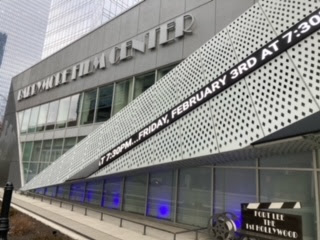
Photo of the Day: Barrymore Film Center, Fort Lee NJ

Late this afternoon, filled with curiosity while in Fort Lee, NJ, I walked over to the Barrymore Film Center, which opened late this past October after a two-year delay caused by COVID. Longtime readers of this blog might be surprised to know that it took this movie aficionado so long to make my way over there.

I wasn’t really expecting much when I heard about this space, a combination of a repertory film theater and museum. But, at $16 million, it’s a handsome structure.

Increased development in the borough over the past decade or so has made traffic and parking more difficult to negotiate.

But I expect that, come what may, I will find a way to return soon—and, with luck, often—to this site that celebrates not only Fort Lee as the birthplace of the motion-picture industry in the silent era, but also its greatest acting family—a dynasty whose most illustrious siblings (Lionel, Ethel, and John Barrymore) grew up in a rambling summer house in the Coytesville section of town.

Within a few weeks, I hope to post on an exhibition running into March on the Barrymores—and, perhaps, on the 267-seat theater. (Among the classics scheduled for the next week: The Lost Weekend, The Apartment, The Birds, North by Northwest, and Vertigo.)