Showing posts with label Fort Lee (NJ). Show all posts

Friday, December 27, 2024

Exhibit Review: Classic Film Posters, Barrymore Film Center and Museum, Fort Lee, NJ

Film fans often take for granted the unique power of a movie poster. It must intrigue and lure potential audiences without misleading them about the content being advertised. If it’s lucky, it will also be aesthetically beautiful, and freeze the image of the film for ages to come.

I thought of this while viewing “Coming Attractions: Classic Film Posters from the Konstantino Spanoudis iKON Collection,” at the Barrymore Film Center and Museum in Fort Lee, NJ, not far from where I live in Bergen County. If you have a chance, rush to see this exhibit before it closes January 5. Even better, couple your trip with a ticket for one of the classic, independent, or art house movies playing in this burgeoning mecca for cinephiles in the tristate area.

The 70 items on display range from 1910, the dawn of the silent era (which began, this nonprofit center and museum will remind you, in Fort Lee) to 1981, concentrating mostly on the U.S. but with some foreign posters for a wider context.

As you look through the materials, you might be surprised to discover that issues that preoccupy Americans now had their genesis over a century ago. Censors back then, for instance, focused first on these posters—an inexpensive alternative to newspaper advertising.

Lithographers were the original creators of movie posters, and, like the other form they created—circus posters—highlighted, and sometimes exaggerated, lurid content. Opponents’ anger, then, often concentrated on the art itself, which would likely be seen by more passersby than the movies themselves.

As late as the 1930s, American movie posters were still seen as the products of hacks who labored in an industry more respected for the money it generated than as an art. So many motion pictures were being produced then that the useful life of a poster could be only days, leading to their trashing, recycling, or return to exchange.

French, German, and Italian artists often signed their work, enjoying greater recognition than their largely anonymous American counterparts. (A conspicuous exception: Saul Bass, who transformed the movie-poster industry with his art for Otto Preminger, Billy Wilder, and Alfred Hitchcock—and whose seminal work for Anatomy of a Murder is shown here.)

Konstantino Spanoudis, a Greek-born Fort Lee owner and curator of iKON Art Gallery, has amassed well over 6,000 movie posters since he began accumulating this art in the late 1980s.

What’s on display in the museum’s 1,800-sq.-ft. exhibition gallery reflects his fascination especially with classic Hollywood, B-westerns, Abbott and Costello comedies, sports, and “race films” (movies made by Black filmmakers for segregated movie houses).

Nearly 20 of the pieces relate to Bergen County, mostly Fort Lee, including for:

* Fighting Death (Solex Studio, Fort Lee, 1914)

* Silent “vamp” Theda Bara’s Carmen (made at Fort Lee’s Fox Studio, 1915); and

* The multi-part Lincoln epic, Son of Democracy (filmed in Ridgefield Park, 1917).

Among the other titles promoted by these posters:

* Sarah Bernhardt’s Queen Elizabeth (1912), one of the first silents to promote a specific film and star rather than “the movies” in general; and

* Gilda (1946, pictured), the film noir starring Rita Hayworth;

* La Dolce Vita (1960), by Federico Fellini, one of the imports that these posters advertised;

* A trio of James Bond films, from the Sixties dawn of the franchise (Dr. No, Thunderball, and You Only Live Twice);

* Jaws (1975), and;

* Raiders of the Lost Ark (1981).

The industry has progressed from an ephemeral advertising art to one whose most prized items can garner $40,000 to $50,000. The Barrymore exhibit provides a great way to appreciate two fine arts that nobody expected much from at their beginnings: the motion picture industry itself, and the posters that promoted it to a public that eventually couldn’t get enough of it.

Sunday, August 27, 2023

Fairbanks and Pickford, Hollywood’s First ‘Power Couple,’ Recalled in Fort Lee Exhibit

Try to imagine, if you can, what the motion picture industry was like a century ago. Color film was decades away, and even talkies hadn’t arrived yet.

But the studio system had come into being, and, most important of all, the star system. Two stars in particular, married to each other, burned especially brightly, not only headlining their own movies but producing their own projects. And film fans couldn’t get enough of their love story.

The pair I’m talking about, Douglas Fairbanks and Mary Pickford, are the subject of an exhibit running through December at the Barrymore Film Center in Fort Lee, NJ.

Readers of this blog know that I’ve made it a point to catch several vintage movies in the theater at this relatively recent addition to the Bergen County cultural scene. But the museum space is also a must for movie aficionados.

Although the museum’s first exhibit, on John, Lionel, and Ethel Barrymore, featured a family with Bergen County connections, this current exhibit, “Power Couple: Douglas Fairbanks and Mary Pickford in Hollywood," is remarkable in its own way.

Unlike the Barrymores, Fairbanks and Pickford never lived in Fort Lee. But they worked in the borough during the early days of the silent film industry.

A forerunner of Errol Flynn, Harrison Ford, Arnold Schwarzenegger, and Tom Cruise, Fairbanks was Hollywood’s first great swashbuckling action hero, an actor who endowed costume dramas like The Thief of Baghdad, Robin Hood, and The Mark of Zorro with his enormous charisma and athletic ability, even performing his own stunts, in independent films he produced.

Pickford was, like Fairbanks, a producer in her own right—in fact, as the first woman to own her own movie company, as well as theaters themselves and a studio lot, the most powerful female in Hollywood.

That clout derived from her box-office success as “America’s Sweetheart,” with audiences flocking to see this actress in her twenties playing innocent, virginal, but spunky girls (an illusion enhanced by her 5-foot-tall frame, bashful glance, and blond curls).

The two stars met not long after Fairbanks came out to Hollywood in 1915. At first, because they had other spouses at the time, they tried to conceal their attraction from each other and, more important, the public.

But, while spearheading the drive for Liberty Bonds during WWI, the two not only found a way to cement Hollywood’s relationship to Washington decision-makers for the next century, but their own liaison. Married at last in 1920, they lived and threw parties in one of the most lavish estates in Beverly Hills, “Pickfair.”

Together with friends Charlie Chaplin and D.W. Griffith, Fairbanks and Pickford formed their own film studio in 1919, United Artists—a venture meant to ensure that the creative talent—directors and stars—rather than moguls or banks, would control the distribution network of films.

Although their popularity as the king and queen of Hollywood lasted for more than a decade, they became two of the casualties of the transition from silents to sound pictures. Both Fairbanks and Pickford chafed at the restrictions placed by limited microphone mobility on camera movements in the new era.

Additionally, they had trouble adjusting their old personas for audiences. Years of chain smoking left Fairbanks unable to exhibit the daredevil stunt work that had been his stock in trade. The aging Pickford found the ingenue roles that had made her the highest-paid actress in Hollywood to be golden handcuffs as she tried to transition to more adult roles. (Her decision to cut her trademark hair was not only front-page news but inspired an outpouring of protests from fans.)

The two would make only one film together—a 1929 adaptation of The Taming of the Shrew, the first time that the talkies had put Shakespeare onscreen—but it did little to recalibrate audience expectations of their onetime idols. With each facing disappointment, they became less active onscreen, with Pickford even retiring from screen acting (though not producing) in the early 1930s.

Inevitably the marriage crumbled, with the two divorcing and remarrying to different partners in the mid-1930s. Fairbanks died of a heart attack in 1939.

Pickford, though living four decades longer than her ex-husband, was not necessarily luckier in her passage into history. In 1976, millions of Oscar watchers (including me) were aghast when the producers of the shot presented the ailing, 83-year-old Pickford with a lifetime achievement award at Pickford.

The sight of the venerable star, outfitted with wig of blonde curls, false eyelashes, and gaudy lipstick, was shocking enough that columnist Mike Royko wrote, “"Mary Pickford, the one-time screen darling of America, has managed to offend people. She did it by growing old.”

I could not close this post without considering the two stars in their heyday—what they meant to each other and to the overall Hollywood dream factory. More than 200 items in the Fort Lee museum exhibit help in this regard.

They trace the evolution of the Fairbanks-Pickford relationship, including stills, posters, window cards, set and costume designs, boots and practice swords used by Fairbanks in career highlights like Robin Hood, and Pickford’s hairbrush set.

Most poignantly, there is a small sample of the many love letters that Fairbanks sent Pickford throughout their relationship—which, despite their eventual divorce, she kept in a box in Pickfair until the day she died.

Tuesday, March 21, 2023

Exhibit Review: ‘The Royal Family’ of Broadway, Hollywood—and Fort Lee, NJ

In the late 1920s, when the George S. Kaufman-Edna Ferber comedy The Royal Family played to packed audiences at the at the Selwyn Theater, audiences knew that the group in the title were not Britain’s Windsors but an American acting dynasty strongly resembling the Barrymores. When Paramount Pictures adapted the play for the big screen in 1930, the studio felt it best, considering the many non-theater aficionados outside the Big Apple, to tack “of Broadway” at the end of the title.

Over the last century, with siblings John, Lionel, and Ethel filming one classic after another—and with John’s granddaughter Drew making her own contribution to the industry as an actress-producer—the Barrymores could just as easily be called “The Royal Family of Hollywood.” Now, with an exhibit about the multi-generational thespians now running in a film center named for them in northern New Jersey, they could also be labeled “The Royal Family of Fort Lee.”

In a late January blog post of mine that related my discovery of the Barrymore Film Center, I promised that I would discuss a first-floor exhibit on the family that runs through the end of March. It really is must viewing for anyone interested in film and theater history—even, more broadly, New Jersey and Fort Lee history.

The exhibit curators have scoured far and wide for photos, posters, sculptures, props, and other materials associated with John, Lionel, and Ethel Barrymore. Separate walls tell the story of each sibling—all loaded with talent, looks, and money, but also with more than the normal share of offstage drama that actors often encounter.

The dynasty started not with this trio but with John Drew, who became an actor and theater manager after emigrating from Ireland in the 1830s. In turn, his daughter Georgiana, herself an actress, wed Herbert Blythe, an Indian-born British stage actor professionally known as Maurice Barrymore. It is he who, in effect, became the patriarch of “The Royal Family.”

A talented comic actor who became one of the first Broadway stars to star in vaudeville, Maurice did well enough financially to buy a summer cottage in what is now the Coytesville section of Fort Lee, several blocks from the film center. (Despite ardent efforts by film buffs, that house was demolished 22 years ago.)

As the museum chronicles, Fort Lee, because of its proximity to Broadway, the Hudson River and Palisades, became the de facto birthplace of the American film industry. It’s appropriate, then, that three of Maurice’s acting progeny, all of whom spent much of their youth in the town—Lionel, Ethel, and John Barrymore—came as close as you can get to being present at the creation of this narrative art form.

(Oddly enough, though the three had more than 300 screen appearances among them, they only appeared together once on the big screen—the 1932 film Rasputin and the Empress. A poster for that movie, part of the exhibit, is the image accompanying this post.)

Moviegoers of the past few decades are likely to be familiar with the four decade career, as actress, producer, talk-show host, and gossip-page fixture, of Drew Barrymore. But her triumphs and travails pale in comparison with the great sibling triumvirate who dominate the Barrymore Center exhibit.

Still, you’ll likely be in for something of shock when you first enter the exhibit room to see a photo of a young woman who bears a startling resemblance to the current best-known member of the family. But it’s not Drew but Ethel Barrymore—a similarity all the more surprising because Ethel was Drew’s grandaunt rather than, more directly, her grandmother.

Among the items that depict Ethel here are a photo, a portrait, a bust of the actress, and a poster from her first movie, The Nightingale, shot in 1914 right in Fort Lee.

Unlike her brothers, “The First Lady of the American Theater” worked primarily on the stage, as she followed in the tradition of her grandfather, John Drew, as star and manager of Broadway’s Ethel Barrymore Theater, which the Shubert Organization created as a vehicle for her.

A guide at the museum told me that her favorite member of the family was Lionel Barrymore, and the artifacts on display make a compelling case for his versatility.

Then in their toddler stage, films in the silent and early talkies era left Lionel and many other denizens of Hollywood skeptical about their cultural potential—even when, as in his case, he went behind the camera to direct, rather than his usual position in front.

(He is best known, of course, for his performance as miserly Mr. Potter in the Yuletide classic It’s a Wonderful Life—a kind of American counterpart to his annual radio broadcasts over two decades as Scrooge in Dickens’ A Christmas Carol.)

The creative instinct that Lionel couldn’t display, even as a well-compensated contract player for MGM Studio, he satisfied by picking up a paintbrush or playing the piano and oboe. While walking through the gallery, you’ll hear his First Piano Concerto and Memoriam on the Death of John Barrymore.

Although Ethel and Lionel displayed more self-discipline, John Barrymore has always fascinated me the most of the trio. His talent was matched by an appearance that gave rise to the nickname “The Great Profile.”

Unfortunately both were exceeded by a raucous lifestyle that spawned a million anecdotes—most, remarkably enough, true. (When asked if the very young Romeo and Juliet had a physical relationship, he cracked, “They certainly did in the Chicago company.”)

Committing his father to Bellevue in 1901 was a searing experience for John, but he could not escape the family propensity for substance abuse—and he seems to have passed this genetic inheritance to children Diana and John Drew Barrymore and the latter’s daughter, Drew.

By the early 1930s, John was having trouble showing up on time for studio work and memorizing his lines. Within a decade, as a has-been Shakespearean actor in the stage comedy My Dear Children, he verged close to self-parody.

But the exhibit also includes evidence that John at his best was an electrifying, even pioneering, actor, such as the chair and dagger he used in a 1920 stage production of Hamlet (proclaimed for years as the best many had seen) and the suit of armor he donned for Richard III.

If you have a chance, see the Barrymore exhibit before it closes March 26. Both aficionados of this legendary family and those with only the slightest inkling of what they once meant to the early film industry will come away with greater appreciation for this trio who left their unmistakable marks on American entertainment.

Saturday, March 18, 2023

Photo of the Day: Fort Lee Mural

This afternoon while in Fort Lee, a few miles from where I live in Bergen County, NJ, I had a little extra time, so I took a five-minute walk north of the George Washington Bridge. 

I’ve become accustomed to how much the borough has changed over the years. But the mural you see here—and which I promptly photographed—was a sight I hadn’t come across before.

The mural, located at 1637 Palisade Avenue, was unveiled this past August. It was created by Dan Kitchener, a London-based artist whose street art can also be seen in Tokyo, Hong Kong, Russia, the United Kingdom, and elsewhere in Europe.

Saturday, January 28, 2023

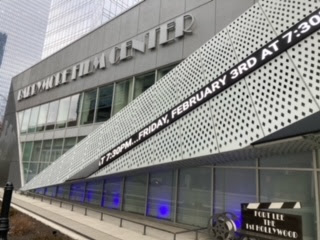
Photo of the Day: Barrymore Film Center, Fort Lee NJ

Late this afternoon, filled with curiosity while in Fort Lee, NJ, I walked over to the Barrymore Film Center, which opened late this past October after a two-year delay caused by COVID. Longtime readers of this blog might be surprised to know that it took this movie aficionado so long to make my way over there.

I wasn’t really expecting much when I heard about this space, a combination of a repertory film theater and museum. But, at $16 million, it’s a handsome structure.

Increased development in the borough over the past decade or so has made traffic and parking more difficult to negotiate.

But I expect that, come what may, I will find a way to return soon—and, with luck, often—to this site that celebrates not only Fort Lee as the birthplace of the motion-picture industry in the silent era, but also its greatest acting family—a dynasty whose most illustrious siblings (Lionel, Ethel, and John Barrymore) grew up in a rambling summer house in the Coytesville section of town.

Within a few weeks, I hope to post on an exhibition running into March on the Barrymores—and, perhaps, on the 267-seat theater. (Among the classics scheduled for the next week: The Lost Weekend, The Apartment, The Birds, North by Northwest, and Vertigo.)

Thursday, November 5, 2020

Photo of the Day: 'Rebelmen’ Statue, Monument Park, Fort Lee NJ

Monument Park, the only park in the U. S. dedicated to the soldiers of the American Revolution, opened in 1908, with future WWI hero General John "Black Jack" Pershing among the 20,000 people on hand for the ceremonies.

Among the sites at this 727-acre space in Fort Lee NJ (which I photographed in July 2018) is this statue by Charles Tefft that evokes one of the most famous passages in Thomas Paine’s The American Crisis:

“These are the times that try men's souls. The summer soldier and the sunshine patriot will, in this crisis, shrink from the service of their country; but he that stands by it now, deserves the love and thanks of man and woman. Tyranny, like hell, is not easily conquered; yet we have this consolation with us, that the harder the conflict, the more glorious the triumph. What we obtain too cheap, we esteem too lightly: it is dearness only that gives every thing its value.”

Every age has its “times that try men’s souls.” These days are ours—maybe not as dramatic as when Paine published his lines in December 1776, just 72 hours before Battle of Trenton, but still a time when the spirit of freedom needs to be defended.

Friday, January 25, 2019

Photo of the Day: Monument Park, Fort Lee, NJ


I took the image accompanying this post late last July. It shows Monument Park in Fort Lee, NJ. At its dedication in 1909, General John "Black Jack" Pershing—within a decade, leader of the U.S. forces in World War I—attended the ceremony. 

This 727-acre site at Palisade Avenue and Angioletti Place was, during the American Revolution, part of Fort Constitution, manned by soldiers of the Continental Army under George Washington. As Winston Churchill would say later of the Royal Air Force, “Never was so much owed by so many to so few”—in this case, a mere 2,600 American troops against the mightiest imperial power of the late 18th century. 

It’s a busy neighborhood—and even more so with all the development going on in town now—but I hope visitors park their cars and take a few minutes to sit in this park and remember what we owe these embattled soldiers from so long ago.

Saturday, August 11, 2018

Photo of the Day: Church of the Good Shepherd, Fort Lee NJ


I took the accompanying photo of this picturesque Gothic Revival church last weekend, while walking around in Fort Lee, several miles from where I live in Bergen County, NJ. The Church of the Good Shepherd, built in 1867, is Episcopalian.

Monday, August 6, 2018

Photo of the Day: Evolving Fort Lee Skyline, NJ


If you grew up around Fort Lee but haven’t been back in a while, the attached image would astonish you. Even if you have been back more recently, you are still likely to feel some surprise at what the development of the last few years has wrought, as I was a few weeks ago when I took this shot.

Monday, November 21, 2016

Photo of the Day: Field of Heroes, Fort Lee High School, NJ


This past Saturday, driving on Lemoine Avenue in Fort Lee, N.J., I was struck by a remarkable sight on the left hand side of the road: thousands of flags on the front lawn of Fort Lee High School. I had to pull over to the side of the road, park, and take a picture of this. I suspected that the display had been put up around Veterans Day, but wondered how much longer it would stay there.

In answer to the latter question, it turned out, not for long—a post on the school’s Web site indicated that members of the student council and the band were due to remove them this afternoon. But this is not the first time they were up—the 5,000 flags honoring veterans and emergency service personnel first appeared three years ago and have been placed on the lawn at least twice since then. I sure hope we’ll see them again next year, too.

I could not let this occasion go by without thanking the school and its students for this visually powerful, profoundly moving tribute to American heroes who, at constant risk to their own lives, strive to keep the rest of us safe.