Showing posts with label William Wyler. Show all posts

Sunday, November 30, 2025

Flashback, November 1900: Dreiser’s ‘Sister Carrie’ Released by Half-Hearted Publisher

When the publishing firm Doubleday, Page released Sister Carrie in November 1900, it was without publicity, reflecting the company’s growing doubts and lack of enthusiasm. 

Though an-house reader, novelist Frank Norris, enthusiastically recommended it, one executive or another must have had second doubts after taking it on, as Doubleday tried to offload it on another firm, until author Theodore Dreiser insisted that they were contractually obliged to put it out.

Praise on both sides of the Atlantic didn’t help the reception of the fictional debut of journalist Dreiser. Only a third of its first printing of 1,000 copies were sold, and Doubleday turned over what was left to a remainder house.

Little did anyone know that Sister Carrie would become a landmark in American literature, highlighting the rise of naturalism—a movement that viewed human beings as animalistic, subject to environmental and heredity forces, usually beyond their control. Free will played little to no role in characters’ actions.

If this sounds like a vision colored by Charles Darwin’s theory of evolution, you would be right. In depicting situations with the exactitude and objectivity of a scientist, Dreiser found a writing mode in which he could use to best advantage his skill as a fact-gathering journalist. 

(One key scene in Sister Carrie was based on a five-week Brooklyn trolley strike he had covered in 1895 for the New York World, when he actually rode the rails and observed clashes between union workers and scan drivers.)

Along with his champion Norris and Stephen Crane (another reporter-turned-fiction writer), Dreiser was one of the primary exponents of naturalism, revealing life among the lower classes to a degree most readers had never experienced.

As critical acceptance of this novel grew, it found its way into academe. Its relatively moderate length (roughly 500 pages) has facilitated its listing in many college American literature survey courses, and despite its massive size (900-plus pages), Dreiser’s later An American Tragedy also continues to be regarded as a classic.

Still, it is doubtful that any reader has enjoyed Sister Carrie. It’s not just that Dreiser lacked a sense of humor that could occasionally brighten his unrelentingly grim subject matter and worldview.

No, unlike Crane, Jack London, or European practitioners of naturalism like Emile Zola or Guy de Maupassant, Dreiser could not resist a hopelessly verbose, ham-fisted style, with clotted, cliched sentences.

When he mounted a rhetorical soapbox, not only do his chapter titles induce cringes (e.g., “When Waters Engulf Us We Reach for a Star”), but longer passages can strain credulity, as in this one introducing the title character, inexperienced teenager Carrie Meeber, traveling to the big city:

“When a girl leaves her home at eighteen, she does one of two things. Either she falls into saving hands and becomes better, or she rapidly assumes the cosmopolitan standard of virtue and becomes worse.”

In tone, that was out of sync with a quiet mastery of detail that lent his narrative believability.

No stranger to temptations of the flesh, Dreiser recorded, with a candor unusual for the time, his characters’ sexual desire. Even before publication, he had only reluctantly yielded to the urging of his wife Sara and friend Arthur Henry to tone down some passages.

Originally, for instance, he wrote of Carrie, “Her dresses draped her becomingly, for she wore excellent corsets and laced herself with care….She had always been of cleanly instincts and now that opportunity afforded, she kept her body sweet."

Sara revised it to read, “Her dresses draped her becomingly. . . . She had always been of cleanly instincts. Her teeth were white, her nails rosy."

(Readers would not know what Dreiser originally intended his book to convey until 1981, when the University of Pennsylvania Press published an edition based on the author's uncut holograph version, containing 36,000 words more than what Doubleday released.)

Indeed, Dreiser made no moral comment on Carrie (or most of his characters, for that matter). He outraged self-professed guardians of public morality especially by not punishing her for living out of wedlock.

As time went on, Dreiser pushed harder against such censors, observing in one 1940 letter, “Any writer, artist, painter or sculptor, or thinker of any breadth of mind who wants to present reality is now being presented by a kept Press."

Readers should not be left with the impression that the sense of authority Dreiser displayed derived solely from his skill as a reporter. He also understood all too well, through his own situation and that of family members, the quandaries that Carrie and her lovers faced as they reached for opportunities for love and money in a big metropolis:

*Like Carrie, Dreiser left home as a teenager for life in a large city;

*His sister Emma, like Carrie, caused a scandal by eloping with a married man;

*Like Carrie’s lover George Hurstwood, Lorenzo A. Hopkins, the man whom Emma ran off to Montreal with, absconded with his employer’s money, before dying, broken and alcoholic, in New York.

*Like Hurstwood, Dreiser himself loved possessions and fancy restaurants.

Sister Carrie concluded in tragedy, with Carrie triumphant as a Broadway actress but unable to shake the emptiness inside, while Hurstwood killed himself in a flophouse. Real life mirrored fiction for the author: A year consumed by bitter quarrels with Doubleday ended even more bleakly, as Dreiser’s often improvident father died on Christmas Day.

With a plot and style unrelieved by humor, even of the dark variety, Sister Carrie is about as lighthearted as Edgar Allan Poe’s “The Fall of the House of Usher.”

While this flaw can frustrate readers, it doesn’t negate what a milestone and achievement the book represented in American literature. As Dreiser’s biographer Richard Lingeman noted, the novelist exhibited "sympathy with the outsiders looking in, those who didn't belong, who desire the light and warmth inside the walled city."

(The image accompanying this post comes from William Wyler’s 1952 adaptation of Dreiser’snovel, with the title shortened to Carrie. Jennifer Jones, as the title character, sits between her current lover, Charles Drouet, played by Eddie Albert, on the right, and her future one, George Hurstwood, played by Laurence Olivier.)

Wednesday, November 20, 2024

Flashback, November 1959: ‘Ben-Hur’ Remake Charges to Front of Nation’s Box Offices

Sixty-five years ago this week, struggling MGM bet that the market for cinematic biblical epics was not yet exhausted. The game paid off handsomely when the release of Ben-Hur—the sound adaptation of the best-selling novel of the 19th century—reaped box-office gold, saving the studio from bankruptcy.

In looking through my past blog posts, I was surprised to discover that, though I had written about much connected to this property—General Lew Wallace’s 1880 novel, a director whose one-reel 1907 short triggered a landmark copyright decision, and a 1925 budget-busting silent epic—I’d never written about the version that thousands have seen, in theaters and on television, for the past three generations.

This post, then, is my attempt to rectify this situation and to give this movie all the honor it deserves.

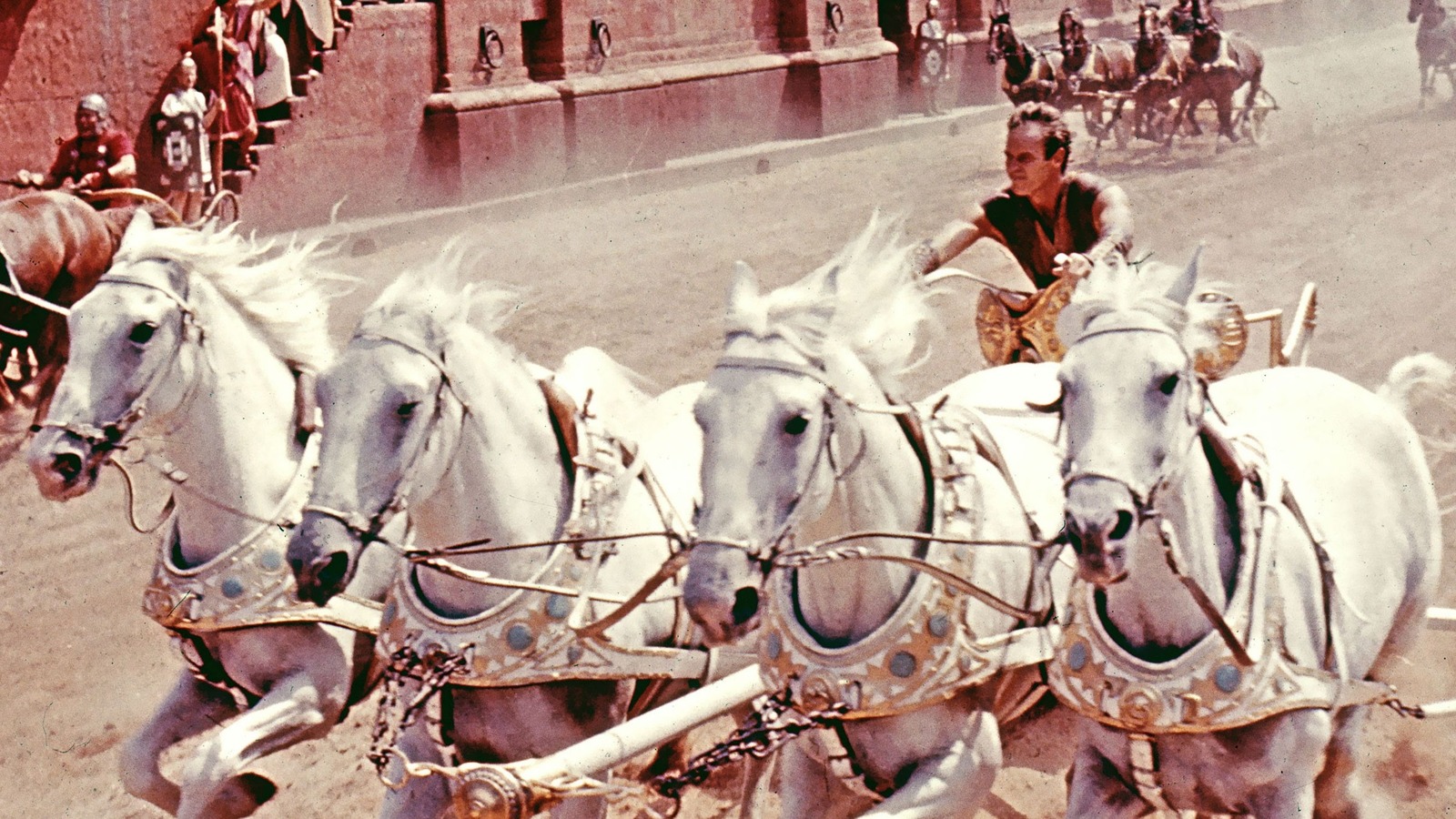
The 1959 remake became one of the most honored films in Hollywood history, netting Oscars for Best Picture, Best Director (William Wyler), and Best Actor (Charlton Heston). The 11 it netted in all set a record for the time that has only been equaled since then by Titanic in 1997 and The Return of the King in 2003.

It is also among the most influential movies in screen history. Most recently, Francis Ford Coppola listed it among the 20 films that inspired the epic he released a few months ago, Megalopolis.

Yet another director-producer’s debt to the film is more obvious. The first installment in “Star Wars” saga, The Phantom Menace, features a pod race that is a homage to the archetypal chariot race of Ben-Hur.

Even more so, the first trilogy in George Lucas’ bestselling series, focusing on Anakin Skywalker, bears strong similarities to Lew Wallace’s hero: another slave who makes a splash by competing in a great race, but never really feels entirely at home in the society that now embraces him, and is consumed by revenge for much of the action.

Ben-Hur also left its mark on the evolution of the film epic itself. Without ever stinting on pyrotechnics (it became the first film shot with Panavision lenses to win the Best Cinematography Oscar), it veered sharply from the sword-and-sandals movies associated with Cecil B. DeMille (The Ten Commandments), Howard Hawks (Land of the Pharoahs), and King Vidor (Solomon and Sheba).

Wyler delegated direction of the chariot race sequence to Andrew Marton and Yakima Canutt, while concentrating with his usual perfectionism on the actors’ performances. His creation of a more intimate, character-driven epic would release later releases such as Lawrence of Arabia, Doctor Zhivago, Young Winston, Reds, and, only a year later, Spartacus.

(In fact, Kirk Douglas only pursued the latter property when he lost out in the competition to play Ben-Hur to Heston, being offered instead the consolation prize of the titular hero’s friend-turned-enemy, Messala—a role that he considered nothing more than a second-rate villain.)

This desire to focus on characters rather than spectacle has led some viewers to regard the hour-and-a-half remaining after the chariot race to be anticlimactic. But this misunderstands the nature of the property.

The movie took its cue from the subtitle of the Wallace novel, “A Tale of the Christ,” tracking the miracle following Christ’s crucifixion that eventually frees Judah of the bitterness that has spurred his quest even as it deformed his life.

In their quest for character development, Wyler and producer Sam Zimbalist (who died of a heart attack in Rome just as the movie neared completion) employed six different screenwriters: Karl Tunberg, Gore Vidal, Christopher Fry, S. N. Behrman, Maxwell Anderson, and Ben Hecht.

Decades after the film’s release, Vidal caused a stir with his suggestion of a gay subtext in the Judah-Messala relationship. Audiences at the time were less likely to notice such elements than today, and in any case both Wyler and Heston denied them when asked about it in later years.

More likely, contemporary audiences would have responded to the Cold War resonance of the plot.

Judah’s refusal to renounce his Jewish heritage and pursue Roman glory with Messala triggers his family’s fall from wealth and influence, not unlike how rejection of informing consigned a host of Hollywood talent to blacklisting in the McCarthy Era.

At the same time, the presence of Rome as an authoritarian power imposing its will on a restless foreign people would have reminded many of the similar role played by the Soviet Union.

Sunday, October 6, 2019

This Day in Film History (‘The Heiress,’ Classic Wyler Adaptation of James, Opens)


Oct. 6, 1949—The Heiress, a costume drama that demonstrated the big-screen potential of the psychological fiction of Henry James, premiered in New York City. Though not a box-office success, it scored with critics, and it stands today as a model for screen adaptations of novels and plays.

My headline understated the process by which the word-heavy James came into focus in image-heavy Hollywood. The dramatic promise latent in “The Master,” largely unrealized in his own lifetime (see my prior post on his London stage disaster, Guy Domville), was first manifested by Ruth and Augustus Goetz in their hit 1947 adaptation of Washington Square, The Heiress.

That same year, Hollywood might have been forgiven for tiptoeing around James after the critical and box-office drubbing given The Lost Moment, an adaptation of The Aspern Papers starring Robert Cummings and Susan Hayward. 

But after watching The Heiress on Broadway, Olivia de Havilland was so convinced it would work on film that she persuaded William Wyler to take on the project, and the Oscar-winning director meshed so well with the Goetzes on fashioning the screenplay that Paramount Pictures generously bankrolled the production.

But the raw material in the hands of Wyler and the Goetzes was more than a bit challenging. James’ attitude towards his characters was frequently ironic; inferences about motives were largely between the lines; and he refused to provide a happy ending for his heroine.

I heard Washington Square (1880) once described wittily (and more or less accurately) “the James book for those who hate James.” Written two decades before the rococo style of his “later period” in the early 1900s (The American, The Golden Bowl), this was simple in comparison.

The content, however, is anything but, focusing on a struggle for autonomy, as Catherine Sloper—the shy “heiress” of the play and film title—is scorned by her father for ungainliness (an ironic reminder of the beautiful mother who died while giving birth to her), pursued by a fortune hunter, and undermined by an insipid aunt. She must not only negotiate the path to adulthood without honest, practical advice from any responsible adult, but do so in the face of a trio with no real regard for her feelings.

When imagining how to reconceive a play for the screen, most directors think in terms of “opening it up” with exterior shots. But Wyler did not see this as appropriate for this drawing-room drama. 

Washington Square was preeminently an interior mental drama, marked by the multiple obstacles to happiness in the way of the painfully self-conscious Catherine. As a visual counterpart to her mental state, then, Wyler emphasized the interior architecture of the Sloper home.

The quickest the camera moves, then, is in the crucial dance scene, not only because of the bodies waltzing around the floor but because of Catherine’s giddiness when the charming cad Morris Townsend passes unexpected attention to her. 

Otherwise, the stillness of the camera throughout most of the rest of the movie underscores Catherine's growing agony as her father, justifiably suspicious of Townsend’s intentions, threatens to disinherit her and a disappointed Townsend abandons their plans to elope.

It is Catherine’s understanding of this last development that allows Wyler to capitalize on the Sloper home’s interiors. In the play, she gave full vent to her sorrow in a long monologue. Wyler dispensed with just about all the lines penned by the Goetzes, choosing instead to have de Havilland trudge wearily up the staircase.


Director Martin Scorsese later described to critic Roger Ebert the impact of The Heiress on his budding movie consciousness:

“When I was nine or 10, my father took me to see ‘The Heiress,’ which was the first costume piece that had a powerful impact on me. I didn't understand every detail, but I knew that something terrible had happened, a breach of trust and love - and everybody was dressed so nicely and they had such nice drawing rooms. I didn't understand how a father could talk that way to his daughter, explaining that the man was after her for her money, 'Because you're not clever and you're quite plain.' That's quite a scene.”
Other scenes, equally memorable, owe much less to the novella. In the book, several years after jilting Catherine, Morris returns, having lost most of his hair in the interim. (It is as if he left looking like Rob Lowe and came back looking like Wallace Shawn.) In the film, Clift’s sunny confidence is gone but not his looks.

Most of all, Catherine’s response to Morris’ desperate plea to marry him for real this time is the exact opposite of James’ quiet fadeout. It is the logical consequence of her fierce answer when her Aunt Pennyman asks if she can really be so cruel. Yes she can, Catherine answers: “I have been taught by masters.”

And so, Catherine, after seemingly consenting to go away with the supposedly chastened Morris, locks him out when they are supposed to meet, leaving him pounding the door in helpless frustration. It is only partly an audience-pleasing act of revenge, for it also involves Catherine’s emotional imprisonment as a lifelong spinster in a house that has never meant happiness for her.

No two ways about it: this material was grim. After agreeing to back the film, Paramount evidently sense the nature of the proposal it had accepted, and pressed Wyler to make Morris sympathetic. In the end, Wyler only softened the character without changing his essential nature, and that only heightened the suspense through much of the film about whether he would in fact go ahead with his plan to wed Catherine.

As would occur with Carrie (1952), Wyler’s adaptation of Theodore Dreiser’s Sister Carrie, the director’s refusal to make more than minimal nods toward audience expectations of a happy ending cost Paramount dearly at the box office for The Heiress. But Hollywood honored the film with eight Oscar nominations; de Havilland ended up winning her second Best Actress Oscar for the role; and the movie is now studied by cineastes such as Scorsese as a sensitive and spot-on literary adaptation.

Perhaps the only inexplicable misstep in the production involved the score by Aaron Copland, which was, in the words of this fine post on the blog “Words of Note,” “chopped to bits, poorly dubbed, and rescored without his approval” by Wyler. Though the composer won an Oscar for the score, Copland—who had been contributing music for movies for the last decade—created only one more film score for the rest of his life.

Sunday, November 23, 2014

Flashback, November 1934: Hellman’s ‘Children’s Hour’ Acclaimed, Banned


By the time the curtain came down on the opening-night performance of The Children’s Hour at Maxine Elliott's Theatre on November 20, 1934, it was impossible to miss the irony in the title of Lillian Hellman’s drama. Whereas Henry Wadsworth Longfellow’s beloved fireside poem of that name had evoked “voices soft and sweet,” Hellman’s tragedy traced the consequences of a lie told by a mean-spirited little girl—and, for good measure, confronted the taboo subject of lesbianism.

There are, though, more ironies associated with the circumstances of this production and how it reflected the playwright’s life than in the script itself.

By now, it is obvious that in her late-life memoirs, Hellman engaged in all kinds of prevarication. She created autobiographical fancies not so much to deny shameful incidents in her life as to transform herself into a heroine no one could be—and, exhibiting the same trait as the girl Mary Tilford of The Children’s Hour, to tear down others (notably, Ernest Hemingway).

Though Hellman would continue to write for the theater for more than two decades, the hallmarks of her subsequent style would be present here: unflinching engagement with provocative subject matter; writing the kind of realistic, “well-made play” that began with Henrik Ibsen; clearly definable lines between good and evil; and a resort to melodrama.

In the early-to-mid-‘70s, it was fashionable to regard Hellman as a champion of liberalism and free thought because of her defiance of the House Committee on Un-American Activities; as an avatar of feminism, as one of the first women to enjoy a string of successes on Broadway; and as perhaps a more accomplished memoirist than a playwright (or screenwriter), given her bestselling trilogy An
Unfinished Woman
, Pentimento and Scoundrel Time.

All of these notions, the passage of time revealed, were overstated, and The Children’s Hour in certain ways shows why. As its protagonists—two women who run a school who are smeared by a vengeful student’s false accusation that they are engaged in a lesbian relationship—attempt to recover their livelihoods and reputations, they are unable to make any headway, even with the support of one woman’s fiancé. An utterly reasonable doctor, the latter is unprepared—in the same way that mainstream liberals would be at the height of McCarthyism, Hellman would later feel—to fight a pathological liar. Implicitly, an abuse of power on a small scale—the destruction of lives in a small town—becomes repeated and magnified in American society as a whole.

In The Children’s Hour, the personal might certainly have been political, as a later generation of feminists would say—but sisterhood was hardly powerful. The two teachers, Karen and Martha, find no support from other women for their cause.

Just how high the stakes were in this production can be seen in the comment by Hellman’s producer (and, with the departure of longtime companion Dashiell Hammett for Hollywood, her temporary lover) Howard Shumlin, “This play could land us all in jail.” The first strong hint of trouble came when one actress after another turned down a chance at the two major roles, which offered what should have been catnip to them: some of the strongest, most complicated characterizations seen on Broadway to that point.

The playwright may have cultivated the image of a tough woman who refused to be intimidated by powerful men. (She even later claimed that, when theater owner Lee Shubert slapped her leg down while ordering her to “get your dirty shoes off my chair," she shot back: “I don’t like strange men fooling around with my right leg, so don’t do it again.”) But, in light of all the high stakes for this show, her drunkenness on opening night might have been more than simply a case of the jitters for a first-time Broadway dramatist.

Even after casting was finally done, censorship proved a difficult obstacle. In London the following year, the Lord Chamberlain, working only from a script, forbade permission to mount the show “because of its theme.” Similar bans went into effect in Boston and Chicago, with the result that, even in some of the most liberal, urban places in the United States, audiences could not see The Children’s Hour until the film starring Audrey Hepburn and Shirley MacLaine opened in 1962.

As I discussed in a recent post, Hellman’s posthumous reputation was darkened by both a libel suit she relentlessly pursued against Mary McCarthy and the revelations produced during the discovery phase of the litigation about Hellman’s distortions of her personal history. In contrast, The Children’s Hour was accompanied by contretemps concerning an unjust accusation that she had followed history too closely.

The critic John Mason Brown took Hellman to task for not acknowledging, in the program’s playbill, that the conflict in the play had been inspired by a Scottish case in the Victorian Era. But Hellman, no more than other playwrights, was under no compulsion to write in a playbill about a historic incident that she had, in effect, translated for modern audiences—and in any case she had, in a newspaper interview broadly distributed before Brown’s comments, mentioned this case that had inspired her.

In the wake of the gay-rights movement, many critics no longer see much dramatic tension in the lesbian theme that seemed so sensational in the 1930s. But audiences that have had the chance to read The Children’s Hour or see it performed have no such qualms, for they agree with Hellman’s contention that lesbianism is not the principal point of the play.

That was reinforced when Hellman adapted her play for the screen in 1937. Her screenplay circumvented restrictions on depicting gays and lesbians in Hollywood’s Production Code Administration by converting this homosexual triangle into a heterosexual one. She was not unduly bothered by this change, she observed, because the play was actually about the power of a lie.

Critics have generally regarded that initial adaptation, These Three (1937), as superior to the later version helmed by the same director, William Wyler—even though the passage of a quarter-century had allowed Wyler to depict the lesbianism charge with a freedom impossible before.

In fact, modern audiences are likely to regard Hellman’s theme of the destructive power of gossip and deceit as even more relevant today than when she wrote the play. Twenty-four-hour cable television, the Internet and social media have vastly expanded the geographic reach of an accusation—and, as many distraught teens and their parents have discovered, the resulting harm to reputations.

Not that Hellman regarded adolescents—or, for that matter, younger children—as innocents. Four decades before movie audiences would be stunned by devils who took on the form of children in The Exorcist and The Omen—two decades before theatergoers tried to come to grips with the spectacle of the homicidal girl at the heart of Maxwell Anderson’s The Bad Seed—Hellman had shown, through spiteful sprite Mary Tilford, that teens could, as easily as King Richard III, “set the murderous Machiavel to school.” So much of the seepage in dramatic intensity in the third act of The Children’s Hour occurs simply because Mary, who sets the plot in motion, can no longer spin her webs.

Though censors tried to hinder productions of The Children’s Hour at every turn, contemporary reviewers were, by and large, far more generous to Hellman. When the board that approved Pulitzer Prize selections bypassed Hellman for the Pulitzer Prize for Drama in favor of Zoe Akins’ less problematic adaptation of Edith Wharton’s novella The Old Maid, critics reacted with such consternation that they created an alternative, the Drama Critics' Circle Award. (Hellman would be honored with that prize two times: for Watch on the Rhine and Toys in the Attic.)

No Hellman drama would equal the 691 performances of Hellman’s Broadway debut—though The Little Foxes (1939) has become more of a favorite with regional theater companies (including a 2009 Shakespeare Theatre of New Jersey production, which I reviewed here).

Much to her chagrin, the questions raised about Hellman’s veracity seriously devalue her value as memoirist. But the critics of her stagecraft have also been proved wrong by time. Not only have her themes demonstrated continued relevance to modern audiences, but actors have also found her roles substantial, as demonstrated with The Children’s Hour by the West End appearance of Elisabeth Moss as Martha and Keira Knightley as Karen at the Comedy Theatre in London three years ago.

Saturday, April 5, 2008

This Day in Film History (Birth of Bette Davis)


April 5, 1908—Those “Bette Davis eyes” first stared out at the world on this date in Lowell, Mass.

Her birth name was actually Ruth Davis, but she took the first name “Bette” in tribute to the French novel Cousin Bette by Balzac. Had her career not fallen into the abyss in her mid-to-late 40s, that role—a vengeful poor relation out to destroy her richer Parisian cousins—might have made a wonderful vehicle as she made the transition from leading lady to character actress. It would have afforded plenty of opportunity to display the intelligence—and seething amusement and anger at what suckers men are—behind those famous eyes.

Shortly before her 10th birthday, her father left the family—the first of a lifelong series of men who would never stay around, including four husbands.

Lack of money didn’t prevent her mother from sending her and her sister to boarding school, however. After that, acting beckoned.

People had her pegged from the start as a star in the making at John Murray Anderson's Dramatic School in Manhattan. Davis, her (initially) less successful classmate Lucille Ball remembered in her autobiography, Love, Lucy, “earned raves for everything she did. A short, dynamic blonde, she projected with great verve.”

Battles With the Studio
After a short Broadway stint, she made her way to Hollywood. Universal Studios couldn’t figure out what to do with her, and for awhile it appeared that Warner Bros. couldn’t either. Even after her star-making role (made on loan to RKO) in Of Human Bondage as a ferociously unsympathetic prostitute and a compensatory Oscar for Dangerous a year later, she was so annoyed with Warner Bros. for the parts they offered her that she left for England. A threatened lawsuit by Jack Warner brought her to heel, but she had made her point, and from then on the quality of the roles improved.

Critic Terrence Rafferty, whose judgment I have come to trust over the years, labeled Davis “the greatest actress of the American cinema” in a
fine career summation in The New York Times last weekend. I’m not sure I would go that far: Katharine Hepburn and Meryl Streep, for instance, have displayed a flair for comedy that Davis rarely if ever showed, and Streep in particular has displayed an extraordinary capacity to make herself over into virtually anybody. But there is little if any doubt of the tremendous impact that Davis at her best could make.

Whenever people think of Davis, several films come immediately to mind: Dark Victory, Now, Voyager, All About Eve, Whatever Happened to Baby Jane?, Jezebel, The Letter, and The Little Foxes. (The last three were made in collaboration with director
William Wyler. According to interviews with Charlotte Chandler done not long before the actress died, Davis aborted the child she conceived with Wyler while making Jezebel. Later, when he proposed marriage, she took too long to think about it and Wyler married someone else. For the rest of her life, she mourned him as the man who got away—though the director, predictably, thought that life with her would have been impossible, given her tempestuousness.)

Three Davis Favorites
All of these films deserve their acclaim, but I would suggest three others not as well known: Mr. Skeffington, The Old Maid, and Old Acquaintance.

Her last Oscar-nominated role while under contract to Warner Bros., Davis’ Fanny Skeffington is a vain beauty who marries her Jewish husband to save her brother from a stock-market scandal. The self-sacrificing decision by loving and long-suffering Job Skeffington (played by Claude Rains) to let her go leads her to embark on a string of empty affairs—and to end up lonely when a bout of diphtheria ruins her looks.

The plot is surely melodramatic and the film bears all the marks of the ‘40s “woman’s movie” (the more mature version of today’s “chick flick” we know today). But Davis negotiates her character’s passage from flirtatiousness to heartbreak well. (Kudos also to cinematographer Ernest Haller, whose black-and-white photography made Davis appear at the height of her allure--though even here, Davis needs to be given her due, since --characteristically--she never allowed anyone else to do her makeup for her.)

The Old Maid and Old Acquaintance became battlegrounds with a star whose tempestuousness may have exceeded Davis’:
Miriam Hopkins. In The Old Maid, an adaptation of the Edith Wharton novella, the actresses’ on-screen rivalry for the affection of the daughter that Davis’s Charlotte bore out of wedlock and Hopkins’ Cousin Delia adopted as her own was played out off-screen. Every bit of that intensity shows onscreen in the faceoffs between Davis and Hopkins. (Not long before her death, Davis paid a tribute of sorts to Hopkins, calling her “a wonderful actress but a bitch,” even – perhaps the ultimate compliment from Davis, given the run-ins she’d have through the rest of her career with other co-stars– “the most thoroughgoing bitch I have ever worked with.”)
.
Last summer, I saw the Roundabout Theatre Company’s revival of John Van Druten’s Old Acquaintance. Though Margaret Colin and Harriet Harris gave their all, the play felt curiously flat—as did, I might add, the more explicit film remake Rich and Famous starring Jacqueline Bisset and Candice Bergen in the Davis-Hopkins roles. But then, it was hard not for these two to measure up to my memory—the 1943 film featured a battle for the ages.

With Davis’ first choice for her frenemy in the film, Norma Shearer, turning down the role, the stage was set for a rematch between Davis and Hopkins. The script, like the play, featured a scene in which Davis’ midlist novelist, level-headed Kit Marlowe, was supposed to slap her longtime friend, Hopkins’ successful trashy novelist Millie Drake, for her jealousy and general all-around idiocy. The day the scene was shot, everybody on scene gathered to watch the most eagerly awaited rematch since Joe Louis and Max Schmeling’s shot but epic encounter at Yankee Stadium five years before.

Davis didn’t disappoint, letting Hopkins have it in a scene that makes the short list of any great Davis moment.

In her speech accepting her Best Actress Oscar for Terms of Endearment, Shirley MacLaine referred to the “turbulent brilliance” of co-star Debra Winger. That ferocious commitment to excellence was also the hallmark of Davis—who, in fact, in
a late-career interview, offered Winger up as one of two young actresses she particularly admired (Sissy Spacek was the other).

The tragedy of Winger’s career—now in abeyance for who knows how long?—is that she made her mark in relatively few films. For all of Davis’ clashes with moguls, directors and co-stars, the genius of the studio system was that it offered her repeated opportunities to practice her craft—and, in the case of Mr. Skeffington, elevate what seems at first glance to be hopelessly humdrum material.

A Little-Known Late-Career Treat
How might Davis’s career have turned out had she been born later? One tantalizing glimpse can be found in this 1963 guest appearance Davis made on Perry Mason, when CBS called on several stars to fill in for Raymond Burr as he recovered from surgery. (Given the lack of decent roles Davis was getting at that point, even after Whatever Happened to Baby Jane?, she probably jumped at the chance to play something.)

The show’s formula didn’t allow Davis a lot of room, but watch this clip as her defense attorney listens to her client—eyes flitting around the room, fingers clutching and unclutching her pencil--and you’ll learn all you need to know about her character’s restless intelligence. “The Case of Constant Doyle” is like watching Michelangelo doing a pencil drawing—not an ideal medium, but enough to reveal an outsized talent. It's easy to imagine Davis on Law and Order or its progeny.

For a long time, Hollywood discussed making an American version of Helen Mirren’s detective Jane Tennison in Prime Suspect. I think Davis would have performed marvels with the flinty but troubled middle-aged detective superintendent.