Showing posts with label Gore Vidal. Show all posts

Sunday, January 4, 2026

This Day in Literary History (Death of Christopher Isherwood, ‘Cabaret’ Chronicler)

Jan. 4, 1986—Anglo-American novelist, playwright, screenwriter, memoirist, and diarist Christopher Isherwood died of prostate cancer at age 81 in Santa Monica, CA.

Thousands of Broadway playgoers and even more movie and TV fans may have seen the Cabaret without associating it with Isherwood, whose Berlin Stories (1930) inspired the musical about decadent Weimar Germany. 

The latter came from the first decade of his writing career, when as part of the “Auden Circle” of modernist British and Irish writers, he became associated with left-wing politics and was hailed as “the hope of English fiction” by critic Cyril Connolly.

After emigrating to America with W.H. Auden as Britain was on the brink of war in 1939—a move denounced as cowardice in the face of the Nazi threat by the pair’s critics—Isherwood moved his career and lifestyle in entirely new directions—including, for that atheist, a conversion to Hinduism (and even a brief time as a monk in the 1940s) and three decades of what he cheerfully admitted was hackwork as a Hollywood screenwriter.

Most significantly, following his decision to publicly acknowledge his own sexual orientation in 1971, he emerged as a godfather figure to gay authors, including the likes of Truman Capote, Edmund White, Armistead Maupin, Patricia Highsmith, and Gore Vidal.

Did Isherwood deserve Vidal’s praise in a December 1976 New York Review of Books assessment as “the best prose writer in English”? I’m inclined to see that as exaggeration—or, more charitably, an expression of Vidal’s gratitude for championing his work early in his career. Even so, Isherwood is an important writer and his work contains considerable merit.

The clarity, even transparency, of his prose masked how complex his artistic vision could be, just as his much-discussed wit and charm often obscured his complicated personality.

Perhaps the most famous line in all of his work, from Berlin Stories—“I am a camera with its shutter open, quite passive, recording, not thinking”—encourages a sense of his objectivity. That is crucial because, as an early practitioner of metafiction, Isherwood frequently created a persona explicitly named “Christopher Isherwood.

Conversely, his memoirs, which readers would normally view as more reality-based than his fiction, employed composite characters, chronicled events out of sequence, or reshaped them differently from the actual occurrences as recorded in his diaries.

Isherwood’s style is uncluttered, concise and graceful, adding to the believability of both his fiction and nonfiction. Whether in bohemian Berlin of the interwar period or the European emigres and New Age devotees of Southern California’s postwar era, his nonjudgmental “eye” takes in all it sees.

Though influential and helpful to many people, Isherwood was not always admirable. Interviews and documentary evidence from his extensive diaries led biographers Peter Parker and Katherine Bucknell to conclude that he could also be drunken, neurotic, promiscuous (an estimated 400 lovers by age 44), and even antisemitic. 

(He told a listener that "Hitler killed 600,000 homosexuals." When this young Jewish producer responded that "Hitler killed 6 million Jews," Isherwood said acidly, "What are you? In real estate?")

I find Isherwood’s relationship to Hollywood particularly fascinating. His movie and TV assignments often involved subjects he surely did not find congenial (for example, as I mentioned in this post from 17 years ago about “Silent Night” composer Franz Gruber).

But what Hollywood chronicler Tom Dardis called “Some Time in the Sun” for famous novelists-turned-screenwriters like F. Scott Fitzgerald not only gave Isherwood a lifestyle far more comfortable than he had enjoyed in Britain but also fueled his creativity. 

Prater Violet (1945), for example, is still considered one of the best fictional representations of the Hollywood “dream factory.”

When it came time to adapt Cabaret from stage to screen, director Bob Fosse made an unexpectedly felicitous decision, by casting Michael York—practically a dead ringer for the young Isherwood—in the role of the author’s alter ego “Brian.”

Wednesday, November 20, 2024

Flashback, November 1959: ‘Ben-Hur’ Remake Charges to Front of Nation’s Box Offices

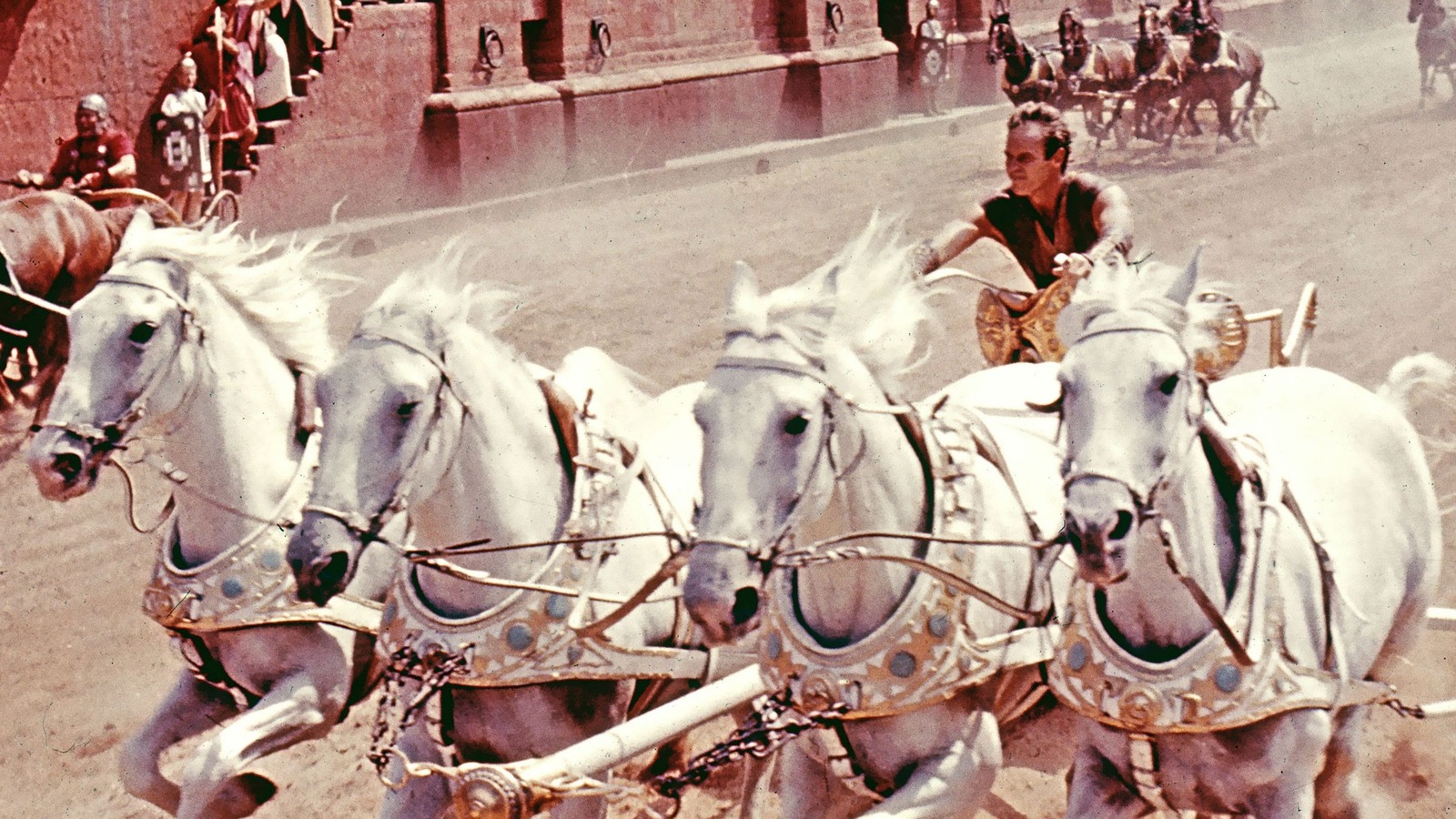
Sixty-five years ago this week, struggling MGM bet that the market for cinematic biblical epics was not yet exhausted. The game paid off handsomely when the release of Ben-Hur—the sound adaptation of the best-selling novel of the 19th century—reaped box-office gold, saving the studio from bankruptcy.

In looking through my past blog posts, I was surprised to discover that, though I had written about much connected to this property—General Lew Wallace’s 1880 novel, a director whose one-reel 1907 short triggered a landmark copyright decision, and a 1925 budget-busting silent epic—I’d never written about the version that thousands have seen, in theaters and on television, for the past three generations.

This post, then, is my attempt to rectify this situation and to give this movie all the honor it deserves.

The 1959 remake became one of the most honored films in Hollywood history, netting Oscars for Best Picture, Best Director (William Wyler), and Best Actor (Charlton Heston). The 11 it netted in all set a record for the time that has only been equaled since then by Titanic in 1997 and The Return of the King in 2003.

It is also among the most influential movies in screen history. Most recently, Francis Ford Coppola listed it among the 20 films that inspired the epic he released a few months ago, Megalopolis.

Yet another director-producer’s debt to the film is more obvious. The first installment in “Star Wars” saga, The Phantom Menace, features a pod race that is a homage to the archetypal chariot race of Ben-Hur.

Even more so, the first trilogy in George Lucas’ bestselling series, focusing on Anakin Skywalker, bears strong similarities to Lew Wallace’s hero: another slave who makes a splash by competing in a great race, but never really feels entirely at home in the society that now embraces him, and is consumed by revenge for much of the action.

Ben-Hur also left its mark on the evolution of the film epic itself. Without ever stinting on pyrotechnics (it became the first film shot with Panavision lenses to win the Best Cinematography Oscar), it veered sharply from the sword-and-sandals movies associated with Cecil B. DeMille (The Ten Commandments), Howard Hawks (Land of the Pharoahs), and King Vidor (Solomon and Sheba).

Wyler delegated direction of the chariot race sequence to Andrew Marton and Yakima Canutt, while concentrating with his usual perfectionism on the actors’ performances. His creation of a more intimate, character-driven epic would release later releases such as Lawrence of Arabia, Doctor Zhivago, Young Winston, Reds, and, only a year later, Spartacus.

(In fact, Kirk Douglas only pursued the latter property when he lost out in the competition to play Ben-Hur to Heston, being offered instead the consolation prize of the titular hero’s friend-turned-enemy, Messala—a role that he considered nothing more than a second-rate villain.)

This desire to focus on characters rather than spectacle has led some viewers to regard the hour-and-a-half remaining after the chariot race to be anticlimactic. But this misunderstands the nature of the property.

The movie took its cue from the subtitle of the Wallace novel, “A Tale of the Christ,” tracking the miracle following Christ’s crucifixion that eventually frees Judah of the bitterness that has spurred his quest even as it deformed his life.

In their quest for character development, Wyler and producer Sam Zimbalist (who died of a heart attack in Rome just as the movie neared completion) employed six different screenwriters: Karl Tunberg, Gore Vidal, Christopher Fry, S. N. Behrman, Maxwell Anderson, and Ben Hecht.

Decades after the film’s release, Vidal caused a stir with his suggestion of a gay subtext in the Judah-Messala relationship. Audiences at the time were less likely to notice such elements than today, and in any case both Wyler and Heston denied them when asked about it in later years.

More likely, contemporary audiences would have responded to the Cold War resonance of the plot.

Judah’s refusal to renounce his Jewish heritage and pursue Roman glory with Messala triggers his family’s fall from wealth and influence, not unlike how rejection of informing consigned a host of Hollywood talent to blacklisting in the McCarthy Era.

At the same time, the presence of Rome as an authoritarian power imposing its will on a restless foreign people would have reminded many of the similar role played by the Soviet Union.

Friday, October 18, 2024

Movie Quote of the Day (‘The Best Man,’ on a Candidate’s Missing Wife)

Sue Ellen Gamadge [played by Ann Sothern, far right]: [to William Russell, played by Henry Fonda, center] “We want to see a lot more of your wife—a great deal more. You know, there are still people who don't trust the English.”

Dick Jensen [played by Kevin McCarthy]: “Mrs. Russell was sick during the primaries.”

Sue Ellen: “Yes, yes, yes. I know. But she has to be at your side at all times. She must seem to be advising you. It did Adlai Stevenson great harm not having a wife and trying to be funny all at the same time, too. Great harm.”— The Best Man (1964), screenplay by Gore Vidal, based on his play, directed by Franklin J. Schaffner

Gore Vidal’s political satire has lost little if any of its sting, six decades after he wrote it. The setting—the smoked-fill rooms at a convention that will determine a party’s candidate—may have lost its importance, but his Broadway play and adaptation are at heart about power and its use in smashmouth politics.

And, even though we now—courtesy of Ronald Reagan and Donald Trump— have Presidents who’ve been divorced, voters are still awfully curious about candidates’ spouses.

Which brings us to William Russell’s wife Alice in The Best Man.

The actress who played Alice on Broadway, Leora Dana, was American, as were the actresses who took on the role in 21st century revivals: Michael Learned, Candice Bergen and Cybill Shepherd. So perhaps that line about “the English” above was made to account for the casting of the admittedly marvelous Margaret Leighton (pictured far left) when the play became a movie.

But, as a student of history, Vidal would probably have been struck by the irony of a foreign-born First Lady. For the first two and a quarter centuries after the founding of the republic, there had only been one such spouse: Louisa Johnson Adams, born in—yes, England.

Then came Melania Trump, Donald Trump’s second wife from Eastern Europe. (Perhaps he might want to reconsider his position on imports?)

For the longest time, I thought Louisa Adams underwent some of the worst experiences of any First Lady as the marital and political partner of John Quincy Adams, a notably frosty fellow who suffered bouts of depression.

After being largely ignored in the White House by her husband, Louisa became something of a recluse and worked on an unpublished autobiography whose title signals her misery: Adventures of a Nobody.

But I’m afraid that the Slovenian-born Melania has—well, trumped her. Ms. Trump has been largely AWOL as her husband plotted his return to the White House (her appearance with him at the Al Smith Dinner being a curious and rare exception), and her memoir, Melania, has just been published.

There is one line from The Best Man, flung out by Leighton, that First Ladies Adams and Trump wish they could have said to their husbands, I’m sure: “I’ve had twenty years of nonsense, of being a good sport.”

At least Mrs. Adams, however, never had to read about her husband’s affair with an adult-film actress conducted during her own pregnancy, sexual misconduct accusations by dozens of other women, and even a civil court jury finding that he’d sexually abused and defamed one of them.

What does the Slovenian Sphinx think of all this? Publicly, nothing. Privately, if she’s ever had a chance to watch The Best Man, I bet she snorts at Ann Sothern’s line about “seeming to advise” the candidate—but nods vigorously at Leighton’s “twenty years of nonsense.”

Thursday, November 10, 2022

Quote of the Day (Gore Vidal, on Public Opinion)

“At any given moment, public opinion is a chaos of superstition, misinformation, and prejudice.” —American novelist, essayist, and playwright Gore Vidal (1925-2012), “Sex and the Law,” originally published in Partisan Review (Summer 1965), republished in Homage to Daniel Shays: Collected Essays,1952-1972 (1972)

Vidal wrote the above not only when tracking public opinion was still in the early stages of being considered a “science,” but also when most people still accepted the word of official sources. It was also, critically, before the current sledge of digital disinformation.

The “chaos” Vidal referred to more than a half century ago certainly proved to be even more the case in 2016 and 2020. Why did we expect the 2022 midterms to be any different?

At this point, the disparity between voter surveys and the final election results is so wide that the entire polling industry should close up shop. Too many prospective voters won’t answer survey questions because they regard them as either an infringement of their privacy or a diabolical plot by the “progressive media.”

How can pollsters and the party handlers who feed off them claim any validity in their results, given these attitudes?

Monday, May 6, 2019

This Day in Literary History (Death of ‘Wizard of Oz’ Creator L. Frank Baum)


May 6, 1919—L. Frank Baum, 63, who failed at multiple careers before creating The Wonderful Wizard of Oz and more than a dozen sequels, died following a stroke in Hollywood, Calif.—a community that, two decades later, would introduce his work to a whole new generation of fans with a musical adaptation of his fantasy starring Judy Garland.

Over the last century, Baum’s creation has expanded beyond even the veritable cottage industry he managed to maintain in his last two decades. Millions of movie fans, TV viewers and playgoers learned the story of Dorothy and her companions and what they encountered on the way to Oz in a host of different takes on that material—not just the Garland classic, but also Return to Oz, the African American-cast stage and screen musical The Wiz, the 1960 Shirley Temple TV adaptation of Land of Oz, as well as Gregory Maguire’s novel Wicked and its current long-running Broadway musical adaptation

It’s also a safe bet that only a fraction of the audiences for these works knows much, if anything, about the man at the center of all this.

Baum would have felt delighted to be recalled in any way at all. Yesterday, I posted about the quintessential “Renaissance man,” Leonardo da Vinci. Baum tried his hand at a number of pursuits, too— actor, playwright, salesman, chicken farmer, lecturer, department store window-dresser, journalist, and movie mogul. Yet, to one degree or another, he failed at all of these.

At the urging of his wife, Baum began writing children’s books in 1897. Though these were popular enough to induce his publisher to request more, the success he enjoyed with The Wonderful Wizard of Oz was of an entirely different magnitude.
Not only has that title been in print continuously since then, but Baum followed it up with 13 sequels (with, after his death, another 19 by Ruth Plumly Thompson, and seven more by other authors, producing a grand total of 40 Oz books) along with a 2002 stage adaptation. 

Oh, about that play: Even though it replaced little Toto with a cow, it ran on Broadway for two years and remained on tour until 1911. It was successful enough for Baum to try his hand on the stage again in 1908, this time with “The Fairylogue and Radio-Plays” combining a lecture by him with live actors, a movie, and projected slides.

It sounds not just innovative but even avant-garde, since neither radio nor film had advanced far as vehicles for narrative art yet. In a way, it was the same type of technical breakthrough that the movie musical represented three decades later. And, like that classic, it was also a bit ahead of its time. 

Because its costs exceeded its revenues, Baum went financially aground again. This time, however, his bankruptcy had to hurt more than before, because he was now forced to give up his rights to the early books that had secured the series’ reputation. 

Still, Baum being Baum, he didn’t let this latest failure keep him down for long, even starting The Oz Film Manufacturing Company in 1914. The venture only lasted a few years, but it can be accounted a mild success, with its several Oz productions keeping the brand name before the public and Baum himself not losing his shirt this time. 

I’ve written that Baum created a virtual cottage industry surrounding Oz, and a cottage industry has also developed surrounding the writer’s sources of inspiration. Some have speculated that it’s a veiled political commentary on the politics of gold and silver in the McKinley Presidency; others cite the peculiar politics of Chicago at the time; still others have looked to contemporary accounts of cyclones in Kansas, and where a yellow brick road might have impressed itself on Baum’s imagination (one possible source: 19th-century West Point), in tracing the germination of this tale that transports readers far beyond their everyday lives.

If you’re like me, your interest in Oz stems from the 1939 film, which was as notable for its visual splendor as for its musical brilliance. I pursued my interest in it--including a spectacular appearance by Judy Garland and MGM co-star Mickey Rooney promoting its New York premiere-- in this prior post

But there have been authors whose interest in the book derived from the books first, notably Martin Gardner, Ray Bradbury, and Gore Vidal. When I first read the latter’s essay on the Oz books nearly 40 years ago as part of his collection The Second American Revolution and Other Essays 1976-1982, I did not wonder why he wrote about it. (Indeed, the editors of The New York Review of Books rightly considered this was within his bailiwick, given his elegant style and his past screenwriting activity).

At the same time, I did question why the frequently waspish novelist wrote at such length on the subject, given what I felt to be the series’ relative lack of literary merit or importance. But, at least on the second count, I think now that I was mistaken. 

Like C.S. Lewis, J.R.R. Tolkien, and J.K. Rowling, and George R.R. Martin, Baum constructed an alternate universe, a fantasy world filled with its own characters and even geography. Countless fantasy readers over the years have found something in those worlds that allow them an escape from their own lives, and even a way of reimagining them.

Vidal claimed that, in defying expectations of traditional gender roles, Baum implicitly taught readers how to be "tolerant, alert to wonders." Although such a perspective appealed to gays such as Vidal and young girls pining for strong heroines, Baum’s sympathy for the marginalized only extended so far. In the 1890s, a newspaper he edited ran two editorials (allegedly written by Baum) calling for extermination of Native Americans. (A century later, two of his descendants apologized to the Sioux Nation.)

(Faithful Reader, did the photo accompany this post remind you of anything? Well, when I got a load of that mustache, I thought immediately of Frank Morgan, the wonderful MGM character actor who played The Wizard. How much did the original illustrations for the book, by William Wallace Denslow, play a role in the casting of Morgan? And how much did Baum’s own flamboyant mustache influence Wenslow’s creative contribution?)

Saturday, September 15, 2012

Theater Review: Gore Vidal’s ‘The Best Man’


Over the Labor Day weekend, contemplating which New York play I’d attend for a Saturday matinee, the gravitational pull of Gore Vidal’s The Best Man proved irresistible. There were the national conventions (the GOP over, the Dems about to occur), the backdrop of the action; an all-star cast; the urge to see how well Vidal’s play, first staged on Broadway in 1960, would hold up; and the desire to assess this, one of the playwright’s seminal works, as part of his entire corpus.

In keeping with Vidal’s overall worldview, the show—which closed this past Sunday at the Gerald Schoenfeld Theatre, after 185 performances--reflects a cold, aristocratic disdain of the American electorate. Yet it exhibits as close to a beating heart as we will find in the work of this lifelong professional skeptic. And, as one might expect, it remains entertaining and provocative more than a half century after its premiere, still packed with insights into the gamy clutching for ultimate power.

With a few exceptions (which I’ll get to shortly), director Michael Wilson not only has not updated the production, but frankly marinates it in period detail. TV monitors placed on each side of the stage evoke the black-and-white images viewers would have seen years ago, reflecting, in a sense, one of Vidal’s preoccupations here—the way that the surface, black-and-white reality of the candidates is at odds with a grayer, morally murkier world in which they work, struggle—and plot. The surnames of reporters (Annenberg, Pearson, Brinkley and Graham) summon up the boldface celebrities of 1960 whose celebrity may have slightly dimmed in the past century.

In many ways, conventions are no longer the dramas they once were. For all practical purposes, the nomination has been decided well before the end of the primaries, and even the Vice-Presidential selection is being announced lately well before candidates appear before the delegates and the TV coverage. That’s why election dramas such as Primary Colors and The Ides of March are set these days in primaries.

But Vidal’s comedy-drama remains a winner. Issues may change, technology may change, but human nature—at its worst in the hideous lust for power—endures.

It helps that Vidal longed to participate in this world, but never managed to do so. The grandson of a U.S. senator from Oklahoma, he ran to represent an upstate New York seat in Congress in 1960, then for governor of California in 1982. Both attempts were unsuccessful. He came closest to fulfilling his ambition when he played a senator in Tim Robbins’ 1992 film, Bob Roberts. In short: he knew enough about politicians to write about it their machinations with insights, but was forced, by necessity, to maintain distance from it all.

Remarkably, Wilson managed to keep the show sharply focused on Vidal’s vision with a cast nearly half of which was different from the one that opened on April 1. When Michael McKean was injured, Mark Blum was forced to assume the role of campaign manager for one of the candidates. By the time I saw the show, Candice Bergen, Eric McCormack, Kerry Butler and Angela Lansbury had been replaced by, respectively, Cybill Shepherd, John Stamos, Kristin Davis and Elizabeth Ashley. If there were any bumpy spots with the new actors, however, it was impossible to tell.

The three major roles in The Best Man would have been instantly recognizable to most Americans in 1960. William Russell, an erudite, witty, liberal candidate with a reputation for weakness, reminded many of Adlai Stevenson. Joe Cantwell, the 40ish redbaiting senator who sneers about the “Groton Harvard Wall Street set,” was (mostly) modeled after Richard Nixon, with elements of Joseph McCarthy thrown in. Art Hockstader, the profanely funny former President who relishes every minute of the game of politics, was Vidal’s spin on Harry S. Truman (with the playwright grafting his religious skepticism onto the Baptist President).

The role of Hockstader is rather like Vito Corleone in The Godfather: Even when absent, his shadow falls across every scene. The two candidates not only seek his endorsement as a means of breaking the convention deadlock, but the characterization is so salty and multi-dimensional that the audience craves his reappearance. Since Vidal gave this role most of the best lines, the producers needed an actor with the heft of James Earl Jones. So they got Jones. It is a role similar to his appearance as Big Daddy in Tennessee Williams’ Cat on a Hot Tin Roof: a larger-than-life powerful figure unable to fight off mortality. Some might argue, in a production that harks back in so many ways to 1960, that it is anachronistic to have an African-American play a President at a time when this country denied blacks their elemental civil rights. But the color-blind casting works here, triumphantly.

The other major updating of the play involves the interpretation of the Cantwell role. Perhaps in an attempt to make it more immediate, John Stamos (a mid-run replacement for Eric McCormack) effects a cocky walk and Texas drawl that will inevitably bring to mind George W. Bush. Yet the character ends up sounding simply stupid, rather than anti-intellectual but cunning, as Vidal wrote it. (Even the character’s surname—cant-well—suggests a master of deceit.)

When Franklin Schaffner directed the film adaptation in 1964, casting Henry Fonda guaranteed that the Russell role would be seen as overwhelmingly noble, not much more. John Larroquette’s interpretation in this production gives the character an off-center vibe, especially when he does a superstitious stepping-game around his hotel room—enough to suggest both his ironic distance from the political hurly-burly and to confirm he is slightly off-center. (When asked if he is crazy, Russell responds: “Any man that wants to be President is crazy.”)

The female roles are not as well-written as the males’, perhaps in keeping with women’s subordinate roles as political helpmates at the time Vidal wrote. Elizabeth Ashley, with the most stage experience, dating back to Barefoot in the Park in 1963 (including a prior stint in the 2000 Broadway revival), does the best here as Sue-Ellen Gamadge, chair of the women’s division of the party.

To be sure, Vidal could contoct howling one-liners with the best of them. (Russell refuses to credit the idea that Cantwell might be “degenerate”—i.e., in the parlance of the time, in this case, homosexual—noting: “No man with that awful wife and those ugly children could be anything but normal.”) At the same time, as America stood at the precipice of the most dangerous years of the Cold War (the Cuban Missile Crisis was only two years in the distance when the play premiered), the playwright evinced a powerful appreciation of what the Oval Office required. “You have no sense of responsibility towards anyone or anything,” Russell tells Cantwell. “And that is a tragedy in a man, and a disaster in a president.”

The title and denouement of the play are deeply ironic. Vidal was deeply skeptical that the American electorate could produce officeholders with the requisite intelligence and maturity—and he would have been the first to cite his own unsuccessful runs as evidence. But lines such as Russell’s to Cantwell suggest that, just this once, any consideration of his career might hold in abeyance his own frank admission of his admitted personality flaws: “I’m exactly as I appear. There is no warm lovable person inside. Beneath my cold exterior, once you break the ice, you find cold water.”

(In the accompanying photo, I caught Kristin Davis--who, in her Broadway debut, played Cantwell’s wife Mabel--after the show, graciously greeting a long line of stage-door fans, such as this unknown but extremely happy one. The long line represented, the former "Sex and the City" star joked, “the nice paparazzi.”)

Thursday, May 10, 2012

Quote of the Day (Gore Vidal, on Narcissism)

“A narcissist is someone better looking than you are.”—Gore Vidal, quoted by Michiko Kakutani, "Vidal: 'I'm at the Top of a Very Tiny Heap,'" The New York Times, March 12, 1981