“Tyranny, in a word, is a farce got up for the entertainment of poor human nature; and it might pass very well, if it did not so often turn into a tragedy.” —English essayist William Hazlitt (1778-1830), “On the Spirit of Monarchy," originally printed in 1823, reprinted in The Collected Works of William Hazlitt, edited by A. R. Waller and Arnold Glover (1904)
Tuesday, October 22, 2024
Thursday, December 9, 2021
Quote of the Day (William Hazlitt, on Why Women Often Have More Good Sense Than Men)
“Women have often more of what is called good sense than men. They have fewer pretensions; are less implicated in theories; and judge of objects more from their immediate and involuntary impression on the mind, and, therefore, more truly and naturally. They cannot reason wrong; for they do not reason at all. They do not think or speak by rule; and they have in general more eloquence and wit, as well as sense, on that account. By their wit, sense and eloquence together, they generally contrive to govern their husbands. Their style, when they write to their friends (not for the booksellers), is better than that of most authors.”—English essayist William Hazlitt (1778-1830), “On the Ignorance of the Learned,” in Table-Talk: or, Original Essays, Vol. 2 (1822)
Naturally, women reading the above would argue with the point that women “do not reason at all.” But, in the context of the true subject of Hazlitt’s piece—theory, classical education and these realms' distance from actual practice (“the most learned man…knows the most of what is farthest removed from common life and actual observation, that is of the least practical utility”)—they are far more likely to nod in agreement with everything else in that paragraph.
(Well, with one other exception: they might substitute "usually" for "often" in that first sentence.)
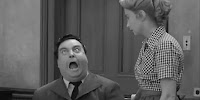
What better illustration of what Mr. Hazlitt is
talking about concerning men without sense and women with it than the picture
next to this post?
Well, maybe there is one—this bit of dialogue from The
Honeymooners:
Ralph: “What's the
matter? Aren't you up on current events? Don't you read the papers? Don't you
read comic books? That's the trouble with you; you don't know the latest
developments.”
Alice: “I don't know
the latest developments? Who is it that lets your pants out every other day?”
This demonstrates why, on more than one occasion, Ralph shows that he has a "BIG mouth"—big enough to put his foot in it.
Tuesday, May 16, 2017
Quote of the Day (William Hazlitt, on Liberty and Power)
“The love of liberty is the love of others; the love
of power is the love of ourselves.” — British essayist William Hazlitt (1778–1830),
Political Essays, with Sketches of Public Characters (1819)Friday, September 18, 2015
Quote of the Day (William Hazlitt, on Books)
“Books let us into their souls and lay open to us
the secrets of our own."—William Hazlitt, “The Sick Chamber,” The New Monthly Magazine, August 1830,
in Selections from William Hazlitt, edited by Will David Howe (1913)He wrote political commentary, biography (including one of Napoleon), literary and theater criticism (Edmund Kean, he famously wrote, "acted with the ferocity of an enraged street urchin"), art criticism (he had originally wanted to become an artist himself until he concluded he didn't have enough talent for it), personal essays (on hating), and sports ("The Fight" is an early classic on boxing).
Blogger Sheila O'Malley, in a post for "The Sheila Variations," offers a good overview of Hazlitt's underrated career and turbulent personal life.
In terms of the latter, it would have been bad enough that Hazlitt could be quarrelsome and drink to excess, but his relationships with women were unfortunate. Both his marriages foundered (surely not helped by his penchant for prostitutes), and--as noted by Alistair Smith in an October 2014 essay for the British newspaper The Telegraph, he did himself in with much of the contemporary commentariate not just through an obsession with a landlord's daughter half his age, but by writing about it at some length in Liber Amoris.
Even in this case, however, he was a forerunner of something new: the confessional memoir that has come to dominate the last several decades.
Wednesday, April 10, 2013
Quote of the Day (William Hazlitt, on ‘Unjust’ Public Opinion)

Thursday, September 16, 2010
Quote of the Day (William Hazlitt, on Liberty and Power)

The image accompanying this post is a self-portrait of the great essayist—in its way, as evocative as the one he painted of his friend Charles Lamb that I mentioned recently. The self-portrait, created when Hazlitt was only 24, captures the duality, the war between the light and dark sides of our character, hinted at in this quotation.
Thursday, September 2, 2010
Quote of the Day (Charles Lamb, on the Desire for Excellence)

One of these men “more excellent than myself” might well have been William Hazlitt, who, had he not decided to give himself entirely to his brilliant essays, might have done equally well with brilliant portraits such as this one of Lamb.
Tuesday, April 21, 2009
Quote of the Day (William Hazlitt, on Being Right)
This observation certainly seems applicable in terms of marriage. Increasingly, it also seems to characterize American political discourse—often, on both sides, not just wrong, but loud wrong.