Showing posts with label Virginia Woolf. Show all posts

Thursday, May 28, 2026

Quote of the Day (Virginia Woolf, After Encountering a Very Important Person in Her Life)

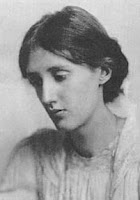
“Not much to my severer taste—florid, moustached, parakeet coloured, with all the supple ease of aristocracy, but not the wit of the artist. She writes fifteen pages a day…knows everyone. But could I ever know her…She is a grenadier; hard; handsome; manly; inclined to double chin.”—English novelist and critic Virginia Woolf (1882-1941), on first meeting novelist and future love Vita Sackville-West [pictured], in a Dec. 21, 1922 entry in The Diary of Virginia Woolf, Volume Two: 1920-1924, edited by Anne Olivier Bell, assisted by Andrew McNeillie (1978)

I think it was one phrase—"florid, moustached, parakeet coloured”—that grabbed my attention in this passage about the stunning androgyne Vita Sackville-West. After this, it was that bit about a new acquaintance who “writes fifteen pages a day.” (I wish I could equal that output!)

I can’t imagine describing anyone this way. But then again, that was part of the acute perception and sensibility of Virginia Woolf.

Saturday, April 12, 2025

Quote of the Day (Virginia Woolf, on ‘A Writer’s Country’)

“A writer’s country is a territory within his own brain; and we run the risk of disillusionment if we try to turn to such phantom cities into tangible brick and mortar.” —English novelist-essayist Virginia Woolf (1882-1941), “Literary Geography” (1905), Times Literary Supplement, Mar. 10, 1905

Wednesday, February 12, 2025

Quote of the Day (Virginia Woolf, on a London Winter in Early Evening)

“The hour should be the evening and the season winter, for in winter the champagne brightness of the air and the sociability of the streets are grateful. We are not then taunted as in the summer by the longing for shade and solitude and sweet airs from the hayfields. The evening hour, too, gives us the irresponsibility which darkness and lamplight bestow. We are no longer quite ourselves. As we step out of the house on a fine evening between four and six, we shed the self our friends know us by and become part of that vast republican army of anonymous trampers, whose society is so agreeable after the solitude of one’s own room.” —English novelist-essayist Virginia Woolf (1882-1941), “Street Haunting: A London Adventure,” in The Death of the Moth, and Other Essays (1942)

Wednesday, July 17, 2024

Quote of the Day (Virginia Woolf, on a Summer’s Night Talk)

“It was a summer’s night and they were talking, in the big room with the windows open to the garden, about the cesspool.” —English novelist-essayist Virginia Woolf (1882-1941), Between the Acts (1941)

Saturday, October 14, 2023

Quote of the Day (Virginia Woolf, on Why ‘The Past Is Beautiful’)

“[T]he past is beautiful because one never realizes an emotion at the time. It expands later, and thus we don't have complete emotions about the present, only about the past.” —English novelist-essayist Virginia Woolf (1882-1941), The Diary of Virginia Woolf, Volume Three: 1925-1930, edited by Anne Olivier Bell assisted by Andrew McNeillie (1981)

Wednesday, August 16, 2023

Quote of the Day (Virginia Woolf, on How to Destroy ‘The Spirit of Freedom’ in Libraries)

“To admit authorities, however heavily furred and gowned, into our libraries and let them tell us how to read, what to read, what value to place upon what we read, is to destroy the spirit of freedom which is the breath of those sanctuaries. Everywhere else we may be bound by laws and conventions—there we have none.”—English novelist-essayist Virginia Woolf (1882-1941), The Second Common Reader (1929)

Tuesday, March 7, 2023

Quote of the Day (Virginia Woolf, on Why Reading a Novel is a ‘Difficult and Complex Art’)

“To read a novel is a difficult and complex art. You must be capable not only of great fineness of perception, but of great boldness of imagination if you are going to make use of all that the novelist – the great artist – gives you.” —English novelist-essayist Virginia Woolf (1882-1941), “How Should One Read a Book?,” originally delivered as a lecture at Hayes Court Common School, Kent, England, Jan. 30, 1926, reprinted as a book in 2020

Tuesday, January 25, 2022

Quote of the Day (Virginia Woolf, on How Books Are Made)

“A book is not made of sentences laid end to end, but of sentences built, if an image helps, into arcades or domes.” —English novelist and essayist Virginia Woolf (1882-1941), A Room of One's Own (1929)

Few could construct sentences, let alone books, like Virginia Woolf, born 140 years ago today. She turned out, by this count, 34 books—essays, biographies, novels, and diary entries. As part of the Bloomsbury set of writers, artists and intellectuals, she also made it possible for others to find their creative voices.

Remarkably, she wrote all of this while being afflicted repeatedly with influenza and, ultimately and more damagingly, what are now believed to be episodes of bipolar disorder. The latter condition led her to commit suicide in 1941.

Woolf is one of the few authors whose work has become voluminous enough and life documented sufficiently to warrant not one, but several blogs devoted to her and/or the Bloomsbury circle, including Blogging Woolf.

Tuesday, September 21, 2021

Quote of the Day (Virginia Woolf, on ‘The Beauty of the World’)

“The beauty of the world which is so soon to perish, has two edges, one of laughter, one of anguish, cutting the heart asunder.” —English novelist-essayist Virginia Woolf (1882-1941), A Room of One’s Own (1929)

Tuesday, December 22, 2020

Quote of the Day (George Eliot, on Why ‘Our Dead Are Never Dead to Us Until We Have Forgotten Them’)

“Our dead are never dead to us until we have forgotten them: they can be injured by us, they can be wounded; they know all our penitence, all our aching sense that their place is empty, all the kisses we bestow on the smallest relic of their presence.” —English novelist, translator, editor, and religious writer Mary Ann Evans, a.k.a. George Eliot (1819-1880), Adam Bede (1859)

Almost nothing was conventional about George Eliot: her appearance; her religious skepticism; her piercing intellect at a time when educating women was not a family priority; her longtime common-law marriage to editor George Henry Elwes; her use of a male pen name so her initial novels would be taken more seriously; and finally, her death at age 61 on this day 140 years ago, in Chelsea, England, only six months after marrying a man 20 years her junior.

She blazed her own path in literature as well, with seven novels characterized by flinty realism and high moral seriousness. In this year of COVID-19, when so many people all over the world have experienced the death of family members or dear friends, the quote above seems not only a fair sample of her attitude, but also an appropriate response to the sense of loss so many feel.

Over the years, Eliot’s detractors (e.g., Mark Twain) have correctly noted her humorlessness, adding even heavier weight to her earnestness. 

But Virginia Woolf, in a 1919 Times Literary Supplement essay on the novelist’s career, generously but judiciously summarized her achievement by noting that she “taken to heart certain lessons learnt early, if learnt at all, among which, perhaps, the most branded upon her was the melancholy virtue of tolerance; her sympathies are with the everyday lot, and play most happily in dwelling upon the homespun of ordinary joys and sorrows.”

More pointedly, Woolf observed that in the 1871 masterpiece Middlemarch, Eliot had created, “with all its imperfections…one of the few English novels written for grown-up people.”

(In an especially relevant post for our time, Delia da Sousa Correa of London’s Open University has written for the Institute of English Studies blog about the role of an earlier epidemic—a cholera outbreak in Britain—in Middlemarch.)

Saturday, October 31, 2020

Quote of the Day (Virginia Woolf, on Fellow Diarist John Evelyn)

“The diary, for whose sake we are remembering the three hundredth anniversary of the birth of John Evelyn, is a case in point.  It is sometimes composed like a memoir, sometimes jotted down like a calendar; but he never used its pages to reveal the secrets of his heart, and all that he wrote might have been read aloud in the evening with a calm conscience to his children….

“Ignorant, yet justly confident that with his own hands he might advance not merely his private knowledge but the knowledge of mankind, Evelyn dabbled in all the arts and sciences, ran about the Continent for ten years, gazed with unflagging gusto upon hairy women and rational dogs, and drew inferences and framed speculations which are now only to be matched by listening to the talk of old women round the village pump.  The moon, they say, is so much larger than usual this autumn that no mushrooms will grow, and the carpenter's wife will be brought to bed of twins.  So Evelyn, Fellow of the Royal Society, a gentleman of the highest culture and intelligence, carefully noted all comets and portents, and thought it a sinister omen when a whale came up the Thames….Nature, it seems, was determined to stimulate the devotion of her seventeenth-century admirers by displays of violence and eccentricity from which she now refrains.  There were storms, floods, and droughts; the Thames frozen hard; comets flaring in the sky. If a cat so much as kittened in Evelyn's bed the kitten was inevitably gifted with eight legs, six ears, two bodies, and two tails.”—English novelist, essayist, and diarist Virginia Woolf (1882-1941), “Rambling Round Evelyn” (1920), reprinted in The Common Reader: First Series, edited by Andrew McNeillie (1925)

John Evelyn was born 400 years ago today in Surrey, to a family made wealthy by gunpowder production. Virginia Woolf captures his unflagging activity in the passage above. But it may be even more shocking to contemporary society, revolving around intellectual specialists, to see all his activities listed: writer, gardener, urbanologist, architect, connoisseur, and bibliophile.

Though I had heard of Evelyn previously, Woolf’s incisive essay made me want to seek out more information on him, even as I pondered her unique vantage point in assessing his literary achievement.

In her fiction, Woolf was concerned with illuminating the interior consciousness of characters. At the time she wrote about Evelyn, she was five years into keeping her own diary—a record she would continue to maintain until weeks before her suicide in 1941. Into what she called her “dialogue of the soul with the soul,” she poured reflections on her work, thoughts of other writers, and her wrestling with the depression that dogged her life—all of which made her more appreciative of the diaries of Evelyn’s contemporary and friend Samuel Pepys.

As Woolf implied, Evelyn was the soul of discretion compared with Pepys. If you want to know what it felt like to be a top government bureaucrat wrestling with financing the Royal Navy by day before getting randy with the family maid by night, then Pepys is your man. If you want to know how an entire society experienced the sights and sounds of a certain day, then you’ll want to read Evelyn, as in this passage recording what happened the day that exiled King Charles II returned to power in 1660:

“This day came in his Majestie Charles the 2d to London after a sad, and long Exile, and Calamitous Suffering both of the King and Church: being 17 yeares: This was also his Birthday, and with a Triumph of above 20000 horse & foote, brandishing their swords and shouting with unexpressable joy: The wayes straw’d with flowers, the bells ringing, the streets hung with Tapissry, fountaines running with wine: The Major, Aldermen, all the Companies in their liver[ie]s, Chaines of Gold, banners; Lords & nobles, Cloth of Silver, gold and vellvet every body clad in, the windos and balconies all set with Ladys, Trumpets, Musick, and [myriads] of people flocking the streetes and was as far as Rochester, so as they were 7 houres in passing the Citty, even from 2 in the afternoon 'til nine at night: I stood in the strand, and beheld it, & blessed God: And all this without one drop of bloud, and by that very army, which rebell'd against him: but it was the Lords doing, et mirabile in oculis nostris: for such a Restauration was never seene in the mention of any history, antient or modern, since the returne of the Babylonian Captivity, nor so joyfull a day, and so bright, ever seene in this nation: this hapning when to expect or effect it, was past all humane policy.”

Ultimately, though not as confessional, Evelyn may prove more suited to the needs of historians and biographies than Pepys.  The latter gave up penning his thoughts in 1669, but Evelyn maintained his habit of diary-keeping from his college days in 1641 to his retirement period in 1704. It’s a prime source for understanding life in 17th-century England.

(For a fascinating discussion on Sayes Court, Evelyn's home in Deptford, and how the author's prized garden there fell victim to the visiting Peter the Great and the Russian Tsar's drunken friends, see Caroline Derry's guest post on the "London Historians' Blog.")

Saturday, March 23, 2019

Quote of the Day (Virginia Woolf, on the Spell Cast by the Essay)


“Of all forms of literature…, the essay is the one which least calls for the use of long words. The principle which controls it is simply that it should give pleasure; the desire which impels us when we take it from the shelf is simply to receive pleasure. Everything in an essay must be subdued to that end. It should lay us under a spell with its first word, and we should only wake, refreshed, with its last. In the interval we may pass through the most various experiences of amusement, surprise, interest, indignation; we may soar to the heights of fantasy with Lamb or plunge to the depths of wisdom with Bacon, but we must never be roused. The essay must lap us about and draw its curtain across the world.”—English essayist-novelist Virginia Woolf (1882-1941), “The Modern Essay,” in The Common Reader (1925)

I picked up The Common Reader while browsing in a bookstore late this afternoon, and read “The Modern Essay” on a subway ride home. From first to last, I was cast under the kind of spell that Virginia Woolf was talking about in the quote above. In one sense, I was captivated by her images (“words coagulate together in frozen sprays which, like the grapes on a Christmas-tree, glitter for a single night, but are dusty and garish the day after”).
 
In another instance, I was swept along by her argument that for an essay to succeed, it required “an obstinate conviction which lifts ephemeral sounds through the misty sphere of anybody’s language to the land where there is a perpetual marriage, a perpetual union.” 

But I was also struck by two other aspects of this essay:


*Woolf’s notion that Victorians “wrote at greater length than is now usual, and they wrote for a public which had not only time to sit down to its magazine seriously, but a high, if peculiarly Victorian, standard of culture by which to judge it.” In other words, she is taking notice of the shorter attention span of the modern (i.e., post-WWI) reader. If Woolf felt this way then, what in Heaven’s name would she think of the age of Twitter?


*Woolf thrills at the vigor of personality that shines through the essay. The great accomplishment of Max Beerbohm, she notes, was giving ‘himself.” What she is talking about is the quality that writing teachers nowadays call “voice.” From their essays, one would not have called Matthew Arnold “Matt” or Walter Pater “Walt,” but with Beerbohm, “the spirit of personality permeates every word that he writes.”
 

For anyone like me who has longed pondered how to make our work—not just the essay but even the more humble blog post—this piece is striking and inspirational.