Showing posts with label Presidents' Day. Show all posts

Monday, February 16, 2026

Photo of the Day: Honest Abe’s Stovepipe Hat

Few objects are so associated with a single person as the stovepipe hat with
Abraham Lincoln. This form of headgear was quite popular in the 19th century, but, if you’re like me, you’re hard pressed to think of another wearer than America’s 16th President.

I photographed the one you see here back in June 2021, while in Manchester, VT, for a beloved relative’s wedding. It’s part of the items on display in Hildene, the summer home of Robert Todd Lincoln, the President’s oldest son.

Abe Lincoln wore several such hats in his lifetime, as soon as he was old enough to afford one in adulthood. It certainly afforded convenience (he took to carrying his paperwork in it as a young attorney), but I think it also made him look more imposing. 

Typically seven to eight inches tall, these hats, when topping his 6 ft.-4 in. frame, brought his total height to nearly seven feet tall, making him stand out as much as modern pro basketball centers.

Believe it or not, this hat—black and narrow-brimmed, made from glossy black pile textile that covers a paper card support—is only three of Lincoln’s still in existence. Evidently he bought it at Siger and Nichols, a firm then based on Maiden Lane in New York City.

There are plenty of reasons to visit Vermont, but if you find yourself in the southwestern corner of the state, you should make it a point to visit Hildene.

Robert Todd Lincoln was one of the more consequential offspring of American Presidents, serving variously as Secretary of War, U.S. Ambassador to Great Britain, and president of the Pullman railroad company.

But there is no doubt that all visitors to this 24-room Georgian revival mansion will want to view its historic exhibit associated with Robert’s father, which not only includes this hat but also an oval dressing mirror from the White House and a Bible owned by the President.

Abraham Lincoln’s words and actions still matter to America. But artifacts like this hat at Hildene also have their function: sort of like relics of a man who’s become known, in effect (and probably to his ironic amusement, could he see it), as America’s great secular saint.

Monday, February 17, 2025

Quote of the Day (George Washington, on Disunity and ‘Arbitrary Power’)

“It is only in our United Character, as an Empire, that our Independance is acknowledged, that our power can be regarded or our Credit supported among foreign Nations—the Treaties of the European Powers with the United States of America will have no validity on a dissolution of the Union. We shall be left nearly in a State of Nature, or we may find by our own unhappy experience, that there is a natural and necessary progression from the extreme of Anarchy to the extreme of Tyranny, and that arbitrary power is most easily established on the ruins of Liberty abused to Licentiousness.”—George Washington (1732-1799), commander in chief of the Continental Army and first President of the United States, “Circular to the States,” June 8-21, 1783, on the National Archives’ “Founders Online” Website

He certainly had his faults, but George Washington has long held an honored place in this country’s history for his vision, wisdom, and integrity. 

The above quote demonstrates why, as does his example of renouncing power and returning to private life when he could easily have become a dictator.

Like many Americans, I have taken for granted that important documents like the above source from our nation’s past would not only be preserved but disseminated in digital form for all of us to ponder.

The way things are going, who knows what will be maintained anymore? Oh, you hadn’t heard that the Presidential administration that came to power in January is forcing out the top leadership at the National Archives?

This is as good a time as any to remember George Orwell’s warning about history in 1984: “Who controls the past controls the future. Who controls the present controls the past.”

Monday, February 19, 2024

Quote of the Day (Abraham Lincoln, on ‘Faith in the People’)

“I have faith in the people. They will not consent to disunion. The danger is, that they are misled. Let them know the truth and the country is safe.” —President Abraham Lincoln, to the Boston (MA) Journal, July 1864, quoted in “President Lincoln Had a Presentiment of Death,” Sandusky (OH) Register, Apr. 29, 1865

Monday, February 20, 2023

Quote of the Day (Abraham Lincoln, on Success Through Avoiding ‘Personal Contention’)

“Quarrel not at all. No man resolved to make the most of himself can spare time for personal contention.” —President Abraham Lincoln (1809-1865), letter to Capt. James M. Cutts, October 26, 1863, in Collected Works of Abraham Lincoln, Volume 6.

As President during the Civil War, Lincoln could not avoid “contention,” nor could he in his marriage. But his patience towards the difficult Mary Todd Lincoln was extraordinary, and his disagreements with opponents were based on policy—what to do about slavery and secession— rather than personality.

That goes a long way towards explaining how he held together a still-young Republican Party—a coalition founded simply on opposing the extension of slavery into new territories—as well as Northern and border states with fundamental disagreements during the war on what to do with slavery even where it existed.

Lincoln could affect not simply events but people, as seen in how he handled the messy situation that gave rise to the quote above. He appears to have delivered these remarks in person to Captain James Cutts, a brother-in-law of the President’s longtime Illinois political rival, Stephen A. Douglas.

Cutts had been court-martialed for several offenses, including arguing with fellow officers—the “personal contention” to which Lincoln referred.

On appeal, Lincoln approved Cutts’ convictions but reduced the sentences to a written reprimand.

The effect of his shrewd advice to the 26-year-old soldier was profound: Cutts took it to heart enough that he decided to prove his worth on the battlefield rather than through fisticuffs. He would receive the Congressional Medal of Honor for his bravery at the battles of the Wilderness, Spotsylvania and Petersburg.

Monday, February 21, 2022

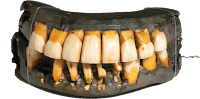
Quote of the Day (Alexis Coe, on George Washington’s Teeth)

“At best, we can say Washington had a poacher's smile. His dentists took chunks of ivory from hippopotamuses, walruses and elephants, sculpted them down, and affixed them to dentures using brass screws.”— American presidential historian and podcast host Alexis Coe, You Never Forget Your First: A Biography of George Washington (2020)

After 12 years of elementary and high school, most American kids don’t know much about George Washington. What they think they know turns out to be a good deal less, or at least more complicated, than they anticipate—and certainly in the case of three matters.

Yes, Washington owned slaves. But, as noted by Pulitzer Prize-winning biographer James Thomas Flexner, he became, unlike Southern planters of his age (including Jefferson), more rather than less bothered by the so-called “peculiar institution” over time.

He not only provided in his will for his slaves’ eventual manumission, but rented most of Mount Vernon to avoid the debt that increasingly encumbered fellow plantation aristocrats and limited their ability to free their own slaves.

And yes, as commander in chief of the Continental Army, Washington crossed the Delaware River to attack British forces at Trenton.

But, as I learned in a visit to Highland, the Virginia home of another President in that crossing, James Monroe (then a junior soldier), Emanuel Gottlieb Leutze’s iconic 1851 painting got almost everything about that event wrong.

(Most obviously, that pose on the edge of the rowboat? It wasn’t a rowboat but a flat boat, and one strong wave would have sent Washington, leaning forward precariously in front, plunging into the river’s icy depths, never to emerge alive.)

Which brings us to the third—and dumbest—item: George’s teeth. It’s always fascinated me how endlessly and boringly fixated Americans are about his choppers. (When I visited Mount Vernon several years ago, this was among the most frequently asked questions the staff encountered.)

Gilbert Stuart’s endlessly reproduced image of the first President concentrated attention on this facial defect—even though the painter tried to downplay George’s sunken cheeks around the teeth by stuffing his mouth with cotton for what certainly must have been a long, uncomfortable portrait sitting.

As you’ll see in the image accompanying this post, the teeth were not, for sure, the kind of pearly whites that celebrities flash from the red carpet.

But it wasn’t until the 19th century—after poor George had died—that America had its significant “firsts” in dentistry: a book on the subject published here (1801), a dentist recommending dental floss (1815), a dental school (1840), and a public demonstration of ether anesthesia (1846). So what did you expect in his time?

And another thing: while George had only one of his original teeth by the time of his death, and the dentures he did have caused him tons of discomfort, they weren’t wooden, okay? They were, as Ms. Coe notes, primarily ivory.

The rather exotic animal sources that she mentions were supplemented by gold, lead, and human teeth that Washington paid for—including those of his own slaves.

I get it that Americans want to know something about heroes like Washington (and the other great February President honored this day, Lincoln) that reveal them as human beings rather than statues, with all kinds of imperfections just like you and me. Nobody could be that good.

But I also wish kids (and yes, their parents) remember what gets lost in our time of trivia and revisionism—why Washington’s contemporaries turned to him for leadership, and why we continue to honor him:

*A lifelong commitment to learn and maintain good manners (the better to restrain a ferocious temper);

*A willingness to serve his country when called to duty;

*Sacrifices he shared with his common soldiers;

*Heeding others when they had better ideas than his own;

*Spotting and encouraging smart younger men like Alexander Hamilton;

*Telling the truth and not stealing from the public purse; and,

*Yielding power willingly, without resort to violence or corruption—virtually unheard of among world leaders at the time, and, as even Americans know all too well since January 6, 2021, not to be taken for granted even here now, as we near 250 years since Washington staked everything he had—including his life—for a new republican experiment. 

(See Adam Littlestone Luria’s excellent New York University Law Review blog post on the “stable and enduring politics” that Washington sought to create.)