
‘Come; see the oxen kneel,
Our childhood used to know,’
I should go with him in the gloom,
Hoping it might be so.”—English poet-novelist Thomas Hardy (1840-1928), “The Oxen,” originally published in The Times of London (Christmas Eve, 1915)
“Nor, again, need we go in quest of any of those
things which this vain world calls great and noble. Christ altogether
dishonoured what the world esteems, when He took on Himself a rank and station
which the world despises. No lot could be more humble and more ordinary than
that which the Son of God chose for Himself.”—English theologian, writer, and
Catholic convert St. John Henry Newman (1801-1890), “Sermon 17: Religious Joy,” in Parochial and Plain Sermons, Volume 8 (1908), in The
Newman Reader
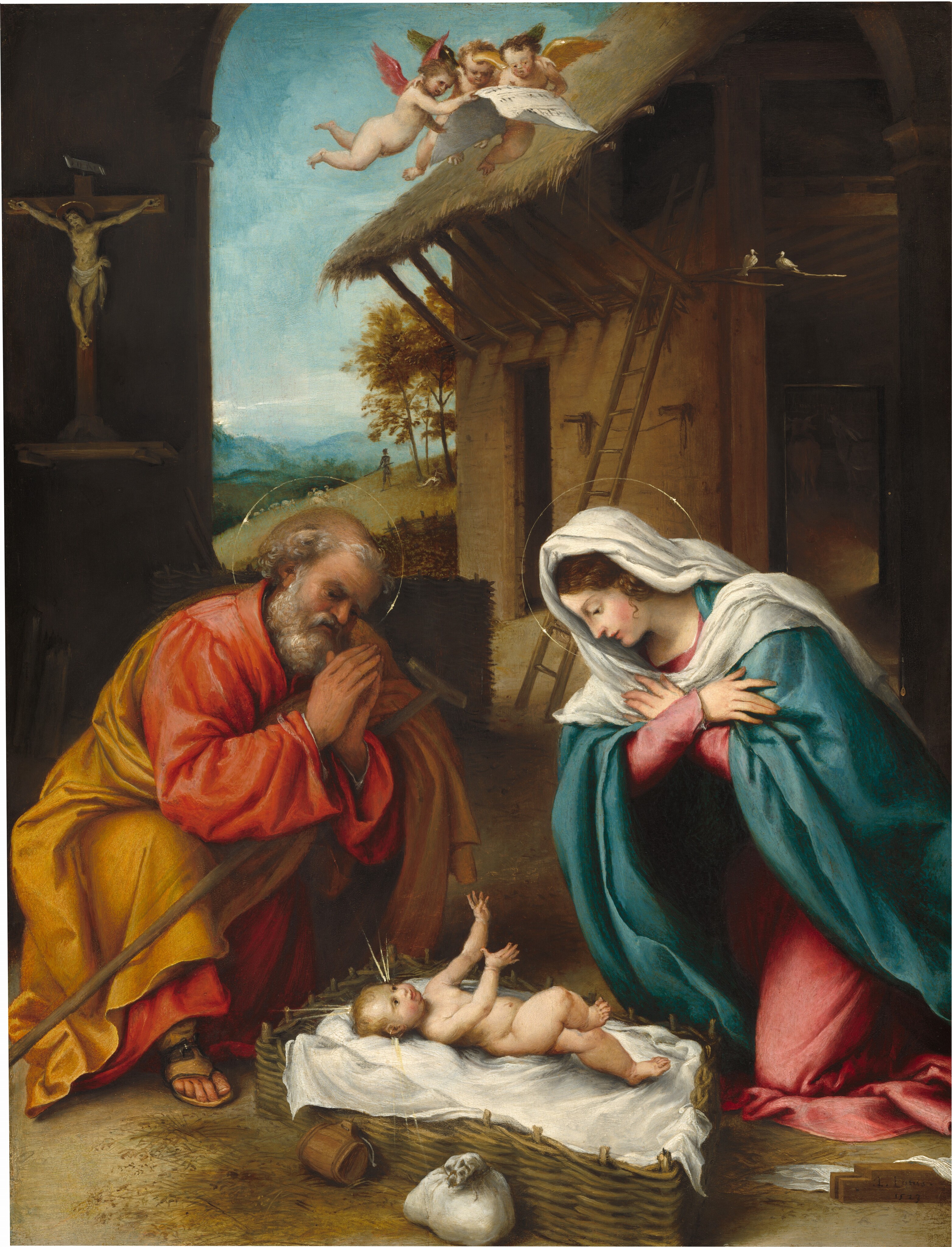
The image accompanying this post, The Nativity,
is a 1523 oil on panel painting by Italian Renaissance artist Lorenzo Lotto (c.
1480-1556/1557).

“Behold, we have the infant Christ in front of us.
“Let’s grow old with Him.”—St. Augustine of Hippo (354-430
AD), “Sermo CXCVI: Christmas #13,” translated by William Griffin, in The Best Christian Writing 2006, edited by John Wilson
The image accompanying this post is The Nativity,
by Italian painter Federico Barocci (1535-1612.)
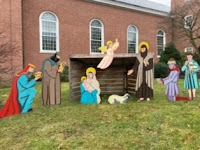
So it was yesterday, when I saw the one accompanying
this post, outside the Reformed Church of Oradell, several miles from where I
live in Bergen County, NJ.
All over the world, people continue to celebrate
births as miraculous signs of joy and hope. The birth of Jesus in Bethlehem 2,000 years ago
was even more so—an act of faith by Mary in bearing this child under unusual
and strained circumstances, and an act of faith by God that human beings,
despite their history and tendency towards sin, were worth such a dramatic
divine intervention in earthly affairs.


