Showing posts with label John Henry Cardinal Newman. Show all posts

Sunday, March 29, 2026

Spiritual Quote of the Day (St. John Henry Newman, on the ‘First Shadowy Triumph’ of Palm Sunday)

“All that is bright and beautiful, even on the surface of this world, though it has no substance, and may not suitably be enjoyed for its own sake, yet is a figure and promise of that true joy which issues out of the Atonement. It is a promise beforehand of what is to be: it is a shadow, raising hope because the substance is to follow, but not to be rashly taken instead of the substance. And it is God's usual mode of dealing with us, in mercy to send the shadow before the substance, that we may take comfort in what is to be, before it comes. Thus our Lord before His Passion rode into Jerusalem in triumph, with the multitudes crying Hosanna, and strewing His road with palm branches and their garments. This was but a vain and hollow pageant, nor did our Lord take pleasure in it. It was a shadow which stayed not, but flitted away. It could not be more than a shadow, for the Passion had not been undergone by which His true triumph was wrought out. He could not enter into His glory before He had first suffered. He could not take pleasure in this semblance of it, knowing that it was unreal. Yet that first shadowy triumph was the omen and presage of the true victory to come, when He had overcome the sharpness of death. And we commemorate this figurative triumph on the last Sunday in Lent, to cheer us in the sorrow of the week that follows, and to remind us of the true joy which comes with Easter-Day.”—English theologian, educator, memoirist, and Roman Catholic convert St. John Henry Newman (1801-1890), “The Cross of Christ the Measure of the World,” sermon preached Apr. 9, 1841, in Parochial and Plain Sermons, Vol. 6

The image accompanying this post, The Entry Into Jerusalem (ca. 1305), was created by the Italian painter and architect Giotto (c. 1267-1337).

Sunday, August 10, 2025

Spiritual Quote of the Day (St. John Henry Newman, on Reason and Faith)

“[I]t is our great misfortune here, and our trial…that, where power of intellect is, there need not be virtue; and that where right, and goodness, and moral greatness are, there need not be talent. It was not so in the beginning; not that our nature is essentially different from what it was when first created; but that the Creator, upon its creation, raised it above itself by a supernatural grace, which blended together all its faculties, and made them conspire into one whole, and act in common towards one end; so that, had the race continued in that blessed state of privilege, there never would have been distance, rivalry, hostility between one faculty and another. It is otherwise now; so much the worse for us;—the grace is gone; the soul cannot hold together; it falls to pieces; its elements strive with each other. And as, when a kingdom has long been in a state of tumult, sedition, or rebellion, certain portions break off from the whole and from the central government, and set up for themselves; so is it with the soul of man.” —English Roman Catholic convert, theologian, educator, and memoirist St. John Henry Newman (1801-1890), “Intellect, the Instrument of Religious Training” (Sermon on the Feast of St. Monica, Aug. 27, 1856)

It was welcome news late last month when Pope Leo XIV named St. John Henry Newman, an honor bestowed through a person’s writings, teachings, and research that have influenced Catholic doctrine. Only 38 saints in the Church’s long history have received this designation, including St. Thomas Aquinas, Jerome, Augustine of Hippo, Teresa of Avila, and Therese of Lisieux.

For a summary of how Newman “influenced the thought and magisterial teachings of the Church during and after his life,” please read this essay by Benedictine College theologian Matthew Muller.
Sunday, December 25, 2022

Spiritual Quote of the Day (St. John Henry Newman, on the ‘Humble,’ ‘Ordinary’ Lot of Jesus at the Incarnation)

“We are reminded that though this life must ever be a life of toil and effort, yet that, properly speaking, we have not to seek our highest good. It is found, it is brought near us, in the descent of the Son of God from His Father's bosom to this world…. No longer need men of ardent minds weary themselves in the pursuit of what they fancy may be chief goods; no longer have they to wander about and encounter peril in quest of that unknown blessedness to which their hearts naturally aspire, as they did in heathen times. The text speaks to them and to all, ‘Unto you," it says, ‘is born this day in the city of David a Saviour, which is Christ the Lord.’

“Nor, again, need we go in quest of any of those things which this vain world calls great and noble. Christ altogether dishonoured what the world esteems, when He took on Himself a rank and station which the world despises. No lot could be more humble and more ordinary than that which the Son of God chose for Himself.”—English theologian, writer, and Catholic convert St. John Henry Newman (1801-1890), “Sermon 17: Religious Joy,” in Parochial and Plain Sermons, Volume 8 (1908), in The Newman Reader

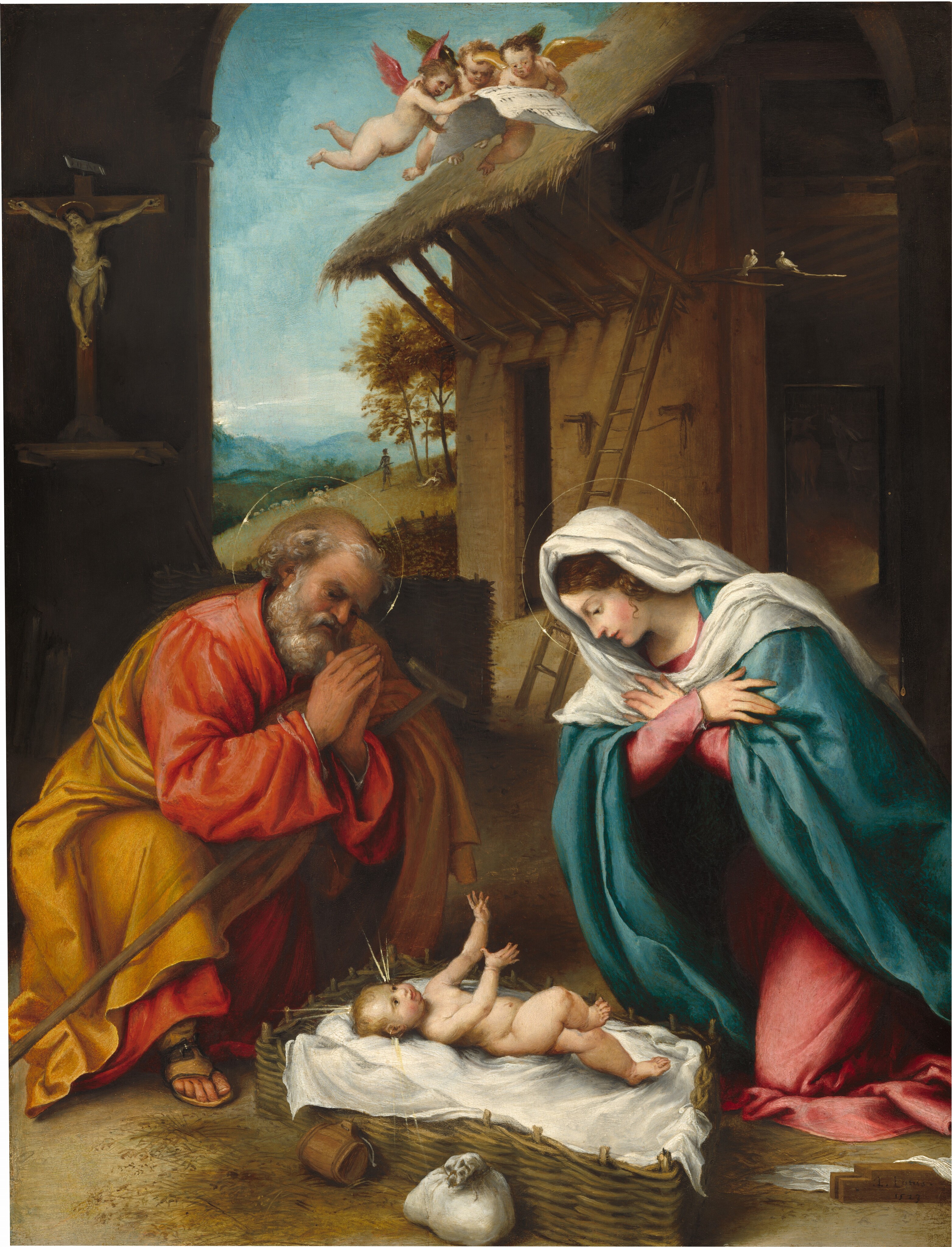
The image accompanying this post, The Nativity, is a 1523 oil on panel painting by Italian Renaissance artist Lorenzo Lotto (c. 1480-1556/1557).

Saturday, November 12, 2022

Quote of the Day (John Henry Cardinal Newman, on Education as Preparation for the World)

“Why do we educate, except to prepare for the world? Why do we cultivate the intellect of the many beyond the first elements of knowledge, except for this world? Will it be much matter in the world to come whether our bodily health or whether our intellectual strength was more or less, except of course as this world is in all its circumstances a trial for the next? If then a University is a direct preparation for this world, let it be what it professes. It is not a Convent, it is not a Seminary; it is a place to fit men of the world for the world. We cannot possibly keep them from plunging into the world, with all its ways and principles and maxims, when their time comes; but we can prepare them against what is inevitable; and it is not the way to learn to swim in troubled waters, never to have gone into them.” —Roman Catholic theologian, educator, and essayist John Henry Cardinal Newman (1801-1890), “Duties of the Church towards Knowledge,” in The Idea of a University (1852)

Sunday, December 22, 2019

Quote of the Day (St. John Henry Newman, on Advent)


“Christ is coming!—from thy bed,
Earth-bound soul, awake and spring,—
With the sun new-risen to shed
Health on human suffering.”—Englist theologian, poet, educator and memoirist St. John Henry Newman (1801-1890), “Advent-Lauds” (translated from a 5th-century hymn, from his Verses on Various Occasions (1880)

Sunday, October 27, 2019

Quote of the Day (St. John Henry Newman, on Priests as Human Guides)


“Had angels been your priests, my brethren, they could not have condoled with you, sympathized with you, have had compassion on you, felt tenderly for you, and made allowances for you, as we can; they could not have been your patterns and guides, and have led you on from your old selves into a new life, as they can who come from the midst of you.”—English Roman Catholic convert, theologian, educator, and memoirist St. John Henry Newman (1801-1890), “Men, Not Angels: The Priests of the Gospel,” Discourses to Mixed Congregations (1849)

I really could not let too much time elapse after his canonization two weeks ago without remarking on some way on John Henry Cardinal Newman. He has survived his detractors in magnificent form, of course.

Still, I confess that I did not read this passage without feeling some ambivalence. When Newman wrote it, he surely meant that priests shared the same frailties that afflicted other human beings. Many Roman Catholics like me have, over the years, more deeply identified with the teachings of the Gospels because of that humanity, just as Newman led his listeners more closely to God in the Victorian Era.

But we now live in a time when—even if they remain a minority—far too many priests have alienated people of the faith, not just through the obvious—the sexual abuse scandals—but also through general misuse of their authority. 

Altogether, it is a far cry from the stringent intellect but gentle personal example of Cardinal Newman.

Sunday, January 20, 2019

Quote of the Day (Blessed John Henry Cardinal Newman, on ‘Love of Heaven’)


“Let us understand, as a first truth in religion, that love of heaven is the only way to heaven. Sight will not move us; else why did Judas persist in covetousness in the very presence of Christ? why did Balaam, whose eyes were opened, remain with a closed heart? why did Satan fall, when he was a bright Archangel? Nor will reason subdue us; else why was the Gospel, in the beginning, ‘to the Greeks foolishness’? Nor will excited feelings convert us; for there is one who ‘heareth the word, and anon with joy receiveth it;’ yet ‘hath no root in himself,’ and ‘dureth’ only ‘for a while.’ Nor will self-interest prevail with us; or the rich man would have been more prudent, whose ‘ground brought forth plentifully,’ and would have recollected that ‘that night his soul’ might be ‘required of him.’ Let us understand that nothing but the love of God can make us believe in Him or obey Him; and let us pray Him, who has ‘prepared for them that love Him, such good things as pass man's understanding, to pour into our hearts such love towards Him, that we, loving Him above all things, may obtain His promises, which exceed all that we can desire.’"— English theologian, poet, educator, and memoirist Blessed John Henry Cardinal Newman (1801-1890), Newman Reader, Parochial and Plain Sermons 8, “Sermon 6, Miracles no Remedy for Unbelief,” first preached on May 2, 1830

Sunday, August 12, 2018

Quote of the Day (John Henry Cardinal Newman, on ‘Faith Without Charity’)


“Faith without charity is dry, harsh, and sapless; it has nothing sweet, engaging, winning, soothing; but it was charity which brought Christ down. Charity is but another name for the Comforter. It is eternal Charity which is the bond of all things in heaven and earth; it is Charity wherein the Father and the Son are one in the unity of the Spirit; by which the Angels in heaven are one, by which all Saints are one with God, by which the Church is one upon earth.” —John Henry Cardinal Newman (1801-1890), A Newman Treasury: Selections from the Prose Works of John Henry Cardinal Newman, edited by Charles Frederick Harrold (1943)

Sunday, December 3, 2017

Quote of the Day (Cardinal Newman, on Earth and Soul at Advent)


“Year after year, as it passes, brings us the same warnings again and again, and none perhaps more impressive than those with which it comes to us at this season. The very frost and cold, rain and gloom, which now befall us, forebode the last dreary days of the world, and in religious hearts raise the thought of them. The year is worn out: spring, summer, autumn, each in turn, have brought their gifts and done their utmost; but they are over, and the end is come. All is past and gone, all has failed, all has sated; we are tired of the past; we would not have the seasons longer; and the austere weather which succeeds, though ungrateful to the body, is in tone with our feelings, and acceptable. Such is the frame of mind which befits the end of the year; and such the frame of mind which comes alike on good and bad at the end of life. The days have come in which they have no pleasure; yet they would hardly be young again, could they be so by wishing it. Life is well enough in its way; but it does not satisfy. Thus the soul is cast forward upon the future, and in proportion as its conscience is clear and its perception keen and true, does it rejoice solemnly that ‘the night is far spent, the day is at hand,’ that there are ‘new heavens and a new earth’ to come, though the former are failing; nay, rather that, because they are failing, it will ‘soon see the King in His beauty,’ and ‘behold the land which is very far off.’ These are feelings for holy men in winter and in age, waiting, in some dejection perhaps, but with comfort on the whole, and calmly though earnestly, for the Advent of Christ.”—English cleric John Henry Cardinal Newman (1801-1890), “Worship, a Preparation for Christ's Coming,” The Newman Reader: Parochial and Plain Sermons, Volume 5