
Showing posts with label FAME. Show all posts
Showing posts with label FAME. Show all posts
Friday, March 14, 2025
Quote of the Day (Flannery O'Connor, on Fame)


Friday, September 22, 2023
Quote of the Day (Brooke Shields, Suffering a Case of Massively Mistaken Identity)

(The accompanying picture of Brooke Shields was taken
Feb. 21, 2018, by Greg2600.)
Monday, March 27, 2023
Quote of the Day (H. L. Mencken, Defining ‘Celebrity’)

Thursday, January 19, 2023
Quote of the Day (Oliver Wendell Holmes Sr., on Fame vs. Notoriety)

Friday, January 13, 2023
Quote of the Day (Larry David, on What Fame Has Done for Him)

It's good to know that David was kidding when talking
to this reporter. Because otherwise, after reading the above, you wouldn’t be
surprised to find out that David’s wife later divorced him—though it’s even
more surprising to learn that a) it took her another nine years to do so, and
b) another woman ended up marrying the real-life inspiration for George
Costanza (AND Bernie Sanders double) three years ago.
(This image of the creator of Seinfeld, Curb
Your Enthusiasm—and Broadway’s Fish in the Dark—was taken at the
2009 Tribeca Film Festival by David Shankbone.)
Wednesday, April 6, 2022
Quote of the Day (Horace Greeley, on How ‘Fame is a Vapor’)

Wednesday, December 22, 2021
Quote of the Day (George Clooney, on Celebrities’ Twitter Presence)
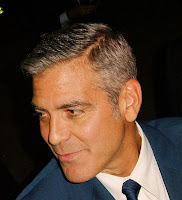
Well, I suppose that the publicist for George Clooney
finally persuaded him to the contrary, because four years after this Esquire
rant, the actor-director opened his own “George Clooney Official”
Twitter page. Nevertheless, Mr. C. must have warned that he would strictly
limit his involvement, because the tweets and retweets consist mostly of
pictures of himself and his wife, with minimal commentary.
Every other day, if not more often, Clooney must nod
his head over his foresight of nearly a decade ago. Though hardly shy about
expressing his opinions, he knows that old-time movie stars loomed large for a
reason other than the big screens of the Golden Age of Film: that overexposure
removes the mystique invested by fans.
Moreover, as someone who admitted to Newsweek
10 years ago that his past life of substance and and womanizing precluded a
life in politics, Clooney knows all too well the perils of going online and
venting to the world before you’ve had time to think it over and calm down.
Even if you’re not a party animal but simply love the sound of your own voice
(an occupational hazard in the entertainment industry), you run a big risk of
looking stupid.
Bette Midler, that means you.
You’d think that the singer-actress would have learned
her lesson from three years ago, when she tweeted that women “are the n-word of the world,” or especially last year, when she mocked Melanie Trump’s accent and called her an “illegal alien”—in both cases, sparking a backlash that led the
outspoken entertainer to issue uncharacteristic apologies.
But here she was at it again this week, when
frustration over Joe Manchin’s opposition to the “Build Back Better” social
spending plan of the Biden administration led her to lash out at the Democratic
Senator from West Virginia for wanting to keep all Americans like his state: “Poor, illiterate and strung out."
Less than an hour later, Midler was backtracking with
a tweeted apology to West Virginians (“Surely there’s someone there who has the
state’s best interest at heart, not his own!”)
No matter. In politics, this would have been
considered a gaffe, a statement that, for anyone not named Donald Trump, would
have halted any possibility for further advancement.
In entertainment, plenty of people feel that she was
right the first time. And therein lies the problem.
Statements like Ms. Midler’s only reinforce the
conviction of many in Red America that liberal elites are condescending and
unworthy of support (even someone like her, who has funded programs for
neighborhood revitalization and wounded veterans). She made it that much harder
to move back into the Democratic column a state that had once firmly backed the
New Deal.
An additional history lesson might be in order here. Ms. Midler, like all non-indigenous Americans (including me), are descended from groups who, for the longest time after arriving on these shores, were “Poor, illiterate and strung out.”
Maybe she should get a copy of Oscar Handlin’s The Uprooted so she can better understand how alienated and resentful the recipients
of taunts such as hers felt in the 19th century—and how belittling those remarks remain to the
underprivileged and marginalized of this country, whoever they are and wherever
they live.
(The photo of George Clooney accompanying this post
was taken at the Toronto International Film Festival on Sept. 9, 2011, by Ed
Van-West Garcia.)
Thursday, August 19, 2021
Quote of the Day (Margo Howard, on the Devaluation of Celebrity)

When Ms. Howard—daughter of Ann Landers and ex-wife of
actor Ken Howard—wrote her screed about “the current surplus of celebridreck,”
she was reacting to Paris Hilton, Jessica Simpson and—God help us—Flavor Flav. In
the decade and a half since, the proliferation of social media has given birth
to countless “influencers.” Is this really a cultural improvement?
(The image accompanying this post, of Jessica Simpson,
was taken June 22, 2008, by John VanderHaagen from Grand Rapids, MI.)
Tuesday, May 25, 2021
Quote of the Day (Jack Kerouac, on Fame and ‘The Enthusiasms of Younger Men’)

“Old letters starting ‘Cher, Cher Jean…’ etc. And O
all the youngish preoccupations!
“Cassady’s letters are wildly beautiful and full of
Irish Celtic verbal zing. Burrough’s old letters contain the same dry humor, like
‘H.C. is sailing away in a boat with a sail to match his blond hair. Enough to
make a man spew.’”—American novelist Jack Kerouac (1922-1969), letter to poet
Lawrence Ferlinghetti, May 25, 1961, in Jack Kerouac Selected Letters: Volume 2, 1957-1969, edited by Ann Charters (1999)
It was only four years since his On the Road had become the fictional touchstone of the Beats, but in his letter to Ferlinghetti 60 years ago today, Jack Kerouac was already sounding less “beato” (the Italian for “beatific,” his sense of the West Coast literary movement) than beaten.
The exhilaration of his recent
move to Orlando, Fla., had dissipated, and he was now worrying about his mother’s
declining health and grousing about left-wing utopianism that he regarded as
insufficiently critical of Soviet totalitarianism and inimical to his beliefs
as a self-described “Catholic conservative.”
His death from an abdominal hemorrhage caused by a
lifetime of heavy drinking was still eight years off, but Kerouac was even now
contemplating posterity. He was lamenting the lost “enthusiasms” of him and his
companions, the complications of immense success (“fame kills all”), and what
time had undone.
But he was also thinking of restoration—of how
preserving his correspondence would enable a deeper, kinder appreciation of his
circle in all their humor and humanity.
To a large extent, Kerouac’s faith in these letters was
justified. They could not arrest his inexorable physical and creative decline,
but they have played their part in the more generous consideration of his early
work that has occurred in the last few decades. Moveover, they allow readers to
see, without the filter of a biographer, the novelist in all the complications
and salvific compassion that governed his life.
Or, as he wrote in his 1958 novel The Dharma Bums,
“One man practicing kindness in the wilderness is worth all the temples this
world pulls.”
Friday, July 24, 2020
TV Quote of the Day (‘Barney Miller,’ In Which Harris Learns the Limits of Literary Fame)

Louise Austin
[A librarian, played by Miriam Byrd-Nethery]: “We have your book.”
Det. Ron Harris [played
by Ron Glass]: “Oh, do you?
Louise: "Blood
on the Badge—364.12 in the crime section.”
Harris: “Well uh, look,
I certainly hope people are bringing it back on time.”
Louise: “It's never
left.”— Barney Miller, Season 7, Episode 13, “The Librarian,” original air date Feb. 19, 1981, teleplay by Frank Dungan, Jeff
Stein, and Tony Sheehan, directed by Noam Pitlik
Thursday, January 9, 2020
Quote of the Day (Saul Bellow, on How Being a Celebrity is Like ‘A High-Voltage Cable’)

“To be a celebrity is like picking up a high-voltage
cable which you can’t release. I saw it with Marilyn Monroe, she lived in a
state of horrible excitement, and died of it. I didn’t want to be ignored or
obscure, but I didn’t want to kill myself.” — American novelist and Nobel
Literature laureate Saul Bellow (1915-2005), "Saul Bellow Interview: 'My Agonies Over Writing,'" interviewed by David Pryce-Jones
for Telegraph Magazine (UK), Oct. 3,
1975, reprinted June 10, 2015
Wednesday, June 26, 2019
Quote of the Day (Jo Ellison, on Madonna and Other Aging Celebrities)

“None of us will be spared from eventual
obsolescence, but while most of us only learn the extent of our irrelevance
when we realise we are mentally incapable of programming the Sky box, or have
become the last refusenik to subscribe to the office's new ‘collaboration hub,’
it's a far bleaker world for creatives who suffer the ignominy of age while
simultaneously having fame wrested from their fingertips by younger models.”—Jo
Ellison, on Madonna and other aging celebrities, in “Trending: Have You Hit the
Age of Irrelevance?” The Financial Times,
June 15-16, 2019
John Wayne was over 60 when he wore an eyepatch for his Oscar-winning role as Sheriff Rooster Cogburn in True Grit. I'm not sure why Madonna's wearing one at roughly the same age, except maybe to do what she's always done: acted unconventionally.
If she wanted another hit, she evidently got it, as her latest collection of tunes, Madame X (yes, you can see that letter) ranks #1 on the Billboard chart. But the musician who ranks #2, Bruce Springsteen, is almost 10 years older, and he didn't need any eyewear.
(Photo of
Madonna taken by MTV International during the world premiere of her music video
"Medellin" on MTV, Apr. 24, 2019.)
Friday, January 12, 2018
Quote of the Day (Robert Morley, on Why ‘Americans Make the Best Fans’)
 “Americans make the best fans, perhaps because they
always seem to have time on their hands. The native young pound along behind,
thrust a cigarette into one’s hand, and are off back to the shop. Worst of all
are the temporarily incapacitated who demand you sign the plaster on the
fractured limb. I find it well nigh impossible to scratch on plaster of Paris,
yet others seem to manage.”—English stage and screen actor (and longtime fixture
in British Airways commercials) Robert Morley (1908-1992), The Best of Robert Morley (1981)
Friday, December 23, 2016
Photo of the Day: The ‘Fame’ High School, NYC
 A
little over a week ago, while visiting Lincoln Center, I photographed this
building at the corner of 66th Street and Amsterdam Avenue. But
millions of music and television fans would scoff at the idea of the Fiorello H. LaGuardia High School of Music and Art and Performing Arts as any old building.
The
easiest way to remember it is as the inspiration for the fictional setting of the 1980
film Fame,
as well as the TV series spinoff that ran from 1982 to 1987. But even
that might not indicate the full star quality of this specialized secondary
school. The following is an extremely partial list of famous alumni: Jennifer
Aniston, Adrien Brody, Ellen Barkin, Hal Linden, Cy Coleman, Carole Bayer Sager
James Burrows, Liza Minnelli, Janis Ian, Laura Nyro, Suzanne Vega...I could go
on and on.
If
the school has an unwieldly name, it’s because it’s actually the union of two
institutions founded separately: the High School of Music and Art, founded by
New York Mayor Fiorello H. LaGuardia in 1936, and the School of Performing Arts, created in
1948. Lincoln Center's creation in the 1960s provided the impetus for amalgamating the two institutions into this, one of four specialized high
schools in New York City.
The
building that you’re looking at now opened in 1984, with a state-of-the-art
concert hall and theater. Well, the best and brightest who enter this highly
competitive high school deserved no less.
Subscribe to:
Posts (Atom)


