Showing posts with label Eugene McCarthy. Show all posts

Wednesday, February 16, 2022

Quote of the Day (Eugene McCarthy, on How Politicians Are Like Football Coaches)

“Being in politics is like being a football coach. You have to be smart enough to understand the game, and dumb enough to think it’s important.”—U.S. Senator and Presidential candidate Eugene McCarthy (1916-2005), quoted in Darcy G. Richardson, A Nation Divided: The 1968 Presidential Campaign (2002)

Wait, wait…you mean football’s not important?

Forget about challenging a powerful party apparatus stacked against him—that quote might be as good a reason as any why Senator McCarthy—by nearly all accounts, witty and brilliant—never became President. Political consultants talk about “the Nascar voter,” but if you ask me, football voters are far more numerous.

I hate to say it, but football was already beginning to replace baseball as America’s game in the Sixties when McCarthy said this. He just attuned to reading the signs, intent as he was on guiding legislation through the Senate, or reading the poetry of Robert Lowell.

The first two Super Bowls had already been played when McCarthy trudged through the snows of New Hampshire to challenge Lyndon Johnson in that state’s primary. Wilder football fans were wondering why the winning coach in those initial Super Bowls, Vince Lombardi, didn’t run for President himself.

Nothing that’s happened in the five decades since has fundamentally shaken Americans’ love affair with the game. Not steroids, not halftime wardrobe malfunctions, not traumatic concussion-related injuries, not Colin Kaepernick taking a note, not even Tom Brady monopolizing the Super Bowl.

St. Paul has a Winter Carnival. The Super Bowl provides a nationwide version of it, only on the gaudiest scale imaginable.

I’ve become convinced that the sport has become so important to so many, paradoxically enough, because it’s not important.

While everybody worries about something or other day to day—education, health, paying the bills, politicians who not only do stupid stuff but are shameless about it—football gives them a chance to join with other people on something that doesn’t matter because it’s utterly forgettable, with no real-world consequences for them.

Tuesday, March 29, 2016

This Day in Senate History (Birth of Eugene McCarthy, Democratic Primary Insurgent)


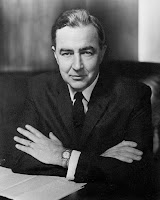
Mar. 29, 1916— Eugene McCarthy, a cool intellectual who, to nearly everyone’s surprise—including his own—ignited voter passion in one of the most turbulent years in American political history, was born in Watkins, Minn.

The recipient of the most rigorous education, McCarthy earned his undergraduate degree at St. John’s University, then was briefly a novice in the Benedictine Abbey His friend Senator Philip Hart of Michigan called him "a man out of his proper time, a man meant for the Age of Faith... when men like Thomas More could make their last defense, beyond the civil law, in religious belief." He was the only politician I can think of who could have argued with James Madison, Alexander Hamilton and James Wilson at the Constitutional Convention about Thucydides, Aristotle, Locke and Montesquieu, then run rings around them when the conversation turned to Saints Augustine and Thomas Aquinas.

The friend of poets such as Robert Lowell, someone who could rattle off with little prompting hundreds of lines from William Butler Yeats, McCarthy also wrote verses that constitute some of the most intriguing of the 16 books he published in his lifetime. They fully vent his contrarian spirit, including these lines from the campaign that earned him a place in American political annals:

I am alone
in the land of the aardvarks.
I am walking west
all the aardvarks are going east.

Opposition to the Vietnam War was a cause he came late to, as he voted for the 1964 Gulf of Tonkin resolution that gave Lyndon Johnson virtually a blank check to escalate the conflict. But once he turned against the war, in 1966, he was all in, in a way that nobody else contemplated being. At a time when no other Democratic politician could be persuaded to test the President and his military policy at the polls, McCarthy took on an incumbent whose power derived in no small measure from vindictiveness against anyone who thwarted his will.

McCarthy did not win the 1968 Democratic primary in New Hampshire. But his 42% of the vote dismayed LBJ so much that the President announced he would not seek another term. The title of McCarthy's memoir of the Presidential campaign, The Year of the People, expressed his conviction that the feelings of the electorate, as reflected in the primaries, needed to be respected at the party’s convention. They weren’t—Hubert Humphrey ended up as the Democratic nominee, despite being too late to enter any primaries—but the need to contain the divisions exposed in these contests and at the convention led to major rule changes in both parties. (Eight years later, Ronald Reagan took his own challenge to a sitting President of his own party, Gerald Ford, all the way to the convention.)

The Minnesota Senator, then, posed the most consequential challenge to a sitting President and party bosses since ex-President Theodore Roosevelt ran against hand-picked successor William Howard Taft in the 1912 GOP primaries. Now, we have been living in a landscape transformed in his wake: instead of the steeplechase primary season of his “year of the people,” a seemingly permanent campaign.

This year, we have been witnessing another stormy, likely transformative primary season. But exactly which candidate fills McCarthy’s role, and how, is a matter of some dispute.

For instance, when I typed “Eugene McCarthy” AND Trump into Google, I came up with more hits on McCarthy and …Bernie Sanders. The high-toned style of Sanders does have more personality traits in common with McCarthy, another Senator critical of his party’s incumbent President, than the boorish Donald Trump does. But there, the similarities end.

When all is said and done, in the likelihood that Hillary Clinton beats Sanders, she will probably gain the support, however reluctantly granted, of his base. The same cannot be said of Trumpeters, however, who, if they walk out on the GOP convention in Cleveland, will sit out the general election, as many McCarthy supporters did in 1968.

At another level, there are some intriguing parallels between the McCarthy and Trump campaigns:

*Each candidate did not realistically expect to win their party’s nomination. Stephanie Cegielski, a strategist for the Make America Great Again super PAC, has claimed that Trump did not originally think he would win, but would have simply been satisfied to place second in the delegate count, virtually guaranteeing what he wasn’t granted at the 2012 GOP convention: a prominent speaking role. Similarly, McCarthy had unsuccessfully urged Bobby Kennedy to yield to the entreaties of the “Dump Johnson” movement by running, and even as he announced his candidacy he expressed the hope that RFK would eventually enter the race.

*Each man emerged as a protest candidate. While McCarthy’s insurgency was fueled by anger over Vietnam, Trump’s has occurred with a GOP electorate that has largely upended conservative orthodoxy on free trade, entitlements and immigration.

*Each was transformed by encounters with rivals, becoming far more bitter than expected. The current nastiness between Trump and Ted Cruz is all the more striking considering their bromance in the early season of the primaries. And once Kennedy did jump into the race after New Hampshire, now knowing he could not be accused of splitting the party, McCarthy regarded the move as an act of opportunism that would only divide the anti-war vote.To the end of his days, he spoke more bitterly about his assassinated rival for the antiwar vote than about the President the two were trying to replace, according to a retrospective by NPR's Ken Rudin after McCarthy's death in 2005 . (See my account of their final, fierce faceoff in the winner-take-all California primary.)

*Each rewrote the rules of campaigning by introducing new players into their party’s coalition. Ominously for Hillary Clinton, Trump has done well in crossover primaries that allow Democrats to vote Republican, especially with angry white males. These might be termed “Falling Down” ex-Democrats, after the Michael Douglas movie of that name. In 1968, thousands of young people went “clear for Gene”—trimming their long hair and appearing presenting—in stumping door to door for the candidate.

*The tensions of the campaigns found explosive release in violence. Although neither McCarthy nor Kennedy encouraged this, it seemed a constant specter hanging over the campaigns. We are already seeing something of a repetition of that today. Fights have been breaking out at Trump appearances, with his own campaign manager arrested for interfering with a female reporter. Trump has warned darkly of “riots” if he is denied the Republican nomination, and his expressed willingness to allow delegates to carry weapons at the convention not only creates a security nightmare, but also a threat to democratic procedures.

*In both campaigns, candidates’ wives were collateral damage from the combustible energies unleashed by the campaigns. The current fracas involving Heidi Cruz and Melania Trump might be more public, but McCarthy’s family suffered as well. Abigail McCarthy—every bit as intellectually formidable as her husband, and an ardent backer of what appeared initially to be a quixotic campaign—ended up being hospitalized three times while her husband was on the hustings—and, within a year of the campaign’s end, the two had separated as a result of Eugene’s affair with a journalist.

Stylistically, of course, McCarthy can be considered the antithesis of Trump: far more intellectual, less willing to pander shamelessly.

And, although it’s been said that Trump has hurled “insults” at opponents, he is really only peddling puny epithets that any eight-year-old can toss in a schoolyard. For a real insult, one that could have come from the 19th-century golden age of American political invective, consider McCarthy's elegant jibe at George Romney, a prospective GOP world-beater forced from the race because of his gaffe that he had been “brainwashed" by the military on a trip to Vietnam. In the case of Romney, widely regarded as an intellectual lightweight, McCarthy observed that “a light rinse would have been sufficient." Similar remarks to Capitol Hill colleagues over the years led them to nickname him "The Needler."

At best unconventional, at worst merely quirky, McCarthy could exasperate observers by his unexpected advances into and retreats from the American political thickets. (Garry Wills: “Eugene McCarthy spent a good deal of his time trying to prove that he was too good for politics. What use was that? Most of us are too good for politics; but we do not make a career of demonstrating it.”) Nowadays, though, most people would die to be represented by someone who doesn’t stick slavishly to an ideology or party line but is interested in something more than politics.
Saturday, March 16, 2013

This Day in Electoral History (RFK Launches Last Campaign)


March 16, 1968—Robert F. Kennedy, deciding that Lyndon Johnson’s below-expectations victory in the New Hampshire primary meant he could not divide the party worse than it already was, announced his candidacy for President in the same Senate room where his brother John had declared his eight years before.

The symbolism was unmistakable, not just in the setting but in the statement from the U.S. senator from New York: Camelot would be taken back from those who had plunged the realm of civilization into chaos. As it turned out, though, Bobby would only reenact his brother’s Arthurian odyssey of exhilaration and tragedy.

Bobby’s move opened him up to charges he was at some pains to deny: that he was a “spoiler” of the insurgent candidacy of Eugene McCarthy, who had assumed the real risk of defying President Johnson over the Vietnam War by taking him on in the primaries. As much as RFK concentrated in his statement on the issues he cared passionately about (inequality, civil rights, the plight of American cities), the ensuing 85-day campaign became a triangular psychodrama involving himself, the President and the Senator from Minnesota.

In his announcement, the Senator and former Attorney-General insisted that he held “no personal animosity or disrespect toward President Johnson,” going on to observe that his brother Jack’s successor in the Oval Office “was extremely kind to me and members of my family in the difficult months which followed the events of November of 1963.” But, though meant to strike grace notes, both statements—certainly the first, and arguably even the second—were disingenuous.

The title of an account that examined the two men’s relationship perfectly sums how they viewed each other: Jeff Shesol’s Mutual Contempt. The source of the conflict derived from the fight for the 1960 Democratic Party nomination, when Bobby came to loathe LBJ and his camp for insinuations about Jack Kennedy’s health, while Johnson regarded Bobby (then serving as his brother’s campaign manager) as a ''grandstanding little runt'' for attempting to withdraw JFK's previous offer of the Vice-Presidency.

While candidate and President Kennedy had coolly decided that he needed LBJ’s support in Texas enough to let bygones be bygones, Bobby made little secret of his animosity. In the wake of the President’s assassination—in Johnson’s home territory, at that—the Attorney-General's dislike mounted, fed by small but fresh outrages (e.g., Johnson’s reportedly overeager assumption of power on the plane ride back from Dallas, his abrupt dismissal of JFK’s secretary Evelyn Lincoln). For his part, LBJ made it all too clear that he did not want Bobby as his running mate in his own 1964 run, and he bemoaned how quickly RFK (now a Senator from New York) became, in effect, the center of opposition to his Vietnam policy.

Bobby’s announcement of his candidacy was “the final straw,” a now-retired LBJ told future biographer Doris Kearns Goodwin: “The thing I feared from the first day of my Presidency was actually coming true. Robert Kennedy had openly announced his intention to reclaim the throne in the memory of his brother. And the American people, swayed by the magic of the name, were dancing in the streets.” (Two weeks after RFK’s declaration, LBJ announced he would not be a candidate for re-election—then privately told Vice-President Hubert Humphrey that he had his blessings if he wanted to enter the race.)

As for McCarthy: Robert Kennedy made sure in the declaration of his candidacy to take note of his colleague's “remarkable” showing in New Hampshire. (It was not a victory—McCarthy had achieved 42.2% of the vote—but the tally pitilessly exposed LBJ’s vulnerability.) But if the relationship between himself and his fellow Senator hadn’t reached the level of all-out blood feud, as it had with Johnson, there were certainly longstanding tensions that rose to the surface now.

Again, some of this dated back to the 1960 campaign. Instead of falling behind the candidacy of JFK, another Catholic of Irish-American descent, McCarthy nominated Adlai Stevenson at the Democratic Convention with an eloquent plea for the delegates to “not leave this man without honor in his own party.” It also appears that one of McCarthy’s quips from that year—“I’m twice as Catholic as Kennedy and twice as liberal as [Hubert] Humphrey”—had been exaggerated by a reporter into “I should run for President—I’m twice as Catholic as Kennedy, twice as liberal as Humphrey and twice as smart as [Stuart] Symington.”

The remark, however embroidered, did have at its core a truth: McCarthy’s perceptions of his intellectual gifts vis-à-vis the Kennedy clan, not just the President but his aggressive younger brother. Seven years ago, a Michael Novak essay for First Things magazine recalled his involvement in the ’68 campaign, when he had reluctantly turned away from the candidacy of friend McCarthy in favor of RFK. An intellectual who had read (and could often recite) Yeats and assorted Catholic fiction writers, McCarthy “didn't think much of the unlearned "Southie's" Boston-style Catholicism," Novak observed. "McCarthy wanted to blaze a new path for Christians and Jews in public life. A path of learning and poetry and joyous fun.”

Novak doubted that Bobby possessed anything like this reflectiveness: “One wondered which serious religious authors he or his brothers had read, if any.” Yet over time—not only after his own turn toward neoconservatism, but after post-assassination allegations of an RFK affair with Marilyn Monroe—Novak preferred to be “more inclined to look upon his sheer raw guts and the burning determination of his eyes when he glimpsed something he had to do and fight through, whatever unknown difficulties he must face.”

RFK thought of McCarthy, in the words of speechwriter Jeff Greenfield, as "an indolent dilettante of a candidate." Historian Arthur Schlesinger reflected similar conventional wisdom of Kennedy and his closest advisers when he wrote that, following his election to the Senate, McCarthy had become "indolent, frivolous and cynical," as well as overly beholden to legislative requests from the banking community of the Twin Cities.

Three other circumstances surrounding Bobby Kennedy’s announcement are also noteworthy:

*McCarthy loyalists—including the candidate’s extraordinarily shrewd wife Abigail—believed that Walter Cronkite had flown to DC not only to discuss RFK’s entrance into the race but also to urge him toward that course. Douglas Brinkley's recent biography of the CBS anchor confirmed the truth of that rumor. It was indeed extraordinary—a journalist covertly abandoning the objectivity supposedly the hallmark of his profession—but also emblematic of the strong (but by no means universal) support that the Kennedys enjoyed in the media.

* The night before he declared he would jump into the race, RFK had been awakened by brother Ted, just back from a meeting in Green Bay, Wisc., with McCarthy, to announce that Abigail McCarthy “had killed” the chance for collaboration between the two campaigns against LBJ. In her gracefully written memoir, Private Faces Public Places, the Minnesota Senator’s wife expressed annoyance at any notion that she had nixed a deal, believing that Ted Kennedy had simply presumed that the presence of herself and daughter Mary had disinclined her husband to make common cause with the Kennedys against LBJ. The “deal” that Ted (wielding a briefcase, in the wee hours of the morning, in the hotel room)( had been deputized to make was that the Kennedys would help McCarthy in any possible way in the upcoming Wisconsin primary. McCarthy responded that he was doing well in the state and needed no help; that he was already on the ballot in Nebraska, Oregon and California; and that, “if we really want to challenge the President, there are primaries which have not been entered, and which it would serve a real purpose to enter” (West Virginia, Louisiana, maybe Florida). After Ted Kennedy and his aides left without accomplishing their mission, McCarthy remarked bitterly to his wife and Mary, “That’s the way they are. When it comes down to it, they never offer anything real.”

*Novak’s memoir of his relationship with the two liberal anti-war rivals to LBJ highlights that Robert Kennedy’s candidacy was as much existential as issues-based. For all his putative ruthlessness, Kennedy was riven by passions that, in the case of his candidacy, had left him indecisive, and the last five years had only amplified them. It had taken him months to work through his grief—and, perhaps, guilt—over his brother’s murder. (Had his feverish quest to bring down the Mafia and Fidel Castro resulted in retaliation from either?) Significantly, the one intellectual resource he had embraced during this period, at the urging of sister-in-law Jackie Kennedy, was Greek tragedy. 

Paradoxically, the shyest and most vulnerable of the Kennedy brothers had decided to plunge into a race in which he would take on rock-star proportions, with followers almost desperate to get close to him. The apocalyptic rhetoric of the candidate himself reflected this. RFK's closing sentence in his declaration--that what was at stake was nothing less than "our right to moral leadership of this planet"--was a secular restatement of another insurgent restoration campaign against an incumbent, ex-President Theodore Roosevelt's address to Progressive supporters in his battle against William Howard Taft in 1912: "We stand at Armageddon and we battle for the Lord."  

“I do not lightly dismiss the dangers and the difficulties of challenging an incumbent President,” Kennedy noted in his announcement. That very realization had made him reluctant in the first place to take on Johnson. But the question inevitably comes to mind how much he gauged the dangers of running in perhaps the most tumultuous year in American history. His own assassination in California less than three months later, just after the winner-take-all primary victory he needed to give him a realistic chance for the nomination, came in the middle of a period that also featured soldiers brought home on body bags, campus unrest, race riots, protests for almost every cause imaginable, and an assassination of another public figure, Martin Luther King Jr. 

As President, JFK had the responsibility of leading the free world in its hour of maximum danger, and as a Senator for nearly 50 years, Ted Kennedy left his mark on all kinds of legislation. But in all his ambition, animosity, anguish and achievement, Robert Kennedy will remain the most fascinating of his brothers for biographers, novelists, playwrights, and armchair psychologists.

Thursday, September 9, 2010

Quote of the Day (Eugene McCarthy and James Kilpatrick, on the Parameter, a Political Beast)


“To persons of limited horizons—those lacking the world view of, say, the editors of Foreign Affairs—a Parameter may look like a perimeter. It is not.  .  .  .  In the world of politics, Parameters live to be defined. Their arms embrace the illimitable and the unknowable, but usually they embrace the expendable. ‘Within the Parameters of our budget,’ people say. Then the Parameter, like the squid, emits an inky cloud and disappears.”—Eugene J. McCarthy and James J. Kilpatrick, A Political Bestiary: Viable Alternatives, Impressive Mandates and Other Fables (1979)

The recent death of retired conservative columnist James J. Kilpatrick (in the image accompanying this post) did more than bring to mind his 1970s jousts on 60 Minutes with Shana Alexander, which inspired the great Dan Aykroyd-Jane Curtin “Point-Counterpoint” skits on Saturday Night Live. It also led me to a fine appreciation of his writing skills by Andrew Ferguson in The Weekly Standard, which in turn brought to mind his collaboration with former Presidential candidate Eugene McCarthy, A Political Bestiary.

True, cartoonist Jeff MacNelly made his own, not insignificant contribution to this wry satire on the clichés that grow in the peculiar soil of Washington. But in the quote that Ferguson included—one that I’ve reproduced here—it’s easy to see the mocking wit and literary grace that the two authors—one, Kilpatrick, a DC outsider by profession; the other, McCarthy, by inclination—brought to this project.

Thursday, August 28, 2008

This Day in Political History (Daley Unleashes Cops on Protesters)


August 28, 1968—In Chicago, as delegates at the Democratic Convention prepared to nominate Hubert H. Humphrey for President, television viewers were stunned at what they saw from the Second City—ugly discord in the nation and in the party in charge.

Outside, in the city’s downtown, 26,000 city police and National Guardsmen, on orders of Mayor Richard Daley, cracked down on 10,000 protesters against the Vietnam War.

Inside the convention, while nominating George McGovern for President, his colleague, Abraham Ribicoff of Connecticut, noted pointedly that with the Senator from South Dakota in the Oval Office, “we wouldn’t have to have Gestapo tactics in the streets of Chicago!” With an irate Daley shouting back “You faker” and “Jew SOB,” Ribicoff smiled and said, “How hard it is to accept the truth.”

The convention in Chicago had consequences that would reverberate through the years:

* Students for a Democratic Society, the National Mobilization Committee to End the War in Vietnam (MOBE), the Youth International Party (Yippies) did not mobilize middle-class youths through the protest, as they had hoped, but annoyed the majority of the 89 million viewers to side with the cops, according to polls taken after the event.


* The protest split the old-style, blue-collar elements of the Democratic Party from the “New Left.” As journalist Mark Stricherz chronicled in Why the Democrats are Blue: Secular Liberalism and the Decline of the People's Party (2007), the Democrats decided to embrace groups that had been disenfranchised at the convention--young people, blacks, and college-educated suburbanites--with new delegate-apportioning rules. The core issues of these groups—opposition to the war, combating racism, abortion—were alien to the economic concerns that motivated the blue-collar Northern ethnic Catholics and Southern white Protestants who played key roles in the New Deal coalition.


* The man who championed these “Dutton Rules” (named for party activist Fred Dutton) was Senator McGovern, who would take the arcane nominating rules that he had helped shepherd into being and win the 1972 Democratic nomination for President in the process. That reminds me a bit of one of the funniest columns by New York Times columnist Maureen Dowd, in which she noted how Dick Cheney, hired to vet George W. Bush’s Vice-Presidential selections in 2000, ended up being the running mate—sort of like a beauty-pageant judge who ends up with the tiara herself.


* The protest played into the hands of Richard Nixon, who had been making political hay all year with the notion of “crime in the streets”—and who, upon being elected President, put it in a vastly more convenient spot for him: in the Oval Office.


* The sheer messiness of the cop-authorized rampage authorized by Daley—combined with that of the 1972, Duttton Rules-dominated Democratic Convention—has led both parties to move increasingly toward the kind of boring, choreographed convention derided by David Frum in a recent Wall Street Journal article.
(This past week, the Democrats may have done the unthinkable: instead of persuading the electorate to turn out an unbelievably unpopular incumbent party, they might have bored viewers to death with umpteen repetitions of the word “change.” It's hard to produce the kind of electricity Obama did four years ago when everyone this time was not only singing from the same hymnbook, but doing so with the exact same notes.)

Although Mayor Daley despised the protesters as privileged kids, he had something in common with them that neither recognized at the time, and that is not even realized very well to this date. According to Charles Kaiser’s 1968 in America, Daley had told Bobby Kennedy already that he hated the Vietnam War.

For a particularly vivid account of these turbulent days in Chicago by an extremely interested—and uncommonly perceptive—observer, take a look at Private Faces, Public Places, by Abigail McCarthy, wife of (though, four years after the events, she was separated from) defeated candidate Eugene McCarthy.

From 1974 to 1999, Abigail McCarthy was a columnist for Commonweal, a magazine for moderate-to-liberal Catholics. Judging from her memoir, I’m sorry I didn’t read her more often while I had the chance. I doubt that even to this day whether any spouse of a major candidate has written an account so wrenchingly honest about the costs of campaigning on a candidate’s family. She knew all too well about this, having been hospitalized three times during the long primary season.

It was Abigail’s misfortune to come to Chicago after her third convalescence. If that wasn’t enough to send herback to the hospital, I don’t know what would. Especially as she relates what was happening in Grant Park as she looked out from the Hilton that day:

“From our windows we could see the menacing blue lines of police and the massing of the National Guard, the constant passing of the weird jeeps armed with front screens of flesh-tearing barbed wire….I listened in dread as the announcements from the police bullhorns bounced against the hotel walls and the refusals echoed back….With each police incident, with each person stopped and questioned, with each one shoved aside at the hotel entrances, the demonstrators in the park had more and more sympathizers in the hotel.”

One of the worst legacies of Richard Daley was an economically and racially polarized city. Miraculously, this past week witnessed an African-American sojourner who set down roots in this same city—now being led by Daley's son Richard—who won the nomination of his party, at a convention far more peaceful than the one that convulsed the City of Broad Shoulders 40 years ago to the day.

Sunday, June 1, 2008

This Day in American History (RFK-McCarthy Debate)


June 1, 1968—In the last debate before the climactic California primary, Robert F. Kennedy won the press war of expectations about the outcome with several unexpected thrusts—but a pro-forma statement in support of Israel clinched a viewer’s decision to assassinate him a few days later.

The sudden, ghastly end to RFK's life has tended to put out of focus the nature of his campaign in these final days. I think it’s useful to re-examine why he evoked so many passionate responses, both pro and con.

Bobby Kennedy, in All His Varieties

Of the three brothers who ran for President, Bobby fascinates me the most. With his quick wit, ironic distance, and automatic assumption that his private affairs would be kept out of public life, Jack seems like a Regency aristocrat. In the tributes that have poured in since the revelation of his grave medical condition, it's now more recognized than ever that Teddy is one of the barons of Capitol Hill. His knowledge of where each vote can be found would have made him a success starting as the lowliest ward heeler job, even if he'd never been born into a political dynasty.

Bobby was something different entirely. Without his older and younger brothers' personas, he could slip into any role outside of his time and place that you can imagine and still somehow fit. His churchgoing piety and deep religious commitment could have pushed him into the priesthood (whether he'd be a liberation theologian or monsignor to a cardinal is another story). He could be the classic political boss in a big-city machine—cutting whatever deal he had to, ruthless when he needed to be—or, with his passion and fire for the oppressed, join a revolution.

Some of that quicksilver quality was seen in an incident I commented on previously: his
powerful impromptu speech on the night of the murder of Dr. Martin Luther King Jr. "It feels safe to say that no one else in American public life would have quoted Aeschylus' Agamemnon to an angry black crowd on the day that King was killed," former Bill Clinton speechwriter Ted Widmer noted a week or ago, in an article for the New York Observer.

Anxiety on the Eve of Debate

Bobby’s entrance into the race was so sudden that the campaign had little if any time to organize. Though he scored some successes (notably in Indiana), a loss in Oregon to
Sen. Eugene McCarthy gave a severe pummeling to the Kennedy political operation’s reputation for being as smoothly run. The candidate found himself badly needing a victory in the winner-take-all California primary in early June. He even reversed his previous position that he would not debate McCarthy only Hubert H. Humphrey were invited, too.

In all but one way, Bobby’s political base in the primaries resembles Hillary Clinton’s today: principally in its heavy reliance on the white working-class (read: ethnic Catholic) and Hispanic voters. Barack Obama has inherited McCarthy’s base of the more college-educated, secular progressive voter. Obama’s candidacy has prevailed for two reasons: a) the black vote has gravitated to him rather than Clinton, and b) while the union workers that Kennedy could rely on has decreased over time, the proportion of college students and African-Americans has grown.

Going into the debate, RFK and his staff did not have a lot of reason to be confident. While Bobby’s speeches were eloquent, they were staff-written and rehearsed. It was a miracle that he delivered such an impassioned address on the night of the King assassination, but it might simply have been a product of emotions (especially the anguish over his own brother’s death) and deep reading finally given an outlet.

Bobby didn’t shine as well in a debate. It was surprised to discover a couple of years ago that he had not performed so well in a May 15, 1967 with the new governor of California, Ronald Reagan. (Jimmy Carter and his handlers in 1980 would have done well to check
the transcript of the RKF-Reagan debate to understand what a dangerous opponent they were facing.) When asked why Kennedy rejected repeated invitations to appear on his show “Firing Line,” William F. Buckley Jr. quipped, “Why does baloney reject the grinder?” McCarthy, on the other hand, had much more of a reputation for being articulate and witty.

The debate between the two Democrats was held on a Saturday night in San Francisco on the K.G.O. station in San Francisco. ABC news broadcaster Frank Reynolds served as moderator, with journalists Bob Clark and Bill Lawrence the chief questioners.
According to Evan Thomas’ account, the exhausted candidate was handed “about two pounds” of briefing material the night before, only to fall asleep with his beloved dog Freckles by his side. That left an all-day round for the day of the debate for preparation. RFK was determined to be as non-specific as possible about whether he had authorized FBI wiretaps of Dr. Martin Luther King Jr.

Outpointing McCarthy

Kennedy still did not shine in this static format (more like a joint press conference than a freewheeling exchange of views), but he did manage to underscore differences with McCarthy on policy matters rather than reasons of ambition, which those “Clean for Gene” so often accused him of harboring. In a point recently echoed faintly in the Clinton-Obama marathon, Kennedy—himself a Vietnam War opponent—took McCarthy to task for willingness to negotiate an end to the war with the Viet Cong. Two more exchanges were even more controversial.

McCarthy’s suggestion for transporting African Americans out of the impoverished inner cities to areas in the suburbs where there were greater employment opportunities brought a response from Kennedy that at the time even deeply dismayed many on the candidate’s own staff: “You say you are going to take 10,000 black people and move them into Orange County?”

Reading this sentence in isolation, I was ready to accept the usual historical verdict: that RFK had gotten off a cheap shot that was a blatant appeal to white-ethnic voters (regarded then and now as something that in the ‘70s was called the “Archie Bunker voter” and in the 1980s, only somewhat more kindly, as the “Reagan Democrats”). But for Kennedy's sterling civil rights record, that sentence would have been more widely decried had it come from a Nixon or Agnew.


The sentences immediately following, however, provide a more understandable—and liberal—context: “You take them out where 40 percent of them don't have any jobs at all, that's what you are talking about. But if you are talking about hitting the problem in a major way, taking those people out, putting them in the suburbs where they can't afford the housing, where their children can't keep up with the schools, and where they don't have the schools for the jobs, it's just going to be catastrophic. . . . [W]e have to face the fact that a lot of these people are going to live here [in the ghettos] for another several decades. And they can't live under the conditions that they are living under at the present time."

McCarthy found himself on the defensive on a second point: Kennedy’s charge that he wanted to overcharge Israel for aircraft. In contrast, Kennedy promised more aircraft for Israel. According to Thomas, RFK himself believed that he had “pandered” to the Jewish vote with this promise, in an attempt to defuse the absurd charge that he was anti-Semitic. (In fact, from touring Israel in 1948, Kennedy had come away much impressed with the new nation's courage and determined that America had to help it survive.)

The Opening Salvo of Arab Terrorism

Kennedy’s promise of continued, even heightened, support for Israel had a far more fateful consequence outside of votes, however. His statement could not have reassured one Palestinian-American, who, that very day, had been so angered by a prior photograph of the senator wearing a yarmulke outside a synagogue that he had purchased a box of ammunition for his .22 caliber pistol.

Several observers noted that McCarthy was not as sharp as he could have been, allowing Kennedy to get by with a mediocre if gaffe-free performance. Four days later, Kennedy beat McCarthy by 4.5% in the California primary. He still had an uphill fight for the nomination against Humphrey, who had been methodologically picking up votes in caucuses while his rivals engaged in fratricidal conflict that divided the anti-war left. But at least Kennedy now had the state he absolutely needed if he hoped to remain a viable candidate through the convention two months later in Chicago.

Nobody, least of all the candidate, could have guessed that the young Palestinian-American who had purchased the box of ammunition, Sirhan Sirhan, would be waiting for him in the Ambassador Hotel on the night of his triumph. Nor did anyone realize at the time that the resulting assassination, far from being senseless, was in fact one unaffiliated terrorist’s inauguration of more than 30 years of steadily encroaching thrusts against America and its institutions that would climax on September 11, 2001.