
Showing posts with label Elie Wiesel. Show all posts
Showing posts with label Elie Wiesel. Show all posts
Saturday, February 24, 2024
Quote of the Day (Elie Wiesel, on Why ‘We Must Not See Any Person as an Abstraction’)


Tuesday, July 11, 2023
Quote of the Day (Elie Wiesel, on Hope in Memory)

Sunday, February 27, 2022
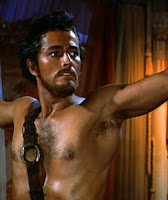
Spiritual Quote of the Day (Elie Wiesel, on the ‘Great Melancholy’ of Moses’ Joshua)
“A great melancholy emerges from his life story, a
sadness that stays with him to the end of his days. Is it because his life
unfolds in the midst of noise and fury?”—Jewish novelist, essayist, Holocaust
survivor and Nobel Peace laureate Elie Wiesel (1928-2016), “Joshua: Silent at
the Tent Door,” Bible Review, December 1998
The image accompanying this post is of Joshua, Israel’s
leader after the death of Moses—played onscreen by John Derek in the 1956 blockbuster,
The Ten Commandments.
Sunday, September 15, 2019
Quote of the Day (Elie Wiesel, on Abraham, ‘The First Angry Young Man’)

“Abraham: the first enemy of idolatry. The first
angry young man. The first rebel to rise up against the ‘establishment,’
society and authority. The first to demystify official taboos and suspend ritual
prohibitions. The first to reject civilization in order to form a minority of
one. The first believer, the first one to suffer for his belief. Alone against
the world, he declared himself free. Alone against the world, he braved the fire
and the mob, affirming that God is one and present wherever His name is
invoked; that one is the secret and the beginning of all that exists in heaven
and on earth and that God's secret coincides with that of man.” —Nobel Peace
Prize laureate, Holocaust survivor and human-rights activist Elie Wiesel
(1928-2016), “The Sacrifice of Isaac: A Survivor’s Story,” in Messengers of God: Biblical Portraits and Legends (1976)
The image accompanying this post is God Renews His Promises to Abraham (c.
1896-1902), gouache on board, by the French painter James Jacques Joseph Tissot
(French, 1836-1902), at the Jewish Museum, New York.
Sunday, March 25, 2018
Quote of the Day (Elie Wiesel, on Adam and How It Is ‘Given to Man to Begin Again’)
 “It is not given to man to begin; that privilege is
God's alone. But it is given to man to begin again—and he does so every time he
chooses to defy death and side with the living.
Thus he justifies the ancient plan of the most ancient of men, Adam, to
whom we are bound both by the anguish that oppressed him and the defiance that
elevated him above the paradise we shall never enter.”—Romanian-born American
Jewish Nobel Peace Prize laureate, Holocaust survivor and human-rights activist
Elie Wiesel (1928-2016), Messengers of God: Biblical Portraits and Legends (1976)
Thursday, April 13, 2017
Quote of the Day (Elie Wiesel, on the Proper Response to Human Suffering)
 “Human suffering anywhere concerns men and women
everywhere.”— Holocaust survivor, human-rights activist, and Nobel Peace Prize laureate Elie Wiesel (1928-2016), Night,
translated by Marion Wiesel (1955)
Tuesday, July 5, 2016
Quote of the Day (Elie Wiesel, on the Need ‘Never To Be Silent’)
 “I swore never to be silent whenever and wherever
human beings endure suffering and humiliation. We must always take sides.
Neutrality helps the oppressor, never the victim. Silence encourages the
tormentor, never the tormented. Sometimes we must interfere. When human lives
are endangered, when human dignity is in jeopardy, national borders and
sensitivities become irrelevant. Wherever men or women are persecuted because
of their race, religion, or political views, that place must – at that moment –
become the center of the universe.”—Holocaust survivor, author and moral witness Elie
Wiesel (1928-2016), Nobel Peace Prize acceptance speech, Oslo, Norway, Dec. 10, 1986
Monday, July 27, 2009
Quote of the Day (Elie Wiesel, on Despair and Creation)

“Out of despair, one creates. What else can one do? There is no good reason to go on living, but you must go on living. There is no good reason to bring a child into this world but you must have children to give the world a new innocence, a new reason to aspire toward innocence. As Camus said, in a world of unhappiness, you must create happiness.”—Holocaust survivor and Nobel Prize laureate Elie Wiesel, quoted by Michiko Kakutani, The Poet at the Piano: Portraits of Writers, Filmmakers, Playwrights, and Other Artists at Work (1988)
Subscribe to:
Posts (Atom)


