
Showing posts with label Bible. Show all posts
Showing posts with label Bible. Show all posts
Sunday, October 19, 2025
Spiritual Quote of the Day (Tom Holland, on the Bible)


Sunday, August 3, 2025
Spiritual Quote of the Day (Helen Garner, on the Bible’s Repeated Water Imagery)

The image
accompanying this post, Christ and the Samaritan Woman, depicting the “woman
at the well” with Jesus, was created between 1520 and 1530 by the Italian
painter Vincenzo Catena (1470-1531).
Sunday, April 14, 2024
Spiritual Quote of the Day (Marilynne Robinson, on the Bible’s ‘Interest in the Human’)

The image accompanying
this post, Abraham and Isaac (also known as The Sacrifice of Isaac),
was created by the Venetian painter Titian (ca. 1488-1576).
Sunday, October 15, 2023
Spiritual Quote of the Day (Deuteronomy, on How God Led the Ancient Israelites Out of Affliction)

who went down to Egypt with a small household
and lived there as an alien.
But there he became a nation
great, strong, and numerous.
When the Egyptians maltreated and oppressed us,
imposing hard labor upon us,
we cried to the LORD, the God of our fathers,
and he heard our cry
and saw our affliction, our toil, and our oppression.
He brought us out of Egypt
with his strong hand and outstretched arm,
with terrifying power, with signs and wonders;
and bringing us into this country,
he gave us this land flowing with milk and honey.”— Deuteronomy 26: 5-9
Sunday, March 6, 2022
Spiritual Quote of the Day (C.S. Lewis, on the Psalms as Poems)

Sunday, February 27, 2022
Spiritual Quote of the Day (Elie Wiesel, on the ‘Great Melancholy’ of Moses’ Joshua)
“A great melancholy emerges from his life story, a
sadness that stays with him to the end of his days. Is it because his life
unfolds in the midst of noise and fury?”—Jewish novelist, essayist, Holocaust
survivor and Nobel Peace laureate Elie Wiesel (1928-2016), “Joshua: Silent at
the Tent Door,” Bible Review, December 1998
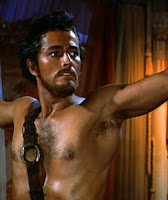
The image accompanying this post is of Joshua, Israel’s
leader after the death of Moses—played onscreen by John Derek in the 1956 blockbuster,
The Ten Commandments.
Sunday, February 20, 2022
Spiritual Quote of the Day (C.S. Lewis, on the Proper Place of the Bible)

Sunday, March 29, 2020
Spiritual Quote of the Day (King David, on Calling Out to the Lord)

“The
waves of death swirled about me;
the torrents of destruction overwhelmed me.
The
cords of the grave coiled around me;
the snares of death confronted me.
“In my distress I called to the Lord;
I called out to my God.
From
his temple he heard my voice;
my cry came to his ears.—2 Samuel 22:5-7
I saw a sign bearing verse 7 of this quote—the one
about calling out to God— as I passed a local Baptist church yesterday morning,
and it seemed perfectly chosen to reflect our nation’s—even our
world’s—difficulties as we cope with the coronavirus crisis.
The verses before what you read here describe this
as the words to David’s song after God “delivered him from the hand of all his
enemies and from the hand of Saul. These are lyrics of thanksgiving and praise,
to be sure, but in this passage, the focus is squarely on David’s desperate
straits. Our dilemma, unlike David’s, is medical rather than military, but for
all that, no less existential.
It has not been just the varying amounts of
difficulties associated with this medical condition (from physical discomfort
to death) on display these past several weeks, nor even the fear of the many
unknowns associated with it, but also everything that divides us as a
society—politics, media, race and ethnicity, (dis)belief in science, and class
divisions.
The virus cannot be the product of a just God’s
plan. At the same time, it reveals, nearly 3,000 years after King David erupted
in lamentation, that the march of civilization has immunized us against the
eternal self-doubts of the human heart, or of the need for God to provide us
with solace and courage to face these multiple trials.
(The image accompanying this post shows Gregory Peck
in the 1951 Biblical epic David and
Bathsheba.)
Sunday, January 19, 2020
Spiritual Quote of the Day (Clive James, on the Scriptures as a Standard Against ‘The Language of Illusion’)

“For me, the scriptures provided a standard of
authenticity against the pervasive falsehoods of advertising, social
engineering, moral uplift, demagogic politics—all the verbal corruptions of
democracy, the language of illusion.”—Australian-born TV personality, critic
and poet Clive James (1939-2019), “Czeslaw Milosz,” in Cultural Amnesia: Necessary Memories from History and the Arts (2007)
Sunday, September 30, 2018
Quote of the Day (Fr. Craig Morrison, on the Beguiled, Baffling and Ambiguous King David)

“As I embarked on this commentary on 2 Samuel, I
assumed that my task was to interpret, or ‘exegete,’ the life of King David for
my readers. But the more I tried to interpret him, the more elusive, complex,
and distant he became. A king, a father, a warrior, a diplomat, a murderer, a manipulator,
a tyrant, a beguiler who is often beguiled, David, as baffling as he is
ambiguous, interprets and exposes the fictions of those who meet him.”—Fr.
Craig Morrison, Berit Olam: 2 Samuel (2013)
The last week has seen public images of Judge Brett Kavanaugh so divergent—star
student, family man and respected judge vs. youthful fratboy, booze hound and
sexual assailant—that it has left viewers wondering how they could be
considering the same man.
The events in the life of King David to which Fr. Morrison refers, however, vividly convey
that, since ancient times, the greatest heroes favored by God can also be all
too human and sinful; that light and dark coexist in the human heart; and that
private misdeeds not only can pollute the conduct of public life, but can have
repercussions lasting far beyond the immediate event.
Having slain the feared Philistine giant Goliath and
survived assassination attempts instigated by the prior Israeli king, Saul,
David was at the height of his influence when he caught sight of Bathsheba, the
wife of one of his generals, Uriah, bathing. The pregnancy resulting from the
subsequent affair would have been sinful, but a private matter among the king, his friend and the latter's wife.
But David compounded his transgression with an abuse of power: ordering Uriah into the front lines of a battle without adequate support, making certain he would be killed and unable to learn about and protest the betrayal of his friend and wife.
But David compounded his transgression with an abuse of power: ordering Uriah into the front lines of a battle without adequate support, making certain he would be killed and unable to learn about and protest the betrayal of his friend and wife.
David’s sin could not remain secret, of course. He
might have won the hand of Bathsheba, but he was confronted by the prophet Nathan as an adulterer and,
in effect, a murderer. He ruled Israel for 40 years, but his reign was darkened
by a revolt led by one of his children, Absalom.
The actual story of
King David resists any such shallow attempts at justifying the private
misbehavior of the powerful I do not profess to know anything about the truth or
falsity of Christine Blasey Ford’s
charges against Judge Kavanaugh. But for those who wonder what harm really
occurred from events 35 years ago, it is well to remember that actions
performed secretly long ago can indeed cry out to the world, far louder and
later than we could ever imagine.
If the Devil can quote Scripture to their purpose,
then so can politicians and political commentators. Twenty years ago, Bill
Clinton quoted Psalm 51—widely regarded as David’s confession of his affair—in
a more successful attempt to move the nation past his affair with Monica
Lewinsky than his initial, angry televised attempt. In 2016, Sean Hannity
attempted to explain away Donald Trump’s videotaped bragging about groping
women by noting, “King David had five hundred concubines for crying out loud."
(The image accompanying this post is a still from
the 1951 film David and Bathsheba, starring
Gregory Peck and Susan Hayward as the lovers.)
Subscribe to:
Posts (Atom)


