
Showing posts with label Disasters. Show all posts
Showing posts with label Disasters. Show all posts
Tuesday, April 14, 2026
Quote of the Day (Gillian Tett, on Investors and ‘Once-Unimaginable Disasters’)


Saturday, January 18, 2025
Quote of the Day (Mike Davis, on How Southern California ‘Transgressed Environmental Common Sense’)

In this weekend’s Wall Street Journal, columnist Peggy Noonan, remembering how her family’s house in New Jersey burned down over 50 years ago, observes that “you never get over a fire.” More problematically, she contends that “All disasters have political reverberations,” and, in particular, that after the Palisades wildfires of this past week, there will likely be “a new shift, a reorientation toward reality.”
I have the utmost respect for the writing style that won Ms. Noonan a Pulitzer Prize, and sometimes find myself agreeing with her arguments. But her most recent column epitomizes so much of the mistaken and misdirected commentary that has raged, high and low, in the wake of this catastrophe that has already burned more than 90,000 acres, displaced 92,000 residents and cost more than two dozen lives.
Although her latest reflections show no understanding of either the long history or still relatively recent events that have led Southern California to this pass, what is truly shocking is that so many other comments in the public and private sphere are far worse—ranging from the wildly irrelevant to the astonishingly ill-informed.
This past Sunday, a priest in my parish related how dumbfounded he felt when a friend called to claim that God was punishing California for all the abortions in the state. From the opposite side of the political spectrum, some have seen this as God’s judgment on the U.S. for abetting the enormous loss of life in Gaza.
A few days ago, a member of a Facebook group devoted to the work of novelist and Christian apologist C.S. Lewis set off a ferocious debate by posting a meme with a fake photo of an Oscar statuette burnt to a crisp—presumably representing divine judgment on liberal, godless Hollywood.
For sure, L.A. Mayor Karen Bass should be embarrassed for making a trip to Ghana that broke her campaign promise to stick close to home—and this at a time when the area’s weather condition had become increasingly vulnerable. But just as surely, her responsibility for the disaster is being exaggerated by rivals past and present, outside and inside her party, who dream of occupying her office themselves someday.
More important, though the level of the disaster might be unprecedented, its occurrence is anything but. It might, in fact, be more proper to speak of the recurrence of wildfires.
Which brings us to Mike Davis and the above quote.
Upon his death two years ago, the British paper The Guardian hailed him for offering “prophetic warnings” about so much related to Southern California’s environment. But I doubt that Davis would claim any such powers of divination.
If anything, he would say, he was only pointing out that disasters had already happened in the state, that they had happened again, and—based on that record and the unrestrained growth spurring it in the first place—it was practically guaranteed that disaster would strike again.
Ms. Noonan faults progressive California politicians for preoccupation with “unquantifiable secondary and tertiary issues” like climate change.
But as far back as 1998, Davis warned that Malibu was already “the wildfire capital of North America and, possibly, the world”:
“At least once a decade a blaze in the chaparral grows into a terrifying firestorm consuming hundreds of homes in an inexorable advance across the mountains to the sea. Since 1970 five such holocausts have destroyed more than one thousand luxury residences and inflicted more than $1 billion in property damage. Some unhappy homeowners have been burnt out twice in a generation, and there are individual patches of coastline or mountain, especially between Point Dume and Tuna Canyon, that have been incinerated as many as eight times since 1930.”
What lay behind all this, Davis wrote, was a “selfish, profit-driven presentism.” Politicians and developers rebuffed proposals to preserve parks, beaches, playgrounds and mountain reserves for the community, choosing instead an “artificial borderland of chaparral and suburb [that] magnified the natural fire danger while creating new perils for firefighters who now had to defend thousands of individual structures as well as battle the fire front itself.”
Ms. Noonan sees the three-decade dominance of the Democratic Party in the state as a major reason for the failure to contain the fire. I even agree with her that “A one-party state will yield one-party rule that encourages, sloth, carelessness and corruption.”
But she ignores the long postwar history when Republicans, at the state and federal level, were equally responsible as Democrats, if not more so, for the lack of control on growth. (And, if one-party rule poses grave difficulties for governance, she has been noticeably silent about the dangers posed by the current GOP control of the three branches of the federal government.)
Couple this destructive postwar development trend with the current months-long drought—among the “feedback loops” in the delicate ecosystem that Davis pointed out—and you have the necessary conditions for the most recent natural disaster.
Mother Nature belongs to no political party, Ms. Noonan, and will not be disrespected by either Republicans or Democrats. At long last, after so much time, Mother Nature has imposed such high costs associated with insurance and rebuilding that growth in Southern California may be halted, even reversed.
In the meantime, let’s
not blame the most recent conflagration on an angry Almighty. And while we’re
at it, let’s lay off the ecological Cassandras that tried to alert government
officials, business professionals, and residents about what all too sadly, has now
occurred.
Friday, December 31, 2021
Quote of the Day (Jeffrey Schlegelmilch, on How Megadisasters ‘Permanently Alter the Course of History’)
I’m sorry to close out this year on a downer note, but
this interview with Jeffrey Schlegelmilch is important for explaining in such
clear terms what the world has been witnessing, not just this year but so far
in the 21st century.
Immediately after the above quote, Schlegelmilch points
to the source of these large-scale disasters that are happening more often:
human activities:
“We are pumping pollutants into the atmosphere at
unprecedented rates, leading to more extreme weather events. At the same time,
we are building in flood zones, in forested regions susceptible to wildfires,
and in other hazard-prone areas. This dynamic is not unique to climate change.
Other disasters, like pandemics, have components where societal development is
increasing both the threat and our vulnerability. New diseases are emerging
because we’re encroaching into wildlife areas and coming into closer contact
with animals that harbor exotic pathogens, and the diseases are spreading
faster through human populations because of our global connectedness.”
It's one thing when this happens elsewhere in the
nation on the evening news, and quite another when it occurs locally, even on
your own street. Such was the case at the start of September, when Hurricane
Ida struck my hometown of Englewood, NJ.
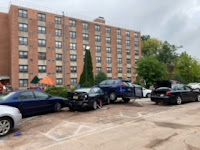
Across the street from me, several residents of a
housing project were evacuated when an adjacent creek overflowed and surged
through their apartments. They were not able to move back in until the end of
September.
The situation was—and remains—worse at a senior citizens’
project at the end of the block. The picture accompanying this post, taken a
day or so after the waters from the brook had receded, only hints at what
happened in and around this complex.
Not only were multiple cars damaged (or even lost),
but the flood damaged electrical systems in the basement of the building,
including the elevator controls and hot water. As a result, residents were hurriedly
moved to CareOne facilities, then to area hotels.
Initially told to take only enough to last them a few
weeks, these seniors didn’t have enough time even to take winter coats. It
turned out they needed these, as their time away now looks like it will take
many more months. (This article from the Bergen Record just
before Christmas tells of their plight, as well as the commendable effort of
the NAACP to alleviate it by collecting coats for them.)
Some of this situation was the unforeseen consequence
of one of the “human activities” cited by Schlegelmilch: building in a
floodplain. Nearly 50 years ago, these two projects were constructed along the
brook, in an attempt to deal with urgent housing problems of the time.
To make the projects possible, bulldozers rechanneled
and tamed the brook by scooping out hundreds of rocks and pebbles, with walls
built higher and fences erected to prevent the flood damage that had occurred
regularly in previous years.
And that’s how it was for nearly the following
half-century. But Hurricane Ida, with its force of historic proportions, overwhelmed
defenses deemed close to impregnable back then.
The citizens displaced by the storm face an uncertain
future, exacerbated by the disruption of routine, isolation and loneliness prevalent
during the COVID-19 pandemic.
But one also has to ask: If a disaster such as
Hurricane Ida (or, for that matter, COVID-19) can happen once, what’s to prevent
it happening again, particularly when so
many deny that interlocking crises like this even exist? No matter how high and strong our barriers
are and how much we spend, will it be enough if there is a next time?
Or, maybe I should say: when there is a next
time.
Monday, March 23, 2020
Quote of the Day (Jean Kerr, on Self-Possession in the Face of Calamity)

“If you can keep your head when all about you are
losing theirs, it's just possible you haven't grasped the situation.” —Irish-American
humorist-playwright Jean Kerr (1922-2003), Please Don’t Eat the Daisies (1957)
Wednesday, March 18, 2020
Quote of the Day (Historian Charles A. Beard, on the ‘Achievement of the Human Spirit in Spite of Disasters’)

“[A]s I look over the grand drama of history, I find
(or seem to find) amid the apparent chaos and tragedy, evidence of law and plan
and immense achievement of the human spirit in spite of disasters. I am
convinced that the world is not a mere bog in which men and women trample
themselves in the mire and die. Something magnificent is taking place here amid
the cruelties and tragedies, and the supreme challenge to intelligence is that
of making the noblest and best in our curious heritage prevail.”—American historian
Charles A. Beard (1874-1948), letter of June 25, 1931, quoted in Will Durant, On The Meaning of Life (1931)
Wednesday, December 30, 2015
Quote of the Day (Richard Feynman, on the ‘Way Nature Works’)
 “Trying to understand the way nature works involves
a most terrible test of human reasoning ability. It involves subtle trickery,
beautiful tightropes of logic on which one has to walk in order not to make a
mistake in predicting what will happen.” —Nobel-winning physicist Richard P.
Feynman (1918-1988), The Meaning of It All: Thoughts of a Citizen Scientist (1998)
Tuesday, April 22, 2014
Quote of the Day (Timothy Egan, on Settlement as an Environmental Delusion)

“It is human nature, if not the American way, to
look potential disaster in the face and prefer to see a bright and shining lie.
The ‘taming’ of this continent, in five centuries and change, required a mighty
mustering of cognitive dissonance. As a result, most of us live with the danger
of wildfire, earthquake, tornado, flooding, drought, hurricane or
yet-to-be-defined and climate-change-influenced superstorm. A legacy of
settlement is the delusion that large-scale manipulation of the natural world
can be done without consequence.”—Timothy Egan, “A Mudslide, Foretold,” The
New York Times, March 30, 2014
As I write this, President Obama was expected to
visit today with friends of the victims of last month’s mudslide in Oso, Wash.,
as well as first responders on the scene. Yesterday, NPR reported that the official death toll from the disaster had risen to 41, with another four people still missing.
You have to ask yourself why an event such as this
occurs, particularly, as in this case, where there had been prior worrisome
incidents. Perhaps the reason, as discussed in this blog post by David Ropeik for Psychology Today, lies in the “Risk Perception Gap,” or the self-delusional mental
calculus that leads people to choose to go on “living in a place they like, but
which could kill them.”
My guess is that the only way we will be able to
free ourselves from such delusions is if the insurance costs of living in these
environmental danger zones became too exorbitant. At that point, the
conservative reluctance to have government save people from misfortune will
meet the liberal desire to protect the environment, and, at long last, bring about
necessary change in where construction is allowed.
Subscribe to:
Posts (Atom)


