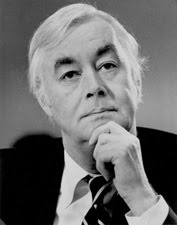
Showing posts with label Daniel Patrick Moynihan. Show all posts

Wednesday, January 7, 2026

Quote of the Day (Daniel Patrick Moynihan, on a State ‘Tempted by Self-Interest’)

“A state that finds itself tempted by self-interest to erode traditional norms may in time regret its conduct."— American politician, diplomat and social scientist Daniel Patrick Moynihan (1927-2003), On the Law of Nations (1990)

Wednesday, December 23, 2015

Photo of the Day: Daniel Patrick Moynihan Place, DC


Daniel Moynihan Place is set amid the much larger Ronald Reagan Building in Washington, which, at 1.9 million sq. ft., is one of the largest federal structures in our nation’s capital. 

It was inexplicable to me that such a large complex would be associated with such an unrelenting critic of the federal government. But then again, it’s probably not more of a head-scratcher than the decision to name a national airport in that metro area after the President who fired air-traffic controllers after they went out on strike, then refused to rehire them.

Likewise, it seemed unexplainable that this particular of space within the complex would be named for the late U.S. Senator from New York, one of the most perceptive critics of Reagan’s policies in the White House.

But unlike many in Washington now, Senator Moynihan was not one to let politics become overly personal, or to let such ill feeling interfere with a larger objective. When Bill Clinton signed the legislation naming the building after Reagan 20 years ago Tuesday, the senator said the structure was "named for a great president and a good cause."

That statement might need some context, particularly since Moynihan continually assailed Reagan’s urban policies, signature tax cuts and "consuming obsession with the expansion of Communism – which is not in fact going on." By the time Clinton signed this legislation, however, Reagan had publicly disclosed his struggle with Alzheimer’s and the GOP, now in control of Capitol Hill, wished to honor its hero. Moynihan had an eye on a prize of his own: the revitalization of Pennsylvania Avenue, a charge given him by then-boss John F. Kennedy after the latter noticed the dingy street on his inaugural day parade.

The Reagan Building, then, fulfilled one element in Moynihan’s long-range, quarter-century vision, so he yielded on the naming of the site with good grace.

I did not know any of this history when I visited Washington last month and took this picture. This open space merely seemed to offer a great nocturnal image, the kind of place that up-and-coming politico Francis Underwood would stride through in the TV series House of Cards.

On second thought, however, I wondered about that. As seen here, Moynihan Place offers a blaze of light. It would be far too bright for the machinations of Underwood, who prefers an infinitely darker, more solitary place to implement his ruthless schemes.

Tuesday, March 29, 2011

Quote of the Day (Pat Moynihan, on the Rosenbergs and Other Cold War Spies)


“It had been governmental secrecy that had allowed critics of the Rosenberg and Hiss cases to construct their elaborate theories about frame-ups and cover-ups. For years the Rosenbergs' defenders demanded that the government reveal its secrets about the case. When the government gave in and released the documents, the secrets made the government's case even stronger….As the secret archives of the Cold War are released, the original case made against Soviet espionage in this country has received ever more conclusive corroboration. Secrecy raised doubts about the great internal-security cases of the Cold War; ending that secrecy has resolved them.”—Daniel Patrick Moynihan, Secrecy: The American Experience (1999)


The conviction of Julius and Ethel Rosenberg on espionage charges, which took place 60 years ago today, occurred only one-third of the way through their ill-fated legal odyssey, but it represented an extremely early point on their passage into American legend.


The title of Alistair Cooke’s account of the Alger Hiss case, A Generation on Trial, only hints at the volcanic emotions of the Rosenberg case. Somehow, in the minds of the couple’s supporters, this was the Dreyfuss case and Sacco-Vanzetti multiplied.


The late Senator Moynihan’s discussion of the U.S. government’s long refusal to disclose a key source of its certainty of the couple’s guilt—the VENONA decryption of intercepted Soviet diplomatic communications—highlights not only an important element of the case, but also brings to the fore an issue with continuing importance today: When does the need to keep a national-security secret no longer operate?


At the time that the Venona transcripts became available to scholars, in 1995, the Rosenbergs had been dead four decades, and even the Soviet Union had ceased to exist. It’s easy to see that at this point, there was no longer any need to keep this intelligence motherlode secret.


But why couldn’t the secrets have been divulged two decades earlier? People can argue—and have—that the initial decoded encryptions were so small and fragmentary compared with all the intercepted communications that it took a long time to make sense of them. There’s also the claim that however long it took to decode them, the need remained compelling to ferret out the truth about at-large Soviet intelligence agents no matter how long it took.


The 1970s represented a critical point, when the writing and study of postwar American history—not to mention the course of American culture—could have been positively affected by disclosure. Weren’t any weapons systems depicted in the intercepts outdated by this point? Didn’t discussion of American troop movements belong to history by theh? But the mania for secrecy took on its own logic.


In the meantime, a thousand conspiracy theories, born of New Left historiography, with the U.S. overwhelmingly seen as at fault, were allowed to bloom. All kinds of questions, including the origins of the Korean War, remained unanswered. Moreover, the guilt and innocence of people accused of espionage remained a live question.


It became possible for the Rosenberg children to argue in the 1970s—the decade of Richard Nixon and Watergate—that their parents were only guilty of living in a time of hysteria and government coverup. Over time, the Rosenberg case formed the backdrop of the likes of E.L. Doctorow’s fictionalized The Book of Daniel (and the Timothy Hutton film Daniel) as well as Tony Kushner’s depiction of Ethel Rosenberg as avenging spirit in Angels in America.


VENONA’s release left the Rosenberg defenders with an increasingly eroded defensive position. It takes a long time for an illusion to die, and we should not be surprised that those cherished by so-called "Red Diaper Babies" should be any different. As the probability strengthened that Julius did, as charged, steal and pass to the Soviets the secrets of the A-bomb and that Ethel, at minimum, knew it, die-hards tried one excuse after another, including that the pair did not trade anything important and that the espionage began while the U.S. and U.S.S.R. were still allies.


After all this time, it really is hard to say how much the U.S. government gained by clamping down on the VENONA secret. It is certain, however, that the New Left gained a pair of dubious martyrs. After all, how could the Rosenbergs have not have suspected, by the time of their execution in 1953, that they were dying for a murderous ideology and tyrant that in no way merited leaving their sons orphans?

Saturday, July 10, 2010

Quote of the Day (Pat Moynihan, Summarizing British Reactions to Past and More Recent Famines)


“I really did feel I was talking to Sir Charles Trevelyan 122 years ago, assuming all was well in Connaught, that the new potato crop was coming along nicely, and that in any event the Irish always were a bit disorganized.”—Daniel Patrick Moynihan, then assistant to the President for Urban Affairs in the Nixon administration, describing a meeting with a British official who claimed the malnutrition producing famine in Biafra was only 5 or 10 percentage points above normal, quoted in Sam Roberts, “Papers Show Moynihan in Full Voice Under Nixon,” The New York Times, July 3, 2010

You might think that it was mostly by academic training that the late Senator Moynihan possessed a long memory. But the tart voice coming out of the memo quoted above could only come from an Irishman with total recall for historical wrongs.

Moynihan’s sometimes vaguely Anglophilia manner (enhanced by a stint as a Fulbright Scholar at the London School of Economics in the early 1950s, as well as by a donnish air) could sometimes put people off. But anger over the Irish potato famine of the 1840s, at least on this one occasion, led him to burst out more like a former denizen of Hell’s Kitchen than Harvard Yard.

The bureaucrat Charles Trevelyan—father of the British civil service, and, in the late 1840s, the treasury administrator with primary responsibility for Irish famine relief—is the dominating sensibility—obtuse, hidebound by economic ideology—of Cecil Woodham-Smith’s great history of the Potato Famine, The Great Hunger.

The identity of the British official of the late 1960s who provoked Moynihan’s outburst is unclear from the Times article, but I certainly believe his type existed.

After all, that long blindness on the part of many British government officials persists into our own time. After all, it took the 12-year, $295 million inquiry by Lord Saville before a Conservative Party government finally admitted that government troops had fired without provocation on Ulster Catholics in a 1972 civil-rights march, in the day that will be forever known as Bloody Sunday.

Saturday, May 16, 2009

Words for Obama, From a Prior Notre Dame Address


“The crisis of the time is not political, it is in essence religious. It is a religious crisis of large numbers of intensely moral, even godly, people who no longer hope for God. Hence, the quest for divinity assumes a secular form, but with an intensity of conviction that is genuinely new to our politics. Central to the quest for secular grace is the detestation of secular sin incarnate, namely, the United States of America, ‘the most repressive, inhumane capitalistic-imperialistic nation,’ as the student paper of a Middle Western state university recently put it, ‘the world has ever seen.’”—Daniel Patrick Moynihan, “Politics as the Art of the Impossible,” delivered as the Commencement Address at Notre Dame University, June 1969, reprinted in Moynihan’s Coping: On the Practice of Government (1974)

If Barack Obama and his speechwriters were casting about for models for the President’s upcoming oration at Notre Dame University, they could have done worse than studying Pat Moynihan’s speech on a similar occasion at the school 40 years earlier.

The university’s awarding of an honorary degree to Obama has caused no end of controversy from the usual subjects—the Catholic archbishops, insisting on the primacy of abortion to the near-exclusion of all other issues, and liberals, asserting with equal vehemence that abortion should hardly be on the table at all as a subject for discussion, more than 35 years after Roe v. Wade.

During the past election, Obama’s comment on the matter—that the question of when life began would be “way above his pay grade”—showed how much he wished this issue would just go away. Yet ducking the matter is not only futile, but a disquieting indication of a lack of moral seriousness.

One politician who rarely if ever avoided controversy was the late Senator Moynihan—so much so that The New York Times in the mid-Seventies dubbed him, rather snarkily, “that rambunctious child of the sidewalks of New York.” Agree with him or not (and there was much to take issue with him about), at least Moynihan paid people the compliment of having intelligence enough to listen to a provocative, soundbite-free argument.

In other words, he made you think outside the boundaries of left and right. God only knows, we could use some of that today.

Let’s start with the tension that gives Moynihan’s polemics so much of its tension and force—his belief that there were some things government could and must do and others that it couldn’t. As enumerated in his Notre Dame address, the latter amounted to this:

“It cannot provide values to persons who have none, or who have lost those they had. It cannot provide a meaning to life. It cannot provide inner peace. It can provide moral energies, but it cannot create those energies. In particular, government cannot cope with the crisis in values that is sweeping the western world.”

If Obama wants to create some common ground with those who opposed Notre Dame’s invitation, he might want to acknowledge what has been all too wanting in his party’s platform these last three decades: that abortion is not a matter of sexual freedom or personal privacy, but an issue of “the crisis in values” that Moynihan warned about. And that crisis lies at the heart of the issue that perhaps cost the senator the most in his career: his analysis of family life.

As a subcabinet official in the Johnson administration, Moynihan had written a report about African-American family life. The controversy that developed over his analysis of the growing crisis of illegitimacy stifled debate on the issue, leading to two decades of hardening ideological positions and, worst of all, governmental inaction.

We are facing something analogous now with respect to abortion. As a Catholic politician, Moynihan faced even fiercer pressures than Obama, a non-Catholic, does now.

The senator’s response—generally pro-choice, though he opposed partial-birth abortion as coming uncomfortably close to infanticide—pleased few people totally, though it did reflect his belief in incrementalism—a longstanding attitude that came under fire from both left and right in the late 1960s and early 1970s.
The "quest for secular grace" that Moynihan noted merely replaced one form of consuming passion--religion--with another--politics. The all-or-nothing-at-all attitude carried over from one realm to another, however.

For all their differences in temperament—Obama is possessed of almost remarkable reserves of cool, while Moynihan was anything but—the President shares something of the same attitude, that politics is a work of imperfect men to bring about a better society. But he might want to consider everything else he has in common with the late senator:

* Both were born far outside the major cities that became their homes—Moynihan in Tulsa, Obama in Honolulu;
* Both provoked some unease from opponents because they were sojourners—Moynihan, drifting between government and academe; Obama, not just from place to place but even from one governmental position to another;
* Both were associated, either as graduate or academic, with Ivy League universities;
* Both had to figure out how to put together winning coalitions in their first Senate campaigns;
* Both married strong-willed women; and
* Both became famous for their writings (Moynihan, for puzzling out public policy; Obama, for puzzling out the difficulties posed by his mixed-race inheritance).

But the similarity Obama might want to consider the most is this: both men grew up for long periods of their childhood and youth without fathers. Obama’s, we know, broke up with his wife and returned to Kenya; Moynihan’s dad, an alcoholic, walked out on the family, leaving his wife to run a saloon and his son to pick up whatever he could from shining shoes.

After nearly four decades of Roe v. Wade, Obama might want to ask his audience—not just the one in the seats in South Bend, but nationally—whether wanted babies are really more of a fact of life than before; and what we, as a society, are doing to strengthen or destroy this structure.

He might ask his audience if the fact that abortion is a moral issue necessarily puts it outside the realm of governmental action at all, and might challenge his own supporters to ask whether a single-minded commitment such as that displayed by much (though hardly all) of the pro-life movement is really such a bad thing after all.

Obama’s own rise to the Oval Office testifies to the strength and worth of a single cause—the civil-rights movement. Were civil-rights activists swayed by Southern segregationist politicians who wondered why the commotion for a single cause when they voted liberal down the line in just about every other way?

And what was the civil-rights movement if not a moral cause? President Kennedy’s powerful address to the nation after Birmingham was nothing if not blunt about the nature of this issue: “We are confronted primarily with a moral issue. It is as old as the scriptures and is as clear as the American Constitution.”

Part of the conundrum that has confused American politics over the last several decades is that Democrats, for most of the 20th century the party of economic regulation, now insist on sexual deregulation, while Republicans have moved in the opposite direction.

If Obama truly wants to move Americans out of their hardened positions on abortion, he needs to use words, directed at his supporters as much as at the protestors who so visibly annoy many in the media.

Few modern Americans believed as much in the power of words to reframe a debate as Moynihan. Three decades ago, he was profiled in a book called The Literary Politicians by Mitchell Ross. Nowadays, you’d be hard-pressed to name another contemporary figure who sought to advance discussion of public policy as powerfully through the pen as through their office (the other subjects of Ross’ book—William F. Buckley Jr., John Kenneth Galbraith, Arthur M. Schlesinger, Norman Mailer, Henry Kissinger, and Gore Vidal—have either passed on or are now in the twilight of their careers).

Yet Moynihan, uniquely among modern Senators, would fit in well with the brilliant intellects—and yes, politicians—who met in Philadelphia in 1787 to frame the Constitution. As he talks about the debate that has polarized Americans for too long, Obama would do well to follow the boundary-crossing, independent line that Moynihan pursued so well throughout his career.

Monday, December 15, 2008

This Day in Cold War History (Alger Hiss Indicted for Perjury)

December 15, 1948—In its last day of existence, a federal grand jury handed down an indictment of former State Department official Alger Hiss, with only one vote more than necessary to secure the charges.

The trial involving Hiss and accuser Whittaker Chambers became not just a key moment in the Cold War, but also a cause celebre that British journalist Alistair Cooke called, in a book on the subject, A Generation on Trial.

Hiss faced only perjury charges because the statute of limitations had expired on espionage charges—and the espionage charges ended up beyond the statute of limitations because Chambers feared that he himself might also be charged, so he kept mum.

Initially, I thought, the Hiss-Chambers case would make a great movie. I mean, think of the plot elements: a pumpkin patch where a key piece of evidence is hidden; the spectacularly bad teeth that the elegant Hiss claims helps him to identify the unkempt Chambers; two antagonists almost polar opposites in appearance; and a spy case.

Thinking over recent biopics, however, I’m not so sure Hollywood would do well by it. Leave aside how you would persuade Oliver Stone, from whom so many Americans learn modern and even ancient history, to get his grubby hands off the project. 

No, Hollywood would still find a way to oversimplify this trial, if recent biographical treatments such as Milk, De-Lovely, or Good Night, and Good Luck are concerned.

But really, Hollywood can adapt this project with a minimum of sweat. You see, back in 1984, the PBS series “American Playhouse” aired the teleplay Concealed Enemies, by Hugh Whitemore. If nothing else, its casting penetrates to the heart of why Hiss ultimately went to jail for perjury.

Edward Herrmann played Hiss as arrogant, while John Harkins depicted Chambers as almost spectacularly tortured. (Peter Riegert, leaving his Animal House days behind, lent crucial support as Richard Nixon, steering away from the obvious post-Watergate stereotype of an out-and-out crook in favor of something more subtle: a young politician in a hurry continually worried that his Congressional committee’s star witness is so unstable that he’ll sink not just the anti-communist investigation but any hopes of higher public office for Nixon.)

In a memo, Nixon wrote that Hiss was “rather insolent toward me,” and you can’t help but wonder if that act of lese majesty sparked the young congressman’s subsequent crusade. 

If you want to identify what the future President was talking about, this remark by the well-heeled Hiss—former clerk to Supreme Court Justice Oliver Wendell Holmes Jr., longtime Roosevelt administration official, part of FDR’s entourage at Yalta—will serve as well as any other: "I graduated from Harvard. I heard your school was Whittier."

Years later, Hiss still didn’t get it, displaying an almost Frasier Crane-style smugness. The House Un-American Activities Committee investigating his case, he noted, “wasn’t very bright, wasn’t very alert, and didn’t think the way I did.” 

You get the sense reading this that the first two points followed, in Hiss’s mind, as a natural consequence of the last.

Even his friends didn’t do Hiss much good in the end. When asked to comment on his conviction at his second trial (the first ended with the jury unable to reach a verdict), Harry Truman’s Secretary of State, Dean Acheson, observed, “I do not intend to turn my back on Alger Hiss.” As if that weren’t enough, he pointed out a passage in Matthew 25:36: “Naked, and ye clothed me: I was sick, and ye visited me; I was in prison, and ye came unto me.”

All well and good, but I can’t imagine that Acheson would have displayed similar compassion for Joseph P. Kennedy. Don’t get me wrong: the Kennedy patriarch’s manipulations, buying of people and votes, anti-semitism, and appeasement advocacy while Ambassador to the Court of St. James fill me with nothing but contempt.

When he fell from power in the latter position in 1940, the Washington establishment—including Acheson—properly turned its back on Kennedy. But that ostracism derived as much from the fact that, in the Establishment’s mind, Kennedy was a pushy Irish upstart as from any real transgressions. 

Put it another way: whatever his sins, Joe Kennedy was not a traitor. In contrast, Hiss was indubitably a member of “the club” who could be forgiven.

Or could he? In the “Inferno” section of The Divine Comedy, Dante reserves the lowest, ninth circle of hell for traitors, for treason is an icy sin of judgment. 

If Hiss was indeed a spy—and the solidifying historical consensus, given the disclosure of the Venona encrypts that point to him as the operative code-named “Alles” and Allan Weinstein’s influential summary of the case, Perjury, is that he was—it would be far harder to forgive him.

Even now, when Richard Nixon, propelled into national prominence by the case, has long passed from the scene, the Hiss-Chambers case remains startlingly relevant. 

As the late Senator Daniel Patrick Moynihan revealed in his book Secrecy, the U.S. army decoded Soviet cables corroborating espionage charges against Hiss as well as Julius and Ethel Rosenberg, but never revealed their existence, even to President Truman. One result was liberal-conservative strife over the extent of Soviet espionage.

A second reason why attention must be paid to this case was outlined by historian Ron Rosenbaum: “It reminds us that the failure to resolve divisive questions about the secret history of our time, the failure to address the ineptness of American ‘intelligence' in the past, the unresolved cases and bad judgments that riddle the record of our clandestine services have paved the way for contemporary intelligence fiascoes up to and including the failure to ‘connect the dots’ before 9/11, and the claim that the case for finding WMD in Saddam's Iraq would be a ‘slam dunk.’”