Showing posts with label This Day in Scientific History. Show all posts

Friday, March 3, 2023

This Day in Scientific History (Robert Hooke, ‘London’s Leonardo’ and Newton Nemesis, Dies)

Mar. 3, 1703— Robert Hooke, considered the foremost experimental scientist of the seventeenth century, died at age 67 in London, having sped his decline by trying different drugs and medical remedies that did nothing to cure his maladies.

Hooke’s achievements were so numerous, in so many different fields, that he has been labeled “London’s Leonardo.” I will list these inventions and discoveries shortly, for those readers (more than a few, I believe) unfamiliar with them.

But right now, I should tell you why I wanted to write about him in the first place.

No matter how staggering or monumental a scientist’s advances might be, these do not interest me in and of themselves. When I was young, you could look these up in a print encyclopedia—and now, even more swiftly, through a Google search. But a few minutes after your research, you would be likely to remember none of what you read.

No, it’s not the cool, objective man in a lab that draws my attention, but another figure in the field of science: the compulsive searcher for knowledge, doggedly and sometimes foolishly pursuing what may seem like dead ends—and then, when he makes his startling discoveries, in a proud defense of his work, revealing that he is subject to the same quirks, jealousies, anxieties, and pettiness as anyone without his brilliance.

Students may not realize it from the dull science texts they have to read, but Hooke was definitely a genius of this latter type. Possessed of abundant curiosity, he became a curious figure in his own right—not just during his own lifetime, but for historians of science who have tried ever since to puzzle out the background of a titan who ranged across physics, astronomy, chemistry, biology, geology, even architecture and naval technology.

Among his accomplishments were:

*improving the design of the compound microscope;

*discovering, observing, and naming the “cell,” the fundamental unit of life;

*writing Micrographia (1665), the first textbook in English to feature observations made under a microscope, beautifully illustrated by Hooke himself;

*inventing the balance spring, the used in mechanical watches, alarm clocks, kitchen timers, marine chronometers, and other timekeeping mechanisms;

* inventing the universal joint, the iris diaphragm, and an early prototype of the respirator;

*formulating Hooke’s Law, which states that the amount of force applied to an elastic object is proportional to how far it stretches;

*theories about fossils and the possibility of long-lost species nearly two centuries before Darwin;

*serving as assistant to the pioneering chemist Robert Boyle, including experiments on air pumps;

*collaborating with Sir Christopher Wren on problems of longitude and comets;

* serving as Chief Surveyor and helping rebuild London after the Great Fire of 1666.

But Hooke was all too human—just how much, though, not known until his diaries were published in 1935. He wrote as quickly as his active worklife allowed, about virtually all aspects of his existence—including his liaisons, indicated by a special symbol, to prevent them from being easily read and understood by prying eyes.

Quarrelsome and paranoid, Hooke was unfortunate enough to make an enemy of a similarly choleric character: Sir Isaac Newton. Hooke, habitually inclined to believe he had been insufficient credit by other scientists, complained in a similar fashion about correspondence he had had with Newton concerning gravity.

For a reader trying to find a modern equivalent of the feud between Newton and Hooke, consider the bitter relationship between NBA Hall of Famers Michael Jordan and Isiah Thomas—in each pair, a legend whose fame extended beyond his field to the wider culture, but who continues to denigrate a rival decades later.

Newton was unlike scientists such as Christian Huygens or Johannes Hevelius that Hooke had contended with: he could carry a grudge forever, displayed what biographer James Gleick has described as “implacable ruthlessness” towards scientific foes, and wielded enormous institutional authority as president of the Royal Society.

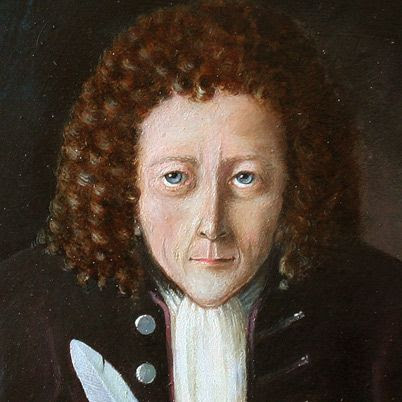
(One common explanation for why no portraits of Hooke were made during his life is that Newton ensured that one was removed and destroyed at the Royal Society—a rumor that Dr. Felicity Henderson discussed in a fine2010 blog post for that organization. Thus, the image accompanying this post is an imagined one, from this century, with no certainty that it is like the original.)

Newton also outlived Hooke by nearly a quarter century, ensuring that his fame shone all the brighter, to Hooke’s disadvantage. It was no accident that Alexander Pope would write the epitaph, “Nature and Nature’s Laws lay hid in Night:/God said, ‘Let Newton be!’ and all was light.”

Far from achieving similar celebrity, Hooke came in for mockery on the stage, even during his lifetime. Thomas Shadwell’s 1676 farce The Virtuoso mocked the “new world” that Hooke had announced in Micrographia, leading the scientist to carp in his diary about the reaction of other playgoers who recognized him as the object of the ridicule: “Damned Doggs. Vindica me Deus. People almost pointed."

Far all his brilliance and the distance he had travelled from his humble origins, Hooke could never shake his hyper-sensitivity. Some of it may have derived from his appearance. A sickly child, Hooke developed curvature of the spine at the age of 16 that only worsened with time.

Maybe that was the reason for one of the discoveries about his private life made in his diaries: he had no intimate relationships with adult women of his class, instead consorting with house maids, as well as with his niece Grace.

The latter’s death at age 27 in 1687 was a blow from which Hooke never recovered. His intake of experimental drugs to deal with his mounting maladies (e.g., double vision, near-delusions) grew apace, leaving him essentially bedridden for the last year of his life.

Monday, August 10, 2020

This Day in Scientific History (Death of Robert Goddard, Secretive Space Pioneer)


Aug. 10, 1945— Robert H. Goddard, a physicist who shook off academic bewilderment and even public derision to perfect the principles of rocketry that helped launch the Space Age, died at age 62 from throat cancer in Baltimore, Md.

The importance of Goddard to American aerospace can be summed up quickly enough. C.D.B. Bryan’s The National Air and Space Museum ranks the scientist’s March 1926 launch of the world's first flight of a liquid-propelled rocket as comparable to the Wrights’ maiden flight at Kitty Hawk in 1903. More than 200 patents led Goddard, along with Russian Konstantin Tsiolkovskiy and the German Hermann Oberth, to be considered among the three “fathers” of modern spaceflight. In 1959, the National Air and Space Administration (NASA) established the Goddard Space Flight Center in Greenbelt, Maryland, in his memory.

But, listed in such a fashion, the facts in the preceding paragraph are as inert as lines in a deadly high-school science text. Fundamentally, they tell us little to nothing about this pioneer.

They take on more significance—and more interest—when we understand the human being who achieved all this despite society’s misunderstanding and his own imperfections. That is when reading history is transformed, and that is what I’ll try to do in this short space.

Elon Musk’s Space X venture, for instance, would have been inconceivable without Goddard’s advances. (Indeed, another Musk concept, the futuristic “Hyperloop” transportation mode, owes much to another one Goddard’s speculations, contained in a 1905 paper that proposed traveling in a train-like vehicle inside a vacuum tube at very high speeds.)

The irony is that, while thousands around the world applauded in May as Space X carried humans once again, this time in a private commercial venture, into Earth's orbit—and as countless reporters and investors tracked the billionaire Musk’s every Tweet—the socially awkward Goddard was so appalled by ridicule directed towards him that he worked on many of his projects in utmost secrecy—and committed close associates to do likewise.

Introversion had so hamstrung Goddard at the start of his career that he almost gave up what would become his life’s work. Frail from a youthful bout with tuberculosis, he often proved preoccupied and absent-minded in chairing the physics and math departments at Clark University in Massachusetts. Early on, so few colleagues saw value in his work that in 1915, he had to look to the Smithsonian Institution for a lifeline to continue his research.

Not surprisingly, Goddard did not enjoy the instant name recognition that came to Wilbur and Orville Wright as aerospace pioneers. A few years after they made their breakthrough at Kitty Hawk, the brothers demonstrated their machine publicly. 

Unlike Goddard, they remained in the public eye because they formed a business and were ready to battle competitors in court for the credit for their invention. And unlike Goddard’s initial experiments with rockets, which carried neither human beings nor cargo, the ultimate purpose of the Wrights’ invention was easy for the human imagination to grasp: manned flight.

Yet Goddard differs from the Wrights in another sense that might make him more attractive to those fascinated by the lives of inventors: the deep devotion of a spouse. 

Neither Wilbur nor Orville ever married, and they depended crucially on their sister Katharine not only as a sounding board for their ideas but, in the case of Orville after a devastating injury, as virtually a nurse. (When she finally decided to marry, at age 52, Orville stopped speaking to her, only ending their estrangement two years later when she became fatally ill with pneumonia.)

In contrast, for all his shyness, Goddard was able to gain a wife who supported him personally and professionally. During a period in the 1930s, when he worked in Roswell, N.M., with a crew that never numbered more than seven people, Esther Goddard served as official photographer and was responsible for dousing fires caused by rocket exhausts.

Believing her husband to be a great man who never achieved his due in life, she worked unstintingly to ensure that he would in death. It wasn’t only that Esther filed more than three-fifths of the patents eventually credited to him after his demise, but that she mounted a herculean effort to document and promote his achievements. As recounted by biographer David A. Clary in Rocket Man: Robert H. Goddard and the Birth of the Space Age, this included:

*hiring two typists who helped transcribe her husband’s research—a voluminous collection of notes, photographs and photostats of his drawings that eventually amounted to 22 volumes;

*transcribing Robert’s diaries and lab notebooks (a task she was uniquely suited for, as she appears to have been one of the few who could decipher his frequently illegible scrawls);

*kick-started an authorized biography of her husband—then hired another biographer while the first suffered a nervous breakdown;

*helped compile her husband’s papers; and

*lectured extensively on Robert, attempting—successfully, as it turned out—to elevate him into what Clary calls “the Mount Rushmore of rocketry.”

Robert Goddard was fortunate that he had the love of Esther, as well as the support of three influential friends: Charles Greeley Abbot, Assistant Secretary of the Smithsonian Institution, who helped him secure funds for his work; aviator Charles Lindbergh, who helped him secure grants from the Guggenheim Foundation; and philanthropist Harry Guggenheim, who not only provided Goddard with funding that amounted to $188,500 but helped bankroll Esther’s effort to preserve her husband’s memory.

But for them, he might have lived out his days in bitter disappointment. The media of the time did not help matters. His 1919 paper outlining his vision, “A Method for Reaching Extreme Altitudes,” led to the derisive nickname “Moon Man.” A New York Times editorial attacked him for lacking “the knowledge daily ladled out in high schools.” (The Gray Lady didn’t get around to a correction until 1969—after the launch of Apollo 11.) 

Even a particularly crucial breakthrough of Goddard’s in July 1929—a rocket that reached twice the altitude of his 1926 liquid-propelled launch—provoked snickers because of the noisy proceedings on his Aunt Effie’s remote farm in Auburn, Mass. (The next morning, one Worcester paper ran the headline, MOON ROCKET MISSES TARGET BY 238,799 ½ MILES.)

If man has been able to reach beyond his orbit, it is because figures like Goddard remained undeterred by such ignorant naysayers.

Wednesday, December 12, 2012

This Day in Scientific History (Robert Noyce, Silicon Valley Titan, Born)


December 12, 1927—Robert Noyce, who co-invented the integrated chip, the tiny bit of silicon that furnished the foundation for millions of transistors, and who then re-invented American corporate practices as co-founder of Fairchild Semiconductor Corporation and Intel, was born in Grinnell, Iowa.

Before Bill Gates, before Steve Jobs, there was Noyce, who, for all his fame within the world of high-tech, never enjoyed the wider public name recognition given the founders of Microsoft and Apple. But Noyce was nicknamed “the Mayor of Silicon Valley” for a reason. He received 16 patents on semiconductor methods, devices and structures—discoveries used later in robots and the Apollo manned flights to the moon, as well as for an American computer industry that has flourished while other parts of the manufacturing sector have died on the vine.

I first became aware of this high-tech pioneer when I read Tom Wolfe’s essay, “The Tinkerings of Robert Noyce: How the Sun Rose on the Silicon Valley,” in the December 1983 issue of Esquire. That mammoth special issue, commemorating the 50th anniversary of the legendary magazine, was called “The 50 Who Made The Difference,” containing profiles of key individuals in American life in the prior half-century, including Muhammad Ali, Betty Friedan, William S. Paley, Philip Johnson, Dr. John Rock, a developer of the birth-control pill, William Levitt, Dr. Benjamin Spock, Carl Bernstein and Ralph Nader. Noyce (who died in 1990) was not anywhere near as well-known as many, if not all, the others on the list, but his influence was arguably every bit as extensive.

The Noyce piece became, in effect, Wolfe’s goodbye to the New Journalism he had begun practicing 20 years before as a young reporter. The writer was about to take up the fiction that has largely consumed his time since then. But before he was done with nonfiction, he contributed what can, in certain ways, be read as a coda to The Right Stuff.

I have never read how Wolfe became interested in Noyce’s story, but given the details about the importance of the semiconductor to the space program, it’s very possible that the fascination grew out of his research for The Right Stuff. This time, though, Wolfe paid tribute not to the astronauts, nor even to those at NASA who guided them through space, but instead to the man ultimately responsible for a major component of Apollo 8, “a miniature computer two feet long, one foot wide, and six inches thick, exactly three thousand times smaller than the old ENIAC and far faster and more reliable”—a direct outgrowth of the integrated chip created by Noyce and Texas Instruments engineer Jack Kilby in 1959.

There is another link between the space program chronicled by Wolfe and the origins of Silicon Valley that the writer discussed. Recall how, in The Right Stuff, Wolfe had some fun with John Glenn when the astronaut chastised several of his Mercury colleagues for tomcatting around. “In his eyes burned four centuries of Dissenting Protestant fervor,” Wolfe notes.

Wolfe discovered a similar motif in the background of Noyce and other pioneers of Silicon Valley, who thought they had shed their old mores after World War II, only to find out differently. The founder of Noyce’s hometown, Josiah Grinnell, was a 19th-century Congregationalist minister who founded public schools in the Heartland, and was a benefactor of the college in Iowa that now bears his surname. Noyce and other key engineers in the rise of Silicon Valley didn’t have the cachet of graduates back East, but they brought a similar moral fervor to their endeavor of changing the world.

Noyce did so not just with the science itself, but with the way of business life he evangelized. His departure from the fold of his boss, transistor inventor William Shockley—and then, subsequently, the departure of those who worked for Noyce himself, at Fairchild and Intel—became a kind of career template for getting ahead in Silicon Valley.

Even more important was the corporate environment Noyce created. At Intel, Wolfe writes, Noyce not only insisted on “no executive suites, no pinstripe set, no reserved parking places, or other symbols of the hierarchy,” but he also created a common space for all employees—an end to “the eastern corporate protocol of small metal desks for underlings and large wooden desks for overlords.”

Making all of this possible was Noyce’s personal charisma—itself, Wolfe seems to waggishly suggest, in his choice of metaphor, a kind of secular outgrowth of the inventor’s religious background:

“With his strong face, his athlete's build, and the Gary Cooper manner, Bob Noyce projected what psychologists call the halo effect.  People with the halo effect seem to know exactly what they're doing and moreover make you want to admire them for it.  They make you see the halos over their heads."

Sunday, June 10, 2012

This Day in Scientific History (Franklin and Son’s Kite Experiment)


June 10, 1752—In the kite experiment with lightning that made him a transatlantic hero of Enlightenment science, Benjamin Franklin relied heavily on his son, a young man increasingly favored by his father despite the stigma associated with his illegitimate birth.  Two decades later, however, father and son received a shock worse than anything they encountered in their experiment when they found themselves on opposite sides in the colonies’ break with England.

No matter what your age, there’s a good chance that your image of Franklin comes from a painting or illustration showing him holding the kite aloft while William Franklin, a boy, watches in wonder. In fact, on that June afternoon in Philadelphia, William was the only witness to the event.

But much of the rest of the visual impression, like much of what we know about Benjamin Franklin, is enshrouded in myth. (That wouldn’t have surprised his jealous Continental Congress colleague John Adams, who, with time on his hands and frustration building as Vice-President, vented, in his often hilariously grouchy vein, to his friend Benjamin Rush: “The history of our Revolution will be one continued lie from one end to the other. The essence of the whole will be that Dr. Franklin’s electrical rod smote the earth and out sprang General Washington. That Franklin electrified him with his rod – and thenceforward these two conducted all the policies, negotiations, legislatures, and war.”)

For starters, William wasn’t a young boy but a 22-year-old man who had already distinguished himself for bravery in the colony’s militia. And he wasn’t a mere observer:  According to biographer Willard Sterne Randall, he had designed the kite himself, then run around in the pasture three times holding the kite. (At 46, Ben was in little condition to carry out the experiment himself; he was already putting on the weight that would, in old age, leave him painfully gout-ridden.)

In fact, this was not his first involvement with his father’s thinking about all of this. In the past several years, as Benjamin segued from the printing business that had made him rich and famous into an equally busy retirement as an inventor and politician, he had assigned William the task of gathering in glass bottles electricity from thunderstorms passing overhead.

William was there when his impatient father didn’t want to wait around in the summer of 1752 for completion of the steeple of Christ Church in order to conduct an experiment with lightning. A kite flying high in a storm, he reasoned, would serve just as well.

Call William a mere lab assistant, if you want, but that particular experiment wouldn’t have been done if he hadn’t been willing to put himself in harm’s way so his father could observe how the whole thing turned out from the safety of a shepherd’s shed.

None of this is to take away what Benjamin accomplished, with what he considered his most important invention: a lightning rod that saved countless colonial buildings and lives from the longtime hazard of fire. Making an impact on the international scientific scene should have been daunting for someone so advanced in age, lacking in formal education, and an ocean away from the Royal Academy of Science. Yet Franklin proved more than equal to the task. His achievements are memorialized in Philadelphia’s Franklin Institute Science Museum.

When I visited the museum several years ago, the cries of delighted children reverberated throughout, in no small way because of a dozen interactive exhibits. Many of the permanent exhibits revolve around subjects that fascinated Franklin: meteorology, communications, even sports. But the heart of the museum is the Franklin National Memorial—America’s official tribute to the Founding Father.

James Earle Fraser’s 20-foot marble high statue of Franklin dominates the museum’s rotunda. Surprisingly for such an epitome of bourgeois ideals, Franklin here resembles a Greek or Roman god. But perhaps it’s not entirely a fanciful notion: as the man who first fully explained electricity, then invented a life-saving lightning rod, Franklin was sometimes regarded as the American Prometheus, the tamer of nature’s most mysterious and terrifying power.

In loving, and frequently surprising, detail, Memorial Hall not only displays items associated with Franklin but delights in true arcana about the man. Many of Franklin’s possessions have been collected here, notably an odometer he used in establishing postal routes, a sword and scabbard he wore at the court of France, his composing table, and many of his original publications.

The focus, however, is on Franklin’s scientific achievements. Everyone knows about Franklin’s experiments with lightning and electricity, but he achieved many other scientific and technological “firsts”— first American printer to make molten type; first to invent bifocals; first to propose daylight savings time; even first to eat a French fry!

Puckishness, combined with an ever-questing curiosity, produced Franklin’s triumphs. He loved to play parlor tricks to show off recent discoveries. (Not that these demonstrations couldn’t embarrass Franklin--once, in checking equipment, he accidentally shocked himself, then begged the recipient of his letter not to disclose this secret.)

The modern world continues to benefit from Franklin’s innovations in ways he never conceived. His “long-reach arm,” for instance, allowed him to reach books on top shelves in his study without stepping on a ladder. In the twenty-first century, the “long-reach” cuts branches and pulls down merchandise in grocery stores.

The least introspective of men, Franklin often showed more interest in the natural world than in his own psyche. As soon as he saw a problem, nothing could stop his relentless search for a practical solution. 

While sailing back and forth from England in 1753, he wondered why there was a difference in the general ocean current and that of the Caribbean. As a result, he became the first to explain the existence of the Gulf Stream, leading to voyages from England to America being shortened by several weeks. He developed bifocals because he tired of carrying two pairs of glasses around all the time. His swim fins and flotation vests originated in his love for swimming. His stove used heat and fuel far more efficiently than those built up to that time.

In science as in business, Franklin frequently attained the most by working through others rather than by himself, however. One Memorial Hall exhibit highlights his crucial role in publicizing the first organized American observation of the Transit of Venus in 1753. He acted as influence and example to Philadelphia’s other great colonial scientist, David Rittenhouse.

America’s first internationally acclaimed scientist had high hopes of working most productively through his own son. After the lightning experiment, William became an important ally of Benjamin’s in promoting a plan for a united colonial effort to defend against attacks in the French and Indian War, as well as in transferring control of Pennsylvania from the descendants of William Penn to the crown. Benjamin watched with pride as his son apprenticed himself to a prominent Pennsylvania lawyer, then won appointment as royal governor of New Jersey, where he impressed many with his administrative ability.

Then, when Benjamin fell out with the crown over his conduct as London agent for the colonies, he was shocked to find that William had become a Loyalist. William, seized by the patriots and thrown into prison for a few years, suffered so badly in body and mind (his wife died while he was incarcerated) that even George Washington was moved to write on his behalf. But Benjamin refused to intervene, the Continental Congress dropped any notion of intervention, and William continued to languish in prison.

A couple of years after the war ended, father and son met for one last time in London, but the atmosphere resembled a tense business meeting more than a family reunion.  A once-close partnership that produced one of the world’s great advances in science and safety was irretrievably shattered.  

Monday, September 7, 2009

This Day in Scientific History (Freud Gives 1st American Lecture)


September 7, 1909—Speaking extemporaneously in German, tossing unexpected one-liners into the mix, Sigmund Freud delivered the first of five lectures on his revolutionary method for treating mental illness—psychoanalysis—in a country that embraced his pioneering work far more quickly than Europe ever did, but which he could never bring himself to like.

In late August, Freud and disciples Carl Jung and Sandor Ferenczi had disembarked from the George Washington before traveling to Clark University in Worcester, Mass., where the Austrian physician was set to speak on five consecutive days on “The Origin and Development of Psychoanalysis.”

The European group had been invited by Clark president G. Stanley Hall, who, in observance of the institution’s 20th anniversary of becoming the second graduate school in the U.S., had scheduled a mind-boggling agenda of conferences featuring renowned speakers in Clark’s major areas of study: mathematics, physics, chemistry, biology, psychology, child welfare, and international relations.

The picture accompanying this post captures several of the participants. In the front row, from left to right, are Freud, Hall and Jung; in the back row are Abraham A. Brill, one of the earliest psychoanalysts; Ernest Jones, the biographer whom Brenda Maddox would term “Freud’s Wizard” for his role in disseminating the master's ideas in the Anglosphere; and Ferenczi.

After twenty years of patient work, Freud’s theories had still not caught fire to anywhere near the extent that he wanted. The prior year, the “First International Congress of Psychoanalysis” had been held in Salzburg.

Now, you’d think that a new psychological theory heavily reliant on interpreting sexual matters (you can almost see the delighted male faces in attendance: It’s all about sex), coupled with the chance to soak up the sounds of the city that nurtured the likes of Mozart and Schubert, would have brought everyone running to this “First International Conference.” But only 40 people showed up—an okay turnout, but, all things considered, still disappointing.

That’s part of the reason why Freud’s eyes popped when, the prior December, he received the invitation from Hall. To have him speak, the university would award him an honorary degree—the only official honor of this kind that Freud received throughout his life.

The honorary degree didn’t end up being the only inducement the university would offer to lure him over:

* Freud’s speaking honorarium was increased from $400 to $750;


* Hall promoted Freud as the star attraction of the conference; and,


* The school issued, at Freud’s request, a last-minute speaking invitation to Jung as well.

Leon Hoffman’s New York Times op-ed article last week, “Freud’s Adirondack Vacation,” notes one of the interesting oddities of the conference. Despite an hour alone together, the Viennese physician failed to win over pioneering American psychologist-philosopher William James to his ideas on the interpretation of dreams and the power of the unconscious (“They can’t fail to throw light on human nature,” James wrote, “but I confess that he made on me personally the impression of a man obsessed with fixed ideas.”)

The person that Freud did impress—perhaps more crucially, given that James would be dead within a year anyway and would therefore have little time to propagate the Austrian's ideas—was James Jackson Putnam, a professor of neurology at Harvard. Putnam invited Freud, Jung and Ferenczi to his family camp in the Adirondacks, where, amid the wonders of nature, the American and the Austrian became friends.

Within two years, Putnam would become the first president of the American Psychoanalytic Association, a post from which he proselytized for Freud’s idea that mental illness was not simply a result of “degeneration” of the brain, but that the unconscious could powerfully influence the body.

Freud could not have been more pleased by the reception of his work in the United States, writing:


“In Europe I felt as though I were despised; but over there I found myself received by the foremost men as an equal. As I stepped onto the platform at Worcester to deliver my Five Lectures upon Psychoanalysis it seemed like the realization of some incredible day-dream: psychoanalysis was no longer a product of delusion, it had become a valuable part of reality."


For all his gratitude to Hall and Putnam for spreading his ideas, however, Freud was far more ambivalent about their country: “America is the most grandiose experiment the world has seen, but, I am afraid, it is not going to be a success,” he would observe some years after his only visit to this country.

Maybe some of Freud’s attitude stemmed from a not-especially-healthy source: “What is the use of Americans," he remarked, “if they bring no money?'

At the time of his death in 1939, forced into exile from Austria, watching Europe plunged into another military conflagration, Freud would have been astonished to know that six years hence, the nation he scorned would lead the way in eradicating the mass psychosis of Nazism from the European body politic.

Sunday, September 6, 2009

This Day in Scientific History (Ground Broken for 1st U.S. Nuclear Power Plant)

September 6, 1954—On Labor Day, a crowd witnessed President Dwight D. Eisenhower—in town recovering from a heart attack--waving a ceremonial neutron wand over a neutron counter in Denver, Colorado, sending a radio signal to another site 2,500 miles away in Shippingport, Pa. that construction could begin on what was expected to be the world’s first nuclear power plant.

Another plant in Great Britain beat the one near Pittsburgh to the punch, opening nearly a year before. But the life of the American plant—from its opening in 1957 to its decommissioning in 1989—illustrates how initial optimism about a new technology can often give way to disillusionment.

The Shippingport plant, begun 10 months after Eisenhower unveiled his “Atoms for Peace” program before the United Nations, inaugurated the American love affair with the nuclear power plant. Lewis Strauss, chairman of the Atomic Energy Commission, thought that this facility—the nation’s first full-scale central station nuclear power plant--was not merely a “pioneer venture” but would even exceed in importance the first railroad to the West. He predicted a future in which energy would be “too cheap to meter.”

Dreams die hard.

A little more than 20 years later, as a high-school sophomore, I attended a school assembly in which a representative of the atomic power industry appeared to present a dog-and-pony show about the industry.

Though hardly a hotbed of radicalism, my school viewed the presentation with irony. The follow-up questions, though polite, were pointed about safety issues. And this was three years before Three Mile Island.

The 60,000-kilowatt Shippingport demonstration project was built jointly by Westinghouse Electric Corp. and Pittsburgh’s Duquesne Light Co., under the direction of Admiral Hyman Rickover’s Naval Reactor Group. Philip Fleger, head of Duquesne, conceived of the project as a way to eliminate the coal and the pollutants that fouled the Pittsburgh air in those days.

According to an interview Fleger gave American Heritage nearly a quarter-century after the plant’s opening, the company needed an alternative to the coal mines it already owned because new urban development laws in Pittsburgh involved strict smoke controls. Opposition to a coal-fired plant they had planned for the Allegheny River forced them to look to something else.

Under Rickover’s typical ferocious prodding, the Shippingport plant opened in two and a half years, compared to the 12 to 14 years required from inception two decades later. Unfortunately, the project went considerably over its budget.

Two decades later, the Beaver County plant was converted to a light water breeder reactor. The plant achieved another first in 1989: the first successfully decommissioned nuclear power plant, involving decontamination technology and nuclear waste-handling techniques. Its nuclear remains were transported more than 8,000 miles across country, finishing its journey on a barge on the Columbia River to be buried on the Hanford Military Reservation in the state of Washington.

Monday, June 30, 2008

This Day in Scientific History (Mysterious Cosmic Body Explodes in Siberia)

June 30, 1908—In central Siberia, shortly after 7 a.m., a comet or asteroid entered Earth’s atmosphere and exploded between five and 10 kilometers above ground, devastating an entire forest and leaving behind a century-old mystery that haunts scientists to this day.

Why should the so-called “
Tunguska explosion”—an event that happened in the middle of nowhere, practically—concern us? Because similar past disturbances in the atmosphere have had major effects on the evolution of the world, scientists say. Moreover, because the fireball flew through the atmosphere in a largely unpopulated region, the world lucked out then. We might not be so fortunate next time—and, according to the best calculations, “next time” might not be all that far off.

I learned about this event in the June 2008 issue of Scientific American, a magazine that, when I had to read it for some projects in my high school biology class with Larry Chinnock in St. Cecilia High School, really made my eyes glaze over. Something must have happened in the intervening years, though, because the articles made more sense to me. My guess is that they simplified it for the likes of me. (I did, after all, pick this up at a newsstand.) You won’t be able to read the full text online, but even
this excerpt, I believe, will be enough to make you want to read the whole thing.

The atmospheric disturbance registered the largest impact of a cosmic body to occur on the Earth during modern history, according to the article. What was it like to experience this extraordinary event? According to one Russian eyewitness, at the closest human habitation, a trading station:

"I was sitting on the porch of the house at the trading station, looking north. Suddenly in the north...the sky was split in two, and high above the forest the whole northern part of the sky appeared covered with fire. I felt a great heat, as if my shirt had caught fire... At that moment there was a bang in the sky, and a mighty crash... I was thrown twenty feet from the porch and lost consciousness for a moment.... The crash was followed by a noise like stones falling from the sky, or guns firing. The earth trembled.... At the moment when the sky opened, a hot wind, as if from a cannon, blew past the huts from the north. It damaged the onion plants. Later, we found that many panes in the windows had been blown out and the iron hasp in the barn door had been broken."

Far away, even in lands as distant as Britain, the effects could be felt:

* Instruments recorded seismic vibrations as much as 1,000 km (600 miles) away.


* Closer, around 60 km away, observers were thrown to the ground or knocked unconscious.

* The closest human observers (if they could be called “observers”—maybe were asleep in their tents at the time) were reindeer herders, some of whom were blown into air and knocked unconscious. At lease one man died.

* Londoners could see a pink, phosphorescent night sky.

* An Israeli scientist estimated in 1975 that the explosion was between 10 and 15 megatons in magnitude—the equivalent of 1,000 Hiroshima atomic bombs.

Believe it or not, it was 19 years before the authorities could mount a serious scientific investigation into what happened. The lapse is unfortunate, but a bit more understandable when one considers what was happening in Russia during those years. For the first nine years, the country was wracked by internal unrest, mobilization for WWI, then the Russian Revolution. Then after 1917 came invasion by Russia’s former Western partners in WWI, civil war, and the beginning of the “dictatorship of the proletariat.”

The authors of the Scientific American article will be conducting further investigations into the origins of the disturbance this year. By better understanding what kind of event this was, they hope to be better prepared the next time it happens—which could be within our lifetime.

Saturday, June 14, 2008

This Day in Scientific History (Brave New World of Biotech Opens)

June 14, 1973—At the Gordon Research Conference, a private confab of molecular biologists at the New Hampton School in rural New Hampshire, Herbert Boyer’s announcement that he and a colleague had recombined e coli genes with genes from a different organism opened a vast new vista of medical research, signaled the potential of what became a multibillion-dollar industry—and brought to the surface ethical concerns about the emerging field of biotechnology.

I first heard about this discovery in a fascinating volume of historical essays known as Days of Destiny, edited by James M. McPherson and Alan Brinkley. The book concentrates on 31 unheralded but vital days in American history, such as the dinner party held at Thomas Jefferson’s room in Philadelphia that led to the passage of Alexander Hamilton’s economic program, the Dred Scott decision, and the first widespread use of standardized testing. Daniel J. Kovles’ contribution, “The Battle Over Biotechnology,” recounts the troubled beginnings of this field.

The genesis of the idea came six months earlier, at a Honolulu confab on plasmids, or circles of DNA found in bacteria. At the conference, two scientists went to a deli and, while munching over corned-beef sandwiches, also chewed on each other’s ideas: Herbert Boyer, a biochemist and genetic engineer at the University of California at San Francisco, and Stanley Cohen, an associate professor of medicine at Stanford University.

An enzyme that Boyer had isolated would enable Cohen to use specific DNA segments in plasmids, which in turn could be used to clone precisely targeted strands of DNA. Four months later, the duo had managed to clone predetermined patterns of DNA.

Boyer’s announcement of this collaborative discovery immediately set off sparks among listeners. While many recognized immediately the potential for biomedical medicals, others foresaw the peril that “recombinant DNA” (as it became known) would result in a 20th-century version of Frankenstein’s monster—genetically engineered life from animal or even human genes.

The morning after Boyer’s presentation, on the final day of the meeting, 15 minutes were set aside to discuss the ethical considerations involved in recombinant DNA. This in itself was unusual, given that such meetings were normally confined strictly to science.

But the scientists—many of whom were liberal and understandably guilt-stricken over the role of physicists in the creation of the atomic bomb—initiated a series of discussions and letters among themselves that led to a set of guidelines from the National Institutes of Health that restricted research with recombinant organisms to special containment facilities and ensured that they couldn’t survive if they somehow escaped even these.

Before long, politicians were raising alarms about the potential for abuse, and a number of scientists who had first raised alarms about ethical issues, including James D. Watson, one of the discovers of DNA, began to fear that they had unleashed ignorant, headline-hunting pols in an arena where they didn’t belong. But the potential for medical gains was so enormous that progress could hardly be slowed.

Three years after the Gordon conference, Boyer teamed up with venture capitalist Robert A. Swanson to form Genentech. Subsequent discoveries in the next couple of years, including human insulin and human growth hormone, led the company to become one of the most eagerly snapped up initial public offerings when it hit Wall Street in 1980.

Today, there are more than 1,500 American biotech companies, manufacturing not only insulin and growth hormones but also cancer treatments, an agent to dissolve blood clots in victims of heart attacks, and more. But, as the scientists originally surmised, ethical issues have risen along with advances in health.

In 1999, for instance, Genentech was forced into a settlement with the Food and Drug Administration the FDA for $50 million over charges that it paid doctors to prescribe its human growth hormone, as well as other, "more aggressive activities." And other concerns have come to the fore as well:

1) The patenting of plants and animals, promoting corporate control over a natural heritage.
2) Conflicts of interests created by universities who were financially beholden to biotech companies for research.
3) Genetically modified foods in grocery stores, seen by many as potentially dangerous.
4) “Tinkering” with human life to create, in one nightmare scenario, children made to order.

Friday, April 25, 2008

This Day in Scientific History (DNA’s “Secret of Life” Explained)

April 25, 1953—Unlocking what they believed might be “the secret of life”—and beating several rivals to the punch with their discovery—James D. Watson and Francis Crick described the molecular structure of DNA, the hereditary material that forms individual human beings, in a landmark paper that appeared in the influential scientific journal Nature.

In the same issue of the journal were two other articles dealing with DNA –the acronym for deoxyribonucleic acid – whose co-authors included Maurice Wilkins and Rosalind Franklin. Wilkins and Franklin had been working at a lab in Cambridge, while Watson and Frick were at King’s College in London. These four, together with Linus Pauling, were locked in a struggle to figure out the nature of DNA.

In Larry Chinnock’s high school biology class at St. Cecilia’s High School in Englewood, N.J., I first learned about this particular phenomenon. After I figured out how to spell the damn thing (for one year only, figuring –until I had to write this blog post!—that the acronym DNA would do just fine on all occasions for the rest of my life), I squinted at the strange full-color diagram in our text showing this “double-helix.”

The text did a good enough job, I suppose, of explaining how DNA exerted itself on chromosomes. But I don’t think it gave us a really good idea of the brave new world opened up by this momentous discovery.

Nor—and this is something that might have appealed to a history aficionado like myself—did the book help us grasp how the struggle to understand DNA was another in a long line of scientific donnybrooks.

From Orville Wright quarreling with the Smithsonian Institution over the proper credit that should be given to him and brother Wilbur over the airplane, to Alexander Graham Bell’s fevered (and, some people think now, highly suspect) last-minute rush to gain a patent for the telephone, to Isaac Newton’s quarrels with…well, everybody, science is not really the disinterested, objective search for truth that the high priests of science would like us to believe.

Fifteen years after he and Frick published the fruits of their research, Watson wrote The Double Helix: A Personal Account of the Discovery of the Structure of DNA. Just as the year before, Norman Podhoretz’s Making It exposed the “dirty little secret” of New York intellectual life (ambition), Watson’s memoir spelled out a world that you and I never encountered in high school science classes: cutthroat competition among men (and, in this case, women) in white suits.

It was understood while these scientific investigations were occurring that Cambridge was ceding leadership in the race to identify DNA to King’s College—except that Watson and Crick weren’t engaged in these ethical niceties. Franklin, working under the direction of Wilkins, had produced a photograph of a DNA molecule that was given without her permission by Crick to Watson, who admitted later, "My jaw fell open and my pulse began to race." At a glance, it opened up to them the helixical nature of DNA, as well as its method of replication. They rushed their realization into print, beating not only Pauling (who didn’t have access to Franklin’s revelatory image) but Franklin herself.

Nine years after the epic discovery, Watson, Crick and Wilkins received Nobel Prizes for their work. Franklin received none, because six years earlier she had died of ovarian cancer at age 37.

Upon publication, The Double Helix was hailed for making scientific discovery thrilling and relatively jargon-free for the layman. But, in those days before consciousness-raising, Watson did something that would now be called politically incorrect and back then, by men of a certain stripe, would be considered ungallant: he dissed the deceased Franklin as bossy and frumpy.

In recent years, a couple of major biographies have reversed this cruel stereotype, revealing what a talented crystallographer Franklin was. Conversely, Watson’s reputation took a major hit when he was forced to resign from the Cold Spring Harbor Laboratory in Long Island, after stating that he was not optimistic about the future of Africa because the intelligence of Africans was lower than that of whites. The remark was a double nightmare for his institution not just because it exposed Watson’s individual racism but because it revived memories of the lab’s shameful past as the epicenter of the eugenics movement, America’s misbegotten embrace of scientific racism.

In a way, Watson’s fall from grace was poetic justice—not just because of isolated incautious remarks (which more than one politician has made in this electoral cycle, lest we forget), but because they were the latest example of a pattern of criticizing minorities and women, according to “Talking Points Memo” blogger Joshua Micah Marshall. Not only had Watson dumped all over Rosalind Franklin (and at a time when she wasn’t around to defend herself), but later sexist remarks led to a mass walkout by female members of a West Coast audience.

Evidently, the brashness of Watson’s youth has hardened into cantankerousness. He has had to learn the hard way what the rest of us could have told him much more easily: a Nobel Prize doesn’t immunize you from making stupid remarks.

Years earlier, upon realizing the momentous adventure upon which they were embarking, Crick remarked to Watson that they had discovered “the secret of life.” But as far as I’m concerned, baby-boomer bard James Taylor knew the real secret. Sadly, the now-octogenarian Watson does not appear to have learned it.

Sunday, April 6, 2008

This Day in Scientific History (Teflon Invented)

April 6, 1938—On his very first assignment in DuPont’s largest lab, chemist Roy J. Plunkett made a mistake. Fortunately, it did not blow the place to smithereens or lead to one of those sci-fi nightmares out of The Fly, but rather resulted in one of the great inventions of the century, at least as far as anyone laboring in a kitchen is concerned: tetrafluoroethylene resin, better known as Teflon.

In Jackson Lab in Deepwater, New Jersey, the 28-year-old scientist was synthesizing new forms of the DuPont refrigerant Freon®. He and assistant Jack Rebok had produced and stored more than 100 pounds of tetrafluoroethylene gas (TFE) at dry-ice temperatures before chlorinating it.

But as they prepared a cylinder for use, none of the gas was released—yet surprisingly, the cylinder weighed exactly the same. Opening the cylinder, an annoyed Plunkett found flakes of white powder spilling out.

When he got over his surprise, Plunkett broadened his research beyond the objective at hand by testing the powder for more than just its refrigeration potential, discovering not only that it was heat resistant and chemically inert, but that most other substances would not stick to it. Over a year later, after he was able to recreate through experimentation what he had found by accident, he took out a patent for the substance, shortening its name to Teflon. The patent was granted two years later.


During World War II, polymerized tetrafluoroethylene (PTFE) played such an important role in military applications that DuPont agreed to reserve its entire output for government use. It was especially critical to the Manhattan Project, where it was used to separate the isotope U-235 (which makes up about 0.7 percent of the element uranium in its natural state) from U-238.

In 1944, DuPont’s production unit for PTFE in Arlington, N.J., was rocked by an explosion.
Working in utmost secrecy, investigators determined that the accident occurred because of chemical processes rather than sabotage. The unit was rebuilt, with heavy barricades surrounding it.

The military uses of PTFE pointed to larger commercial possibilities that DuPont eagerly explored in the postwar period. Still, the company was wary, despite intensive and successful testing, about using Teflon for kitchen purposes, worrying about product liability. When it finally did act, it was as a result of pressure from, of all places, France.

Hearing about Teflon from a colleague, an engineer, Marc Gregoire, decided it would be a neat idea to put the substance on his dearly beloved fishing gear in order to prevent tangles. But his wife Colette was the real smarty in the relationship: Why not try it on her frying pans? Marc thought about it, tried it, and when it proved successful, they even started selling it on the streets of France and, eventually, set up their own business.

Before long, multiple kinds of nonstick cookware were being sold in the U.S. The first look Americans got at the stuff on their home turf was in 1960, at a banquet for Plunkett, who had just been awarded Philadelphia’s Scott Medal for his invention. Attendees at the banquet walked home with a complimentary muffin tin coated with Teflon. By the end of that year, at the worst possible time—the Christmas season--Macy’s flagship store in Herald Square ran out of its supply from France.

Shortly thereafter, so many inferior knockoffs of nonstick cookware were being sold that DuPont felt it needed to step in to save its reputation. (Not that the desire to make a buck didn’t play a role.) In 1968, it came up with Teflon II, which the company promoted as not only non-stick but even scratch-resistant. The product now became a part of consumer history.

And, two decades later, political history, too. Trying to come explain why President Ronald Reagan escaped unpopularity despite policies that hurt large numbers of voters, a congresswoman from Colorado with a gift for soundbites, Patricia Schroeder, found the perfect image while fixing eggs for her children one morning.

The President, the liberal Democrat told reporters, had a Teflon coat like the pan she was using, so nothing stuck to him. Within a year, the media had widely adopted her phrase: “
Teflon President.”

The phrase--much like Plunkett's original product--was even adapted for other uses, as crime reporters, accounting for mobster John Gotti’s initial ability to wiggle out of guilty verdicts for his crimes, referred to him as “The Teflon Don.”

Tuesday, February 19, 2008

This Day in Scientific History (Edison Patents Phonograph)

February 19, 1878 – Inventor Thomas Alva Edison secured US patent No. 200,521 for the phonograph, the first machine to record someone’s voice and play it back.

Edison came up with the idea in the second half of 1877 (the precise date remains uncertain, though he filed for the patent in December). He tested his cylinder phonograph with the old nursery rhyme, “Mary had a little lamb.”

“Of all my inventions, I liked the phonograph best,” Edison later claimed. But, at the time of his patent, he only conceived of music recording as a secondary use for his new machine. He expected the primary market would involve “Letter writing and all kinds of dictation without the aid of a stenographer.” But the hearing-impaired inventor was not so stubborn that he wouldn’t oblige his public.

Edison’s invention took the democratization of music to another level. From now on, people need not be satisfied with sheet music, but could listen to the best of modern music—Caruso, Tchaikovsky, etc.—in their own homes.

Robert V. Bruce’s entry on “The Wizard of Menlo Park:” in
The Reader’s Companion to American History (edited by Eric Foner and John A. Garraty) points out that Edison was “clumsier in entrepreneurship than in invention, distracted by the demands of management, [with] his inventive genius ebbing with age.” What could he mean?

I got a pretty good idea of what Bruce was talking about when I visited the
Edison National Historic Site in West Orange, N.J. The ugly red-brick buildings were where Edison and his group of “muckers” labored long hours to come up with more than half of his 1,000 inventions.

One anecdote illustrates Edison’s unique brand of management style as he aged. In the morning, annoyed with an associate, he told him he was fired and should be off the premises by noon. By the end of the day, struggling with a knotty technical problem, he asked where the employee was. “You fired him this morning,” he was told. “Well, get him back,” the great man answered.