Showing posts with label THE MARY TYLER MOORE SHOW. Show all posts

Monday, May 8, 2023

TV Quote of the Day (‘The Mary Tyler Moore Show,’ With Lou on What Mary’s Parties Are Like)

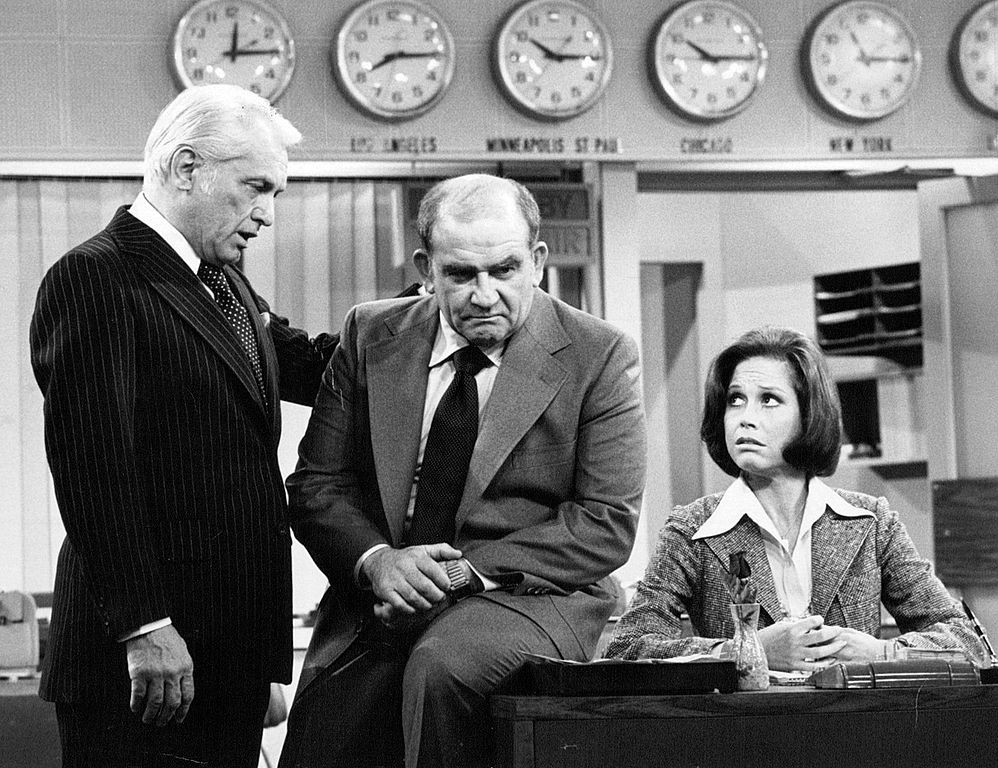
Lou Grant [played by Ed Asner]: “It's not that I don't have a good time at your parties, Mary. I've had some of the worst times in my life. Agony.”—The Mary Tyler Moore Show, Season 4, Episode 10, “The Dinner Party,” original air date November 17, 1973, teleplay by Ed. Weinberger, directed by Jay Sandrich

This particular party must have been pretty bad. Even Ted Baxter (played by Ted Knight) is consoling Lou!

Monday, September 19, 2022

TV Quote of the Day (‘The Mary Tyler Moore Show,’ on a Disastrous Combo of News Footage and Ted Baxter)

Lou Grant [played by Ed Asner]: “Explain to me why, while I was hearing Ted's voice describing the arrival of the new water buffalo at the Minneapolis zoo, I was watching film of the vice president returning from his trip, and Ted's voice saying, ‘And here's the big ox now, lumbering down the ramp with his handler.’” —The Mary Tyler Moore Show, Season 3, Episode 13, “Operation: Lou,” original air date Dec. 9, 1972, teleplay by Elias Davis and David Pollock, directed by Jay Sandrich

Saturday, September 19, 2020

This Day in TV History (‘The Mary Tyler Moore Show,’ Standard-Setting Workplace Comedy, Premieres)

Sept. 19, 1970—Premiering on CBS, The Mary Tyler Moore Show not only provided its titular star with an even longer-running series than the one that propelled her to star, The Dick Van Dyke Show, but also set new standards for adult, character-driven situation comedy.

I posted previously on the 75th birthday on the luminous Mary Tyler Moore and how she created an immensely appealing role model for the millions of “character women” thronging the American workplace as a result of the women’s liberation movement of the late 1960s

But one aspect of her career that deserves further exploration here is her generosity in ceding significant air time to fellow cast members—and her shrewdness in understanding that the sitcom’s success could be sustained through this attention to others, even to the point of allowing them to have many of the funniest lines in episodes.

For Mary Richards, a heartbroken runaway from a broken relationship, the workplace becomes a new form of family. By necessity, the show’s scripts needed to bring out the fun and caring of these new people in her new life in Minnesota.

Far more than The Dick Van Dyke Show, then, The Mary Tyler Moore Show would depend on its ensemble cast—wider, deeper, wringing laughter more from the nuances of character than from the laugh-a-minute pace of prior comedies.

The series was as strong on its last night on the air in 1977 as its first. For that, series creators James L. Brooks and Allan Burns required sturdy script architecture rather than interior decorating—multiple quirky but realistic characters that opened up near-endless comic possibilities, while taking the burden off the group’s first among equals, Ms. Moore. 

As I mentioned in a prior post, the two were delving more deeply into a dynamic they had touched on the year before with their ABC dramedy Room 222: a middle manager who functioned as the calm eye in a storm--in this case, a fast-paced newsroom.

Amazingly, The Mary Tyler Moore Show would manage to survive the departure of significant characters like Rhoda Morgenstern and Phyllis Lindstrom (each getting a spinoff series) while slotting in others that took up the slack—notably, daffy Georgette Franklin Baxter and “Happy Homemaker” Sue Ann Nivens.

Moore and husband Grant Tinker, the co-head of their production company, MTM Enterprises, had received a commitment for 13 episodes from CBS, giving them four months to cast the show—an unusually long time. Ultimately, they would need every bit of it.

The best explanations for the course of this casting can be found in two interviews conducted by the Archive of American Television with Allan Burns and Mary Tyler Moore.

Gavin MacLeod was the first of the supporting players to be cast. Though called in to try out for the role of gruff Lou Grant, he asked if he could take a shot at Murray Slaughter. While Brooks and Burns had envisioned Murray as a comic nemesis for Mary Richards—something like a pesky mosquito, irritating her in close proximity from the adjacent newsroom desk—MacLeod’s warm conception led them to rethink Murray as an ally for Mary. 

Brooks and Burns were similarly unexpectedly impressed by Cloris Leachman as intrusive neighbor Phyllis, and quickly cast her, too.

Then, the show entered a prolonged casting void, as Brooks, Burns, Moore and Tinker tried to achieve the right alchemy of actor and character.

Silver-haired Ted Knight was different from the tall, dark and handsome anchorman—and possible Mary love interest—Ted Baxter was expected to be. But a terrific nightclub appearance by Knight led them to rethink him. (Two L.A. newscasters, George Putnam and Jerry Dunphy, along with actor Jack Cassidy, are believed to have inspired the creation of the buffoonish Baxter.)

Ed Asner was masterful in his initial audition as Mary’s bearish but lovable boss Lou Grant. But, when he performed with Ms. Moore, the magic of that earlier effort mysteriously vanished. But, just before he left, he also to try it again. This time, according to Ms. Moore, he pulled “gold from his pocket.”

Much like Ms. Moore’s casting on The Dick Van Dyke Show, Valerie Harper came aboard at the last minute. In certain ways, it was the trickiest character to deal with. Ms. Harper recalled that reading as “the easiest, most pleasant audition process I ever went through,” but the initial studio audience reaction to her brash, bandana-wearing Rhoda Morgenstern was frosty. 

It required an astute adjustment of dialogue to turn that around. Instead of leaving the audience simply with Phyllis’ characterization of “that dumb awful woman that lives upstairs,” they included the assessment of Phyllis’ precocious daughter Bess that “Aunt Rhoda's really a lot of fun--Mom hates her,” thereby considering softening perceptions of the woman contesting Mary’s right to the apartment who will eventually become her dearest friend.

The influence of The Mary Tyler Moore Show can be seen in such later ensemble sitcoms as Cheers, 30 Rock, Friends, Murphy Brown, and The Office, as well as other critically acclaimed but now less well-remembered Eighties shows as Blair Brown’s The Days and Nights of Molly Brown and Geena Davis’ Sara. But it was difficult for any of these latter series to match the intricate craftsmanship of the original, and impossible to match its warmth.

Moore, Tinker, Burns and Brooks fashioned something miraculous: not merely brilliant writing, but actors who performed with consistent professionalism and ease with each other. For all the wit of the dialogue, the appropriate enduring impression of the final episode is of a group hug among perhaps the finest ensemble in sitcom history.  

Thursday, December 16, 2010

This Day in TV History (“One Day at a Time” Debuts)


December 16, 1975--Critics and fans were quick to note that the sitcom One Day at a Time, which premiered on this date on CBS, was produced by Norman Lear, already known for such boundary-pushing series as All in the Family, The Jeffersons, Good Times, Maude and Sanford and Son. But few viewers of the series starring Bonnie Franklin, Mackenzie Phillips and Valerie Bertinelli took notice of the opening credits, which revealed that the series had been created by writer Allan Manings and actress Whitney Blake.


It’s hardly surprising that Manings’ contribution was overlooked. As Joe Gillis, William Holden’s cynical screenwriter in Sunset Boulevard, notes, “Audiences don't know somebody sits down and writes a picture. They think the actors make it up as they go along.” But the lack of notice for Blake was another matter entirely. Amazingly enough, in a reunion 30 of the show’s stars on The Today Show 30 years later, Phillips, Bertinelli and co-star Pat Harrington still had no idea about the nature of her contribution.

Only a decade before the show's debut, Blake had concluded a five-year run in a sitcom herself: Hazel, starring the Oscar-winning character actress Shirley Booth as a maid. Maybe because she played second banana to Booth, Blake did not make the same kind of impression that other actresses of the time, such as Barbara Billingsley, Donna Reed or Jane Wyatt, did as TV moms.


If viewers were to recall Blake at all by 1975, it might have been because her blond good looks had been inherited by daughter Meredith Baxter, then not far into a long TV career of her own. By this time in her late 40s--an age that, at that point (and even, to a somewhat lesser extent, now) was regarded as a danger zone for leading ladies--Blake was running the danger of disappearing into the rabbit hole of TV memory.


But if Blake had barely registered as a TV mom herself, she made sure that she’d create a truly memorable one secondhand. It was Blake’s memories of raising Baxter and her siblings as a single mom that Manings, her third husband, channeled into the creation of Franklin’s character, Ann Romano.


Ann Romano might, in a way, be regarded as the missing link between The Mary Tyler Moore Show and The Gilmore Girls. Allow me to explain.


Think of the situation common to MTM and ODAAT: A young woman, fresh from a busted-up relationship, relocates to a Midwestern city, where she hopes to start over and wash that man right out of her hair.


Actually, if Ms. Moore and her husband of the time, producer Grant Tinker, had had their way, there would have been an even larger similarity: Mary Richards would have been a divorcee, too.


But the Tiffany Network would have none of it. Not only were such characters practically invisible at the time (these didn’t get past the programming censors), but the network had a more prosaic concern: they were so afraid that Ms. Moore would be so associated with her previous great role as Laura Petrie that audiences would think she had run out on Dick Van Dyke!

Five years later, due in no small part to Lear, all the old taboos were gone--and Bonnie Franklin, better known for roles on the stage (notably Applause, the musical version of All About Eve), was far more of a blank slate than Moore. The top brass at CBS, then, were far more ready for an idea about a divorced mom struggling to make ends meet in Indianapolis with her teenage daughters. Blake and Manings brought the idea to Lear, who developed it further.

One Day at a Time went on to run for nine years and 209 episodes. Some of its DNA ended up encoded in the likes of Kate and Allie, The New Adventures of Old Christine, and The Gilmore Girls. (The latter show also featured an actress, Lauren Graham, who, like Franklin, was only in her early 30s when the show premiered--not much older than the actress(es) who played her daughter(s).)

The Gilmore Girls had one less daughter than One Day at a Time, but somehow the estrogen level seemed more amped up. True, Lorelai Gilmore had her diner love interest, Luke, but there’s a Sensitive New Age Guy lurking beneath his blue baseball hat (tipped off by the fact that he cooks but Lorelai doesn’t, which allows him to criticize her unhealthy eating habits).

“Sensitive” is not the word that comes to mind about Dwayne Schneider, the building superintendent played to perfection by Pat Harrington. With his moustache constantly twitching expectantly in the hope that Ann Romano would respond to his flirtatious hints, his cigarette dangling from his lip and his tool-belt hanging from his waist like a gun holster, the character became “the Burt Reynolds of the Boiler Room.”