And we've been poisoned by these fairy tales.”—“The End of the Innocence” (1989), written by Don Henley and Bruce Hornsby, performed by Henley from his CD of the same name
Saturday, April 11, 2026
Song Lyric of the Day (Don Henley, on ‘Armchair Warriors’)
And we've been poisoned by these fairy tales.”—“The End of the Innocence” (1989), written by Don Henley and Bruce Hornsby, performed by Henley from his CD of the same name
Wednesday, April 8, 2026
Song Lyric of the Day (The Grateful Dead, on ‘Easy Street’)
“When life looks like Easy Street, there is danger at your door.”—American rock ‘n’ roll singer-songwriters Robert Hunter (1941-2019) and Jerry Garcia (1942-1995), “Uncle John’s Band,” performed by the Grateful Dead on their Workingman's Dead LP (1970)
A thought that applies just as much to nations as to
individuals.
Tuesday, March 11, 2025
Quote of the Day (Lauren Groff, on Indie Rocker Florence Welch)
“[English singer-songwriter Florence] Welch [of Florence and the Machine] ran up from her garden a creature of flesh and blood, wearing a prim prairie dress with flowers speckled all over it. She is tall — somewhere near 5-foot-10 — ardent and elegant, with long red Pre-Raphaelite hair and the strong-boned face of a medieval saint. She has an incredible vigor to her speech, which is frequently crowded with images. She was talking even before coming into the room and spoke nonstop for hours, thoughtfully, in loops and circuits; I only interjected a few times. With other people, being monologued at like this might have been hellish, but Welch was a little goofy, quite funny — her laugh is deep, sudden, frequent and startlingly loud. On multiple occasions during our hours together, she paced in excitement. Once she sped off upstairs to fetch something, coming down the staircase with such fast footsteps that I was briefly afraid she’d tumble the rest of the way.”— American novelist and short story writer Lauren Groff, “Florence!”, T (The New York Times Style Magazine), Oct. 20, 2024
The image
accompanying this post, of Florence Welch fronting Florence and the Machine,
was taken Apr. 18, 2009, by Juan Bendana.
Thursday, March 28, 2024
Quote of the Day (Pete Townshend, on the Ultimate Optimism of ‘Tommy’)
“I don’t want it to feel as though I think ‘Tommy’ needs to be treated only seriously. It has lightheartedness and joy. It has the idea that whether you’re an abused child or a healthy child, we prevail ultimately, by turning toward the light. That’s simplistic but it’s also powerful, particularly when set to music.”—Rock ‘n’ roll songwriter and The Who guitarist Pete Townshend, on the upcoming revival of his “rock opera” “Tommy,” quoted by Rob Tannenbaum, “Talking to a New Generation,” The New York Times, Mar. 24, 2024
It will be interesting to see the reviews following “Tommy”’s opening tonight at the Nederlander Theatre. But, however it’s received, the music’s place in rock ‘n’ roll history is secure.
The original LP’s release in 1969 climaxed a decade of increasing ambition and sophistication for rock ‘n’ roll, and pointed the way forward to how the concept album could become, as a November 2020 Spin Magazine article put it, “the first album to successfully blend exceptional storytelling with advanced production.”
Moreover, it was
prescient in examining the cult of celebrity, and spiritual striving in an age
of cultural fracture.
Sunday, March 3, 2024
Spiritual Quote of the Day (Bruce Springsteen, on Flannery O'Connor and ‘The Intangible Mysteries of Life’)
“[T]he short stories of Flannery O'Connor landed hard on me. You could feel within them the unknowability of God, the intangible mysteries of life that confounded her characters, and which I find by my side every day. They contained the dark Gothicness of my childhood and yet made me feel fortunate to sit at the center of this swirling black puzzle, stars reeling overhead, the earth barely beneath us.”—American rock ‘n’ roll legend Bruce Springsteen, “By the Book: Bruce Springsteen,” The New York Times Book Review, Nov. 2, 2014
Wednesday, January 17, 2024
This Day in Rock ‘n’ Roll History (Joni Mitchell Hits Commercial Peak With ‘Court and Spark’)
Jan. 17, 1974— Many fans of Joni Mitchell who knew her best as a folk music artist must have heard her sixth studio album, Court and Spark, with some astonishment.
The prior year had passed without the release of a
Mitchell LP, the first time this had happened since the start of her recording
career. It was not a vacation, nor even an emotional withdrawal and regrouping after
crushing end of a love affair, as had happened before For the Roses.
Instead, she took to trying out new sounds, and
testing which musicians could help her achieve these looser, breezier rhythms. Even
many of the Southern California rock musicians that Mitchell had befriended had
trouble with concepts that sounded too abstract to them.
The turning point came when session musician Russ
Kunkel suggested she find a jazz drummer. She found not only a jazz drummer,
but an entire ensemble: Tom Scott’s L.A. Express, whose musicians played on the
entire album.
The extended studio recording sessions turned out to
be time well-spent. The first single from Court and Spark, “Raised on
Robbery” (maybe my favorite song from the LP), benefited from the horns from LA
Express and Robbie Robertson’s lead guitar licks complementing Mitchell’s
breathless, saucy vocals.
But it was the follow-up, “Help Me,” which became the
only record by the Canadian-born singer-songwriter to crack the Billboard “Hot
100,” peaking at #7 and helping the LP achieve platinum status.
Well, you can’t have everything. One thing Mitchell could have used a bit more of was recognition from the recording industry as a whole.
But Court and Spark won only one Grammy out of four nominations: Best
Arrangement Accompanying Vocalist(s), for “Down to You” (given to Mitchell and
Tom Scott), losing out to Olivia Newton-John for Record of the Year and Best Female
Pop Vocal Performance and to Stevie Wonder for Album of the Year.
Much too much ink was spilled in the Seventies on
Mitchell’s love life, including in relation to Court and Spark. At a
half-century remove, it all feels stale and beside the point.
What matters now—and it should have then—was not her
romantic, but her creative, restlessness.
Critics who charged Mitchell with being merely
autobiographical and self-absorbed now had to reckon with a lyricist whose
powers of observation were never more apparent, fully a match for the
watercolor “The Mountain Loves the Sea” that this former art student used for
the cover of her latest album.
Readers may point to other examples on the album of
her growing tendency to look outward, but these are mine:
· * “Raised on Robbery,” inspired by Mitchell
witnessing a hooker attempting to pick up a man in a Toronto hotel bar who’s
more focused on a hockey game;
· * “Free Man in Paris,” informed by Mitchell’s
trip to Paris, watching then-boss David Geffen of Electra-Asylum Records
seeking a short respite from his normal round of “dreamers and telephone
screamers”; and
· * “People’s Parties,” in which the
singer-songwriter evoked compassion for the kind of people she met at Southern
Cal social gatherings who, though seemingly possessing “a lot of style,” are desperately
hiding their insecurities, including the “photo beauty” who all of a sudden is “crying
on someone’s knee.”
Equally remarkable were arrangements that didn’t make
the final cut for Court and Spark. One track I have in mind is this
extraordinary, extended “Piano Suite” of “Down to You / Court and Spark /Car on a Hill,” which Mitchell finally released on Archives Vol. 3: The
Asylum Years, 1972-1975, this past fall.
In a few years, Bob Dylan would evoke those cursed “to
know and feel too much within,” a group that certainly included Mitchell. An
eighth grader when Court and Spark was released, I read its printed
lyrics without grasping the struggle it took to put them to paper, or to sing
them before thousands.
I was even less able to comprehend her album-to-album
evolution, the complex chords she wove around her delicate, intricate lyrics,
or the dizzying variety in tones displayed in this career pinnacle. All of that could only come from a musician who, though analytical and introspective, also delighted in fun and collaboration.
But somehow, I still managed to absorb enough of what
she was trying to convey to know Mitchell was something special.
Within only a couple of years, Mitchell had become so
enamored of jazz arrangements that, with Mingus (named for the jazz
innovator with whom she collaborated before his death from cancer), she had
more or less left folk and rock—really, the pop mainstream of the time.
As with another contemporary idiosyncratic female
singer-songwriter, Laura Nyro, radio stations were not ready to give Mitchell much
airtime for such jazz experimentation.
Mitchell didn’t care; she was impervious to the moans
of record-company execs for more commercial fare, or record buyers who kept
yelling in concert for past hits. As she told Cameron Crowe in a 1979 Rolling
Stone interview:
“You have two options. You can stay the same and
protect the formula that gave you your initial success. They’re going to
crucify you for staying the same. If you change, they’re going to crucify you
for changing. But staying the same is boring. And change is interesting. So of
the two options, I’d rather be crucified for changing.”
Saturday, July 29, 2023
Quote of the Day (Patti Smith, on Mesmerizing Musician Tom Verlaine)
“I went to see Television whenever they played, mostly to see Tom [Verlaine], with his pale blue eyes and swanlike neck. He bowed his head, gripping his Jazzmaster, releasing billowing clouds, strange alleyways populated with tiny men, a murder of crows, and the cries of bluebirds rushing through a replica of space. All transmuted through his long fingers, all but strangling the neck of his guitar.”—American singer-songwriter and memoirist Patti Smith, on guitarist, songwriter, and Television frontman Tom Verlaine (1949-2023), in “Postscript: Tom Verlaine,” The New Yorker, Feb. 13 and 20, 2023
I never followed Tom Verlaine’s music, whether as part of Television in the Seventies or as a solo artist in the Eighties, so I didn’t take much notice of his death this January.
But I was instantly
struck by Patti Smith’s extraordinarily vivid description of her lover from their
punk-rock days, and wanted to share with readers how she elevated this
mini-portrait to high art.
(The image accompanying
this post, a 1977 publicity photo of Tom Verlaine promoting Television's debut
album, Marquee Moon, on Elektra Records, was taken by Roberta Bayley and
distributed by Elektra Records, then scanned by Yahoo Japan Auctions.)
Wednesday, November 16, 2022
Quote of the Day (Ray Davies, on Bands’ Creativity, Adrenaline and Downtimes)
“When ‘You Really Got Me’ dropped out of the Top 10, my record company said, ‘We need a follow-up.’ I wrote ‘All Day and All of the Night’ in a few minutes, and we recorded it in a day. Bands go through an adrenaline period where they have hits for a year or two, and then they have to assess things. It’s important to do that in any form of creativity. The secret is to know there’s going to be downtimes where you need to re-energize and refocus.”—English rock ‘n’ roll singer-songwriter and Kinks frontman Ray Davies, interviewed by Andy Greene, in “The Last Word: Ray Davies,” Rolling Stone, Apr. 6, 2017
Tuesday, August 9, 2022
Quote of the Day (Tom Petty, on Cowboys, Elvis and Guitars)
“I had always thought guitars were cool because of cowboys. Cowboys played guitars. And Elvis [Presley] played guitar, so I just thought, ‘Hell, I'm gonna need one of those.’ It wouldn't be until a few years later, I guess with the Beatles coming, [that] I really got serious about learning.”—American rock ‘n’ roll singer-songwriter Tom Petty (1950-2017), on what he thought when his parents got him his first guitar, quoted in Melinda Newman, “Tom Petty: A Portrait Of the Artist,” Billboard, December 3, 2005
Saturday, May 28, 2022
Quote of the Day (Ray Davies, on Rock ‘n’ Roll in a ‘Gone to the Catskills' Transition)
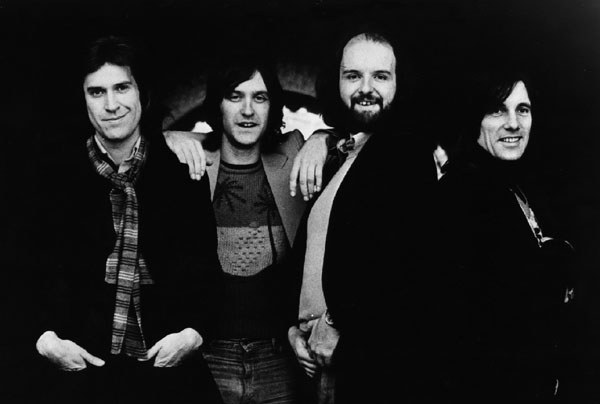
“A certain element of rock is over, but I don’t think it’ll ever be dead. As long as there’s a kid on the street with a guitar who wants to make a noise, rock will be alive somewhere. Stadium rock, yes, I think that is over. Rock and roll’s going to a period of transition. It’s just gone to the Catskills. It’ll come back.” —English rock ‘n’ roll singer-songwriter Ray Davies (pictured here at left, with his former—maybe future?—band, The Kinks), interviewed by Andy Greene, in “The Last Word: Ray Davies,” Rolling Stone, Apr. 6, 2017
The Catskills...Hmmm...If
what Davies has in mind is East Durham, then rock 'n' roll's in quite a
"period of transition"—and may emerge with an Irish brogue!
Wednesday, November 17, 2021
Quote of the Day (Pete Townshend, on What Rock ‘n’ Roll ‘Failed to Finish’)
“Rock ’n’ roll was a celebration of congregation. A celebration of irresponsibility. But we don’t have the brains to answer the question of what it was that rock ’n’ roll tried to start and has failed to finish. Neither do our journalistic colleagues, no matter how smart they think they are…That postwar vacuum that we tried to fill — we did fill it for a while, but then we realized it was fizzling out. The art proposed the questions without offering solutions. So what the Who are doing at the moment — we’ve made a good album [WHO]. I hope it’ll do O.K. I don’t need it. Nobody needs it. Some of the subjects of the songs are quite deep, but they’re not as brave as ‘Won’t Get Fooled Again,’ which is saying: ‘[Expletive] off. I’m going to solve this problem with my guitar and my singer with long, golden hair and a big [expletive].’”—Rock ‘n’ roll guitarist and singer—songwriter Pete Townshend, quoted in David Marchese, “Talk: The Who’s Pete Townshend Grapples With Rock’s Legacy, and His Own Dark Past,” The New York Times Magazine, Dec. 1, 2019
This quote is interesting in itself, but it’s also a
good way for me to touch on, briefly, what I should have mentioned already
earlier this year: the 50th anniversary of the band’s masterful album,
Who’s Next.
In this link, blogger Bobby Owsinski— producer/engineer,
author and coach—posts about a video of producer/engineer Glyn Johns talking
about the recording of that LP.
Monday, August 9, 2021
Quote of the Day (Alice Cooper, on a Beatles Classic)
“Every moment of this song is pure Beatles. It’s absolutely, mathematically perfect. I’m pretty sure they were aliens.”—Rock ‘n’ roller Alice Cooper, on the Beatles’ hit “You Won’t See Me,” quoted in “The Playlist—Guest List: Alice Cooper,” Rolling Stone, Feb. 13, 2014
I agree with this observation 100%. Well, maybe except
for that last part about the aliens…
Saturday, August 7, 2021
Quote of the Day (Poet Dana Gioia, on a Beach Boys Song for ‘Every Lovesick Summer’)
And this one I pretended to despise,
But if I was alone when it came on,
I turned it up full-blast to sing along –
A primal scream in croaky baritone,
The notes all flat, the lyrics mostly slurred.
No wonder I spent so much time alone
Making the rounds in Dad's old Thunderbird.”—American poet-critic Dana Gioia, “Cruising With the Beach Boys," from 99 Poems: New and Selected (2016)
Saturday, March 27, 2021
Quote of the Day (Chrissie Hynde, on Hippies vs. Punks)
“[Punks] didn’t like hippies, because their parents were hippies. I was in the States during the hippie era and in England during the punk era. They were both anti-establishment—that’s what they had in common. But the hippies were smoking pot, which makes you complacent, and the complacency wasn’t what punk was about—it was about action.”—Singer-songwriter—and Pretenders leader—Chrissie Hynde quoted in Rob Tannenbaum, “Q and A: Chrissie Hynde,” Rolling Stone, June 19, 2014
(The image accompanying this post, showing Chrissie
Hynde in concert, was taken Aug. 10, 2007 in Santa Barbara, CA by John
Slonaker.)
Saturday, March 6, 2021
Quote of the Day (Cameron Crowe, on Meeting Lou Reed on His First Night in NYC)
“In 1973 I got an assignment from Rolling Stone to cover Todd Rundgren, and was flown to New York City. On the first night there, a publicist for RCA Records offered to take me to Max’s Kansas City. And it was like a dream straight out of Creem Magazine—Lou Reed was sitting there. I was probably a little too eager to meet Lou, and my friend the publicist informed him that I had written the current Rolling Stone cover story on Jackson Browne. ‘Did you read it?’ the publicist asked. Lou indicated that he had, and that he was deeply unimpressed both by the article and the whole exercise of having to meet me. I believe I mentioned I was also an acquaintance of [critic] Lester Bangs—which might have put a crease or two in the proceedings. I remember leaving, and the publicist said, ‘You didn’t meet Lou on a good night, but you’ll always be able to say that on your first night in New York you met Lou Reed.’”—Former teenage rock journalist—and future Oscar-winning screenwriter-director—Cameron Crowe, quoted in “Behind the Red Rope,” Classic Rock Magazine, February 2006
(Photograph of Lou Reed taken in Malaga, Spain, in
July 2008, by Marcelo Costa.)
Wednesday, January 13, 2021
Song Lyric of the Day (Tom Petty, on Being ‘Far Away From Your Trouble and Worries’)
You belong somewhere you feel free.”—American rock ‘n’ roll singer-songwriter Tom Petty (1950-2017), title cut of his CD Wildflowers (1994)
Sunday, November 29, 2020
Spiritual Quote of the Day (Bob Dylan, on How the Gospel ‘Can Give You Courage’)
“[G]ospel news is exemplary. It can give you courage. You can pace your life accordingly, or try to, anyway. And you can do it with honor and principles. There are theories of truth in gospel but to most people it’s unimportant. Their lives are lived out too fast. Too many bad influences. Sex and politics and murder is the way to go if you want to get people’s attention. It excites us, that’s our problem.”—American singer-songwriter—and Nobel Literature laureate—Bob Dylan quoted in Douglas Brinkley, “Still Painting His Masterpieces,” The New York Times, June 14, 2020
Thursday, November 12, 2020
Quote of the Day (Neil Young, on His Songwriting Process)
“My songwriting process has never changed. I never try to write. I know when it’s there. I hear a bell ringing in my head and I just leave . . . but I don’t try. Sometimes three months can go by...”—Canadian-American rock ‘n’ roll singer-songwriter Neil Young quoted in Cameron Crowe, “Neil Young: The Last American Hero,” Rolling Stone, Feb. 8, 1979
Neil Young
was born 75 years ago today in Toronto, Canada. Unlike one of his better-known
lyrics, he has neither burnt out nor faded away.
That does not mean that, in his creative restlessness,
he hasn’t unsettled either bandmates or audiences. After all, this is the
musician who, after the enormous success of his Harvest LP in 1972, would
later feel compelled to write: “ ‘Heart of Gold’ put me in the middle of the
road. Traveling there soon became a bore so I headed for the ditch. A rougher
ride, but I saw more interesting people there.”
(For an interesting take on the resulting “Ditch
Trilogy” of albums, see this fine February 2018 post on the blog for Pandora from Eric Shea.)
You can often guess at how well a singer-songwriter’s
popularity will endure by the number of other artists who have covered his
songs. In this regard, Young stands among the best, with Johnny Cash, Patti
Smith, Smashing Pumpkins, Pearl Jam, Roxy Music, The Pretenders, Boz Scaggs, The
Everly Brothers, Gillian Welch, Linda Ronstadt, Emmylou Harris, Nicolette
Larson, Radiohead, and Bob Dylan all
performing his work.
Through it all, he remains uncompromising and
indomitable. Long may he run!
(Photo of Neil Young taken in concert Nov. 9, 1976, in
Austin, Texas, by Mark Estabrook.)
Tuesday, September 22, 2020
Song Lyric of the Day (Neil Young, on ‘Mother Nature on the Run’)
That was floating on the breeze
Look at Mother Nature on the run
In the 1970s.”—Neil Young, “After the Gold Rush,” from his LP of the same name (1970)
This week marks the 50th anniversary of the release of Neil Young’s third solo album—one that many observers see as the best of his career. The most enigmatic of its 11 songs might be the title tune.
This was supposed to be part of a soundtrack Young hoped to compose for an aborted project by actor Dean Stockwell about a tidal wave sweeping over Southern California. Linda Ronstadt (who later covered it, with Dolly Parton and Emmylou Harris, on their “Trio” CD) recalled, “I would listen to Neil singing that all the time on the road. I would think, ‘This is the future.’”
Certainly, that line
about “Mother Nature on the run” feels less like trippy vision than reality in
2020.
Thursday, September 17, 2020
Song Lyric of the Day (Lou Reed, on ‘Anyone Who's Ever Played a Part’)
Oh, they wouldn't turn around and break it
And anyone who's ever played a part
Oh, they wouldn't turn around and hate it.”—“Sweet Jane,” performed by the Velvet Underground, from their LP Loaded (1970), lyrics and music by Lou Reed (1942-2013)


