Showing posts with label Marilyn Monroe. Show all posts

Saturday, October 10, 2015

Quote of the Day (Raymond Chandler, on What He Had in Common With Marilyn Monroe)


“Marilyn Monroe and I were the only ones that made all three brows.”— Mystery writer Raymond Chandler, on a 1955 Daily Express survey of readers’ favorite lowbrow, middlebrow and highbrow celebrities, quoted in Frank MacShane, The Life of Raymond Chandler (1976)

Sunday, August 5, 2012

Bonus Quote of the Day (Arthur Gelb, on Monroe’s Dizzying Walk)


“When she walked, it was as though she had a hundred body parts that moved separately in different directions. I mean, you didn’t know what body part to follow.”—Former New  York Times managing editor Arthur Gelb, quoted in Maureen Dowd, “The Love Goddess Who Keeps Right on Seducing,” The New York Times, August 5, 2012

A half-century to the day that she died, Marilyn Monroe remains an object of fascination, in a way that others who have died younger (such as Jean Harlow, a full decade younger than Monroe at the time of her death) have not. Gelb (who cops to making, and following through on, a boorish, drunken bet that he could touch the star’s “flawless porcelain back” at Sardi’s) has put his finger on one element, her overpowering sexuality. (Billy Wilder also captured that walk in her memorable introduction in Some Like It Hot—a movement so astonishing it leads Jack Lemmon’s cross-dressing, mob-dodging musician to gasp that it’s “like jello on springs”).

She was the ultimate woman who makes guys act endlessly stupid just by her sheer presence.

But only part of the fascination owes to her raw physical appeal.  Much of the  continued interest relate to her vulnerability, the lingering questions of Kennedy involvement in her last desperate days, and her attempt to break out of the image that she herself had so adeptly created.

Goodbye, Norma Jean. It’ll be a long time—if ever—before we see your like again.

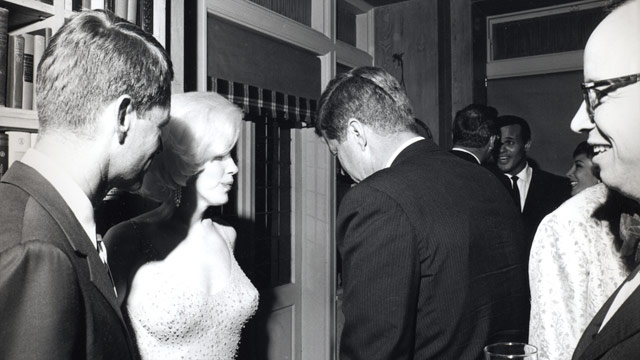
(Photograph of Monroe in her famous dress-with Jack and Bobby Kennedy and Arthur Schlesinger Jr., , on the occasion of the President’s 45th birthday party celebration in New York’s Madison Square Garden, in 1962 —by Cecil W. Stoughton, official White House photographer.)

Sunday, August 28, 2011

Flashback, August 1956: “Prince” Party Marks Apex of Olivier, Rattigan

Terence Rattigan loved the good life, and he proceeded to celebrate it again with a grand soiree at his country estate in Sunnydale, England, close to where his screenplay for The Prince and the Showgirl was being filmed. Anyone seeing the host—not only the creator of hits on Broadway and the West End, but also reputedly the highest-paid screenwriter in the world—together with the male star of the movie, Laurence Olivier, could be forgiven for thinking they were on top of the world.

But already, both men sensed that, beneath the placid surface of their lives, dangers lurked, and that they would never have it so good again. Their problems involved two women—both connected to this particular film property—and an up-and-coming playwright-screenwriter.

Two Women--Both Trouble

One of the two women was Olivier’s wife, actress Vivien Leigh, who had originated the role of “the showgirl” in the original stage version of the film (then titled The Sleeping Prince). The play, Rattigan didn’t mind admitting, was a trifle, a confection whipped up the year that Elizabeth II was crowned queen, when the whole island was even more absorbed in all things royal than ever before.

British critics and audiences weren’t exactly wild about it, either, leading Rattigan’s good friend Noel Coward to offer some tongue-in-cheek consolation: ““Don’t worry, Terence. I not only f--- up some of my plays by writing them, but I frequently f--- them up by acting in them as well.”

Rattigan, then, was thrilled when this unlikely property drew interest from an even more unlikely source: Marilyn Monroe, whose ambition was to act in a film with Olivier.

At first, Olivier was thrilled about working with Monroe, too. Upon first meeting her, he wrote about how he would break the news to Leigh if he went ahead with his idle fantasy of an affair with the blonde bombshell. He thought she was sweet, enchanting. But not for long.

You have to love the accompanying photo of Monroe surrounded by Olivier and Leigh. First of all, it is so staged. You can tell that the three principals--all acutely aware of how they looked on camera--must have sensed how this shot would look like once it was snapped. But more important, as consummate actors, they’re expressing an affection for each other that they didn’t feel in life, except maybe fleetingly.

Within only a week or two, the actor-knight was fuming over the actress’ chronic tardiness, her inability to get through scenes quickly, and the excessive influence of her adviser Paula Strasberg, wife of Actors’ Studio coach Lee Strasberg. For her part, Monroe suspected—probably correctly—that her director-star wanted her in this role less for her acting skills than her proven box-office ability.

Soaking all this up, with some humor but also with an insecurity to match Monroe’s own, was Leigh. It would have been out of the question for the Oscar-winning star of Gone With the Wind and A Streetcar Named Desire to repeat her stage performance on screen. While the fortysomething Leigh could have gotten away with being a showgirl onstage, the big screen, with its often giant, pitiless closeups, would have exposed the evidence of the years starting to show on her still-beautiful face.

Early in the filming, then, when Leigh inquired of Olivier’s assistant Colin Clark how the movie was progressing, she smiled, with a touch of minx, when he told her that it really wasn’t going well at all.

Olivier must not have believed his horrible fortune. If he had thought he was getting a respite from one mentally unstable woman--his wife (more on this in a minute)--he was badly mistaken. A quarter-century later, in his memoir Confessions of an Actor, he acknowledged that, when all was said and done, Monroe had given “a star performance,” observing particularly that “no one had such a look of hurt innocence or of unconscious wisdom.”

Middle-Aged Angst

Even that recollection, however, was tinged with lingering difficult memories of the filming, as well as what was occurring in his personal life. “I was fifty. What a happy memory it would have been if Marilyn had made me feel twenty years younger--but I was upset by her insolence, which showed my age, I suppose….Maybe I was tetchy with Marilyn and with myself, because my career was in a rut.”

Even though Monroe, like Olivier, showed up at Rattigan’s party, the soiree gave the director a few hours to forget about his middle-aged angst. Rattigan, too, was able to forget momentarily the sense that his own career and life had slipped out of gear and he might not be able to get back on track.

Ever since the spring, when John Osborne’s Look Back in Anger had electrified the London theater world, Rattigan had worriedly taken in the critical hosannas that erupted over this drama of working-class alienation and towering fury, realizing that his own brand of theater--in which somewhat more genteel characters struggle against misfortune and shame with barely repressed despair--was no longer in favor. He feared, with reason, that his heyday was over.

Coward, a mutual friend of Rattigan and the Oliviers, felt the same fears about his future place in the British theater that afflicted his playwright confidante. But at least in early summer, Coward thought he could stave off public disaffection for awhile with a box-office success: Ms. Leigh in his new play, South Sea Bubble.

“Filled With Forebodings”

Coward’s confidence evaporated when Leigh announced to the press on July 12 that she was expecting a child by Christmas. While cabling his congratulations to her and Olivier, the playwright confided to his diary his considerable annoyance about replacing his star --and his enormously perceptive take on what the pregnancy might mean for her:

“I also think, from Vivien’s point of view, that it is a highly perilous enterprise. If anything goes wrong it will very possibly send her around the bend again; she is over forty, very, very small, and none too well balanced mentally. I am filled with forebodings and a curious sense of having been let down.”

Coward was right to feel unease. He had been privy to much of the couple’s agony earlier in the decade, as, during a U.S. appearance in the “two Cleos” (Shakespeare’s Antony and Cleopatra and George Bernard Shaw’s Caesar and Cleopatra), Leigh began to show stronger and more frequent symptoms of manic depression. A further strain had developed between husband and wife over her affair with co-star Peter Finch on the set of the 1954 film Elephant Walk. Her nervous breakdown on location required that she be replaced by Elizabeth Taylor.

At this point, another consideration comes into play: Was Leigh really pregnant? The possibility that she might not have been was raised by Donald Spoto in his 1992 biography of Olivier:

“Still slim, no one could have guessed that she was four months pregnant, and no medical records confirming her testimony have been uncovered. In view of Marilyn Monroe’s imminent arrival and assumption of Vivien’s role, there was widespread speculation that the pregnancy was a deception designed by Vivien to maintain a hold on Olivier’s attention.”

But Spoto’s footnotes on this reveal no sources about any of this. In contrast, in his biography of Olivier, Terry Coleman includes the testimony of Olivier’s sister-in-law Hester Ives St. John, who vividly recalled the devastating denouement: a middle-of-the-night call from Leigh’s GP to a gynecologist, who, after examining the star, said: “I’m sorry, we couldn’t save it. It was a girl.”

Curtains on One Marriage and Three Lives

Leigh was devastated by the miscarriage. By Christmastime, instead of celebrating the birth of the first child of their 16-year union, she and Olivier were quarreling. Matters worsened during Olivier’s appearance in Osborne’s The Entertainer, when the actor, already so worn by his demanding role as has-been vaudevillian Archie Rice that he needed rejuvenation injections, was subjected to humiliating fights in front of cast and crew by Leigh.


By 1958, after Olivier had begun an affair with Joan Plowright, who played his daughter in Osborne’s drama, the marriage of Britain’s most famous theatrical couple existed in name only.

Olivier divorced Leigh and married Plowright in 1960. Marriage to the younger woman gave him the stability and family he couldn’t have with Leigh. As for Leigh, though she embarked on a new long-term relationship, she continued to think of herself as Lady Olivier.


When Leigh died in London in 1967 from tuberculosis, Olivier, notified of her death, discharged himself from the hospital where he had been recuperating from surgery for prostate cancer, entered her flat through a side door to avoid the waiting press, then stood alone at her bedside, praying for forgiveness, he later wrote, “for all the evils that sprung up between us.”

As for Rattigan, he was nominated for a Best Screenplay Oscar for adapting his own Separate Tables in 1958, but otherwise he fell into the irrelevance that he feared would come to pass. For 10 years, it has been said, he couldn’t enter his favorite London club because he couldn’t bear the awkwardness shown by other members over his lack of a West End hit.

As I wrote earlier this year, it was only shortly before his death in 1977 that the tide began to shift somewhat in Rattigan’s favor--and a more sustained comeback is occurring this year, in the centennial of his birth.

A Story Retold on Screen

Later this year, the months of anticipation and agony surrounding The Prince and the Showgirl will be reenacted onscreen in My Week With Marilyn, a biopic based on a memoir by Colin Clark.
The new movie by Simon Curtis, which will premiere in another month at the New York Film Festival, contains a cast that looks well-matched to its real-life originals. Michelle Williams, though more petite than Monroe, seems very capable of capturing her vulnerability. Playing what might be her most interesting role in years--Vivien Leigh--will be Julia Ormond.

But the closest match of star to subject in the film might be Kenneth Branagh as Olivier. Like Olivier, Branagh is an actor-director who won considerable acclaim on stage and screen for his adaptations of Shakespeare, later fell into something of a middle-aged funk, and was once considered, with former wife Emma Thompson, as a successor to Olivier and Leigh as Britain’s royal thespian couple. He is, then, extremely knowledgeable about the stresses placed on career and marriage by enormous fame.


Oddly enough, I don't see among the cast members anyone who will be playing Rattigan. In one way, though, I'm not surprised. As William Holden's sardonic screenwriter-gigolo, Joe Gillis, noted acidly in Sunset Boulevard: "Audiences don't know somebody sits down and writes a picture; they think the actors make it up as they go along."

Friday, August 19, 2011

Quote of the Day (Marilyn Monroe, on a Claim to Fame—and a Liability)

“I've been on a calendar, but never on time.”—Marilyn Monroe, Look Magazine, March 5, 1957

Monday, March 30, 2009

Quote of the Day (Billy Wilder, on Marilyn Monroe)

"I have discussed this with my doctor and my psychiatrist and my accountant, and they tell me I am too old and too rich to go through this again."—Writer-director Billy Wilder, on working with the chronically late Marilyn Monroe in Some Like It Hot, quoted in Paul Peachey, “Billy Wilder, The Gruff Filmmaker Who Gave Marilyn Monroe Her Best Roles, Dies at 95,” The Independent, March 29, 2002

Yesterday marked the 50th anniversary of the release of Seven Like It Hot, voted as the number-one comedy of all time two years ago by the American Film Institute—and #14 among films of all kinds by AFI. 

I’m not sure it would get my vote—Wilder’s own The Apartment, a satire of postwar office business and sexual politics, cuts deeper, as sharp in its way as Richard Yates’ novel Revolutionary Road or cable TV’s Mad Men, and yet offers a more positive take on the transformation wrought by love.

But Wilder’s 1959 breakneck comedy about two jazz musicians (played to uproarious effect by Tony Curtis and especially Jack Lemmon), disguising themselves as women to avoid the Chicago mob following the St. Valentine’s Day Massacre, might pack more enjoyment per frame than any other comedy I can recall.

For a movie filled with so much fun, its production was grueling—much of it courtesy of Monroe, still at the height of her allure, but already beginning the descent that ended in her death three years later.

Seldom has any actress been trashed so thoroughly by her director and male co-star as Monroe was by Wilder and Curtis. 

Time, however, can permit perspective, self-knowledge, candor and occasionally forgiveness. In later years, both Wilder and Curtis spoke of Monroe with a rueful recognition that, no matter how aggravating she could be, she was also instrumental in the enduring popularity of one of the true milestones in their filmographies.

Wilder might have been spoiled by working twice (Sabrina and Love in the Afternoon) with Audrey Hepburn, whose talent was only exceeded by a professionalism and warmth that made virtually every man on the set—from the lowliest gaffer to the leading man—fall in love with her.

In contrast, Monroe’s tardiness added to the cost of filming, and her groggy inability to recall lines when she did arrive on the set complicated every scene. (It didn’t help that Monroe was pregnant during filming. Sadly, it ended, as with her other pregnancies, in a miscarriage.)

The difficulties created by Monroe were legion—the two- and three-hour morning waits; the 50-plus takes of single scenes; the filming at the Hotel Coronado in San Diego (so that Monroe would not consume even more time by being transported to the set).

Wilder’s revenge didn’t end with her banishment from the wrap party at the end of filming. He immediately let loose with comments like the one above, and The Apartment contains a caricature so obvious that, even with a blonde with a breathy voice, the filmmaker felt it necessary to have one character say: “I can’t pass this up—she looks like Marilyn Monroe.”

After her death, Wilder had thought better of the actress that had so exasperated him. He started by admitting that, despite her weaknesses, the camera loved her. 

Later still, he noted: “She was an absolute genius as a comedic actress, with an extraordinary sense for comedic dialogue. It was a God-given gift. Believe me, in the last fifteen years there were ten projects that came to me, and I'd start working on them and I'd think, 'It's not going to work, it needs Marilyn Monroe.' Nobody else is in that orbit; everyone else is earthbound by comparison.”

Monroe’s pre-Some Like It Hot history with Curtis was complicated by a different factor from the director’s: the two had had an affair nearly 10 years before. Post-production on their classic, when asked what it was like to work with her, the actor said, in one of the most famous judgments ever rendered by one actor on his female co-star, that kissing her was “like kissing Hitler.”

Long after her death, Curtis said he was joking in reaction to what he thought of as a stupid question. Maybe some of his feelings about her at the time owed to sexual frustration, as he admitted in his autobiography that during their romantic yacht scene, Monroe made extra sure he was aroused.

Innocence was displayed as much in Monroe’s performance as it had been four years earlier in her prior collaboration with Wilder, The Seven-Year Itch, but her frothiness in the previous film had been replaced this time by vulnerability, at its height during her delivery of “I’m Through With Love.”

Like another blonde who died at age 36, Princess Diana, Monroe became as known for that vulnerability—a private life filled with torment, and dread of the media machine she had previously fed—as she was for her glamour.

It was natural that Elton John would adapt the Bernie Taupin lyrics to their song “Candle in the Wind” for the occasion when “the people’s princess” was buried. To his credit, Elton early on—as Wilder and Curtis eventually did—came to see the screen goddess as “something more than sexual,/More than just our Marilyn Monroe.”

Tuesday, February 5, 2008

This Day in Literary History (McCullers and Dinesen Meet Miller and Monroe)

February 5, 1959 – At the request of a writer she had come to admire, the Baroness Karen Blixen (aka Isak Dinesen), Carson McCullers held a luncheon at her home in Nyack, N.Y., that brought together the Out of Africa memoirist with America’s reigning sex symbol, Marilyn Monroe, and Monroe’s husband, Arthur Miller.

A former colleague who has remained my great friend more than 20 years later introduced me to Nyack. In certain ways, this Rockland County village reminds me of my hometown, Englewood, N.J.—a community accessible to New York City by public transportation, multicultural, overwhelmingly Democratic in politics, and enjoying something of a downtown revival in recent years.

Yet, for all of Englewood’s galleries, Nyack has an even more powerful arts presence. Residents of the village have included not only McCullers, but also realist painter Edward Hopper, playwright Charles MacArthur and his wife Helen Hayes, and Rosie O’Donnell. The plethora of beautifully preserved Victorian homes are an artistic asset all by themselves.

I noticed on the Web that a link to the McCullers Center in town – presumably, the novelist’s longtime home – is no longer active. I hope that the home is still operating. If those walls could only talk!

For starters, I’d love to hear the voices from this particular encounter. I first became aware of this grand summit of celebrated female misfits when I read First Encounters: A Book of Memorable Meetings, a 1994 collection of vivid color drawings and accompanying essays that originally appeared in The Atlantic Monthly, created by the husband-and-wife team of Edward and Nancy Caldwell Sorel. The 1975 Virginia Spencer Carr biography of McCullers, The Lonely Hunter, filled in the details.

At a joint meeting of the American Academy and National Institute of Arts and Letters in January 1959, McCullers not only had the chance to meet the Danish writer whose African tales she had admired for years, but also fulfill one of the latter’s wishes: to meet Monroe. Even the particular dietary requirements of “Tanya” (the English name by which Dinesen wanted to be known) – oysters, white grapes, and champagne – proved to be only a temporary obstacle.

At the dinner, the normally loquacious McCullers yielded the floor to her wraithlike foreign guest, who related a story that her Southern-born host later claimed was used verbatim in Dinesen’s collection Shadows on the Grass two years later. Monroe had her own tale to relate – her hilariously misguided attempt to whip up the kind of homemade noodles that her mother-in-law used to make in “the old country”.

Later, McCullers would claim that she played a record, whereupon the three women danced together on top of her black marble dining table—an account that Miller disputed, given the frail condition of the hostess and her 80-something-pound, wrinkled foreign guest.

No matter—what was true was that Dinesen compared the American actress to a lion cub in her vitality and innocence, and that, in Miller’s summation of the relationship between his wife and his hostess, “there was certainly a natural sympathy between the two women who lived close to death.”

Wednesday, January 23, 2008

This Day in Cultural History (Arthur Miller's 'After the Fall' Opens to Controversy)

January 23, 1964 —The latest drama of guilt and personal responsibility from Arthur Miller, After the Fall, starring Jason Robards, Jr. and Barbara Loden (pictured with the playwright here), opened at Lincoln Center. 

The production quickly became swallowed up in controversy—like so much of the playwright’s life to this point, as much for political as personal reasons.

The tragedy marked the first time in over a decade that Miller had worked with Elia Kazan, the director who had not only influenced a generation of more naturalistic theater and film actors but had also shepherded two of Miller’s key plays onto the stage: All My Sons and the Pulitzer Prize-winning Death of a Salesman. 

But the two friends’ opposing decisions on “naming names” before Congress at the height of the Hollywood red scare—Kazan acquiescing, Miller defying—fractured their friendship.

But the two former friends came together to collaborate on the inaugural production of a new repertory theater then being installed at Lincoln Center. 

Surmounting their disagreements over politics—and disregarding in particular those who claimed that “friendly witnesses” before HUAC should be professionally shunned—Miller and Kazan came together over a play that, for all its traditional Milleresque musings on responsibility, the Holocaust, and the obligations of marriage and family, also featured at its center a thinly veiled version of the woman who had been lover to Kazan and wife to Miller—Marilyn Monroe.

The news of Monroe’s death came as Miller was finishing After the Fall. Inevitably, given the open wounds of a marriage that had collapsed during the disastrous filming of The Misfits, the central situation of the play—a fortysomething angst-ridden liberal, “Quentin,” confronts a past that includes his blacklisting and his failed marriage to a substance-abusing entertainer, “Maggie”—was inspired by the relationship between the playwright and Monroe.

But the decision of the actress playing Maggie, Barbara Loden, to wear a blonde wig sealed the identification with America’s recently deceased sex symbol, to the near-total exclusion of the play’s nettlesome themes and challenging dramaturgy, including the spartan setting and the non-linear plot.

More than twenty years after its premiere, Miller was still bitter in reflecting on the play’s reception in his autobiography, Timebends: “With a few stubborn exceptions the reviews were about a scandal, not a play, with barely a mention of any theme, dramatic intention, or style, as though it were simply an attack on a dead woman.”

I first became aware of the play ten years later, in the midst of discovering his other dramas, in a 1974 TV production that included Christopher Plummer as Quentin, Faye Dunaway as Maggie, and a pre-Lou Grant and pre-Sopranos Nancy Merchand as Quentin’s mother.

Other attempts have been made to mount the play, including one by New York’s Roundabout Theatre Co. and, in a remarkable attempt to free it from the link to Monroe, a 1990 Royal National Theatre production in London that featured, as Maggie, a black actress, Josette Simon. But, with the legend of Monroe burning brighter with every year, the play remains a handful for any director and cast.

Monroe’s bewitching of one male after another is astonishing, and not only because she intrigues gays as much as heterosexuals. (Think of Andy Warhol’s pop art paintings of the star, or Elton John’s “Candle in the Wind” tribute to “Norma Jean.”)

She also led an American statesman (and, possibly, his Attorney-General brother) to flirt with disaster by engaging in an affair; she led a proud ex-ballplayer ex-husband to contemplate wedding her again after her divorce from Miller came through; and she led a prize-winning novelist (Norman Mailer) into one of the most embarrassing books of his career, a dissection of the meaning of her life.

But the male she may have transfixed the most was Miller, for he ended up writing about her a second time, in what turned out to be his last production, Finishing the Picture.

I saw this play—an even more thinly veiled fictionalization of their crumbling relationship than After the Fall, occurring on the troubled set of The Misfits—not long after it premiered in Chicago’s Goodman Theatre in October 2004. It was hard to resist getting a ticket for a show starring Matthew Modine, Stephen Lang, Harris Yulin, Frances Fisher, Stacy Keach, Linda Lavin, and Scott Glenn.

The play moved along at a brisk pace, and, particularly with Lang and Lavin playing characters based on Actors Studio head Lee Strasberg and his wife Paula, included large doses of uncharacteristic and highly welcome humor from Miller. Moreover, it spotlights a dilemma omnipresent on nearly every film: the presence of insurance companies that can derail a production if a star becomes incapacitated or dies.

But one aspect of the play was disturbing: the character at the center of this turmoil is always seen in the most distressing of circumstances—running across the darkened stage naked in those moments when she wasn’t moaning in a drug- or alcohol-induced stupor. In fact, I can’t recall the Monroe character uttering a single intelligible syllable the whole night. It was as if Miller could not even allow his ex-wife a voice.

Terry Teachout, a prolific cultural critic whose blog has served as an inspiration for mine, dissents from the notion of Miller’s greatness that has prevailed once again after a mid-career fall from critical favor. In turn, I take issue with Teachout: Miller’s intense concentration on the family and personal failings as the source of tragedy—not one’s place in society—reinvented it for modern audiences without losing elements that had bound audiences from the Greeks to the present day.

The great irony of the playwright’s later life might have been that he never commented publicly—and only at the very end came to grips privately—with the tragedy of his post-After the Fall years: the 1966 birth of his son Daniel, stricken with Down’s syndrome.

Though it had been an open secret among his inner circle for awhile, a Vanity Fair article from this past fall led to much consternation in the blogosphere—especially over the notion that the wife Miller married after his divorce from Monroe, photographer Inge Morath, wanted to keep the baby.

Miller, however, was determined to keep it out of his life. Eventually the baby was placed in a Connecticut mental institution, where he remained for 17 years, under appalling conditions. The playwright never spoke of this fourth child and never mentioned him at all in Timebends.

Remarkable, once removed from the facility, Daniel improved and even thrived. In his last decade, Miller finally began meeting occasionally with his son, and, to his credit, changed his will shortly before his death so that his son might have a stake in the estate.

But one wonders about the psychic toll his longtime abandonment of his son took on the playwright. Miller’s creative output began to decline later in the decade, not long after the birth of his child—an ironic development in the life of a playwright whose work returns obsessively to the theme of fathers and sons.

Monday, January 14, 2008

This Day in Sports History (DiMaggio and Monroe Wed)

January 14, 1954 – New York Yankees legend Joe DiMaggio tied the knot with film superstar Marilyn Monroe at a civil ceremony in San Francisco City Hall. 

It was not the first marriage of a major sports figure with someone in the entertainment industry (several years earlier, New York Giants manager Leo Durocher had married Lorraine Day), nor will it be the last (David Justice and Halle Berry would marry in the 1990s). But the DiMaggio-Monroe union still ranks as the one with the most marquee value.

The two celebrities enjoyed ambivalent relationships with the press that created their legends. Many sportswriters, like fans, worshipped “The Yankee Clipper” as a hero, but DiMaggio was an often-aloof loner who, in the words of teammate Eddie Lopat, “led the league in room service.” 

In countless photographs from pinups, movie stills and film openings, Monroe had been built up into her generation’s great symbol. But the public craving for photographs had become so insatiable that she felt increasingly compelled to spend hours primping in front of a mirror before stepping out the door.

The two met after DiMaggio had retired after a career that included several World Series trophies with the Yankees and a 56-game consecutive hitting streak. Monroe’s career was on the upswing. 

The two’s first date did not begin auspiciously (neither was very interested in the other’s profession, and Monroe, in a pattern that would continue with her film work, was too hours later). But the actress was attracted to older men and DiMaggio to blondes, and eventually they hit it off.

The newlyweds were on a trip to Japan the following month when Monroe made a morale-boosting appearance for American troops in Korea. She credited her past appearances there with boosting her career, since she received so many letters from GIs that her film studio began offering her bigger parts. This time, she received an equally tumultuous reception.

When she re-joined her husband, she told him: "You never heard such cheering." DiMaggio, still not far removed from his own playing days, replied, "Yes, I have."

The remark was a clue to the jealousy that unraveled the marriage.

 A scene in the Billy Wilder film The Seven-Year Itch required that Monroe’s skirt blow up while she was standing over a subway grate. Though filming was done at night, thousands of fans showed up at Lexington and 52nd Street in New York to see the star, and paparazzi flashbulbs flashed so incessantly that Wilder agreed to a deal: in return for allowing Monroe to pose, they would let him film unimpeded.

DiMaggio, who didn’t think much of the film business, was not thrilled by the scene. Afterward the couple fought, and Monroe filed for divorce.

In 1961, after Monroe had married and divorced playwright Arthur Miller, she and DiMaggio began to see each other again. The former couple were even considering remarriage, DiMaggio told associates.

By this time, however, Monroe’s star was the one in descent, with the aging sex symbol increasingly addicted to pills and tiresome to producers, directors and co-stars weary of the delays caused by her substance abuse.

On August 4, 1962, DiMaggio received the news that his ex-wife had died. Since the star had no immediate family, the Yankee Clipper assumed the responsibility for arranging the funeral.

He barred photographers, most of the Hollywood community, and John and Robert Kennedy (rumors were already circulating about her affairs with both of them) from the funeral, blaming them for her death. For the next two decades, the heartbroken DiMaggio had flowers delivered to her grave twice a week.