Showing posts with label John Milton. Show all posts

Sunday, May 5, 2024

Spiritual Quote of the Day (John Milton, on the Archangel Raphael)

“At once on the eastern cliff of Paradise
He lights, and to his proper shape returns
A Seraph winged:  Six wings he wore, to shade
His lineaments divine; the pair that clad
Each shoulder broad, came mantling o’er his breast
With regal ornament; the middle pair
Girt like a starry zone his waist, and round
Skirted his loits and thighs with downy gold
And colours dipt in Heaven; the third his feet
Shadowed from either heel with feathered mail,
Sky-tinctured grain.  Like Maia’s son he stood,
And shook his plumes, that heavenly fragrance filled
The circuit wide.”—English poet John Milton (1608-1674), on the archangel Raphael dispatched to check on Eden, in Paradise Lost (1674)
 
The image accompanying this post, St. Raphael, was created by the Spanish Baroque painter Bartolome Esteban Murillo (1618-1682).

Tuesday, September 27, 2022

Quote of the Day (John Milton, on the Need for Vigorous Debate in Speech and the Press)

“Where there is much desire to learn, there of necessity will be much arguing, much writing, many opinions; for opinion in good men is but knowledge in the making.” —English poet John Milton (1608-1674), Areopagitica: A Speech for the Liberty of Unlicensed Printing, to the Parliament of England (1644)

Thursday, September 8, 2022

Quote of the Day (John Milton, on a Carefree State)

“Come, and trip it as ye go
On the light fantastic toe,
And in thy right hand lead with thee,
The mountain-nymph, sweet Liberty;
And if I give thee honour due,
Mirth, admit me of thy crew
To live with her, and live with thee,
In unreproved pleasures free;
To hear the lark begin his flight,
And singing startle the dull night,
From his watch-tower in the skies,
Till the dappled dawn doth rise.” —English poet John Milton (1608-1674), “L'Allegro,” in The Complete Poems, edited by John Leonard (1999)

Sunday, January 9, 2022

Spiritual Quote of the Day (John Milton, on a Despairing Satan, Eyeing Eden)

“SO For that warning voice, which he who saw
Th' APOCALYPS, heard cry in Heaven aloud,
Then when the Dragon, put to second rout,
Came furious down to be reveng'd on men,
WO TO THE INHABITANTS ON EARTH! that now,
While time was, our first Parents had bin warnd
The coming of thir secret foe, and scap'd
Haply so scap'd his mortal snare; for now
SATAN, now first inflam'd with rage, came down,
The Tempter ere th' Accuser of man-kind,
To wreck on innocent frail man his loss
Of that first Battel, and his flight to Hell:
Yet not rejoycing in his speed, though bold,
Far off and fearless, nor with cause to boast,
Begins his dire attempt, which nigh the birth
Now rowling, boiles in his tumultuous brest,
And like a devillish Engine back recoiles
Upon himself; horror and doubt distract
His troubl'd thoughts, and from the bottom stirr
The Hell within him, for within him Hell
He brings, and round about him, nor from Hell
One step no more then from himself can fly
By change of place: Now conscience wakes despair
That slumberd, wakes the bitter memorie
Of what he was, what is, and what must be
Worse; of worse deeds worse sufferings must ensue.
Sometimes towards EDEN which now in his view
Lay pleasant, his grievd look he fixes sad,
Sometimes towards Heav'n and the full-blazing Sun,
Which now sat high in his Meridian Towre:
Then much revolving, thus in sighs began.”—English poet John Milton (1608-1674), Paradise Lost (1667), Book 4

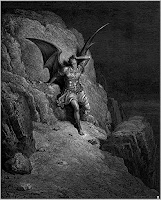
The image accompanying this post, of Satan cast out of Heaven, was created for an edition of Paradise Lost illustrated by the French artist Gustave Dore (1832-1883).

Tuesday, December 9, 2008

Quote of the Day (Thomas Babington Macaulay, on John Milton)

“Paradoxical as the remark may appear,…no poet has ever had to struggle with more unfavourable circumstances than Milton.”—Thomas Babington Macaulay, “Milton,” in The History of England From 1485 to 1685 (Folio Society edition)

Macaulay’s bio-critical essay on Milton—whose birth occurred 400 years ago today—provides not only a useful starting point for considering the creator of Paradise Lost, but also the Victorian whose History of England From the Ascension of James II influenced the course of historiography with its discussion of socioeconomic aspects of the past.

You might as well forget all notions of objectivity when reading Macaulay; he’s no more impartial than Bill O’Reilly or Michael Moore (not to mention your average blogger). But once you accept this, you’ll find vigorous and provocative contentions—and sometimes real gold in his conclusions.

Now, when I first read “unfavourable circumstances” in the above quote, I assumed that Macaulay meant the poet’s blindness. And let it be noted that the composition of the 12-book epic poem was an almost superhuman achievement, involving the recitation of 40 lines each morning to an assistant for five years running. (And, when the assistant wasn’t around, Milton is supposed to have groused, “I want to be milked. I want to be milked.”)

But what Macaulay really meant, it turns out, were the advantages that Milton possessed: his considerable education, scholarly bent, and linguistic skill, including with Latin. For a great poet in an enlightened society, Macaulay thought, “must unlearn much of that knowledge which has perhaps constituted hitherto his chief title to superiority.”

It’s hard to read this essay—published in the Edinburgh Review in 1825, one year after the death of Lord Byron, while the influence of the Romantic poets was very much at full tide—and not think that Macaulay might have been talking about the disadvantages that Milton faced for 19th century readers, rather than his own time. For the Romantic movement had made direct, personal expression the center of the poetic experience. The shift in consciousness this produced would have resulted in a retrospective upgrade of the reputation of Milton’s sonnet, “On His Blindness,” but a downgrading of the lofty experiment in blank verse, Paradise Lost.

Macaulay’s biases are transparent, even for those not that familiar with the 17th century—often comically so. It’s obvious from a reading of this that he believes that Oliver Cromwell can do no wrong, even if his followers might (how this occurs, who can say?), and that the age that followed the Protectorate was “the darkest and most disgraceful in the English annals” (how this surpasses the capricious reign of terror of King Henry VIII in his final two decades, or even the Regency era just passed in Macaulay’s own time, marked by a licentious aristocracy, economic unrest, and the madness of King George III, the essayist likewise doesn’t indicate). Milton is the beneficiary of all this.

But the historian has much of interest to say in comparing and contrasting the two poets who have probably influenced the Western consciousness about Hell than any others, Milton and Dante. Without preferring one to the other, he shows how the Italian poet’s Inferno was rendered with extraordinary particularity and even vivid disgust, while the power of Milton’s images “depends less on what they directly represent than on what they remotely suggest.”

Thursday, September 18, 2008

Quote of the Day (Milton)

“For books are not absolutely dead things, but do contain a potency of life in them to be as active as that soul was whose progeny they are; nay, they do preserve as in a vial the purest efficacy and extraction of that living intellect that bred them. I know they are as lively, and as vigorously productive, as those fabulous dragon's teeth; and being sown up and down, may chance to spring up armed men. And yet, on the other hand, unless wariness be used, as good almost kill a man as kill a good book. Who kills a man kills a reasonable creature, God's image; but he who destroys a good book, kills reason itself, kills the image of God, as it were in the eye. Many a man lives a burden to the earth; but a good book is the precious life-blood of a master spirit, embalmed and treasured up on purpose to a life beyond life.”—John Milton, Aeropagitica (1644)

(As a librarian, reader and writers of sorts, I have to say that the above would certainly constitute part of any credo I might ever care to formulate.)