Showing posts with label George Martin. Show all posts

Tuesday, September 22, 2015

Flashback, September 1965: ‘Yesterday’ Furthers Beatles’ Musical Maturity


After waking up one morning with a tune he couldn’t get out of his head, Paul McCartney (pictured) was sure he had heard the melody before—from his jazz-loving dad, very likely. But the more people he consulted, the more he realized he had something original that would insure his future and that of his group.

“Yesterday,” the title that The Beatles settled on, became more than just the band’s bestselling song since "I Want To Hold Your Hand." With an estimated 3,000 cover versions, it became one of the most popular songs that anyone would compose in the 20th century.

Yet, for all its staggering success, the song—released in mid-September 50 years ago in America—occupied a fraught place in the evolution of both The Beatles and the principal songwriters at the heart of it, McCartney and John Lennon.

Producer George Martin’s suggestion of strings gave the song a unique sound among rock ‘n’ rollers up to that time, but it also made the band question for some time whether they even could refer to themselves as rock ‘n’ rollers after this.

But back to that magic melody. It was as perfectly formed as an egg. Maybe McCartney thought it sounded too good, because he would only go ahead with it after being assured by such older musical pros as Oliver composer Lionel Bart that they hadn’t heard it before.

(A good thing that “Mecca,” as he has come to be known in the tabloids, was nervous as a cat about this; if only bandmate George Harrison, as soon as he had a chance at his first solo album, had shown similar caution, he might not have wound up on the wrong end of a plagiarism lawsuit over “My Sweet Lord,” which was eventually deemed by a court to be too close for comfort to the Chiffons’ “He’s So Fine.”)

Marking time until he had something more suitable, McCartney came up with some “dummy” lyrics. A good thing these were never heard by the general public, as their tone would have clashed with the melancholy sound eventually heard on vinyl:

Scrambled eggs
Oh my baby how I love your legs

(Something similar happened with the genesis of Billy Joel’s “Honesty.” As this is, at worst, a PG-13 blog, I won’t reveal to you its original title. Look it up!)

By May 1965, as the band was shooting their A Hard Day’s Night follow-up, Help, McCartney was spending so much time on the piano, trying to come up with lyrics, that director Richard Lester jokingly warned him,  “If you play that bloody song any longer have the piano taken off stage. Either finish it or give up!'

By the following month, McCartney had, indeed, finished. (In particular, it was while on vacation in Portugal that he came up with the title.) But now he had to translate it into sound. None of the other Beatles could see a spot for even a second guitar, let alone drums. An experiment with Lennon on Hammond organ also went nowhere. That was where George Martin came in.

The producer, more than a decade older than the group, was familiar with sounds from beyond the world of rock ‘n’ roll. As Tim Riley notes in his biography Lennon: The Man, the Myth, the Music, in his early postwar work at the Parlaphone division of EMI, Martin was exposed to “every mode of the era's recording practice: from soloists to orchestras, jazz groups to children’s choirs and remote recordings in Jimmy Shand’s country dance band using EMI’s mobile recording van.”

By decade’s end, due in no small part to the influence of Martin and the Beatles, classical-music instrumentation would be embraced by the pop-rock world, heard in such works as The Beach Boys’ “God Only Knows,” the Left Banke’s Walk Away Renee,” and the Moody Blues’ LP Days of Future Passed.

But it was a decidedly different scene when Martin suggested widening the Beatles’ aural palette with strings for “Yesterday.” McCartney blanched: “I don’t want Mantovani,” he protested. After hearing a crack quartet of players brought in for the session, McCartney, still alarmed by the “gypsy-like” sound he heard, was adamant that the musicians could not resort to vibrato to fatten out the sound.

Since only McCartney, not the other band members, was featured with the string quartet, it also raised the question of whether the song should be released as a solo record. That concern was quickly disposed of. But when McCartney’s bandmates heard the tune with this instrumentation, they were not sure what to do with it. They were so “embarrassed” by what this might do to the band’s reputation as rock ‘n’ rollers, he later admitted, that they decided not to release it as a single in the U.K.

Well, at this point in the group’s career, who needed the Mother Country? America wholeheartedly embraced “Yesterday,” sending it to #1 on the charts.

The new chart-topper, however, for all its seeming simplicity, marked a quantum leap forward in musical maturity. While “I Want to Hold Your Hand” exuded the innocence of young love, “Yesterday” bore all the scars of a failed relationship. Like Lennon’s “Help,” it tried to recover loss of self-confidence, to come to an emotional accounting about one’s self and the people one could depend on—an increasingly uppermost concern for young men trying to find stability and commitment in a world where all the acclaim, money and women in the world were suddenly available.

If he noticed this affinity between the hit he wrote and McCartney’s, Lennon said nothing about it, at least publicly. As a matter of fact, “Yesterday” filled Lennon with deep ambivalence. “Lennon could not help admiring it, or enjoying the profits he would share in its extraordinary publishing returns,” writes Tim Riley. “But it was never a song Lennon would have written on his own, and if the Beatles had to put it on a record, there was no place for him to so much as harmonize alongside his songwriting partner.”

The song’s genesis, then, represented a slight but perceptible shift in the Lennon-McCartney collaboration. At the onset of Beatlemania, an individual song could feature roughly equal contributions between the two. “Yesterday,” though, marked the point at which each would bring nearly finished songs to the studio, requiring less input from their partner. (“A Day in the Life,” for instance, is an overwhelmingly Lennon tune, save for the McCartney bridge—“Woke up, got out of bed”.)

It also may well have also shifted Lennon’s perception of George Martin. "Of course, George Martin was a great help in translating our music technically when we needed it,” Lennon wrote in the early 1970s, bristling at his former producer for saying he had been “painting a sound picture” in recording Lennon’s “Revolution #9, “but for the cameraman to take credit from the director is a bit too much.”

The seeds of that annoyance may have been planted with “Yesterday.” “Imagine two people pulling on a rope, smiling at each other and pulling all the time with all their might,” Martin said of McCartney and Lennon. “The tension between the two of them made for the bond.”

One might be half tempted to say that Martin had to referee that tug of war, except that Lennon, the rebellious skeptic of the Liverpool streets, began to perceive that the band’s producer, of more genteel origins than the Liverpool quartet, was more temperamentally in tune with McCartney than himself. Asked, in a 1971 interview with Rolling Stone Magazine, to explain the difference between Martin and the producer of his first solo LPs, Phil Spector, Lennon insisted it was “nothing personal against George Martin,” but immediately followed that up with, “He’s more Paul’s style of music than mine.”

Given the cold war that existed between Lennon and McCartney at the time, that last statement sure sounds personal. It’s rather easy to read between the lines, at points:“I always liked simple rock and nothing else,” Lennon said. (Classical instruments—the kind used by McCartney and Martin on “Yesterday”--would not really be simple.)

By his own admission, Lennon was annoyed when fans would ask him to autograph something related to a song he had nothing to do with. At one restaurant, “Yoko and I even signed a guy's violin in Spain after he played us ‘Yesterday’. He couldn't understand that I didn't write the song. But I guess he couldn't have gone from table to table playing ‘I Am the Walrus.’”

The divisions over “Yesterday” between McCartney and Lennon continued with the latter’s widow, Yoko Ono. In the 1990s, McCartney contacted her about revising the order of songwriting credits for “Yesterday.” He didn’t request the elimination of Lennon’s name, even though he could have if he wanted, since Lennon had admitted he had nothing to do with the song. Instead, McCartney simply wanted the order of the names changed, in this instance, to read “McCartney-Lennon.” Yoko refused—and, as with much else that happened with the Beatles, before and since, there were hard feelings for a long time over this.

Saturday, June 2, 2012

This Day in Rock History (‘Sgt. Pepper’s’ Released)


June 2, 1967—The Beatles’ LP Sgt. Pepper’s Lonely Hearts Club Band, released on this date in the United States, could, in retrospect, also have been titled Hello, Goodbye.

With their eighth studio album, the Fab Four were bidding hello to identical album track listings in both the U.S. and United Kingdom; to album artwork (including gatefolds) as iconic and ironic as the pop art of the time; and to the upcoming Summer of Love. On the other hand, with the mustaches that ended their clean-cut image, with the drug use that was driving a wedge within the group, and with their concentration on elaborate studio work at the expense of the touring that brought them together even as it extended their fan base, they were saying goodbye to their innocence.

Then as now, Sgt. Pepper’s overwhelming ambition and sound invited hype. Critic Kenneth Tynan styled the work “a decisive moment in the history of Western civilization,” while Rolling Stone has placed it atop its list of the 500 greatest albums of all time.

Much of the LP’s exalted status derives from something a bit overstated: its position as a landmark pop “concept album.” As Jody Rosen noted in a Slate article five years ago, the last notion was “demonstrably false.” It was not merely that the “concept” overarching this album—the creation of an alternative “band” playing its own songs—rested on the thinnest of conceits, but that other artists had gotten there first—e.g., Frank Sinatra and the Beach Boys. In fact, John Lennon claimed that none of his songs on the album were written with the “concept” in mind.

With that in mind, it’s still the case that Sgt. Pepper forms a unified whole, a dazzling example of what a pop album could be. The unity derives, paradoxically, from diversity, a mélange of different musical styles—not only blues and rock, but also jazz, Indian music, classical, and even England’s music hall tradition. ''They were competing with themselves, wanting to get better all the time,'' said producer George Martin 20 years later. Their monster success meant they had unlimited time at the famous Abbey Road Studios, and they spent hours there that were considered astonishing in the grind-them-out atmosphere of '60s pop music.

They were all melded together in an attempt to create sounds that simple rock ‘n’ roll—the new style the group had learned as Liverpool teens only a decade before—had seldom, if ever, heard. “A Day in the Life,” with its massive orchestration, was only the most prominent example.

Ingenious in its own way were the sounds employed for “Being for the Benefit of Mr. Kite.” In prior albums, the group had challenged Martin to come up with increasingly experimental sounds. Now, Lennon told Martin that for this song inspired by an old circus poster, he wanted to "smell the sawdust on the floor" when he heard the record.  

To convey a circus-like atmosphere, according to engineer Geoff Emerick, Martin pumped a harmonium for a full four hours until he collapsed. When he couldn’t find a calliope, he got hold of calliope tapes of marches by John Philip Sousa, chopped them into small sections, and had Emerick piece the whole thing together in random order.

After their breakup, the Beatles, to a man, agreed that they were most cohesive in the Sgt. Pepper sessions. Indeed, several tunes feature some of the most felicitous moments in the entire Lennon-McCartney partnership, including:
·          
*    * Lennon’s jaunty rejoinder to Paul McCartney’s “Getting Better All the Time” (“It can’t get no worse”);
·         * Lennon’s even snarkier answer to the romantic Paul’s question on “With a Little Help From My Friends,” “Do you believe in a love at first sight?” (“Yes, I’m certain that it happens all the time”); and
·         * McCartney’s “woke up, got out of bed…” song fragment to fill an audio hole in the middle of “A Day in the Life”.

After all of those good feelings of collaboration—present, for instance, in just about every groove of “With a Little Help From My Friends”—there were still ill winds blowing through the recording sessions that would undermine the group’s unity in less than a year. The band's growing marginalization of manager Brian Epstein, for instance, worsened his already considerable insecurity, and his death two months after the album’s release would plunge the quartet into shock, grief, guilt, and eventual bickering over future financial directions. 

Lennon’s drug use was also getting to be a far greater problem, as he downed amphetamines to wake up, took pot throughout the day, and, at times, mistook tabs of LSD for the sleeping pills that lay beside them at his bedside. Sometimes he would be AWOL for tracks by McCartney or George Harrison. Toward the end of a March session recording “Getting Better” and “Lovely Rita,” Lennon began to trip out right at the microphone. That night, McCartney, having brought his friend home, did something he’d previously resisted doing—drop acid—in order to keep his collaborator company.

“I’d love to turn you on,” indeed.

That brings up, inevitably, the question of drugs on the album. The BBC banned the LP from the airwaves because of the aforementioned line from “A Day in the Life” as well as the acronym implicit in the title, “Lucy in the Sky With Diamonds.” In the case of the latter, however, Lennon pointed instead to a drawing made by his son Julian in nursery school that the boy referred to as “Lucy in the Sky With Diamonds.” The images, the songwriter insisted, derived from Lewis Carroll—not the only time in 1967 that a rock classic would be based on the surreal fantasies of the Victorian children’s book writer. (See Jefferson Airplane’s “White Rabbit.”)

McCartney might have been the driving force behind the overall concept, production and even album design of Sgt. Pepper, but it remains impossible for me to imagine the LP without Lennon’s contribution. The Joycean wordplay of his lyrics served as a nice balance to McCartney’s often trite ones, and his phantasmagorical visions in “Lucy in the Sky With Diamonds” and “A Day in the Life” opened up future avenues in acid and progressive rock.

“It would be easy to dismiss Sgt. Pepper as rock’s most overrated album if it weren’t the Beatles’ most underrated group effort,” writes NPR critic Tim Riley in his 2011 biography, Lennon—The Man, the Myth, the Music—the Definitive Life. “Almost everything you need to know about the band lies in its grooves, and it holds the best and worst of what they’re most famous for.”

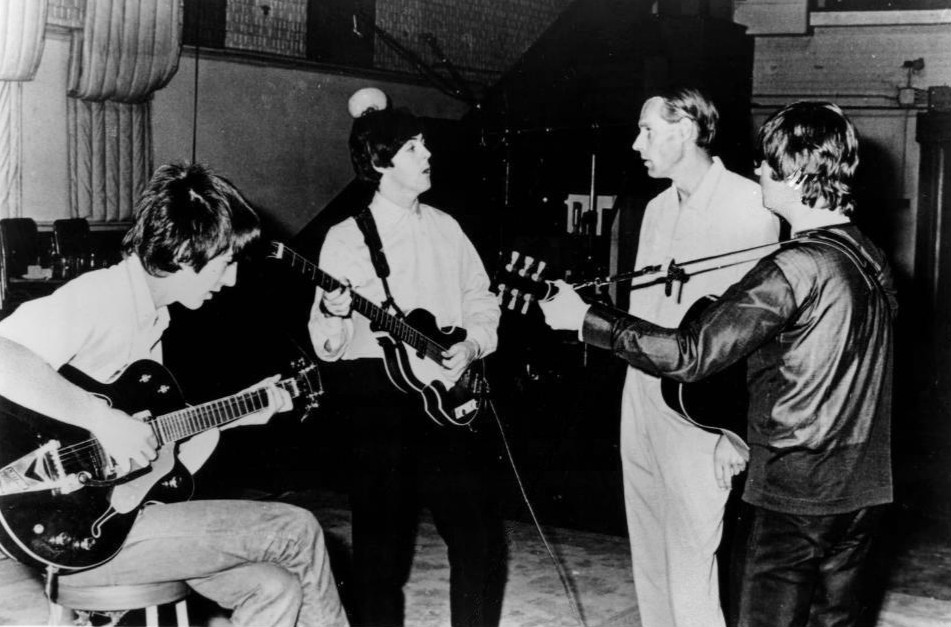
(The photo accompanying this post was taken in 1966, the year that the Beatles entered the Abbey Road Studio to record Sgt.Pepper.  The only band member missing from this publicity shot with George Martin is Ringo Starr.)

Saturday, September 4, 2010

Song Lyrics of the Day (John Lennon and Paul McCartney, Pleading for “Help!”)


“Help me if you can, I'm feeling down
And I do appreciate you being round.”—“Help!”, written by John Lennon and Paul McCartney, performed by the Beatles on their Help! LP (1965)

The Beatles’ title single from their film Help!, on this date in 1965, reached the top of the U.S. charts, where it stayed for another three weeks. Its ascent was accomplished with the same breakneck speed (a little over a month since the film’s release) by which the Fab Four were living for the past year and a half, when Beatlemania became a serious American phenomenon.

Once you pay no attention to the rich but fast sound that producer George Martin conjured in the studio, it becomes obvious that the lyrics—primarily John Lennon’s, with a little help from Paul McCartney—echo “the cute Beatle’s” “Yesterday,” as a cry of the heart amid a time of confusion.

For a long time, I speculated about why a song so essentially melancholy could have such a souped-up production. It turns out that the Beatles’ two primary songwriters wondered the same thing: Lennon pleaded to release the song in a slow version, and McCartney would later play it live in the same fashion.

Maybe the thinking, by Martin and the studio heads at Capitol Records, was that the Beatles needed something bouncy, or at least something to distinguish it from “Yesterday,” which practically begged for its eventual classical underpinnings. They didn’t realize –or maybe they simply didn’t care—that by slowing the song down, the loss in energy would be compensated by a more visceral understanding of the lyrics’ emotional exhaustion—in much the same way, for instance, that for awhile in the 1980s, Bruce Springsteen’s live, acoustic version of “Born to Run” turned the song inside out, so it became about commitment—an end to running, if you will.

Lennon wrote the song for the simplest of reasons—the Beatles’ upcoming follow-up to A Hard Day’s Night needed musical material—but it turned out that the songs had about as flimsy relation to the movie’s plot as you can get, so he could compose virtually anything he wanted. Without intending to do so, he ended up writing about himself.

Was Lennon “the smart Beatle,” as the shorthand of the time held? That might be an exaggeration (McCartney, in Martin’s later recollections, was every bit as eager an innovator in the studio). But he was, without a doubt, the most irreverent, subversive, and anguished of the Liverpool quartet.

“Help!” came from what Lennon later termed “my fat Elvis period,” his term for a time when he was drinking and eating too much. But that wasn’t the half of it.

The kid from the streets of Liverpool with the sharp black leather jacket and sharp tongue to match had been replaced by a co-leader of the most wildly successful band on the face of the earth. That slicing wit was misperceived by most of the public as being indistinguishable from the group’s general good-humored frolicking. The married young father whose touring had only taken him to the Continent was now in the midst of a global sojourn, with his pick of eager young women at every stop along the way.

Nor can we forget the impact of drugs. Introduced to marijuana within the past year, the Beatles had taken to it so enthusiastically that they became too giddy for filming at points during the production of Help! As they began to fracture by decade’s end, Lennon’s drug use was more pronounced than any of his bandmates, and it undermined his competition with McCartney as leader of the group.

By the time Help! appeared, a book by Lennon, A Spaniard in the Works, had just been published. He and his bandmates were at the top of the music and movie worlds. They’d been honored by the Queen, which almost never happened to other musicians their age. They’d even gotten to meet their hero, Elvis Presley.

In short, the world was at Lennon’s command—but he felt only a hollowness inside. By the time that void was being filled 15 years later, courtesy of renewed commitment to Yoko Ono and their son Sean, Lennon had his fateful encounter with Mark David Chapman. In the meantime, he left this anthem about how bottoming out opens you up to others.

Thursday, August 20, 2009

Song Lyric of the Day (John Lennon, on the End of the Beatles)

“I was the walrus,
But now I'm John,
And so dear friends,
You just have to carry on.
The dream is over.”—John Lennon, “God,” from John Lennon/Plastic Ono Band (1970)

“I don’t believe in Beatles,” John Lennon sang in this same song—and on this date 40 years ago, he proved it.
There had been tensions among the members of the Fab Four for awhile: the year before, Ringo Starr had temporarily left the group (though it was short-lived and not publicly announced), and George Harrison had followed suit on January 10 while working on what would later become the documentary film Let It Be.

But now, after a 3½-hour mid-afternoon session at their Abbey Road studio, when the band had settled on the final mix of Lennon’s “I Want You (She’s So Heavy)” and organized the master tape for the Abbey Road album, the Beatles had spent their last hours recording together as one unit. (For an in-depth—and very fine—description of this last session, see this post from the “Beatle Tracks Band” blog.)

The phrase “never again” is a harsh one, and for that reason, despite the legal acrimony that was about to ensue, I doubt that any of the Beatles believed, in their heart of hearts, that this was the end. Maybe it wouldn’t be as a touring band, but they’d shared too much for the goodbyes to mean forever.

But two days later would be their last photographic session, and three weeks after that Lennon would tell his bandmates that he was through. (The secret would still be kept for several months before Paul McCartney finally announced that he was going.) And who on earth would ever expect that, 11 years later, any attempt at a reunion would forever be short-circuited by Lennon's murder?

Nevertheless, if you have to go out, there are far worse ways to go—and few better—than the Beatles did with their swan-song LP, Abbey Road. They’d called upon the services of their old-pro producer, George Martin, when the live-in-studio sessions surrounding what was intended to be called Get Back collapsed in disagreements over the final product.

(Madman producer Phil Spector came out of retirement to try to pull that mess together. The resulting album, Let It Be, horrified McCartney as soon as he listened to all those strings on “The Long and Winding Road.” Yet, for all its brilliant parts, I’m not sure his version--titled Let It Be…Naked-- released nearly six years ago, is much, if any, improvement.)

The result of Martin's renewed collaboration with Paul, John, George and Ringo was a triumph. It not only marked the undeniable emergence of Harrison as a songwriting talent with “Here Comes the Sun” and “Something” (described by Frank Sinatra, who would know, as the greatest love song of all time), but provided, in the “Golden Slumbers” suite on Side 2, one of the most ambitious, unexpected—and beautiful—set of minutes throughout the Beatles’ entire recorded output.

With all due respect to the late, great John, the dream is not over. Like Todd Rundgren (who produced an early Beatles parody-homage, Deface the Music), I say that “A Dream Goes on Forever.” Listen to Abbey Road again and tell me if I’m not right.