Showing posts with label Frederick Douglass. Show all posts

Thursday, February 27, 2025

Quote of the Day (Frederick Douglass, on the Right of Migration)

“There are such things in the world as human rights. They rest upon no conventional foundation, but are external, universal, and indestructible. Among these, is the right of locomotion; the right of migration; the right which belongs to no particular race, but belongs alike to all and to all alike. It is the right you assert by staying here, and your fathers asserted by coming here. It is this great right that I assert for the Chinese and Japanese, and for all other varieties of men equally with yourselves, now and forever. I know of no rights of race superior to the rights of humanity, and when there is a supposed conflict between human and national rights, it is safe to go to the side of humanity. I have great respect for the blue eyed and light haired races of America. They are a mighty people. In any struggle for the good things of this world they need have no fear. They have no need to doubt that they will get their full share.

“But I reject the arrogant and scornful theory by which they would limit migratory rights, or any other essential human rights to themselves, and which would make them the owners of this great continent to the exclusion of all other races of men. I want a home here not only for the negro, the mulatto and the Latin races; but I want the Asiatic to find a home here in the United States, and feel at home here, both for his sake and for ours. Right wrongs no man…

“And here I hold that a liberal and brotherly welcome to all who are likely to come to the United states, is the only wise policy which this nation can adopt.” —African-American abolitionist, reformer, and memoirist Frederick Douglass (1818-1895), “Our Composite Nation,” lecture delivered in the Parker Fraternity Course, Boston, Mass., 1867

I have been looking for the past week for an item I could use related to Black History Month. Little did I know that perhaps the greatest African-American before Martin Luther King Jr., Frederick Douglass, had something pertinent to say not just on freedmen after the Civil War, but would also denounce the arguments in favor of nativism (that “arrogant and scornful theory by which they would limit migratory rights”) that continue to be propagated to this day.

Our current President seems to have forgotten that, as John F. Kennedy noted, we are “a nation of immigrants.” His proposal for a $5 million “gold card” for wealthy buyers, like so much he has done (starting with “Trump bibles”), monetizes something sacred: an immigration system that, for all its faults, still allows the humblest newcomers to dream of something more for themselves and their children.

Trump overlooks any possibility of his idea leading to abuse or unfairness by the wealthy. In fact, he said, he would consider selling the cards to well-heeled Russians: “I know some Russian oligarchs that are very nice people.”

Why does that sound so much like what he said back in 2017: that white nationalists rioting in Charlottesville, VA, included “some very fine people”?

Wednesday, October 2, 2024

Quote of the Day (Frederick Douglass, on When Political Parties Are Strong)

“[P]olitical parties, like individual men, are only strong while they are consistent and honest, and… treachery and deception are only the sand on which political fools vainly endeavor to build.”— American abolitionist and orator Frederick Douglass (1818-1895), Life and Times of Frederick Douglass (1892)

Sunday, February 27, 2022

Quote of the Day (Frederick Douglass, on Education, Newspapers, and Slavery)

“My mistress was, as I have said, a kind and tender-hearted woman; and in the simplicity of her soul she commenced, when I first went to live with her, to treat me as she supposed one human being ought to treat another. In entering upon the duties of a slaveholder, she did not seem to perceive that I sustained to her the relation of a mere chattel, and that for her to treat me as a human being was not only wrong, but dangerously so. Slavery proved as injurious to her as it did to me. When I went there, she was a pious, warm, and tender-hearted woman. There was no sorrow or suffering for which she had not a tear. She had bread for the hungry, clothes for the naked, and comfort for every mourner that came within her reach. Slavery soon proved its ability to divest her of these heavenly qualities. Under its influence, the tender heart became stone, and the lamblike disposition gave way to one of tiger-like fierceness. The first step in her downward course was in her ceasing to instruct me. She now commenced to practice her husband's precepts. She finally became even more violent in her opposition than her husband himself. She was not satisfied with simply doing as well as he had commanded; she seemed anxious to do better. Nothing seemed to make her more angry than to see me with a newspaper. She seemed to think that here lay the danger. I have had her rush at me with a face made all up of fury, and snatch from me a newspaper, in a manner that fully revealed her apprehension. She was an apt woman; and a little experience soon demonstrated, to her satisfaction, that education and slavery were incompatible with each other.” —African-American abolitionist, reformer, and memoirist Frederick Douglass (1818-1895), Narrative of the Life of Frederick Douglass, An American Slave (1845)

Several reasons led me to use this quote from Frederick Douglass, arguably the most significant African-American before Martin Luther King Jr.: Black History Month, this week’s History Channel “Lincoln” documentary (in which Douglass played an important role), and the sheer dramatic power inherent in this scene.

But above all, I wanted to highlight the role of newspapers in the African-American struggle for freedom.

The more pious slaveowners, like the plantation “mistress” in the first of Douglass’ three autobiographies, might be willing to teach slaves how to read the Bible. But even this practice became more limited by Southern legislation after Nat Turner’s Rebellion in 1831.

Plantation owners feared that their slaves would take literacy one step further to search out newspapers that would not only lead them to think for themselves but also to exchange information that could help overthrow the “peculiar institution.” (Indeed, the reaction of Sophia Auld, wife of Douglass’ master, was so harsh because she discovered him in this clandestine activity.)

But psychologically speaking, another concern could have been lurking: the thought that, if a slave could master a discipline entirely limited at this time to whites, it would immediately undercut the belief in racial inferiority used to justify slavery (and, later, segregation).

Today, black newspapers face many of the same challenges that their white-owned counterparts do—notably, the increasingly daunting economics of fielding a print product in the digital age, and the popular belief, propounded by a prior President, that the press is “the enemy of the people.”

But, just as these papers’ longtime role as the voice of their people should not be forgotten, so their future as an information alternative for the same group should not be abandoned.

Douglass’ own experience with owning three newspapers illustrates the importance of such alternatives and the difficulties in maintaining them for the long term. His service as editor and part-owner of the New National Era in the early 1870s proved such a money pit that swore off ever to be involved with the media again.

But, no matter how negative an impression he came away with, Douglass had during that time proved a key national voice during the Reconstruction Era—and his departure left a vacuum just when white America was starting its retreat from equal rights for freedmen.

More significant, when he founded the abolitionist paper The North Star in Rochester in 1847, thrust to the forefront the victims of slavery, in the belief that “that the man who has suffered the wrong is the man to demand redress,—that the man STRUCK is the man to CRY OUT—and that he who has endured the cruel pangs of Slavery is the man to advocate Liberty.”

The black press continued to press the nation to pay attention through long, lonely years when many white politicians and even journalists, when they did not incite hatred against them, acted as if they were invisible. (That might explain why the former President named above could say--puzzlingly using the present tense, as if the object of his praise were still alive--that Douglass was "an example of somebody who’s done an amazing job and he’s being recognized more and more, I noticed.”)

In today’s Bergen (NJ) Record, Jim Beckerman paid tribute to Douglass, anti-lynching crusader Ida B.Wells, pioneering editor T. Thomas Fortune, and other luminaries in his article on “How the Black Press Changed America for the Better.”

Thursday, July 11, 2019

Quote of the Day (Frederick Douglass, on Offering ‘A Liberal and Brotherly Welcome to All’)


“I want a home here not only for the negro, the mulatto and the Latin races; but I want the Asiatic to find a home here in the United States, and feel at home here, both for his sake and for ours. Right wrongs no man. If respect is had to majorities, the fact that only one fifth of the population of the globe is white, the other four fifths are colored, ought to have some weight and influence in disposing of this and similar questions. It would be a sad reflection upon the laws of nature and upon the idea of justice, to say nothing of a common Creator, if four fifths of mankind were deprived of the rights of migration to make room for the one fifth. If the white race may exclude all other races from this continent, it may rightfully do the same in respect to all other lands, islands, capes and continents, and thus have all the world to itself. Thus what would seem to belong to the whole, would become the property only of a part. So much for what is right, now let us see what is wise.

“And here I hold that a liberal and brotherly welcome to all who are likely to come to the United States, is the only wise policy which this nation can adopt.”—African-American escaped slave, abolitionist, orator, and editor Frederick Douglass (1818-1895), “The Composite Nation,” delivered in Boston, Mass., December 7, 1869, in The Frederick Douglass Papers, Series One: Speeches, Debates and Interviews, Vol. 4, 1864-1880, ed. John W. Blassingame and John R. McKivigan (1991)

In the last week or so, I’ve had a number of Facebook friends share on our newsfeed a Fox News link about how Sen. Ted Cruz had “schooled” Colin Kaepernick over the true meaning of a Frederick Douglass Fourth of July oration that the former NFL quarterback had quoted from. 

I suppose we should be grateful to Fox and Cruz for linking to that great speech and bringing it to more people’s attention.

I just wish the Trump Media Mouthpiece and the sniveling Senator from Texas, while they were at it, could have linked to another Douglass speech—the one that I have quoted from and linked to here in this post. It demonstrates a sense of history, a logic and a compassion that have gone sadly missing in the Trump administration’s immigration policy.

Friday, July 4, 2014

Quote of the Day (Henry David Thoreau, on Liberty and Slavery in Massachusetts)


“Three years ago, also, just a week after the authorities of Boston assembled to carry back a perfectly innocent man, and one whom they knew to be innocent, into slavery, the inhabitants of Concord caused the bells to be rung and the cannons to be fired, to celebrate their liberty — and the courage and love of liberty of their ancestors who fought at the bridge. As if those three millions had fought for the right to be free themselves, but to hold in slavery three million others. Nowadays, men wear a fool's-cap, and call it a liberty-cap. I do not know but there are some who, if they were tied to a whipping-post, and could but get one hand free, would use it to ring the bells and fire the cannons to celebrate their liberty. So some of my townsmen took the liberty to ring and fire. That was the extent of their freedom; and when the sound of the bells died away, their liberty died away also; when the powder was all expended, their liberty went off with the smoke.”— Henry David Thoreau, “Slavery in Massachusetts,” address delivered in Framingham, Mass., July 4, 1854

In another month, Henry David Thoreau would celebrate the publication of Walden, his account of a year spent in the woods near his native Concord, Mass.—an attempt to free himself from the “factitious cares and superfluously coarse labors of life” that began, very self-consciously, with his move into a cabin on the woodlot of friend Ralph Waldo Emerson on Independence Day, 1845.

Nine years after that personal declaration of independence, however, Thoreau would use the Fourth of July for a radically different occasion: a speech at a rally sponsored by abolitionist editor William Lloyd Garrison against the Fugitive Slave Act of 1850, a measure meant to dissipate secessionist sentiment among slaveowners by allowing them to recover runaways, even in free Northern states.

Thoreau would not permit an American Revolution that began in protest to devolve into an annual rite of self-congratulation. The risk was especially high in Concord, where the Minutemen had fired on the redcoats at the local bridge—a now-legendary event alluded to by Thoreau, then quickly undercut by him.  

Thoreau’s address didn’t deign to attack Southerners but his own listeners, as well as anyone else in Massachusetts who stood idly by as slaveowners tried to suborn the laws and moral code of the state. Only five weeks before, abolitionists had stormed the Boston federal courthouse in an unsuccessful attempt to free runaway slave Anthony Burns. Moreover, this wasn’t the first time the arm of the law had acted in favor of the slave power: three years before, in an incident Thoreau takes note of here, the escaped Georgia slave Thomas Sims had been apprehended in Boston, endured a trial, and was returned to his owner.

“Slavery in Massachusetts,” then, doesn’t refer to a pre-Revolutionary era when human chattel could still be held in the Commonwealth, nor even to the insidious manner in which the now predominantly Southern institution was making its presence felt here. It referred to the moral subjugation of a people unaware that their freedom had gone “off with the smoke.”

Like Frederick Douglass’ fiery Fourth of July oration of 1852, Thoreau is rebuking latter-day complacency about the American political faith. Righteous anger led him to a radicalism to match Southern extremists. If they did not want to be part of the Union, fine. “Let the State [Massachusetts] dissolve her union with the slaveholder,” he advised. “She may wriggle and hesitate, and ask leave to read the Constitution once more; but she can find no respectable law or precedent which sanctions the continuance of such a union for an instant.” (Garrison, the organizer of this mass protest, had expressed similar sentiments in 1829, when he first entered public life, as I discussed here.)

A good deal of the speech needs to be read with allusions to contemporary events spelled out, as this annotated text does. But Thoreau also spiked the address with a number of statements from his journals that stand on their own as brilliant aphorisms, including:

*“Those who have been bred in the school of politics fail now and always to face the facts.”

* “It is to some extent fatal to the courts, when the people are compelled to go behind them.”

* “A government which deliberately enacts injustice, and persists in it, will at length ever become the laughing-stock of the world.”

*“Whatever the human law may be, neither an individual nor a nation can ever commit the least act of injustice against the obscurest individual without having to pay the penalty for it.”

*"Probably no country was ever ruled by so mean a class of tyrants as, with a few noble exceptions, are the editors of the periodical press in this country. And as they live and rule only by their servility, and appealing to the worse, and not the better, nature of man, the people who read them are in the condition of the dog that returns to his vomit."

*”The law will never make men free; it is men who have got to make the law free. They are the lovers of law and order who observe the law when the government breaks it.”

Thoreau’s Framingham address is a reminder that deep dissatisfaction with governmental refusal to confront problems—and judicial complicity in this process—will inevitably call for organized action to redress the balance. Mid-19th century jurisprudence, to its enduring shame, proclaimed the rights of slaveowners. Our Supreme Court discovers equally unsuspected rights among corporations and gunowners. Where is our Thoreau to heap scorn on them?

Thursday, August 11, 2011

Quote of the Day (Frederick Douglass, on His Terrifying Start in Public Life)

“Mr. William C. Coffin, a prominent abolitionist in those days of trial, had heard me speaking to my colored friends in the little school-house on Second street, where we worshiped. He sought me out in the crowd and invited me to say a few words to the [Massachusetts Anti-Slavery Society] convention. Thus sought out, and thus invited, I was induced to express the feelings inspired by the occasion, and the fresh recollection of the scenes through which I had passed as a slave. It was with the utmost difficulty that I could stand erect, or that I could command and articulate two words without hesitation or stammering. I trembled in every limb. I am not sure that my embarrassment was not the most effective part of my speech, if speech it could be called. At any rate, this is about the only part of my performance that I now distinctly remember. The audience sympathised with me at once, and from having been remarkably quiet, became much excited.”-- Frederick Douglass, The Life and Times of Frederick Douglass (1881)


The above quote was becoming a bit long, so I couldn’t include the coda to what Frederick Douglass wrote here: After his spontaneous address in Nantucket on this date in 1841, he was asked to become a lecturer for the Massachusetts Anti-Slavery Society for the next three years. So began the public career of arguably the most significant African-American before Dr. Martin Luther King Jr.


While this is a virtually word-for-word copy of Douglass’ account of this event from his earlier memoir, My Bondage and My Freedom (1855), it considerably expands his first telling of this in Narrative of the Life of Frederick Douglass, An American Slave, Written by Himself (1845). At the two later points in his life, when neither his intelligence nor his leadership of the African-American community was in question, he could afford to be frank about his anxiety at his first public appearance.


This expanded version, however, probably also arose from Douglass' intervening years of speaking. Everywhere he went, he was undoubtedly asked how he came to occupy his unique position in American life. Moreover, all the while he had been lecturing, Douglass had learned how to tell a story. And really, what could be more uplifting than overcoming not just one obstacle, but also a second—not merely an entire society’s vicious treatment of slaves, but also the considerable remnant of fear and worthlessness this left him?


In later years, Douglass would not always see eye to eye with William Lloyd Garrison, the editor of the abolitionist newspaper The Liberator, but here he generously acknowledged the electric effect that the elder man had on his audience that day. Douglass was too modest to convey, except by suggesting that listeners reacted more to his embarrassment than to his ideas, the full effect that he himself made as a tall, striking 23-year-old escaped slave. But one contemporary correspondent at the event did in observing: “Flinty hearts were pierced, and cold ones melted by his eloquence."


This by no means would mark the end of fear in Douglass’ life. He surely must have felt it again, in 1852, when he delivered an incendiary speech about African-Americans’ ambivalence about Independence Day; in 1859, when it appeared that he might be prosecuted by the federal government for helping to finance John Brown’s failed insurrection at Harpers Ferry; in the Civil War, when he watched sons Charles and Lewis go off to fight in the famous 54th Massachusetts Regiment (the one made famous in the film Glory); or toward the end of his life, when, after watching with growing dismay the retreat of the federal government from protecting freedmen, he took to denouncing lynching with the same kind of oratorical fire he possessed in his twenties.

Saturday, September 18, 2010

Quote of the Day (Booker T. Washington, on “Questions of Social Equality”)


“The wisest among my race understand that the agitation of questions of social equality is the extremest folly, and that progress in the enjoyment of all the privileges that will come to us must be the result of severe and constant struggle rather than of artificial forcing. No race that has anything to contribute to the markets of the world is long in any degree ostracized. It is important and right that all privileges of the law be ours, but it is vastly more important that we be prepared for the exercises of these privileges. The opportunity to earn a dollar in a factory just now is worth infinitely more than the opportunity to spend a dollar in an opera-house.”—Booker T. Washington, “The Atlanta Exposition Address,” delivered September 18, 1895

Frederick Douglass had been dead less than a year when Booker T. Washington appeared before a white audience at the Atlanta Exposition on this date in 1895. It’s a safe bet, however, that the fiery abolitionist leader—who, on Independence Day in 1852, excoriated his countrymen for excluding blacks from the promise of freedom—would have found little to his liking in this speech.

A further irony: with the accommodationist message of his address, Washington, a former slave, became the leading spokesman for African-Americans, a position he held until his death, after two more decades of tireless work. (To that phrase “tireless work,” I should also include the adjective “ineffectual” and "frustrating," because Washington, an inveterate lecturer, had to become used to separate-but-equal—and substandard—accommodations on his numerous travels.)

Especially after the civil rights movement, Washington was dismissed as an Uncle Tom by many revisionist historians, notably his Pulitzer Prize-winning biographer, Louis Harlan. (For a small sample of the latter’s work, see his summary of the educator in this entry from The Encyclopedia of Southern Culture). More recently, historian Robert Norell, in Up From History, has attempted to restore some balance to this sometimes overly harsh skepticism, noting the incredibly harsh environment then faced by African-Americans, including Washington himself in Tuskegee’s home state, Alabama. (Earlier that year, he had saved the life of a local African-American lawyer from a white mob, but only by refusing to acknowledge he had hidden the man in his own home.)

In certain ways, the key to Washington’s position might be found in one sentence quoted above: “No race that has anything to contribute to the markets of the world is long in any degree ostracized.” That touching absolute faith in the marketplace continues to reverberate today (you can almost hear the voice of black conservative columnist Thomas Sowell speaking that line), but I’m afraid that it is contradicted by the facts of history.

One of the few businessmen who did confirm Washington’s belief was Gus Busch, who really did not care about the color of the fans of the team he owned, the St. Louis Cardinals, as long as they drank his beer. But far more often—and especially in the six decades between Washington’s so-called “Atlanta Compromise” and the young Martin Luther King Jr.’s leadership of the Montgomery Bus Boycott—American businessmen have been anything but enlightened when it came to the marketplace and human rights.

A final irony of this address: The refrain “cast your buckets where you are” came to be associated with what blacks would give up, but Washington also used it to undercut the relative position of another group: immigrants. White businessmen need not look to other white, foreign-born workers for cheap labor, he promised: They could get the same thing from native black workers—except that, in the case of the latter—a “patient” group—capitalists need not worry about the strikes then beginning to take hold in America.

In his desperate attempt to assure the survival of African-Americans, then, Washington ended up using his considerable prestige to undermine the status of his own race and immigrant whites. “Up From Slavery”? Perhaps, but not by much.

Tuesday, May 26, 2009

This Day in Congressional History (Kansas-Nebraska Act Passed in Haste)


May 26, 1854—His legislation had already passed one key hurdle at an hour even more unearthly, so Stephen A. Douglas didn’t mind the lengths he had to go to this time.

At 1:15 in the morning, after an extension of a session from the prior day, the Illinois Senator and Presidential hopeful watched as a Joint Committee of Congress voted to approve his Kansas-Nebraska Act.

A word of advice to politicians: never decide anything important in the wee hours of the morning, when you’re exhausted, hungry and maybe even a bit liquored-up. George McGovern settled on Thomas Eagleton as his running mate at a similar hour, and we know how that turned out.

(Or maybe some of us don’t or have forgotten, given the disasters involving more recent Veep candidates—so, a fast recap: After fighting tooth and nail all the way to the floor of the convention for the nomination—and after having had, oh, at least a half dozen other people turn him down—McGovern offered the running-mate spot to Eagleton. When asked by a McGovern aide if he had any “skeletons in the closet,” the Missouri senator—a fine man, by most accounts—intrepreted the question a bit narrowly as referring solely to political corruption, and said no. He did not mention his past hospitalizations because of depression, and the McGovern campaign had no time to check even if it wanted to. The result: hysteria over a medical condition that undoubtedly afflicted more politicians than anyone realized at the time, then McGovern reversing his statement that he was “1,000 percent” behind his running mate and asking Eagleton to resign from the ticket. In other words, the most disastrous Veep choice until George W. Bush’s Veep-vetter, Dick Cheney, managed to turn up "skeletons in the closet" on all Bush’s other choices until, magically, there was nobody left but himself.)


Now, if you had told those assembled, on that day in the antebellum republic, that dire consequences would follow an affirmative vote, they might or might not go along with you. So, I think you’d have to spell it out for them:

* a region that rivaled 20th-century Beirut and Baghdad in violent mayhem;
* a Union torn asunder by the legislation;
* millions dead in the resulting Civil War; and
* lingering sectional discord and racism that would linger for generations afterward.
And, for those of a particular partisan stamp: anger over the measure led to the rise of the Republican Party.
Douglas must have thought his Presidential stock has soared after approval of the measure, which, before final passage, had already passed a key 5 am affirmative vote by the Senate. The act put into law the doctrine of popular sovereignty originally proposed by General Lewis Cass in the 1848 Presidential election, then championed by Douglas himself. The doctrine stipulated that the issue of slavery would be decided by territorial voters themselves.
Agitation over slavery was exactly what Douglas did not want. As an early proponent of manifest destiny, he envisioned an America stretching from sea to sea, bound together by all kinds of internal improvements—roads, canals, and railroads. He was particularly passionate on the last subject, and his desire to have a railroad built might have led him to change the bill in committee enough to bring matters to a boil about it in the North.

He could not help but notice that support for his idea of a transcontinental railroad with its eastern hub in Chicago--the major city in his home state--was thin in the South. If he could give the South something it really wanted on something else, he might be able to move this issue forward.

After a meeting with President Franklin Pierce—a Northern sympathetic to the South—and his Secretary of War, the southerner Jefferson Davis, Douglas redrafted his bill, stating explicitly what he had hoped to fudge: that the Missouri Compromise that had governed territorial admittance to the Union for the last 30 years was superseded by the bill. This meant that, if the voters decided it, slavery could be permitted north of the latitude that had prevailed before this.

Another key change occurred in the revised bill: the territory, once simply known as Nebraska, would now be split into two: Nebraska, the northern half, and Kansas, the southern part.

Reaction in the North was furious. The Missouri Compromise had meant that slavery could be confined. Now that was no longer the case. Moreover, the proximity of Kansas to Missouri, a slave state, meant that slaveowners could far more easily populate it than anti-slavery forces could.
At one point in the debate on Capitol Hill, Salmon P. Chase--himself a future Presidential aspirant--accused Douglas of pushing the bill to further his hopes for the White House. In the course of the angry exchange between the two, the phrase "corrupt bargain" was used.
Virtually nothing could cause greater anger to Douglas. As a strong partisan of Andrew Jackson, he knew that this term had been used to describe how John Quincy Adams had snatched the Presidency from Old Hickory: by appointing Henry Clay as his Secretary of State, thereby swinging the latter's key votes when the election was thrown into the House of Representatives. The "corrupt bargain" charge had bedeviled Adams throughout his single term and had helped elect Jackson President.


Two little men were responsible for passage of the bill that caused such big problems for America.
One was Douglas himself, nicknamed “the Little Giant” to emphasize his outsized impact on the republic in the 1850s. He was at once the best-known and most controversial politician in America at this time. The “great triumvirate” of Clay, Webster and Calhoun had grabbed the headlines, as they always did, in the debate over the Compromise of 1850, but it was Douglas who was the legislative mechanic behind that omnibus bill. He was short—only five feet four inches—but on the stump, shouting, gesticulating, working his stocky frame into a sweat, he looked like a prize fighter.
Douglas boasted about his own critical role in the legislation: "I passed the Kansas-Nebraska Act myself. I had the authority and power of a dictator throughout the controversy in both houses. The speeches were nothing. It was the marshaling and directing of men, and guarding from attacks, and with a ceaseless vigilance preventing surprise."
The second little man was Alexander H. Stephens, a sickly congressman who weighed no more than one hundred pounds. He resembled a 20th-century Georgian, Senator Richard Russell, in being a lonely lifelong bachelor who spent much of his time out of the office mastering congressional rules and regulations.

On May 22, just when it appeared the legislation was on the ropes, Stephens, a supporter of the bill, invoked Clause 119 of the House Rules—a clause that hardly anybody ever bothered with—to keep it alive after an unfavorable committee vote. After the Joint Committee of Congress pulled its midnight-oil act, the bill went to Pierce, who signed it four days later.

A big mistake all around. Racist Northerners who once denounced abolitionist agitation now found that slavery might not be excluded in any territory to which they might journey—and that, at a stroke, this undercut the value of their own labor.

In his Life and Times (1881), Frederick Douglass recalled how the measure “made abolitionists of people before they became aware of it, and…rekindled the zeal, stimulated the activity, and strengthened the faith of our old anti-slavery forces.” In his newspaper, Douglas himself called for “companies of emigrants from the free States” to be “collected together—funds provided” and to be “sent out to possess the goodly land, to which, by a law of Heaven and a law of man, they are justly entitled.”

The act also brought back onto the political scene a lanky lawyer, well-known to both Douglas and Stephens, who’d been in a five-year funk after he’d left the House of Representatives: Abraham Lincoln. Lincoln had been on friendly terms with fellow Whig Congressman Stephens and he knew Douglas well from Springfield (Douglas’ friendliness toward Mary Todd led some to surmise that he was a beau of Lincoln’s future wife, though no real evidence has ever substantiated this).

Lincoln was catalyzed by his opposition to the Kansas-Nebraska Act. According to Doris Kearns Goodwin’s Team of Rivals, a fellow lawyer, T. Lyle Dickey, later remembered that Lincoln, upon hearing news of the passage of the bill, had “discussed the political situation far into the night” with him. That fall, upon hearing a three-hour defense of the act by Douglas at the State Fair, Lincoln leaped to his feet at its conclusion to announce to the crowd that he would deliver a rebuttal the next day.

A speech two weeks later at Peoria was even more powerful, laying out how the Founding Fathers had tried to inhibit the spread of slavery—and how the act now threatened to upset this careful moral and political balance. It served notice that Douglas would have a powerful rival on the local and national scene.

Wednesday, September 24, 2008

Quote of the Day (Douglass, on the Nature of Laws and Events)

"It is our lot to live among a people whose laws, traditions, and prejudices have been against us for centuries, and from these they are not yet free. To assume that they are free from these evils simply because they have changed their laws is to assume what is utterly unreasonable and contrary to facts. Large bodies move slowly. Individuals may be converted on the instant and change their whole course of life. Nations never. Time and events are required for the conversion of nations." – Frederick Douglass, address at the National Convention of Colored Men at Louisville, Kentucky, September 24, 1883

(Douglass’ address was a prescient warning about the erosion of African-American rights in the post-Reconstruction era, particularly as it related to the Supreme Court. His address remains, to this day, remarkably insightful and sober about the need to change a culture and attitudes as much as laws. To be effective, one transformation cannot successfully take hold without the others.)

Thursday, September 4, 2008

This Day in African-American History (Frederick Douglass Escapes From Slavery)


September 4, 1838—Completing a perilous 24-hour escape from slavery, 20-year-old Frederick Douglass arrived in New York City near what is now Chambers Street, his first step in becoming arguably the most important African-American leader before Martin Luther King Jr.

Within a few years, displaying a fiery eloquence and bearing personal witness to the evils of slavery, Douglass made for one of the most prized speakers on the abolitionist circuit. He would also edit one of the leading abolitionist papers, North Star; press during the Civil War for immediate emancipation and for the utility of African-American troops in destroying the Confederacy; and served as a U.S. Marshal toward the end of the Reconstruction Era.

His flight for freedom would make any short list of the greatest, most consequential escapes in American history. Yet Douglass only revealed the full details in his third autobiography, Life and Times (1881), by which time the issue of slavery had been decided by force of arms and his disclosures about who aided him and how would not open anyone to reprisals.

Those dangers were real because of fugitive slave laws on the books at the time. For instance, for assisting Virginia and Maryland slaves on their flight north, Charles T. Torrey, an abolitionist journalist and former Congregationalist pastor, was sentenced to six years at hard labor in the Maryland state penitentiary, where he died.

As a youngster, Douglass was taught, for awhile, to read by Sophia Auld, until her husband Thomas put an end to it, fearing it would make the boy discontented with his lot as a slave. Thereafter, he learned to read on the sly—copying out letters written on lumber by carpenters and asking his white playmates to show him how to form other letters properly.

At age 18, he had tried unsuccessfully to run away. After he was caught, Thomas Auld told him he’d get his freedom at age 25—if he learned a trade in the meantime. By the end of the summer of 1838, however, Thomas’ brother Hugh decided to end a hiring-out arrangement he had had with Douglass that allowed the slave greater financial earning power.


Concerned that he’d be sold and forced to live away from the woman he’d come to love, Anna Murray, Douglass decided on August 12 that on September 3 he would escape. As the day he picked grew closer, his anxiety mounted as he thought of the people he loved that he might never see again if he succeeded and on the probability of severe punishment if he failed.

With help from Anna, who sold two featherbeds to assist him, Douglass managed to get hold of “free papers” that allowed manumitted blacks to move around with some degree of freedom. Dressed in a sailor’s red shirt and black cravat, he boarded a train bound for Wilmington, Del., where he switched to a steamboat for Philadelphia—and even this wasn’t enough, because he promptly booked a train to New York City.

From what I have seen of high school and college curricula, the first autobiography written by Douglass—Narrative of the Life of Frederick Douglass, An American Slave (1845)—is the most assigned of his memoirs, perhaps because it is the shortest and most concentrated in its depiction of slavery. For my part, I prefer Life and Times—not only because it fills in the details of his escape, but because of its vivid portraits of two men with whom he came in contact later on: Daniel O’Connell, the Irish lawyer-politician who gained Catholic emancipation as a Member of Parliament, and Abraham Lincoln. Although O’Connell earned Douglass’ admiration from the beginning for his eloquence and his unwavering denunciation of slavery, Lincoln won it by degrees, after his slow but finally unshakeable move toward emancipation of the slaves during the Civil War.

“No transatlantic statesman bore a testimony more marked and telling against the crime and curse of slavery than did Daniel O’Connell,” Douglass wrote. Lincoln’s Second Inaugural Address, in which he reflects on the awful price paid by North and South alike for their part in this crime, might merit the same tribute. So, of course, might Douglass himself.

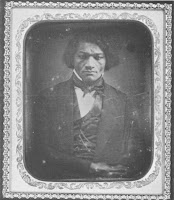
In a class I took at the Chautauqua Institution last month on Seneca Falls and the women’s rights movement, our instructor, Rick Swegan, drew our attention to the portrait of Douglass that I have used for this post. It was taken at roughly the time he wrote the Narrative.


The steady, unflinching look of Douglass in this daguerreotype, Rick noted, was similar to that of some famous black militants of the late 1960s. Though I came across another, earlier image from the time of Douglass’ escape, I felt, like Rick, that the 1840s picture captured something essential in the man—his self-possession, his dignity, and his refusal to be taken for granted by anybody.

Saturday, July 19, 2008

This Day in Women's History (The Seneca Falls Convention)

July 19, 1848—In a decade of rising American sentiment for reform and world clamor for revolution, The Woman's Rights Convention met in the upstate New York community of Seneca Falls. The convention's Declaration of Sentiments, adopted a day later, was patterned on the Declaration of Independence, but took that document a step further: not only claiming that "all men and women are created equal," but that this inherent equality entitled women to the right to vote.

"The history of mankind is a history of repeated injuries on the part of man towards women, having in direct object the establishment of an absolute tyranny over her,” the declaration passed by the convention noted. “To prove this, let facts be submitted to a candid world."

George III might have been the target of the colonists, but in Seneca Falls it was the entire male sex that was charged with subverting rights. The long list of grievances—matching in number (18) those against the clueless British monarch—included:

* denying her the right to the franchise;
* making her, if married, "civilly dead" in the eyes of the law; depriving her of property;
* framing divorce laws to benefit men;
* monopolizing employment;
* closing her off to "avenues of wealth and distinction" such as theology, medicine or law;
* perpetuating a double standard in morality that doomed many women but were never enforced against men.

Calling for the franchise was so radical that even one of the convention’s organizers,
Lucretia Coffin Mott, reproved the prime mover of the resolution, Elizabeth Cady Stanton, for making the delegates “look ridiculous.” But Stanton was not to be dissuaded, arguing that the right to vote was central to all the other freedoms. Her insight proved correct, as demonstrated years later by civil-rights workers in the South in the 1960s who braved threats to their lives to win the right to vote for their race.

Mott was not the only person to give way before Stanton’s polemical power. In his memoir, Life and Times of Frederick Douglass, the great African-American orator recalled the impact of her arguments on his own way of thinking concerning women’s rights:

"I could not meet her arguments except with the shallow plea of 'custom,' 'natural division of duties,' 'indelicacy of woman's taking part in politics," the common talk of 'woman's sphere,' and the like, all of which that able woman, who was then no less logical than now, brushed away by those arguments which she has so often and effectively used since, and which no man has yet successfully refuted."

Just how far Douglass was moved by her arguments was seen on the second and last day of the convention, when Stanton’s resolution in favor of the franchise appeared ready to go down to defeat. Douglass’ speech calling for its approval moved many in the audience to vote in the affirmative.

Not only logic carried the day for Stanton, however. The year 1848 was one of those heady years—1968 and 1989 were others—in which it seemed that the forces of change would carry everything before it and the world really could be made anew. Revolutions in Italy, Ireland, France, and Prussia were causing established governments to tremble all across the continent. In America, rising agitation involved such causes as temperance, prison reform, treatment of the mentally ill, and abolitionism.

The magnetism and very presence of female speakers on abolitionist platforms divided the anti-slavery movement over tactics even as it gave further impetus to the women’s movement. The powerful eyewitness testimony of Sojourner Truth and the southern-born sisters Angelina and Sarah Grimke posed a dilemma for the anti-slavery movement: should they enlist the very public help of these females (who were often more compelling than men on the stump) or should these women accept where custom had always consigned them (i.e., the home)?

The issue came to a head at the
1840 meeting of the World Anti-Slavery Convention in London. After a floor flight, the so-called “Gradualists” (led by New York merchant Lewis Tappan) succeeded in banishing female members of the American delegation to a spot behind a curtain in the meeting hall’s balcony.

This physical position—not only not heard but not even seen—rankled Mott, a female delegate, and Stanton, the newlywed bride of a male delegate to the convention. Events and geography conspiracy to keep the two friends from joining forces again for eight years. What drew them together was an ideological fight on yet another cause—the Quakers’ position on slavery.

Mott, while visiting sister
Martha Coffin Wright, supported a local Quaker group calling for abolitionism. It was a good opportunity to meet Stanton, living nearby in Seneca Falls. The three of them, along with Quakers Mary Ann McClintock and Jane Hunt (Stanton was the only non-Quaker in the group), began over tea on July 13 to discuss women’s issues. They decided to call for a grand convention. Immediately.

It was amazing how much they did with almost no time and not a lot of publicity. Only a couple of local papers and Douglass’s abolitionist publication, North Star, were able to get advance word out about a meeting to be held the following week. Stanton and her fellow organizers also worried that, because of hot summer weather and the height of the farming season, attendance would be poor. Nevertheless, some three hundred people managed to pack the Wesleyan Methodist Chapel for the event. (Ironically, because even Stanton grew unnerved at presiding over such a politically risky gathering, men were not only admitted, but, in the person of Lucretia’s husband James, even allowed to head up the gathering.)

The convention received a large amount of press coverage, much of it mixed. While some editors, such as the New York Tribune's Horace Greeley, were sympathetic, others—notably the New York Herald's James Gordon Bennett-- adopted a tack that has been used repeatedly—and all too successfully—over the years: dismiss the organizers as hysterics and misfits. To that end, Bennett reprinted the entire text of the Declaration of Sentiments, believing that he was exposing the group for what they really were. Stanton, however, welcomed this as a means of spreading their ideas.

In the coming decades, America would become convulsed over the slavery issue, relegating women’s rights to the back of the national agenda. Two decades later, Stanton and her friend Susan B. Anthony would find themselves in opposition to Douglass when the latter called for adopting the Fifteenth Amendment, which forbade denial of the suffrage on account of race, color, or prior condition of servitude—but said nothing about gender. By the time women were granted the right to vote in 1920, only one signer of the Seneca Falls Declaration of Sentiments—Charlotte Woodward—was even alive.

This summer, Seneca Falls will undoubtedly be experiencing more tourists than ever because of the anniversary of the convention. However, local history buffs don’t have to go that far to see a place associated with feminist history. Tenafly, N.J., has a National Historic Landmark, a two-story, white Victorian frame house that was the residence of Stanton from about 1868 to 1887.