


The $2 Bets That Ended a $5 Million Career
23 hours ago

Evil can live on in politics, as well as among the undead.

Sam [played by Sean Astin]: “I know. It's all wrong. By rights we shouldn't even be here. But we are. It's like in the great stories, Mr. Frodo. The ones that really mattered. Full of darkness and danger, they were. And sometimes you didn't want to know the end. Because how could the end be happy? How could the world go back to the way it was when so much bad had happened? But in the end, it's only a passing thing, this shadow. Even darkness must pass. A new day will come. And when the sun shines it will shine out the clearer. Those were the stories that stayed with you. That meant something, even if you were too small to understand why. But I think, Mr. Frodo, I do understand. I know now. Folk in those stories had lots of chances of turning back, only they didn't. They kept going. Because they were holding on to something.”
Frodo: “What are we holding onto, Sam?”
Sam: “That there's some good
in this world, Mr. Frodo... and it's worth fighting for.”—The Two Towers
[Part Two of The Lord of the Rings] (2002), screenplay by Fran Walsh, Philippa
Boyens, Stephen Sinclair, and Peter Jackson, adapted from the novel by J.R.R.
Tolkien, directed by Peter Jackson


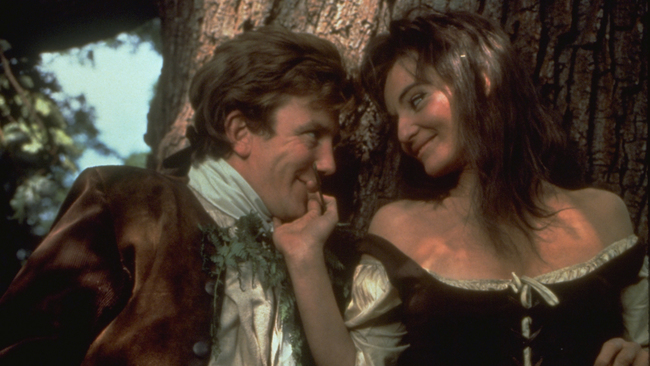
The image accompanying
this post shows Albert Finney as the title character in the Oscar-winning
adaptation of Henry Fielding’s classic. As you might surmise in this scene, Tom
Jones, for all his good instincts, is very, very far from wisdom.

“Cathy's lies were never innocent. Their purpose was
to escape punishment, or work, or responsibility, and they were used for
profit. Most liars are tripped up either because they forget what they have
told or because the lie is suddenly faced with an incontrovertible truth. But
Cathy did not forget her lies, and she developed the most effective method of
lying. She stayed close enough to the truth so that one could never be sure.
She knew two other methods also -- either to interlard her lies with truth or
to tell a truth as though it were a lie. If one is accused of a lie and it
turns out to be the truth, there is a backlog that will last a long time and
protect a number of untruths.”—Pulitzer and Nobel Prize-winning American
novelist John Steinbeck (1902-1968), East of Eden (1952)
Several months ago, I thought of using the above quote
to mark the 70th anniversary of the publication of East of Eden.
Though I didn’t have time to write at the length I wanted then, it may have
turned out for the best. This meditation by John Steinbeck on a monster
in beguiling human form is appropriate for the present moment—the weekend
before Halloween, not to mention an evil hour in the life of the American
republic.
Several years ago, when the American version of House
of Cards was still in production, a close relative of mine asked about
Robin Wright’s Lady Macbeth-type political wife, “How could a woman so
beautiful be so evil?”
Claire Underwood’s American psychological predecessor
was Steinbeck’s Cathy Ames, who sheds lovers, homes—even past identities—as
periodically as a serpent does its skin.
I use “serpent” advisedly, as East of Eden, as alluded to in the title, is an allegory.
The two male characters with first
names beginning with “A”—Adam and Aron Trask—are innocent or naïve, like Adam
and son Abel in the Book of Genesis. The three males with first names starting
with “C”—Cyrus, Charles and Caleb—are analogous to Cain—wild, resentful and
despairing.
The letter “C” also suggests Cathy’s affinity with the
second set of Trask males. But as the novels’ principal female, she also functions
like Eve or Lilith, the she-demon of Near East mythology.
Since its publication, East of Eden has not
been treated warmly by literary critics, who have complained that Steinbeck
grafted this allegorical structure onto a historical saga about his maternal
family, the Hamiltons; that the novel is long and ungainly; and that the author
intruded commentary on the action, violating the injunction to today’s creative
writing students to “show, not tell.”
But, though East of Eden may not be perfect, it
is surely compelling, with its dramatic qualities recognized when it was turned
into a film in 1955, a network TV mini-series in 1981, and (now in development)
a Netflix limited series written by Zoe Kazan.
Hollywood’s divergent treatments of this sprawling
epic partly set in Steinbeck’s own Salinas County resulted in different main
characters. The movie’s director, Elia Kazan, narrowed the plot to the book’s
last quarter, spotlighting James Dean in a prototype thereafter indelibly
associated with him: a conflicted, tortured youth.
But in the early 1980s, the golden age of the
mini-series, TV offered the opportunity for a more expansive treatment of the
novel—6½ hours that concentrated on Adam and Cathy. Inevitably, viewers focus
less on Adam, who fundamentally changes little, than on Cathy (played by Jane
Seymour, pictured in the image accompanying this post).
Midway through the plot, Cathy abandons her life as
wife and mother to become Kate, a prostitute and madam. Her sexuality is not
itself sinful. It’s her use of it, combined with her propensity for
deceit, that makes her fascinating and unpredictable.
As cunning as Eden’s serpent, Kate becomes
additionally cynical as she learns how the hypocrisy of her clients in the sex
trade leaves them utterly vulnerable to her insatiable drive for wealth.
While middle-aged Adam is scrupulous to a fault,
refusing gains from son Caleb’s speculation on beans in a wartime economy, Kate
says in business by keeping a stash of photos of brothel clients for blackmail.
Rereading East of Eden after over 40 years, I
found inadequate Steinbeck’s explanation that monsters like Cathy/Kate are “variations
from the accepted norm to a greater or a less degree.”
But the better word to describe this heinous type is
“violations” rather than “variations.” While “variations” are something
inherent that a person is born with and unable to change, “violations” are
products of free will.
Cathy/Kate violates every norm of responsibility and
selflessness. She shares with Cyrus, Charles and Caleb a willfulness that leads
to destructive outbursts, but unlike them never resists this impulse.
That lack of remorse renders her utterly alien,
Steinbeck observes, in the same way that, “To a man born without conscience, a
soul-stricken man must seem ridiculous. To a criminal, honesty is foolish.”
In the postwar period, the United States struggled to
understand the radical evil that gave birth to the totalitarian regimes of Nazi
Germany and the Communist Soviet Union. But Americans’ aspirations for liberty
didn’t eliminate their own vulnerability to cynics ready to exploit falsehood
and bent on power.
After all, East of Eden arrived halfway through
the reign of terror perpetrated by Joseph McCarthy, as careless about truth as
he was about the damage he created through his access to the media and
investigative responsibility in the U.S. Senate.
Steinbeck abominated McCarthy but did not find him alien to the Eden of American democracy, according to an article this past week in the British paper The Guardian.
In an essay that originally appeared in
1954 in the French journal Le Figaro Litteraire (now published in
English for the first time by Strand Magazine), the novelist wrote:
“We have always had a McCarthy. I could list names and
movements going back to the beginning of our history. And always the end was
the same … It changes its name every few years. It always uses the bait of
improvement or safety.”
The exterior of Cathy Ames may have been beautiful,
but her interior was as ugly as Joe McCarthy’s. The senator, Steinbeck warned
in his French essay, represented “the taking of power by a self-interested
group.”
Current events lead me to think that Cathy schemed
enough but didn’t dream big enough. All she wanted was wealth accumulated and
invested as a sex worker.


 “There are people whose souls have just withered,
people who are willing to go along with anything evil—anything so as not to be
suspected of disagreeing with whoever is in power.”—Russian novelist-journalist
Vasily Grossman (1905-1964), Life and Fate (1960)
“There are people whose souls have just withered,
people who are willing to go along with anything evil—anything so as not to be
suspected of disagreeing with whoever is in power.”—Russian novelist-journalist
Vasily Grossman (1905-1964), Life and Fate (1960) “Mr. Hyde was pale and dwarfish, he gave an
impression of deformity without any nameable malformation, he had a displeasing
smile, he had borne himself to the lawyer with a sort of murderous mixture of
timidity and boldness, and he spoke with a husky, whispering and somewhat
broken voice; all these were points against him, but not all of these together
could explain the hitherto unknown disgust, loathing, and fear with which Mr.
Utterson regarded him. ‘There must be something else,’ said the perplexed gentleman.
‘There is something more, if I could find a name for it. God bless me, the man
seems hardly human! Something troglodytic, shall we say? or can it be the old
story of Dr. Fell? or Is it the mere radiance of a foul soul that thus
transpires through, and transfigures, its clay continent? The last, I think;
for, O my poor old Harry Jekyll, if ever I read Satan’s signature upon a face,
it Is on that of your new friend.’”— Scottish fiction writer Robert Louis
Stevenson (1850-1894), “The Strange Case of Dr. Jekyll and Mr. Hyde” (1886)
“Mr. Hyde was pale and dwarfish, he gave an
impression of deformity without any nameable malformation, he had a displeasing
smile, he had borne himself to the lawyer with a sort of murderous mixture of
timidity and boldness, and he spoke with a husky, whispering and somewhat
broken voice; all these were points against him, but not all of these together
could explain the hitherto unknown disgust, loathing, and fear with which Mr.
Utterson regarded him. ‘There must be something else,’ said the perplexed gentleman.
‘There is something more, if I could find a name for it. God bless me, the man
seems hardly human! Something troglodytic, shall we say? or can it be the old
story of Dr. Fell? or Is it the mere radiance of a foul soul that thus
transpires through, and transfigures, its clay continent? The last, I think;
for, O my poor old Harry Jekyll, if ever I read Satan’s signature upon a face,
it Is on that of your new friend.’”— Scottish fiction writer Robert Louis
Stevenson (1850-1894), “The Strange Case of Dr. Jekyll and Mr. Hyde” (1886)


