Showing posts with label BULL DURHAM. Show all posts

Friday, November 7, 2025

Theater Review: ‘Bull Durham’ the Musical, at the Paper Mill Playhouse

Bull Durham, released 37 years ago, is not only one of my favorite baseball movies but one of my favorite rom-coms.

The screenplay, originating from Ron Shelton’s experience as a minor-leaguer, is filled from first to last with quirky characters and consistently hilarious dialogue that have made it a classic beyond the confines of "the summer game."

Yet, when I heard the news that the Paper Mill Playhouse had turned it into a musical comedy, I wasn’t only curious about how well it had been adapted to the stage.

I also wanted to see if Susan Werner, a singer-songwriter who has adeptly explored multiple musical genres and is a delightfully spontaneous concert performer, could work similar magic with this most difficult of theatrical forms.

And I wanted to see another show, after an interval of a couple of decades, at the Paper Mill Playhouse, New Jersey’s primary performing space for musical comedy.

I managed to catch the musical just before it closed last weekend—poetic justice, as the baseball season concluded at the same time with the Los Angeles Dodgers’ epic Game 7 victory in the World Series.

Except for minor tinkering, the plot of the musical remains the same as the movie. Baseball groupie Annie Savoy, who each season takes one minor leaguer from the Durham Bulls under her wing, as it were, forms the apex of a romantic triangle with Ebie Calvin “Nuke” LaLoosh, a wild young pitcher with “a million-dollar arm and a five-cent head,” and Crash Davis, a cerebral catcher on the downslope of his career, hoping for a last chance to make it back to the major leagues (“The Show”) where he had once spent 24 days.

Shelton has written the “book” (the non-musical portions) of the show, and it scores laughs almost as often as the film. The subplot, though—the romance between devout Christian Jimmy and the more uninhibited Millie—remains largely tangential to the main Annie-Crash-Nuke complications, and a song featuring Annie and the other female characters (“Every Woman Deserves to Wear White”) does little to help.

One of the pleasures of the movie is the way it punctures cliches of the baseball film and the rom-com. The musical, particularly near the end, settles for conventionality rather than the shaggy, sexy charm that sustained the movie. It should have heeded Crash’s advice to LaLoosh: don’t always serve up what is expected.

Werner’s songs begin with the appropriately gospel-tinged “Church of Baseball,” before seguing into more country textures--all in her wheelhouse as a composer who has dabbled in multiple musical genres.

Songs are, with good reason, considered the toughest element to manage in musicals. Although the best are memorable (for instance, “Whatever Lola Wants” and “You Gotta Have Heart” from the one great baseball musical, Damn Yankees), all should be character-based. Considering the decade in which the show has been gestating, with earlier versions premiering in Atlanta and Raleigh, N.C., the lulls in Bull Durham (notably, “A Little Time to Myself”) should have been eliminated.

Luckily, other songs fare better. Although “Pensacola”—with reflections by Bulls manager Skip, coach Larry, and announcer Uncle Roy on their brief road flings—does nothing to advance the plot, for instance, it injects a terrific jolt of comic energy into the show.

In Carmen Cusack, this production has an ideal Annie. She not only has the requisite comic seductiveness and underlying wistfulness of this superfan down pat, but a voice that can convey all kinds of emotions (not surprising, considering her stellar resume featuring roles in musicals like Call Me Madam and South Pacific).

Will Savarese brings an electric comic spirit to Nuke that exceeds even what Tim Ribbons brought to the role onscreen. In his big number, “She’s Mine,” he hilariously suggests nothing so much as a hyper-caffeinated Elvis.

As Crash Davis, Nik Walker doesn’t have the kind of showy roles that Cusack and Savarese possess. But he is every bit the strong, solid presence required in this catcher acquired by the Bulls because he’s smart enough to tutor Nuke but too self-conscious to survive for long in the major leagues—or, as Annie says in the film, implicitly contrasting him with Nuke, “The world is made for people who aren’t cursed with self-awareness.” Annie and Crash are two souls who find in each other a refuge amid the midlife perplexity of facing an uncertain future.

As a musical, Bull Durham is not what it could be. But, while no grand slam, neither is it a strikeout. Call it a solid double.

Monday, July 24, 2023

Movie Quote of the Day (‘Bull Durham,’ With a Mound Conference You Wouldn’t Believe)

Coach Larry [played by Robert Wuhl]: [Jogs out to the mound to break up a players' conference] “Excuse me, but what the hell's going on out here?

Crash Davis [played by Kevin Costner]: “Well, Nuke's scared because his eyelids are jammed and his old man's here. We need a live... is it a live rooster?”

[Jose nods]

Crash: “We need a live rooster to take the curse off Jose's glove and nobody seems to know what to get Millie or Jimmy for their wedding present.”

[to the players]

Crash: “Is that about right?”

[The players nod]

Crash: “We're dealing with a lot of shit.”

Larry: “Okay, well, uh... candlesticks always make a nice gift, and uh, maybe you could find out where she's registered and maybe a place-setting or maybe a silverware pattern. Okay, let's get two! Go get 'em!”—Bull Durham (1988), written and directed by Ron Shelton

But Coach, what about Nuke’s jammed eyelids and the live rooster for Jose’s glove?

Saturday, October 16, 2021

Quote of the Day (Zach Helfand, on the Umpire’s Strike Zone)

"For many years, an umpire’s strike zone was like an extension of his personality. Some umpires were literalists, uncompromising. Some preferred expediency; their boundaries were enormous. No matter who was working, when it rained suddenly everything was a strike. [Joe] West, the record-holding umpire, is a burly man with a Carolina drawl who moonlights as a country singer and used to pal around with Merle Haggard. He told me one umpire described the old standard for learning the strike zone as ‘You call them strikes until someone goes, “Hey!”’ Another of his friends liked to say, ‘The strike zone is like a television set, and every now and then you need [Hall of Fame Baltimore Orioles manager] Earl Weaver or Billy Martin’—the Yankees’ volatile manager in the seventies and eighties—'to come out and adjust the knob.’ Martin once sent an umpire a Christmas card that read ‘I hope you and your family have a wonderful holiday season.’ On the inside, he wrote, ‘Because you sure had a horseshit summer.’ Video evaluation has reined in some quirks, but the strike zone still changes measurably depending on the score, the team batting, and the pitcher’s race.”— Zach Helfand, “Invasion of the Robot Umpires,” The New Yorker, Aug. 30, 2021

You can be forgiven for thinking that in this offseason, San Francisco Giant manager Gabe Kapler might be sorely tempted to pull a Billy Martin and send Gabe Morales an unpleasant holiday greeting.

The first-base umpire did little to slow down—and, I’d wager, much to accelerate—the movement towards the video-evaluated decisions chronicled by Helfand in his New Yorker piece. In Thursday night’s deciding game of the Giants-L.A. Dodgers NLDS playoff series, Morales sent Wilmer Flores and the rest of the Giants to an aggravated, sorrowing postseason by calling a third, game- and series-ending strike on the first baseman.

Most of the rest of the civilized world believes that Flores checked his swing. That sentiment was not undercut in the slightest by Morales' feeble post-game explanation of his decision. ("I don’t have the benefit of multiple camera angles when I’m watching it live. When it happened live, I thought he went, so that’s why I called it a swing.")

The call certainly short-circuited any chance that Flores could have kept the rally alive long enough to tie the score, or maybe win the game. No amount of talk about how it was a game for the ages will salve the wounds of Giant fans.

Forget about masks, chest protectors, and leg guards: During a game, an umpire’s best equipment are ear plugs, so he won’t tune out insulting references by managers and fans to his ancestry. After a game, he is well advised to avoid any electronic medium that talks endlessly about the contest and his role in it.

Some years ago, an acquaintance of mine yelled out on behalf of her beloved Mets, “Hey ump, I’m blind, and even I can tell that was a ball!” Her taunt provoked much appreciative laughter and cheers at Shea Stadium back then. I suspect that from now on, more than a few Giant fans would echo her.

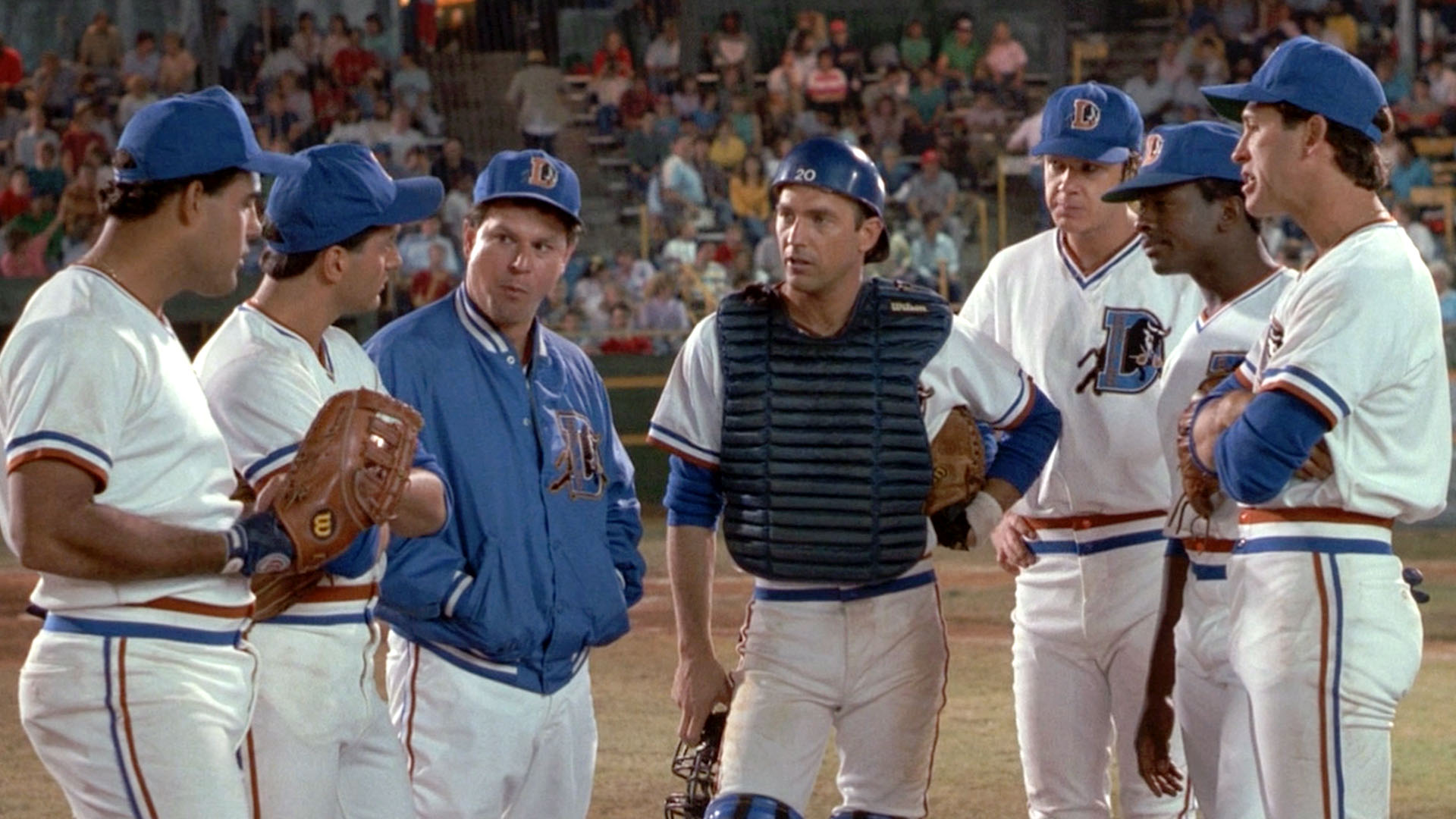
(The image accompanying this post, if you haven’t guessed, comes from Bull Durham, with Kevin Costner’s catcher Crash Davis being tossed from the game for arguing a call by an ump.)

Tuesday, October 9, 2018

Movie Quote of the Day (‘Bull Durham,’ on the Paradoxical ‘Church of Baseball’)


Annie Savoy [played by Susan Sarandon]: “Baseball may be a religion full of magic, cosmic truth, and the fundamental ontological riddles of our time, but it's also a job.”—Bull Durham (1988), written and directed by Ron Shelton

In the dog days of summer, baseball certainly can be a job, as Susan Sarandon’s lovable baseball groupie Annie Savoy indicates. But come October, it more closely resembles “the church of baseball” she hails in the classic movie’s brilliant opening monologue. 

Actually, at this time of year, a number of fans like myself come to believe that the ways of the Almighty are inscrutable. And still more long-suffering acolytes (Cleveland Indian fans, stand up!) are—perish the thought!—thinking there is no God!

Monday, July 15, 2013

Movie Quote of the Day (‘Bull Durham,’ on Strikeouts)


Catcher “Crash” Davis (played by Kevin Costner) to pitcher Ebbie “Nuke” LaLoosh (played by Tim Robbins): “Relax, all right? Don't try to strike everybody out. Strikeouts are boring! Besides that, they're fascist. Throw some ground balls - it's more democratic.” —Bull Durham (1988), written and directed by Rod Shelton

Yankee starter Phil Hughes might prefer the womanly charms of Annie Savoy, but right now he can sorely use the kind of attention bestowed by wise vet Crash Davis in Bull Durham.  At least Nuke LaLoosh was a strapping, wet-behind-the-ears kid not used to the “Show.” No such excuse exists for Hughes, who has been tantalizing Bronx Bomber fans with his potential for several years in the big leagues without measurably advancing.

Hughes’ last game showed his maddening inconsistency: 10 strikeouts, but also three pitches served up for home runs. He specializes in jumping out to two quick strikes on batters, then being unable to finish them off. Sometimes, his pitch counts rise so high that he’s lucky to make it out of the fifth inning. That, of course, tires the fielders behind him.

Now comes the news that the Colorado Rockies are interested in acquiring Hughes and converting him into a reliever. That, however, would solve only one of his problems: the need to develop several pitches to get him through a game. It doesn’t deal with a bigger one: an inability to learn from, and adapt to, experience. Even Nuke, with the help of Crash, learned that "heat" alone wouldn't punch his ticket to "The Show."

Sunday, August 5, 2012

A Hot Day Spent With the Ice-Cold Baby Bombers


Like Annie Savoy, Susan Sarandon’s wised-up voice of wit, wisdom and womanhood in Bull Durham, I fervently believe in “the Church of Baseball.” Unlike her, I’ve never paid attention to minor leaguers—till this past Thursday, that is, when I went on a company outing to Richmond County Bank Ballpark, home of the New York Yankees’ Class A minor-league organization, the Staten Island Yankees.

Bull Durham depicted how minor-league players pass the time, on and off the field, as they await what is all but certain to be a fleeting chance at “The Show.” At times during the Bronx Bombers’ recent struggles with the bat, I’ve speculated that it might be time to send some of the more maddeningly inconsistent miscreants back down to the farm team for some repentance and remedial work. (Moving runners around the bases without benefit of the long ball would be an essential place to start.)

After watching the so-called “Baby Bombers” in action in their Staten Island home, though, I’ve reconsidered. It’s not simply because the Eighth Amendment outlaws cruel and unusual punishment. More to the point, it would mean banishing the pampered, well-paid players to one of the most Stygian regions in all of professional baseball.

But we’ll get to that in a minute. First, a good word (I told you it wouldn’t take long!) about the minor-league experience in general, and the Staten Island Yankees in particular.

Let’s start with the location. You can get to the ballpark by car, if you’re so inclined, but on a sunny day I recommend the way that most of my co-workers and I took: boat.

The stadium is only a half-hour ride from lower Manhattan on the Staten Island Ferry. Even on the hazy day we experienced, the sight of the Statue of Liberty in the harbor—distant, regal and resplendent—is one of the continuing glories of America. And once you’re off the ferry, the park is within easy walking distance.

Don’t ever let anyone tell you differently: Yankee Stadium is the cathedral of sports, the closest that any franchise can come to duplicating the vast hallowed Gothic structures of Europe, with a frenzied playoff crowd emitting a sound as mighty as an organ leading a chorus and congregation at Christmas or Easter. But, especially if you’re in the farther reaches of the stands, you’re lucky to get a good look at players.

The atmosphere is much more intimate at Richmond County Bank Ballpark. The players are life-size, not ant-like, and you have an excellent view not only of the stadium but also of lower Manhattan off in the distance.

The players act as well as look more human here, too. Fans are permitted to get autographs from their heroes up to a half hour before game time. While fame and free agency may have inflated the egos or the assessment of the value of their signature of some in the Bronx, there’s no earthly reason why they won’t honor a request to sign a ball or program in Staten Island.

The way they’re going, though, there seems little chance that many of these “Baby Bombers” will ever have to be begged for their scrawls, let alone become a unit in any future major-league “Core Four.” At the game I watched—painfully—the Baby Bombers looked as if their energy were oozing with every passing minute in the noonday sun. They flailed helplessly at pitches, failed to hold runners close, misjudged fly balls that promptly sailed over their heads for extra bases, and misplayed relay throws from the outfield.

The result: an 11-3 loss to the Auburn Doubledays, the farm team of the Washington Nationals—their sixth straight defeat, and ninth out of their last 10.

In the past, such present or past Yankees as Robinson Cano, Melky Cabrera, Brett Gardner, and Francisco Cervelli got their start in Staten Island.  But one of the stadium workers acknowledged to me the obvious: that this was not one of the Baby Bombers’ better teams in recent years.

The Doubledays proved how the Nationals’ scouting operation has produced the likes of Bryce Harper and Stephen Strasburg, young players with the potential for major impact over a long period of time. The Baby Bombers have to be making Hal Steinbrenner wonder whether his strategy of clamping down on costs by refusing to pay top dollar for every player testing the free-agent market is going to lead to dog days in the Bronx in the next few years.

As the game dragged on, so did the attention of myself and my co-workers. Many—the saner ones—stayed out of the sun under the tent in right field, where the food (all you could eat!) was being dispensed. The rest of us, who decided to get a better view of the proceedings, roasted as the heat and humidity began to climb inexorably.

Throughout the game, I snapped dozens of pictures meant to capture game moments, or at least slices of life in the stands. But when I enlarged the images on my computer later, what stood out were all the empty seats.

There are a few ways of regarding that dismal sight:

*It’s a minor-league game, for God’s sake. Relax.

*Nobody’s going to take a personal or vacation day to spend hours on Staten Island. The real attendance figures to watch are the night games. If these are a problem…

*The Yankees have to come up with more creative promotions. Maybe they could take a page out of George Steinbrenner’s playbook and do something outlandish, like leaking to the media a denunciation of the manager, or threaten not merely firing the poor fellow but beheading him to bring out a crowd.

*With soaring temperatures and relentless humidity, be happy that anyone turned out on one of the dog days of summer to see how a team mired in last place in the New York Penn League McNamara Division (15 games under .500, 14½ games out of first place) proved how it got that way.

Tuesday, October 18, 2011

Movie Quote of the Day (“Bull Durham,” Mangling Otis Redding)

Nuke LaLoosh (played by Tim Robbins) (singing softly as he strums his guitar on the bus) “Oh she may get wooly, women do get wooly, because of all the stress…”--Bull Durham (1988), written and directed by Ron Shelton

Nuke’s teammate Crash Davis (played by Kevin Costner) does not approve of this--er, unique--version of the lyrics of “Try a Little Tenderness” at all, and he proceeds to dress down his wooly-minded pitcher about the real words. For the sour but smart “player to be named later,” it’s all a matter of R-E-S-P-E-C-T--for a classic soul song, for the unspoken rules of a beautiful game, and for “long, slow, deep, soft, wet kisses that last three days” with a beautiful woman.

The magic of Otis Redding can have this effect on people.

“Try a Little Tenderness” appeared on the soul singer’s Dictionary of Soul LP, released this week 45 years ago. Bing Crosby had sung this tune 30 years before, but by the time Redding was through, he owned it.

When Alan Parker directed his 1991 film about an Irish “soul” band, The Commitments, he correctly chose “Try a Little Tenderness” for the soundtrack. The song is played with all force possible, but it still doesn’t come close to Redding’s--which you can hear, in all its raw, incendiary live power, on the soundtrack for the 1967 Monterey Pop Festival.

A few years ago, I heard, Cuba Gooding Jr. had become attached to a biopic about the great soul singer whose life tragically ended in a plane crash less than two years after “Try a Little Tenderness.” Then…nothing. If screenwriter Joe Esterhaz is to be believed (a big if), it appears that Gooding couldn’t believe the script from the Basic Instinct and Showgirls scribe didn’t have enough sex.

Well, maybe Esterhaz wasn’t the best person for this project. But can you name a good film that Gooding’s made in, oh, the last five years?

It would be a shame if this project were in Hollywood Development Hell now. A new generation could be reminded of the magnificent talent that the music industry lost 43 years ago, but that some new Crash Davis, somewhere, will always find a way to revere.