


The $2 Bets That Ended a $5 Million Career
23 hours ago
About two weeks ago, with a short window of time to
get in and out of an area library during this pandemic, I came across a box DVD
set of the mid-1970s British miniseries The Pallisers, an
adaptation of six novels by Anthony Trollope.
College reading lists of Victorian literature are far
more likely to accommodate Charles Dickens, the Bronte sisters, and William
Makepeace Thackeray than this novelist who surpassed them all in productivity,
and by a long shot. (Even Dickens, with 15 novels, lagged far behind Trollope,
with 40.)
But I was enthralled by The Way We Live Now, in
which Trollope tracked the fortunes of a financial pirate who would have found
himself just as much at home in the Age of Enron, and had also enjoyed a couple
of novels in the Barsetshire sequence. So I pulled down from the library shelves, rented—and so far, have been
enjoying—The Pallisers series.
Even so, I suspected that the original print material
represented a rich source that the adaptation could not match. The passage above
demonstrates why.
In certain ways, that paragraph flagrantly violates,
with its ever-present narrator, that cliché of grad school writing programs,
“Show, not tell.” But I don’t mind in the least. The tone of the passage is
ironic (oh, those deflating "little words"!) without crossing into cynicism.
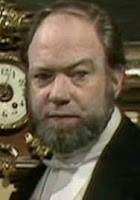
What print can convey, in a way that a visual often
can’t, is also underscored in the contrast between the image accompanying this
post—actor John Stratton, as Bott—and Trollope’s further description of the
character:
“He was a tall, wiry, strong man, with a bald head and
bristly red beard, which, however, was cut off from his upper and lower lip.
This was unfortunate, as had he hidden his mouth he would not have been in so
marked a degree an ugly man. His upper lip was long, and his mouth was mean."
Moreover, as a master realist, Trollope is, like Leo
Tolstoy, ultimately concerned with human nature—a subject that, I’ve come to
believe, changes little, no matter the age, place, or (as in this case) tonsorial style. Mr. Bott might be a Member
of Parliament in the Victorian Era, but in his cloying ambition and urge to
conquer, whether constituents or women, he has more than a few counterparts in
the U.S. Congress of the 21st century.
“Gracious to cold shoulders”—I’m not sure that I’ve
come across such a withering description of politicians. It is very easy to
imagine a modern Mr. Bott verging easily into sexual harassment.
Alice isn’t the only female to recoil in his presence:
her impulsive cousin and friend, Lady Glencora Palliser, does virtually nothing
to hide her distaste for him, despite being warned by her husband, Plantagenet Palliser,
that Bott is an ally to be cultivated for his own work and career in
Parliament.
Altogether, Trollope produced, for a relatively minor
character, a masterly description of a man who is pushy, smarmy, wheedling, odious, and
(to use a William F. Buckley Jr.-type word that expresses in sound exactly what
it intends) oleaginous—exactly the type, on either side of the Atlantic, meant
to stride briskly, like he owned the place, through the corridors of power.
(For an excellent summary of why The Pallisers miniseries,
despite a pace decidedly leisurely by today’s standards, remains “a reminder of
how satisfying television drama can be when writers, producers and directors
concentrate on emotion instead of editing, and don’t underestimate their
audience,” I urge you to read Neil Clark’s 2016 post in the “TV and Radio
Blog” of the British paper The Guardian.)


 "A man's mind will very gradually refuse to
make itself up until it is driven and compelled by emergency."— British
novelist Anthony Trollope (1815-1882), Ayala’s Angel (1880)
"A man's mind will very gradually refuse to
make itself up until it is driven and compelled by emergency."— British
novelist Anthony Trollope (1815-1882), Ayala’s Angel (1880)
 Sept. 15, 1866—Anthony Trollope, well into the serialization of his latest novel, overheard two
readers carping about one of his most popular
characters. Now in her fifth book, Mrs. Proudie, the domineering wife of the Bishop
of Barchester, struck this pair of clergymen as tiresome and clichéd. The big,
bearded, bellowing author walked across the drawing room of the Atheneum Club
to assure the astonished ministers that he would “go home and kill her before
the week is over.” And so he did.
Sept. 15, 1866—Anthony Trollope, well into the serialization of his latest novel, overheard two
readers carping about one of his most popular
characters. Now in her fifth book, Mrs. Proudie, the domineering wife of the Bishop
of Barchester, struck this pair of clergymen as tiresome and clichéd. The big,
bearded, bellowing author walked across the drawing room of the Atheneum Club
to assure the astonished ministers that he would “go home and kill her before
the week is over.” And so he did.


