
Showing posts with label Anne Applebaum. Show all posts
Showing posts with label Anne Applebaum. Show all posts
Wednesday, October 14, 2026
Quote of the Day (Anne Applebaum, on How a Good History Book ‘Defeats Expectations’)


Monday, November 17, 2025
Quote of the Day (Anne Applebaum, on American Culture, ‘No Longer Synonymous With the Aspiration to Freedom’)

By all
means, as you’re watching Ken Burns’ multi-part documentary on the American Revolution this week, please read as many articles as you can from The Atlantic’s
November issue, which is entirely devoted to “The Unfinished Revolution.”
In this year
of PBS budget cuts, Burns has been enormously careful in interviews not to
sound like he’s taking an ideological, let alone party, side. That won’t stop those
inclined from thinking he is indeed “woke.”
For those
like me who fear that he might pull his punches, The Atlantic will provide some
much-needed perspective, especially the pieces by Applebaum, Fintan O’Toole (“What
the Founders Would Say Now”), and David Brooks (“The Rising”). They remind us
that the commitment to equality and against despotism was a near-run thing 250
years ago, and perhaps even more so today.
Thursday, November 7, 2024
Quote of the Day (Anne Applebaum, on How Kleptocracies Spread From Russia)

With Donald Trump’s election to a second term, the United States has officially joined—or, I should say, rejoined—the ranks of the dubious global fraternity of kleptocracies—i.e., governments with leaders who seek personal gain and status at the expense of those they govern.
In an interview last month with Jeffrey Rosen at the National Constitutional Center, Applebaum not only discussed how the kleptocratic model exemplified by Vladimir Putin (pictured) operates in autocracies across the world, but also how it figures in the case of Trump, whose “primary concern at all times is himself and his own finances and his own power.”
Even while President, Applebaum notes, the autocrat-curious politico maintained the practice he’d begun in his days as a New York real estate mogul of selling condos in Trump-branded or Trump-owned buildings to anonymous people, whose intentions—including whether they were out to bribe or influence White House officials—were unknown.
The potential for conflicts of interest was clear, a situation only worsened by how Trump flouted prior Presidential procedures for blind trusts. Though ostensibly turning over management of the Trump Organization to his two eldest sons after becoming President in 2017, he still received updates on the family-owned trust and remained its chief beneficiary.
Just as the Former and Future Guy made a farce of the notion of a “blind trust,” the Supreme Court did so with the belief that justice is blind.
In a preview of its extraordinary deference in this past session in granting Trump broad immunity from prosecution for “official acts,” the Roberts Court dismissed in 2021 two cases involving his violations of the Constitution’s “emoluments clauses” for preventing Presidential corruption. (See Ciara Torres-Spelliscy’s excellent summary from that time for the Brennan Center for Justice.)
I have taken particular interest in Trump’s use of the U.S. government as a virtual slot machine for the Trump Organization because one instance of it occurred not far from my family’s ancestral homeland in County Clare, Ireland.
In September 2019, taxpayers footed a $15,000 bill for Secret Service lodging for Vice President Mike Pence’s trip to Ireland. The lucky beneficiary of this largesse? Trump’s Doonbeg resort, which he had already spent $41 million to buy, renovate and operate without returning a profit to that point.
It was all part of a pattern in which Trump made $82 million from his three properties in Ireland and Scotland through often convoluted and unnecessary travel itineraries and exorbitant tacked-on charges, according to Rebecca Jacobs’ June 2023 report for the ethics watchdog organization Citizens for Responsibility and Ethics in Washington (CREW).
Even while in office, the Trump Organizations
maintained ethically and legally questionable investments involving Trump
International Hotel, New York’s Trump World Tower, Dubai’s Trump International
Golf Club, trademarks in China, and royalties from The Apprentice and
its spinoffs in multiple countries.
Then, while Trump planned his return to power, son-in-law Jared Kushner, while publicly withdrawing from campaign appearances, secured a $2 billion investment from a Saudi Arabian fund led by Crown Prince Mohammed bin Salman, as well as $157.5 million in management fees from foreign investors for work expected to be completed in 2024.
Let’s stop for a second on that last item. Mohammed bin Salman—you may remember him as “MBS,” the shadowy potentate credibly charged with ordering the October 2018 assassination of Saudi journalist Jamal Khashoggi.
Is it necessary to spell out the obvious implications of the Kushner deal for diplomacy and influence peddling?
The naturalist writer Frank Norris titled his 1901 novel of corruption by a massive railroad conglomerate The Octopus. With the resounding victory of MAGA forces this week, American voters have given carte blanche to the Trump Octopus.
Presidents' financial misdeeds are not as easy to understand as their infidelities, but they are more important to know if we hope to grasp how the long-term interests of the American people can be subverted.
Despite Trump’s war against the group he calls “the enemy of the people,” the press
owes it to the republic to continue and even amplify its reporting on the
President-elect’s festering corruption—and Americans in turn owe it to themselves
to pay attention and act accordingly.
Saturday, January 8, 2022
Quote of the Day (Anne Applebaum, on the Business Links Among Dictators)
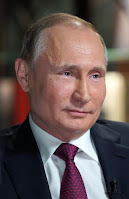
“Unlike military or political alliances from other
times and places, the members of this group don’t operate like a bloc, but
rather like an agglomeration of companies—call it Autocracy Inc. Their links
are cemented not by ideals but by deals—deals designed to take the edge off
Western economic boycotts, or to make them personally rich—which is why they
can operate across geographical and historical lines.”—American journalist Anne
Applebaum, “The Autocrats Are Winning,” The Atlantic, December
2021
Russia’s Vladimir Putin—featured prominently in
Ms. Applebaum’s informative and disturbing cover story of last month’s issue of
The Atlantic, as well as in the photo accompanying this post—might not lead
a sprawling international bloc dedicated to one ideology, the way Soviet
dictators for most of the 20th century did.
But he is certainly a charter member of and
inspiration for what Ms. Applebaum calls “Autocracy Inc.” Combining the black
arts of disinformation and dissent-crushing he learned while in the KGB with the
realization that capitalism provides rich new opportunities for corruption that
can sustain him in power, he has pioneered the most disturbing form of top-down
control seen so far in the 21st century.
In judging the value of American politicians and pundits,
it’s not a bad yardstick to see which ones have continued to hail Putin for his
strength (as discussed in Jonathan Chait’s March 2021 piece for New York
Magazine), even as his methods of corruption, harassment and murder have
become all too brazen.
Saturday, September 7, 2019
Essay: The Parallel Transatlantic Crises

“I’ve so far resisted these comparisons, but now
Britain’s political crisis [i.e., Boris Johnson 'proroguing' Parliament for more than a month, in an unprecedented move to
short-circuit discussion of his 'no-deal' Brexit] really does resemble the
parallel crisis in the United States. A ruthless executive is pushing the outer
bounds of what is constitutionally possible in order to achieve unpopular
outcomes. A ruling party that is afraid for its own electoral future is shamefacedly
supporting him. A divided opposition seeks to block him but doesn’t have a
popular leader itself. A conservative party is using populist slogans that
undermine national institutions. Old precedents and customs are being abandoned
at great speed, leaving only a vacuum in their wake.”—Anne Applebaum, Washington Post, Aug. 29, 2019
There are even more parallels not mentioned by Ms.
Applebaum between Boris Johnson and Donald Trump:
*Both are tonsorially challenged clowns with neither
executive ability nor respect for truth, perpetrating breakdowns in their country’s essential legislative function.
*Both Trump and Johnson lead a base worried by deteriorating order and challenges to traditional values, despite these "populists" own extremely untidy
personal lives.
*Both came to power by emerging from the
socioeconomic flotsam of the 2007-09 Global Financial Crisis, exploiting the
fears of foreigners left in its wake.
*Both found their causes aided by trolls and bots
associated with Russia (yes, the British are investigating how Putin propaganda aided the Brexit campaign, according to this NPR interview with Jane Mayer; as for Trump, not one of the President’s
most raucous defenders can explain the extraordinary coincidence of Russia
releasing the Wikileaks files on Hillary Clinton less than 24 hours after The
Donald urged it to do so).
*Both are calling for stronger trade ties between
their countries, as a seeming counter-move against the Economic
Union (EU)--a strategy that plays into Putin's hopes of undermining economic and military alliances.
*Both the Trump and Brexit campaigns used Steve
Bannon as their scurvy strategist.
*Both leaders have created a ruckus over border
security: Trump, by squawking about a wall with Mexico (and even transferring
Defense Dept. money for other projects to try to speed its construction);
Johnson, by ignoring concerns that lack of a EU “backstop” would doom the
fragile tranquility prevailing in Northern Ireland since the Good Friday
Agreement two decades ago.
*Both have crashed through unwritten rules of law
and conduct that restrained predecessors in their countries’ highest office.
*Both have a penchant for insult: Johnson derided opposition
leader Jeremy Corbyn as “you great big girl's blouse," while Trump has
insulted someone on Twitter pretty close to every day.
*Both now pose a fundamental threat not just to the
economy and governance of their countries, but to the faith that other nations
place in the U.K. and U.S. as birthplaces of liberty.
So far, only one major difference exists in the
ascent to power of Trump and Johnson: In the latter’s first week in office, a
coalition of 21 Conservative Party Members of Parliament—including former
Cabinet ministers—allied with the opposition to force him to make a Brexit deal
or request another extension till early 2020. No such public, principled cohort
has emerged to restrain Trump.
Over the years, I have been critical of much British
governmental policy (including its misbegotten colonial legacy), but this week,
I have to tip my hat to a legislature that, unlike ours, has enough members who
refuse to be bullied into meekly abdicating their time-honored responsibilities.
(Photo of Boris Johnson taken as an MP, July 27,
2016.)
Subscribe to:
Posts (Atom)


