Showing posts with label World War II. Show all posts

Saturday, March 21, 2026

Quote of the Day (Len Deighton, on What Led Him to Write Spy Fiction)

“I was 10 when World War II started. My parents were servants. We lived in a tiny mews house in central London. Our neighbor Anna Wolkoff was the daughter of a czarist admiral. We knew her. My mother sometimes cooked for her dinner parties. I remember her arrest, late at night. The police came. I watched out the window with my parents. We learned she was a spy. Antisemitic. A Nazi sympathizer. My dad fought the Germans in the trenches in World War I. In 1939 he commanded a civilian first-aid post. Anna’s betrayal had a profound effect on my family.”—British novelist Len Deighton (1929-2026), quoted in “By the Book: Len Deighton,” The New York Times Book Review, June 25, 2023

Like fellow spytale spinner John le Carre, Len Deighton—who died earlier this week—found in the genre a vehicle for exploring his childhood memories of trauma. In le Carre’s case, the trauma was inspired by his con man father, a cause of such embarrassment to the son, even into middle age, that it inspired his novel A Perfect Spy.

For Deighton, as indicated by the quote I’ve used, personal betrayal and the trauma it came from Anna Wolkoff. I couldn’t read about her case without seeing this as a British version of the spy-next-door cable drama of the 2010s, The Americans, starring Keri Russell.

Deighton might be known best for several espionage trilogies (e.g., the “Harry Palmer” books and the so-called “Game Set Match” sequence) that, like le Carre, de-romanticized the business of spycraft set out in Ian Fleming’s James Bond tales.

But the nightmare possibility created by Wolkoff—what if she and others like her had helped pave the way for a Nazi takeover of Britain?—may have inspired his 1978 foray into speculative fiction, SS-GB.

That novel is part of a small but intriguing genre of alternative history in which the Nazis remained in control of Europe, including:


*The Man in the High Castle, by Philip K. Dick;
*Fatherland, by Robert Harris; and
*Dominion, by C. J. Sansom.

Sunday, February 15, 2026

This Day in British History (Birth of Brendan Bracken, Diehard Churchill Ally)

Feb. 15, 1901— Brendan Bracken—a mysterious figure who, despite being three decades younger than Winston Churchill, became his closest friend and Minister for Information in his wartime Cabinet—was born in Templemore, County Tipperary, Ireland.

A lanky, bespectacled redhead with charm and energy to spare, Bracken was hard to miss in any assembly. But, if people had no trouble picking him out, they had plenty in figuring him out. 

Who was he? Where did he come from? How had he become so indispensable to Churchill? Why was there a break in their relationship for five years before Bracken re-committed himself to his mentor in the latter’s darkest political hours?

For a long time during his rise in business and politics, even the last part of that first sentence above—about Bracken’s date and place of birth—would have been murky. 

The truth was that Bracken’s father, a well-to-do builder and member of the Fenian brotherhood that sought Irish independence, died when Brendan was three and that his stepfather years later was likewise of republican sympathy.

But by his teens, Bracken was acting so wildly that his mother packed him off to a Jesuit boarding school in Dublin and, when that effort to curb him failed, even further, to a similar institution in Australia.

At age 18, with Ireland plunged into its war of independence from Britain, Bracken was back in Dublin. He embraced his mother’s Unionist sympathies but not her Catholic faith. In the next several years, he not only rejected his Irish identity but bewildered former and newfound acquaintances by denying he had one, passing himself off as Australian. 

At various times, he also changed his age when the circumstances were advantageous and claimed that a brother had died when actually, like all family members except his mother, Bracken was estranged from him.

In 1923, the most important event in his life occurred when he met Winston Churchill. That December he organized Churchill’s unsuccessful General Election race as a Liberal in Leicester West, then another, four months later, as an independent. Finally by the end of 2024, Churchill won a safe seat in a return to the Conservative Party he had abandoned 20 years before.

An astonishing rumor, fed as much by the pair’s close relationship as by the red hair they shared, was that Bracken was his chief’s illegitimate child. The aide not only didn’t deny it but, some suspect, may have even spread the gossip. 

Churchill’s wife Clementine, already fuming that her husband's newfound friend was sleeping in the house with his feet up on the sofa, demanded answers, only to be blithely assured by the great man, “I looked it up, but the dates don’t coincide.”  

Though the rumor was untrue, it's hard not to think of the two men as surrogate family members. Bracken was more responsible, even-tempered and helpful than Churchill's choleric and alcoholic son Randolph. And in Churchill, Bracken found something of a father figure, an affectionate presence who fully shared his Unionist, even imperial, sympathies.

With Churchill’s return to the House of Commons, their paths diverged for a time, with Bracken displaying a talent for finance and business management. He became a publishing mogul, becoming chairman of the Financial News in 1928 and, 17 years later, merging it into The Financial Times, making that paper with its distinct paper color the institution it remains.

This business acumen and journalistic influence became indispensable to Churchill by the end of the decade, when this lifelong politician struggled through the decade known as his “Wilderness Years,” the period when, his relentless ambitions stymied, he was without a Cabinet post, a mere back-bencher.

In 1929, having won election as a Conservative in the North Paddington seat, Bracken allied himself again with Churchill, becoming for the next 10 years a foul-weather friend who stood by him in his lowest political and financial moments.

It was bad enough that Churchill found himself out of step with Conservative leadership on Indian policy, King Edward VIII’s abdication crisis, and appeasement towards Nazi Germany. But his spendthrift habits put him continually in financial danger.

In 1938, press baron Max Beaverbook, disapproving of Churchill’s increasingly dire warnings about Adolf Hitler’s rearmament campaign, terminated his contract for writing an Evening Standard column. 

Without this desperately needed source of funds, a despondent Churchill made plans to sell Chartwell, the home into which he had poured so much of his money.

It was Bracken who came to his rescue by having his associate Sir Henry Strakosch buy Churchill’s American stocks at their original purchase price and pay him interest to boot.

Strakosch performed similar financial magic in 1940, as Churchill moved to the forefront of the movement to fight the Nazi war machine no matter the cost.

Had these arrangements been revealed at the time, they might have opened Churchill up to attempts to discredit his wartime efforts—as indeed has happened now from the American far right, with Darryl Cooper labeling Churchill “the “chief villain of the Second World War” in an interview conducted by Tucker Carlson.

Bracken was as instrumental in ensuring that Churchill finally became Prime Minister as he had been in keeping him from declaring bankruptcy. 

With Neville Chamberlain’s leadership fatally undermined by a closer-than-expected no-confidence vote in the House of Commons, Churchill told Bracken he was willing to serve under Chamberlain’s desired successor, Foreign Secretary Lord Halifax. 

Bracken got his friend to remain silent in the high-level meetings if Halifax were proposed to lead the new government. In the end, Halifax, saying it would be difficult to lead the war effort as a House of Lords member, left the field effectively open to Churchill.

In 1941, Churchill named Bracken his Minister of Information—in effect, in charge of wartime propaganda. Two authors distinctly unimpressed by what they learned about Bracken at close range in the war obliquely targeted him in their novels.

Evelyn Waugh told future biographer Christopher Sykes that Brideshead Revisited’s Rex Mottram was his only character fully drawn from life. Though he tried to disguise the source by making Mottram a Canadian, other details—notably, the character’s colonial origins, opportunism, overwhelming business success, and lack of devotion or even interest in Catholicism—pointed towards Bracken. 

And George Orwell was so incensed by the restrictions under which he labored in Bracken’s Ministry of Information, it was said, that he was inspired to create Big Brother in 1984, with the character’s kinship with the politico hinted at in their initials: B.B.

Churchill’s landslide defeat in the 1945 General Election—in a campaign not helped by Bracken’s advocacy of an overly negative, partisan tone—left the two men out of power.

When Churchill returned to Downing Street six years later, Bracken announced that ill health precluded his continuation in politics. But he was not done serving his mentor and hero.

In June 1953, Bracken joined the Prime Minister’s inner circle in covering up the news of Churchill’s massive stroke, claiming only that the leader required “complete rest” for a while, ensuring that there would be no accurate UK coverage of the problem. 

It wasn’t until a year passed that Churchill, having made a great recovery in the meantime, gave even a hint of his health crisis.

By this time, the health of Bracken himself, a lifelong chain smoker, was in more serious danger. Upon hearing the news of the death of his stalwart friend in 1958 from lung cancer, Churchill lamented the loss of “poor, dear Brendan.”

Tuesday, January 31, 2023

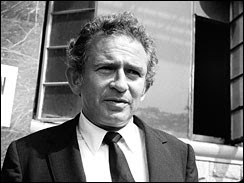
This Day in Literary History (Norman Mailer, Controversial 2-Time Pulitzer Winner, Born)

Jan. 31, 1923— Combative in war and peace alike, Norman Mailer, who won Pulitzer Prizes for two works that straddled fiction and nonfiction, The Armies of the Night and The Executioner’s Song, was born in Long Branch, NJ.

With his first novel, The Naked and the Dead, Mailer, along with Irwin Shaw (The Young Lions) and James Jones (From Here to Eternity), formed a trio of WWII veterans who wrote sprawling fictional accounts that attempted to capture both their personal experiences and the disruptive impact of the conflict on American servicemen.

The three measured themselves against Ernest Hemingway’s achievement with A Farewell to Arms. But most critics agree that, despite massive sales, none matched the impact of that landmark WWI novel.

At this point, Jones’ account is best remembered indirectly, through the 1953 Best Picture Oscar-winning film adapted from it. Shaw, producing novels commercially successful if uneven in quality, has found a secure niche for his many superb short stories.

Mailer’s case for literary posterity is trickier. His ambition and bravado were every bit as immense as his talent. He was never afraid to dare greatly, even if he risked looking foolish—which he did, repeatedly, and with all too few signs of having learned from his experiences.

David Denby’s December critical reappraisal of Mailer in The New Yorker argued that the novelist never really got over the war, in which his military service forced a never-ending feedback loop with an aggressive stance against the postwar world:

“The enormous success of The Naked and the Dead left Mailer uneasy. He had no idea how he was going to live up to it. Seemingly on top of the world at twenty-five, he feared many things. In his novel, the Harvard-educated liberal allows himself to be trapped by power. Mailer, in his own eyes, needed to escape the traps not only of his soft middle-class Jewish background but also of postwar America--the desire for ‘security,’ the endless consumerism, and what he took to be the country's humiliating spiritual mediocrity. It's as if he were still in the jungle, pulling artillery through the night. He had made himself into a novelist in the Pacific, and now he brought the war home, fighting on two fronts—against what he disliked in himself and against those menaces of the nineteen-fifties, ‘conformity’ and ‘adjustment.’ He acted out his rebellion in a continual performance with phallus, fists, booze, and sustained ass-in-chair writing sessions—a pressure at times noble, at times foolish, and certainly rough on other people as well as on himself. He became an egotist of a peculiarly self-afflicting sort, both calculating and spontaneous, provoking many blows, all of them deserved, all of them welcomed. For the author of The Naked and the Dead, the truce never arrived.”

At his best, in person, Mailer could make self-deprecating jabs at his considerable ego and awe listeners with jeweled phrases that came effortlessly to hand—as I witnessed firsthand when I covered his appearance in a seminar at Columbia University’s Writing Division in the School of the Arts back in February 1981.

*He thought while writing The Naked and the Dead that it was "the greatest book since War and Peace and maybe even better," but now admitted wryly that his idea of the book "was higher than it deserved.”

*He chuckled at Truman Capote’s claim that he relied on his photographic memory in lieu of taking notes for In Cold Blood: “I love Truman Capote in 82 ways, but he's a terrible liar. I know he doesn't remember conversations we've had two or three days ago."

*He had used point of view in his own work either as an obtrusive ego, "a burning type of light," or an invisible, disembodied "voice coming over the hill."

At the same time, Mailer pointed out a reason for both his remarkable productivity starting in the 1960s and his prodigal misuse of this creative energy: “I made three movies in the Sixties—directing, writing, and starring in them—and they all failed. I lost $300,000. I've been in debt ever since."

As Mailer was telling the writing students this, he was only months away from a supporting role in yet another movie: philandering architect and murder victim Stanford White, in Milos Forman’s adaptation of E.L. Doctorow’s Ragtime.

One can’t resist thinking that Mailer identified with the intersecting creativity, lust and violence in this figure at the heart of one of the most notorious scandals in early 20th-century America. If he had never equaled Hemingway’s feat of fashioning a virtually new writing style, he had Papa beat in the number of wives (six versus four) and children (nine versus three).

(Knowing the wink-wink style of so much of the Gilmore Girls TV series, I can’t help thinking a similar spirit was at play when it titled one episode, “Norman Mailer, I’m Pregnant!”)

Besides a scandalous private life, another major factor that may ultimately lower his critical reputation could be the baggy monsters of novels that he cranked out starting with The Executioner's Song: Ancient Evenings, Harlot’s Ghost, and Oswald’s Tale.

Over 30 years ago, while interviewing for a copyediting job at a magazine with a reputation for publishing high quality, I was told by a senior editor just how far my authority would extend: “You’ll have to keep in mind who you’re dealing with when you make suggestions in a manuscript. Listen: Norman Mailer will make more from a single article here than you will with your entire yearly salary.”

How many editors, even ones with considerably higher reputations than I would have had starting out, shied away from battling with Mailer? They could go mano-a-mano line by line, chapter by chapter with a manuscript, or they could watch him take his wares to someone else willing to let him write whatever tripe he liked. Neither alternative was appealing.

But with the novelist dead 15 years now, The Mailer Wars are beginning in earnest now.

On one side you have broadsides like this from “One-Way Street” blogger Richard Prouty, who, after Mailer’s death in 2007, predicted that his influence would be “nil” and saw “his only truly original creation” being “journalism mixed with self-aggrandizement, a combination…that can be described as literature as performance art.”

On the other side are defenders like English and film professor Phillip Sipiora, who calls Mailer “arguably the foremost public intellectual of the second half of the twentieth century,” and Denby, who writes that it would be “naïve to pretend that he was not a great American writer.”

My own initial instinct, given the sheer quantity of bad, even idiotic, work Mailer produced over nearly six decades in the public eye, is to lean closer to Prouty than Denby or Sipiora.

But it might be more accurate to see him as a kind of American literary counterpart to the actor Richard Burton, another creative figure who wasted his overwhelming talent in scandal and never-ending substandard projects meant to satisfy his craving for fame and money.

An unblinkered assessment would find that, like Burton, Mailer could, at moments, with his energy focused tightly on work at hand, rank with the very best of his contemporaries.

The Armies of the Night may have the best chance of any of his works of continuing to be read and re-read. It masterfully balances opposites: fiction and nonfiction, comedy (his own larger-than-life persona, enlarged even further through referring to himself in the third person) and the deepest seriousness (the stakes of a government not called to account for its mishandling of the Vietnam War), and the yawning, increasingly unbridgeable divide between the student protesters and the working-class soldiers and marshals facing off against them in front of the Pentagon—a harbinger of today’s “woke” left and Trump voters.

And there is the sheer exhilaration of Mailer's high style in passages like this:

“Arrayed against them as hard-core troops: an elite! the Freud-ridden embers of Marxism, good old American anxiety strata—the urban middle-class with their proliferated monumental adenoidal resentments, their secret slavish love for the oncoming hegemony of the computer and the suburb, yes, they and their children, by the sheer ironies, the sheer ineptitude, the kinks of history, were now being compressed into more and more militant stands, their resistance to the war some hopeless melange, somehow firmed, of Pacifism and closet Communism. And their children—on a freak-out from the suburbs to a love-in on the Pentagon wall.”

Saturday, May 21, 2022

Quote of the Day (Helen Lawrenson, on the Unheralded Merchant Seamen of WWII)

“There is no doubt about it, the merchant seamen took it on the chin during the first half of this year —with no guns, no patrols, antiquated lifebelts, and practically no safety precautions. They were sent out as helpless targets for the subs; but their morale was as magnificent as it was unheralded. That precautions are now being taken to protect them doesn't detract from their courage….

“Those who have been torpedoed and rescued ship right out again as soon as they can get out of the hospital.  That takes plenty of nerve, but the merchant seamen have it. They don't get much publicity, and you seldom hear anyone making speeches about them. They don't get free passes to the theater or the movies, and no one gives dances for them, with pretty young actresses and debutantes to entertain them. No one ever thinks much about their "morale" or how to keep it up.  It was only recently that a bill was passed to give them medals.  And because they wear no uniforms they don't even have the satisfaction of having people in the streets and subways look at them with respect when they go by.”— American editor, writer and socialite Helen Lawrenson (1907-1982), “ ‘Damn the Torpedoes!’”, originally published in Harper’s Magazine, July 1942, reprinted in Reporting World War II: Part One: American Journalism, 1938-1944 (Library of America anthology, 1994)

Perhaps because of husband Jack Lawrenson, the charismatic co-founder and leader of the National Maritime Union, Helen Lawrenson—previously known for her writing about New York society in the 1930s—wrote with marvelous empathy for the sacrifices and heroism of the American merchant marine in WWII.

At the time Lawrenson reported on these sailors for Harper’s in May 1942, U.S. merchant vessels had, through the first four months of the year, endured more than 100 attacks by German U-boats off American coasts. Nearly 1,000 seamen were killed during this time. Even after precautions were finally taken, an average of five or six of these boats were sunk in April alone.

The image accompanying this post—a recruitment poster from 1944—illustrates these men’s grim determination in the face of all hazards.

Much has been written over the years about the “The Greatest Generation” who served in the armed forces during WWII, and I hope to blog more about them myself in the future.

But the merchant seamen in the war faced their own perils in hauling vital cargo in the conflict, and for years their bravery went comparatively unrecognized (the likes of Lawrenson excepted).

Estimates for the number of these men who lost their lives in the war ranged from 6,000 to 9,000, and the survivors of these attacks would not soon forget the fire, explosions, runs for their lives, circling sharks, and floating in open water after their boats were hit.

They couldn’t forget all that—and neither should we. While Lawrenson’s article gives an excellent contemporary account of their dangers and courage, William Geroux’s May 2016 piece for Smithsonian Magazine offers a longer-term perspective on what we owe them.

Tuesday, December 7, 2021

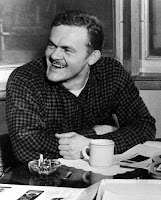
This Day in Literary History (James Jones Survives Pearl Harbor to Pen ‘From Here to Eternity’)

Dec. 7, 1941—The Japanese attack on Pearl Harbor left roughly 2,400 American dead. But one witness in the 27
th Infantry Regiment at nearby Schofield Barracks, Private James Jones, lived to write a bestselling novel about that tragic day and the world it brought to a violent end, From Here to Eternity.

As he recalled what he was doing that dawn 80 years ago in World War II: A Chronicle of Soldiering:

“On Sunday mornings in those days there was a bonus ration of a half–pint of milk, to go with your eggs or pancakes and syrup, also Sunday specials. Most of us were more concerned with getting and holding onto our half–pints of milk than with listening to the explosions that began rumbling up toward us from Wheeler Field two miles away. ‘They doing some blasting?’ some old–timer said through a mouthful of pancakes. It was not till the first low–flying fighter came skidding, whammering low overhead with his MGs going that we ran outside, still clutching our half–pints of milk to keep them from being stolen, aware with a sudden sense of awe that we were seeing and acting in a genuine moment of history.”

Three decades later, Jones still remembered a Japanese pilot’s toothy grin showing through goggles as he strafed the base; Battleship Row, a “living inferno” where men, “precipitated into full–scale war without previous experience and with no preparation, performed feats of incredible heroism and rescue that seemed unbelievable later”; and, from a distance, Pearl Harbor itself, with “the huge rising smoke columns high in the clear sunny Hawaiian air for miles.”

A 20-year-old assistant clerk with aspirations of becoming a writer, Jones gained enough material from his wartime experience for a three-decade career. But his rookie effort was the one that brought him the greatest success, not only netting him the National Book Award in 1952 but becoming the basis of the Oscar-winning film that has continued to keep his characters in the public eye.

Despite having read Jones’ first novel and being generally familiar with the outlines of his subsequent career, I was unaware of many details of his Army experience until I read Roy Morris’ fine article, “Before Eternity,” in the Autumn 2021 issue of MHQ.

I did not know, for instance, that Jones not only based many of his characters in the novel on soldiers in his own unit but also that in several cases, he used only minimal means of veiling their identities (e.g., not even bothering to change their surnames, in some cases).

I was midway through high school when I read Jones’ blockbuster. It was the time of my life when, with the magic combination of the fewest responsibilities and the most energy, I could spend time with many, often long, books.

Even so, I felt my attention severely strained by a novel that, for more than 800 pages, qualifies as a true doorstop. In fact, it could be argued that, for all its concessions to the censorship code of the early 1950s, Daniel Taradash’s screenplay effectively channeled the essentials of Jones’ sprawling plot.

For all the honesty and ambition of Jones’ first published work of fiction—his attempt to depict an entire complex community—it lost much in terms of economy and artistic control. This might have been part of the reason why his best-known literary achievement has not had the same staying power of Ernest Hemingway’s influential novel of World War I, A Farewell to Arms.

In a profile I wrote for my college newspaper years ago, Frank MacShane joked that he had been labeled “the biographer of the stepchildren of literature” for writing about critically underrated authors. Although his reclamation efforts have borne some fruit in the case of John O’Hara and considerably more for Raymond Chandler, he did not produce a similar widespread revival of interest with his 1985 biography of Jones, Into Eternity.

Nevertheless, From Here to Eternity retains considerable value. Readers prepared to look beyond the pair of romances involving Sgt. Milt Warden, Karen Holmes, Private Robert E. Lee Prewitt, and Alma Burke will find both a visceral picture of the peacetime army before America became a world power and a shocking treatment of a military establishment rife with institutional corruption and abuse of power 

Jones would have none of the “Good War” mythology already taking place in the postwar period. He was intent on delivering a decidedly unromantic rendering of the caste system in the military. This novel and the two others that formed his “World War II Trilogy,” The Thin Red Line and the unfinished Whistle, reflected his belief that “In every war there were two wars, the war of the officers and the war of the enlisted men.”

Thus, while officers in that pre-war period might attend clubs where they would even present calling cards, enlisted men would face overwhelming pressures to conform and arbitrary discipline that could land them in brutal stockades.

In the latter respect, From Here to Eternity functions as what today might be seen as a dissection of toxic masculinity. Females are cheated on and exploited; officers look the other way or even encourage bullying (including pressure by Karen Holmes’ husband, the commanding officer in the unit, to induce Prewitt to join the boxing team); and enlisted men endure tedium that can suddenly transform into after-hours barroom fisticuffs and back-alley knife fights.

Within a year, Jones would be not just a witness to war but also a combatant, participating in the Guadalcanal campaign. His experience there—killing with a bayonet two Japanese soldiers—unsettled him. Wounded in early 1943, he underwent extensive medical treatment at a military hospital before being honorably discharged the following year.  

Although Jones’ physical wounds were visible, his psychic ones—what we would call today post-traumatic stress disorder—were less so. His alcoholism, his daughter Kaylie contended in her memoir Lies My Mother Never Told Me, combined with the malaria he contracted in the war to produce the heart condition that ended his life in 1977. 

The school of realism to which Jones belonged may seem less attractive to modern readers than the surrealism of Joseph Heller’s Catch-22 and Kurt Vonnegut’s Slaughterhouse Five. But Jones is just as critical in his way of the military as a soul-killing institution that even destroys its most dedicated members than these two other World War II novels. Clumsy and even artless as From Here to Eternity can seem at points, it also remains vibrant because of Jones’ fierce commitment to truth.

One of Jones’ most eloquent advocates is Joan Didion. Though her exacting, sometimes minimalist style can appear light years away from Jones, she wrote a deeply moving appreciation of the veteran-turned-novelist not long after his death in her essay “In the Island,” published in her collection The White Album:

“A place belongs forever to whoever claims it hardest, remembers it most obsessively, wrenches it from itself, shapes it, renders it, loves it so radically that he remakes it in his image, and not only Schofield Barracks but a great deal of Honolulu itself has always belonged for me to James Jones.”

Tuesday, November 10, 2020

Photo of the Day: World War II Memorial, Washington DC

The debt owed by Americans to the Greatest Generation is enormous. The scope of World War II—a global conflict requiring an all-out effort on the homefront, the service of 16 million members of the U.S. armed forces, and the ultimate sacrifice of more than 400,000 of these Americans—is staggering.

So is the World War II Memorial, designed by the former chief of the Rhode Island School of Design, Friedrich St. Florian, and dedicated in 2004. I visited it nine years later, when I took this photo of its Rainbow Pool with its impressive fountains.

In keeping with this sprawling conflict, this DC site is immense, with 24 bronze bas-relief panels and granite columns telling the story of the Atlantic and Pacific Theaters.

I particularly like this quote inscribed in this stone architecture by President Harry S. Truman, in an address broadcast to the armed forces on Apr. 17, 1945:

“Our debt to the heroic men and valiant women in the service of our country can never be repaid. They have earned our undying gratitude. America will never forget their sacrifices.”

Thursday, September 3, 2020

This Day in Media History (Marguerite Higgins, First Woman to Win Pulitzer for International Reporting, Born)

Sept. 3, 1920—Marguerite Higgins, who overcame the rampant sexism of her time and profession to become the first female winner of the Pulitzer Prize in International Reporting, was born in Hong Kong, in the Asia-Pacific Rim where she would establish much of her reputation.

In the Library of America anthology Reporting World War II, Higgins was the last by birth among the approximately 80 writers represented. A day shy of 25 when Japan formally surrendered, she reported on some of the major stories coming out of the latest six months of the European conflict: the refugee crisis and the liberation of the Buchenwald and Dachau concentration camps.

These would have been great scoops for any reporter. They were extraordinary for a recent graduate of the Columbia Graduate School of Journalism and a woman in an unrelieved, unapologetic masculine environment.

But it was in Asia—specifically, in Korea and Vietnam—where Higgins advanced closer to achieving her stated post-collegiate goal of becoming more famous than Dorothy Thompson, perhaps the most influential female journalist of the day. How she moved towards her goal has made her the subject of speculation and even controversy ever since.

Stationed in Tokyo as the New York Herald Tribune’s Bureau Chief, Higgins was ideally situated to cover the outbreak of hostilities in Korea in 1950. Despite her credentials as a war correspondent in WWII, she was initially ordered out of the country by Gen. Walton Walker.

Only a direct appeal to Douglas MacArthur, who had become Commander in Chief of the United Nations Command in Korea, enabled her to report on the conflict. She joined MacArthur's troops on the daring invasion at Inchon that, for a time, changed the direction of the war. In fact, she was the only female reporter to land on Red Beach (“a rough, vertical pile of stones”) with the men.

The Pulitzer Prize committee cited Higgins’ "enterprise and courage" in her coverage of the campaign, noting that she deserved "special consideration by reason of being a woman." But even as she was winning a new level of renown, she was stirring animosity among the largely male cadre of war correspondents that would dog her even beyond her early death.

Thousands of readers were amazed at how Higgins smashed through conventions that restricted women’s chances for achievement; a smaller cadre of colleagues were disgruntled at how they believed she ignored traditional ethical codes in pursuit of her laurels. It is still not easy sorting through these issues more than a half-century after her death.

While displaying outward bravado, Higgins was inwardly driven by an insecurity so unrelenting that it manifested itself as bravery so extreme that some males believe it shaded into foolhardiness. (Among them was Herald Tribune colleague Homer Bigart, who, like Gen. Walker, wanted her out of the country--leading not just to heightened competition between the two journalists but also to a closely watched feud between the two.) 

Such aggressiveness might be taken for granted among male reporters but were eyed critically when exhibited by females—and led to speculation that Higgins was not above stealing colleagues’ scoops.

Another serious charge against her arose from her good looks. Anyone glimpsing the stunning blonde in the attached photo might be forgiven for thinking that Betty Grable or even Marilyn Monroe had suddenly morphed into a top-flight journalist.

Those same people were often convinced that someone that glamorous could not have succeeded through her own efforts, but by sleeping with important men to further her career. 

In the process, these critics ignored factors that facilitated her work—knowledge of French and Chinese; extraordinary sympathy and compassion for young soldiers that sealed their bond with her; and willingness to endure extreme discomfort and danger.

(Ironically, when particularly obsessed with a story, Higgins was so oblivious to how she looked that she neglected to clean her face.)

Opinion remains divided to what extent those charges were true. But, if ruthlessness in pursuing scoops and straying outside traditional sexual norms are to be assessed, many if not most of Higgins’ male rivals would be as guilty as she.

A third charge against Higgins is more troubling: that, through personal associations and ideological preconceptions, she abandoned objectivity in her reporting on the early days of the Vietnam War. 

In 1963, younger reporters such as David Halberstam and Neil Sheehan were making plain in their dispatches that South Vietnamese forces were collapsing in the Mekong Delta. Based on her high-ranking military sources, Higgins disagreed strongly, airing their view that the Viet Cong were being progressively crushed. Any problem in Southeast Asia had resulted from journalists accepting at face value the notion that Buddhists in Vietnam were being oppressed by President Ngo Dinh Diem's "Catholic-dominated government":

"In the fall of 1963 Washington went into the business of hiring and firing governments,” Higgins charged in Our Vietnam Nightmare. “We not only forgot the one overriding priority, the war effort, but also, for the first time in history, conspired in the ouster of an ally in the middle of a common war against the Communist enemy, thus plunging the country and the war effort into a steep spiral of decline."

Higgins was ill-prepared to examine the reality of Vietnam dispassionately. In 1947, she had witnessed how Communists employed deception in taking over Poland. Friendly with both Jack Kennedy and Lyndon Johnson, she had adopted their view of the need to counter Soviet aggression. And, in 1952, she had married William Evens Hall, an Air Force Lt. General.

Vietnam undermined the credibility of a fellow journalist who accepted the government line, columnist Joe Alsop. Long before that happened, a tropical disease contracted in that country led to Higgins’ death in 1966 at age 45. She is one of a handful of war correspondents buried at Arlington National Cemetery.

During her lifetime, Americans became very familiar with the sight of Higgins—in well-attended lectures, her book covers (War in Korea: The Report of a Woman Combat Correspondent and News is a Singular Thing), and TV appearances (in 1956, the quiz show What’s My Line?). 

Though her celebrity has faded, her face and story have still attracted enough posthumous attention to land her on a postage stamp (in 2002) and have made her the best-known character in a little-noticed film about the early days of the Korean War last year, The Battle of Jangsari.

I have not yet seen that movie, but in a sense its most famous cast member, Megan Fox, should be able to identify intensely with Higgins. In both women’s cases, men were so besotted by their looks that they sometimes had a difficult time taking their drive and work seriously. Time will tell how well Fox counteracts that perception.

Thursday, August 20, 2020

Quote of the Day (Winston Churchill, on How Much Was ‘Owed by So Many to So Few’)


“The gratitude of every home in our Island, in our Empire, and indeed throughout the world, except in the abodes of the guilty, goes out to the British airmen who, undaunted by odds, unwearied in their constant challenge and mortal danger, are turning the tide of the World War by their prowess and by their devotion. Never in the field of human conflict was so much owed by so many to so few. All hearts go out to the fighter pilots, whose brilliant actions we see with our own eyes day after day; but we must never forget that all the time, night after night, month after month, our bomber squadrons travel far into Germany, find their targets in the darkness by the highest navigational skill, aim their attacks, often under the heaviest fire, often with serious loss, with deliberate careful discrimination, and inflict shattering blows upon the whole of the technical and war-making structure of the Nazi power. On no part of the Royal Air Force does the weight of the war fall more heavily than on the daylight bombers, who will play an invaluable part in the case of invasion and whose unflinching zeal it has been necessary in the meanwhile on numerous occasions to restrain.”—British Prime Minister Winston Churchill (1874-1965), “The Few” speech to the House of Commons, Aug. 20, 1940

In his early days as Prime Minister, Winston Churchill was intent on preparing his countrymen for immense sacrifice and on rallying them against the Nazi menace. Eighty years ago today, he reported, in detail and with the stirring words above, on how courageous British airmen had withstood the most serious assault ordered by Adolf Hitler to date.

With France out of the way, Hitler turned his attention in earnest to Britain. Assured by his designated successor, Luftwaffe founder Hermann Goering, that German airforce could overpower British’s in five weeks, he belied that a massive aerial attack would soften Britain up for a knockout blow by land and sea forces. The Luftwaffe began by targeting southern England, but on August 13, 1940 switched to raining punishing blows on British airfields and radio stations.

By “so few,” Churchill could have been referring not just to the Royal Air Force (RAF) compared with the whole population of Great Britain but also to its significant disadvantage against the Luftwaffe. Hitler could call on 1,260 long-range bombers, 320 dive bombers, 280 twin-engine fighters, and 800 single-engine fighters, versus only 900 fighters for the RAF.

From July 10 to October 12—the duration of the Battle of Britain—the British public watched the skies, dreaded the bombs that would eventually come their way, and prayed for the young men rushing to their planes to save them. The first two months were particularly intense for the airmen, wrote Supermarine Spitfire pilot Richard Hillary in his memoir of the battle, The Last Enemy (1942):

“[W]e were always so outnumbered that it was practically impossible, unless we were lucky enough to have the advantage of height, to deliver more than one Squadron attack. After a few seconds we always broke up, and the sky was a smoke trail of individual dog-fights. The result was that the Squadron would come home individually, machines landing one after the other at intervals of about two minutes. After an hour, Uncle George would make a check-up on who was missing. Often there would be a telephone call from some pilot to say that he had made a forced landing at some other airdrome, or in a field. But the telephone wasn’t always so welcome. It would be a rescue squad announcing the number of a crashed machine; then Uncle George would check it, and cross another name off the list. At that time, the losing of pilots was somehow extremely impersonal; nobody, I think, felt any great emotion — there simply wasn’t time for it.”

Like its foe, the RAF sustained heavy losses. Dark days remained, including The Blitz that lasted from September through the following March. But, through a combination of cool-headed British military and political leadership and adept use of radar—and Nazi underestimation of their foe and lack of military intelligence—the RAF prevailed, of course.

The Website of the Churchill Society London labels the speech I’ve excerpted here “The Few.” No other label is necessary to identify its contents, so well-known is the sentence that makes it among the Prime Minister’s most quoted utterances.

That sentence is not just a masterly exercise in political rhetoric but also in effective English, demonstrating in microcosm why Churchill would be awarded the Nobel Prize in Literature 13 years later. It employs to perfection parallel construction—a series of phrases held together by similar words, phrases or grammatical structure. That common element is the word “so,” followed by a set of quantities—with the first two suggesting immensity (“much” and “many”), but the last providing an unexpected contrast conveying paucity (“the few”).

Oh, yes, one last thing: Churchill had a large ego (“All men are worms, but I do believe that I am a glow-worm,” he observed waggishly). But he knew when to step aside and pay tribute to others without drawing undue attention to himself.

His audience—both members of the House of Commons and the larger world who read his words reported afterward—knew exactly who he meant by “the few,” and it did not include himself. (And that is part of the reason why I chose to use a photo of the brave airmen rather than the great statesman who honored them.)

Certain contemporary world leaders might take note of that—and keep in mind that, for his heartfelt acknowledgment of others, Churchill has still managed to be remembered well by posterity.

(I wrote this post while listening to the stirring soundtrack of the 1969 film, The Battle of Britain. Do yourself a favor: When you feel down-heartened by the drumbeat of infuriating news this days, play this YouTube clip of this uplifting music.)

Thursday, June 18, 2020

This Day in WWII History (Churchill, de Gaulle Rally Demoralized Countrymen)


June 18, 1940—With France overrun and British forces only narrowly making it back across the English Channel, Winston Churchill and Charles de Gaulle appealed to their beleaguered countrymen to continue the fight against their Nazi foes. 

Their inspirational speeches became an essential part of their legends. Churchill’s address to the House of Commons especially echoes to the present day with its ringing closing: “Let us therefore brace ourselves to our duties, and so bear ourselves that, if the British Empire and its Commonwealth last for a thousand years, men will still say, ‘This was their finest hour.’” De Gaulle’s “Appeal of June 18” is still taught to French schoolchildren as the birth of the Resistance movement.

The British Prime Minister had been a fixture in his nation’s politics for the prior four decades, so his speech in the House of Commons was heard and absorbed immediately by the electorate. But the French general at this point was still relatively little-known, so his words were not recognized as the official kick-off of the Resistance until well into the war.

In recent weeks, statues of Churchill and de Gaulle have been defaced by vandals who decried their racist attitudes. To be sure, both men were imperialists who did not regard colonials (often non-white) as equal to their rulers.

Speaking before the Peel Commission in March 1937, Churchill said: "I do not admit that wrong has been done to these people [Native Americans and blacks in Australia] by the fact that a stronger race, a higher-grade race, a more worldly-wise race, to put in that way, has come in and taken their place.” In 1959, while noting that the presence of Moslems testified to France’s tolerance, de Gaulle also warned against admitting them in mass numbers, scoffing: “Those who advocate integration have the brain of a hummingbird.”

But both acknowledged frankly that the survival of their countries depended on colonies that could help sustain the fight against the Nazis. Moreover, for all their paternalism towards subject peoples, their battle against Nazism was the most important victory over racism in the 20th century.

In addition to paternalism, Churchill and de Gaulle exhibited swollen egos. But for all their large and real faults, they are remembered rightly as heroes to their countrymen. The desperate situation they faced in June 1940 brought their leadership into sharp focus. It is worthwhile recalling the several ways in which this quality manifested itself:

*Patriotism. Advocacy of imperialism was the negative side of Churchill and de Gaulle’s abiding faith in Britain and France. The positive side was their belief in the best parts of their nation’s heritage. De Gaulle was careful to distinguish between patriotism and the nationalism that fueled the rise of Fascism: “Patriotism is when love of your own people comes first; nationalism, when hate for people other than your own comes first.”

*Conservative, but not reactionary, politics. Churchill and de Gaulle were not only fierce anti-Communists but had little use for Socialism. But they refused to ally with the sizable far-right movements in their countries. Churchill spoke repeatedly throughout the 1930s against appeasement, which assured that he would remain without a leadership position among the Tories throughout the decade. A devout Roman Catholic, de Gaulle never became infected with the anti-Semitism displayed by so many French co-religionists in the wake of the Dreyfuss Affair of the 1890s. Unlike many in the French military, though de Gaulle scorned most politicians, he accepted the legitimacy of the French republic itself. As David Bell noted in a 2018 article in The Nation, he “never embraced the viciously intolerant reactionary nationalism so common among monarchists on the prewar French right.”

*Realism about their nations’ dire crises. Particularly in the case of Churchill, admirers have pointed to the hope the two leaders provided when little appeared on the horizon. But—unlike current leaders on both sides of the Atlantic—that did not mean that they sugarcoated, let alone denied, the catastrophic losses their nations’ armed forces had just sustained, nor what could happen if they lost. The very first line of Churchill’s address spoke of “the disastrous military events which have happened during the past fortnight.” He went on to spell it out: “Our Army and 120,000 French troops were indeed rescued by the British Navy from Dunkirk but only with the loss of their cannon, vehicles and modern equipment. This loss inevitably took some weeks to repair, and in the first two of those weeks the battle in France has been lost.” Similarly, de Gaulle acknowledged in his London radio address: “It is quite true that we were, and still are, overwhelmed by enemy mechanized forces, both on the ground and in the air.” Later, during his political career, he observed, "Politics is nothing else than the art of realities."

*Identification of their countries’ real sources of continuing strength. These frank admissions of losses bolstered the credibility of Churchill and de Gaulle when they explained how they thought Britain and France would defeat Adolf Hitler in the end. Churchill cited the many troops that had escaped the Nazis’ trap in France, the million and a quarter men currently under arms in Britain, the logistical difficulties that would face the Nazis during a cross-channel invasion, the powerful Royal Navy, and the cooperation of the British Empire’s self-governing dominions: Canada, Australia, South Africa, and New Zealand. De Gaulle pointed to the assistance of Great Britain, the support of France’s colonies, and the industrial strength of the United States.

*Calls for collective action. With the crises facing their country so utterly grave, neither Churchill nor de Gaulle was foolhardy enough to say, as one Western leader proclaimed several years ago, “I alone can fix it.” Churchill consulted with his generals and the self-governing dominions, who agreed the fight could be continued. De Gaulle summoned “all French officers and men who are at present on British soil, or may be in the future, with or without their arms,” as well as “all engineers and skilled workmen from the armaments factories who are at present on British soil, or may be in the future.”

*Refusal to compromise with evil. Influential voices in both Great Britain and France contemplated giving up the fight against the Nazis. In May 1940, two members of Churchill’s Cabinet, Neville Chamberlain and Lord Halifax—who, before the outbreak of hostilities, had pursued appeasement of the Nazis—proposed negotiating peace with Hitler. Several weeks later, they had to be persuaded that De Gaulle, only recently promoted to Brigadier General, should be allowed to speak on the BBC for a Free France, rather than Marshal Henri Petain. (The latter would see the honor gained through his WWI service effaced by his leadership of the infamous Vichy collaborationist regime.)

*Refusal to break constitutional norms. Crises offer dictators the opportunity to seize total power. But unlike Hitler, Mussolini and Stalin, who exploited unrest in their countries to seize total power (or by current European and American leaders who have tried to do likewise), Churchill and de Gaulle continued to work, as far as possible, within the constitutional systems of Britain and France.

*Heightened eloquence. Churchill’s powers of rhetoric were such that he won the 1953 Nobel Prize for Literature. De Gaulle’s eloquence is less well-known to Anglophones, but his vision of his country called out the most unexpectedly romantic sentences from this hard-headed general and politician. His War Memoirs begins with this famous paragraph: "All my life I have had a certain idea of France. This is inspired by sentiment as much as by reason. The emotional side of me tends to imagine France, like the princess in the fairy stories or the Madonna in the frescoes, as dedicated to an exalted and exceptional destiny. Instinctively, I have the feeling that Providence has created her either for complete success or for exemplary misfortunes.” 

In calling fellow citizens to arms in their June 18 addresses, Churchill and de Gaulle marshalled the weapons immediately at hand to them: words that expressed truth--an appropriate response to a dictatorship that used propaganda to incite attacks on religious and racial minorities and to devastate an entire continent. 

De Gaulle invoked “the flame of the Resistance” against the enemy, while Churchill’s speech gave rise, in addition to “their finest hour,” this famous sentence that called for ending the hunt for scapegoats for Britain’s military calamity: “If we open a quarrel between the past and the present, we shall find that we have lost the future.”

De Gaulle’s arrogance and humorlessness alienated Franklin Roosevelt, and often he sorely tried the patience of Churchill. But in encountering de Gaulle for the first time in June 1940, the British leader was impressed by the lonely, courageous stance that this newly minted brigadier general and under secretary of state took as the only member of the French government willing to carry on the fight against Hitler from Great Britain. 

Churchill and de Gaulle may have been egocentric, stubborn and not always enlightened towards those who fell outside the whites they saw as integral to their countries' history and governance. But they also recognized in each other brilliance, fortitude and a sincere, steadfast devotion to their countries’ highest ideals—enough to sustain them through their subsequent stormy wartime partnership.