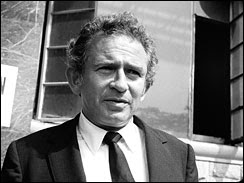
Showing posts with label Norman Mailer. Show all posts

Saturday, April 18, 2026

Quote of the Day (Norman Mailer, Telling JFK How He Erred at the Bay of Pigs)

“Wasn't there anyone around to give you the lecture on Cuba? Don't you sense the enormity of your mistake – you invade a country without understanding its music. You listen to intelligence agents and fail to interpret the style of the prose in which they submit their reports. You, with your shrewd sense of character, neglect to see that none of your boys and men can tell you the truth about Cuba because it would flagellate them too psychically to consider the existential (that is, indescribable) quality of what they report. So they turn nuances into facts, and lose other nuances, and mangle facts into falsities. It keeps you perhaps from recognizing what all the world knows, that we have driven Cuba inch by inch into alliance with the Soviet, as deliberately and insanely as a man setting out to cuckold himself.”— Pulitzer Prize-winning American novelist and essayist Norman Mailer (1923-2007), “An Open Letter to John Fitzgerald Kennedy and Fidel Castro,” originally published in The Village Voice, Apr.27, 1961, reprinted in Collected Essays of the1960s (2018)

Sixty-five years ago this week, a CIA-backed brigade of exiles attempted to take back their country from Fidel Castro, landing at the Bay of Pigs on the southwestern coast of Cuba. Within two days, the invaders were overwhelmed by Castro’s army.

JFK’s authorization of the invasion (concocted in the waning days of White House predecessor Dwight Eisenhower) led Norman Mailer to reevaluate his prior appreciation for the young President as a candidate the year before in the Esquire essay “Superman Comes to the Supermarket”:

“I think it is not impossible he will become a great President, but I also think he could lead us into dictatorship. It is not only up to him, but to many of us, whether he becomes a good leader or a bad one. The question is whether he has a mind deep enough to comprehend the size of the disaster he has inherited here.”

Suffice it to say that in his short tenure in the White House, Kennedy, no matter his faults, showed no signs of leading America into a dictatorship.

But it is doubtful that Mailer—within a few years, and certainly by the end of his long life—could still labor under the illusion, as he put it in his post-invasion “Open Letter” to the caudillo, that the Cuban leader evinced “some sense that there were heroes left in the world.” 

Like other intellectuals who were part of the “Fair Play for Cuba Committee,” he could only cling to the belief that American foreign policy had driven Castro towards Communism. (Documents released in 2022 show that, as early as July 1960, Raul Castro told Soviet premier Nikita Khrushchev that his brother was "discreetly" placing Communist sympathizers in key government positions.)

Dennis Wrong’s February 1962 Commentary post-mortem on Castro’s December 1961 announcement that he was, in fact, a “Marxist-Leninist” predictably took to task Mailer, other members of the Fair Play for Cuba Committee, and the burgeoning “New Left” movement in general for naivete.

That pronouncement was not without justice, especially in the case of Mailer, who, in addition to his still somewhat starry-eyed view of Castro in the wake of the Bay of Pigs, urged him to invite Ernest Hemingway—who had just left Cuba and was in precarious physical and psychological health—to come back to the island, meet with the new leader, and write about what he saw.

But Mailer was right about one thing: JFK’s “boys and men”—i.e., the CIA—had planned a scheme with little to no chance of success, even if Kennedy had authorized more than the limited air support provided. 

The exile brigade totaled 1,500 against Castro’s regular army of 25,000; there was no real groundswell of support within the island; and the Castro regime was aware in advance that an operation would be coming.

To JFK’s astonishment, his assumption of responsibility for this fiasco only three months into his administration boosted rather than lowered his approval ratings. 

But the shadow of that operation’s failure haunted the rest of his thousand days in office—most dramatically, in the Cuban missile crisis a year later—as well as, to an only somewhat lesser degree, those of the 11 men who succeeded him in the Oval Office.

In her 1987 impressionistic portrait Miami, Joan Didion noted that embittered Cuban exiles—conspicuously missing from the chorus of approval for JFK, because of his late refusal for additional support for the landing force—had been involved in multiple foreign and domestic misadventures, including assassination plots against Castro, the Watergate burglary, Chile, Nicaragua, Angola, and Iran-contra. 

In no small measure, they have also anchored GOP support as Florida migrated from being a purple to a red state at election time.

Though even Kennedy court historians like Arthur Schlesinger Jr. acknowledged early on that the exiles had been forgotten in the crush of events, I doubt that any policymakers at the time could have imagined that Cuba would remain a Marxist regime today.

Both Cuban exiles and those still living on the island used to joke that even Castro was mortal. Yet even after his death, control of the government remained in the hands of his aging brother Raul, and now his designated successor, Miguel Diaz-Canel.

But how much longer that continues is very much a live question.

Late last year, as New Yorker contributor Jon Lee Anderson noted in late March,

“[T]he island had faced daily electricity blackouts owing to a lack of fuel, along with severe shortages of food, water, and medicine. Economic activity had all but stopped, and the government, which was essentially broke and unable to secure new loans, had been incapable of providing solutions. Even garbage collection was virtually nonexistent, with huge mounds of refuse piling up on street corners.”

Starting in January, encouraged by the successful extraction of the Cuban regime’s post-Soviet benefactor, Venezuelan President Nicolás Maduro, the Trump Administration decided to exert maximum pressure on the government of Diaz-Canel, issuing an executive order that declared it a national security threat in terms not even used by Dwight Eisenhower and JFK at the height of the Cold War. The administration also authorized tariffs on goods from third countries that sell or provide oil to the island.

Even if the Trump administration succeeds in destabilizing the government of Diaz-Canel, it has operated under wishful thinking reminiscent of both Mailer’s and the JFK-era CIA, an amnesia about history that brings to mind the legendary remark about the benighted Bourbon restoration in France: “they had learned nothing and forgotten nothing."

A change in regime will not by itself bring political freedom or economic opportunity, especially considering the lack of clearly defined goals for Trump’s military operations against Venezuela and Iran. Indeed, new leaders under American aegis may only revive for a new generation resentment towards yanqui exploitation.

In the Reagan administration, as Iran-contra came to light, Didion harked back to the post-Bay of Pigs atmosphere of the Kennedy administration, believing that again it was “time to talk about runaway agencies, arrogance in the executive branch, about constitutional crises and the nature of the presidency, about faults in the structure, flaws in the process." 

The need for that “talk” is certainly even more urgent now.

Tuesday, January 31, 2023

This Day in Literary History (Norman Mailer, Controversial 2-Time Pulitzer Winner, Born)

Jan. 31, 1923— Combative in war and peace alike, Norman Mailer, who won Pulitzer Prizes for two works that straddled fiction and nonfiction, The Armies of the Night and The Executioner’s Song, was born in Long Branch, NJ.

With his first novel, The Naked and the Dead, Mailer, along with Irwin Shaw (The Young Lions) and James Jones (From Here to Eternity), formed a trio of WWII veterans who wrote sprawling fictional accounts that attempted to capture both their personal experiences and the disruptive impact of the conflict on American servicemen.

The three measured themselves against Ernest Hemingway’s achievement with A Farewell to Arms. But most critics agree that, despite massive sales, none matched the impact of that landmark WWI novel.

At this point, Jones’ account is best remembered indirectly, through the 1953 Best Picture Oscar-winning film adapted from it. Shaw, producing novels commercially successful if uneven in quality, has found a secure niche for his many superb short stories.

Mailer’s case for literary posterity is trickier. His ambition and bravado were every bit as immense as his talent. He was never afraid to dare greatly, even if he risked looking foolish—which he did, repeatedly, and with all too few signs of having learned from his experiences.

David Denby’s December critical reappraisal of Mailer in The New Yorker argued that the novelist never really got over the war, in which his military service forced a never-ending feedback loop with an aggressive stance against the postwar world:

“The enormous success of The Naked and the Dead left Mailer uneasy. He had no idea how he was going to live up to it. Seemingly on top of the world at twenty-five, he feared many things. In his novel, the Harvard-educated liberal allows himself to be trapped by power. Mailer, in his own eyes, needed to escape the traps not only of his soft middle-class Jewish background but also of postwar America--the desire for ‘security,’ the endless consumerism, and what he took to be the country's humiliating spiritual mediocrity. It's as if he were still in the jungle, pulling artillery through the night. He had made himself into a novelist in the Pacific, and now he brought the war home, fighting on two fronts—against what he disliked in himself and against those menaces of the nineteen-fifties, ‘conformity’ and ‘adjustment.’ He acted out his rebellion in a continual performance with phallus, fists, booze, and sustained ass-in-chair writing sessions—a pressure at times noble, at times foolish, and certainly rough on other people as well as on himself. He became an egotist of a peculiarly self-afflicting sort, both calculating and spontaneous, provoking many blows, all of them deserved, all of them welcomed. For the author of The Naked and the Dead, the truce never arrived.”

At his best, in person, Mailer could make self-deprecating jabs at his considerable ego and awe listeners with jeweled phrases that came effortlessly to hand—as I witnessed firsthand when I covered his appearance in a seminar at Columbia University’s Writing Division in the School of the Arts back in February 1981.

*He thought while writing The Naked and the Dead that it was "the greatest book since War and Peace and maybe even better," but now admitted wryly that his idea of the book "was higher than it deserved.”

*He chuckled at Truman Capote’s claim that he relied on his photographic memory in lieu of taking notes for In Cold Blood: “I love Truman Capote in 82 ways, but he's a terrible liar. I know he doesn't remember conversations we've had two or three days ago."

*He had used point of view in his own work either as an obtrusive ego, "a burning type of light," or an invisible, disembodied "voice coming over the hill."

At the same time, Mailer pointed out a reason for both his remarkable productivity starting in the 1960s and his prodigal misuse of this creative energy: “I made three movies in the Sixties—directing, writing, and starring in them—and they all failed. I lost $300,000. I've been in debt ever since."

As Mailer was telling the writing students this, he was only months away from a supporting role in yet another movie: philandering architect and murder victim Stanford White, in Milos Forman’s adaptation of E.L. Doctorow’s Ragtime.

One can’t resist thinking that Mailer identified with the intersecting creativity, lust and violence in this figure at the heart of one of the most notorious scandals in early 20th-century America. If he had never equaled Hemingway’s feat of fashioning a virtually new writing style, he had Papa beat in the number of wives (six versus four) and children (nine versus three).

(Knowing the wink-wink style of so much of the Gilmore Girls TV series, I can’t help thinking a similar spirit was at play when it titled one episode, “Norman Mailer, I’m Pregnant!”)

Besides a scandalous private life, another major factor that may ultimately lower his critical reputation could be the baggy monsters of novels that he cranked out starting with The Executioner's Song: Ancient Evenings, Harlot’s Ghost, and Oswald’s Tale.

Over 30 years ago, while interviewing for a copyediting job at a magazine with a reputation for publishing high quality, I was told by a senior editor just how far my authority would extend: “You’ll have to keep in mind who you’re dealing with when you make suggestions in a manuscript. Listen: Norman Mailer will make more from a single article here than you will with your entire yearly salary.”

How many editors, even ones with considerably higher reputations than I would have had starting out, shied away from battling with Mailer? They could go mano-a-mano line by line, chapter by chapter with a manuscript, or they could watch him take his wares to someone else willing to let him write whatever tripe he liked. Neither alternative was appealing.

But with the novelist dead 15 years now, The Mailer Wars are beginning in earnest now.

On one side you have broadsides like this from “One-Way Street” blogger Richard Prouty, who, after Mailer’s death in 2007, predicted that his influence would be “nil” and saw “his only truly original creation” being “journalism mixed with self-aggrandizement, a combination…that can be described as literature as performance art.”

On the other side are defenders like English and film professor Phillip Sipiora, who calls Mailer “arguably the foremost public intellectual of the second half of the twentieth century,” and Denby, who writes that it would be “naïve to pretend that he was not a great American writer.”

My own initial instinct, given the sheer quantity of bad, even idiotic, work Mailer produced over nearly six decades in the public eye, is to lean closer to Prouty than Denby or Sipiora.

But it might be more accurate to see him as a kind of American literary counterpart to the actor Richard Burton, another creative figure who wasted his overwhelming talent in scandal and never-ending substandard projects meant to satisfy his craving for fame and money.

An unblinkered assessment would find that, like Burton, Mailer could, at moments, with his energy focused tightly on work at hand, rank with the very best of his contemporaries.

The Armies of the Night may have the best chance of any of his works of continuing to be read and re-read. It masterfully balances opposites: fiction and nonfiction, comedy (his own larger-than-life persona, enlarged even further through referring to himself in the third person) and the deepest seriousness (the stakes of a government not called to account for its mishandling of the Vietnam War), and the yawning, increasingly unbridgeable divide between the student protesters and the working-class soldiers and marshals facing off against them in front of the Pentagon—a harbinger of today’s “woke” left and Trump voters.

And there is the sheer exhilaration of Mailer's high style in passages like this:

“Arrayed against them as hard-core troops: an elite! the Freud-ridden embers of Marxism, good old American anxiety strata—the urban middle-class with their proliferated monumental adenoidal resentments, their secret slavish love for the oncoming hegemony of the computer and the suburb, yes, they and their children, by the sheer ironies, the sheer ineptitude, the kinks of history, were now being compressed into more and more militant stands, their resistance to the war some hopeless melange, somehow firmed, of Pacifism and closet Communism. And their children—on a freak-out from the suburbs to a love-in on the Pentagon wall.”

Tuesday, April 30, 2019

Quote of the Day (Norman Mailer, on ‘Two Kinds of Brave Men’)


“There are two kinds of brave men: those who are brave by the grace of nature and those who are brave by an act of will.”—American novelist-essayist Norman Mailer (1923-2007), “Punching Papa” (review of Morley Callaghan’s That Summer in Paris), originally printed in The New York Review of Books, later collected in Cannibals and Christians (1966)

Wednesday, June 3, 2015

Quote of the Day (Norman Mailer, on ‘Little Institutional Lies’)


“Each day a few more lies eat into the seed with which we are born, little institutional lies from the print of newspapers, the shock waves of television, and the sentimental cheats of the movie screen.”— Norman Mailer (1923-2007), Advertisements for Myself (1959)

Saturday, July 2, 2011

Quote of the Day (Norman Mailer, on Ernest Hemingway)

“Hemingway’s style affected whole generations of us, the way a roomful of men is affected when a beautiful woman walks through ---their night is turned around, for better or for worse. Hemingway’s style had the ability to hit young writers in the gut, and they just weren't the same after that.” – Norman Mailer, quoted in Michiko Kakutani, The Poet at the Piano: Portraits Of Writers, Filmmakers, Playwrights, And Other Artists At Work (1988)


Like future other images of aging Papa, the image accompanying this post attests to the darkness gathering force in his wounded psyche.


Fifty years ago today, 48 hours after returning from a second round of electroshock treatment at the Mayo Clinic, Ernest Hemingway picked up his favorite shotgun in his Ketchum, Idaho home and shot himself.


The act, committed while his increasingly anxious wife slept upstairs, shocked a world of readers who had encountered the Nobel laureate’s work on high school reading lists or in magazine profiles. They simply could not imagine that a man decorated for bravery in World War I, whose Byronic travels epitomized the rugged life and whose fiction consistently celebrated courage as “grace under pressure,” could have chosen this way out.

Little did they know about the all-consuming depression that brought him to this end. Hemingway’s intimates were alarmed, during his Mayo Clinic stay, by the sign he’d hung up outside his room: FORMER WRITER. And friend (later biographer) A.E. Hotchner would not soon forget what the “former writer” told him of his condition in his last days: “What does a man care about? Staying healthy. Working good. Eating and drinking with his friends. Enjoying himself in bed. I haven’t any of them. You understand, goddamn it? None of them."

(Hemingway’s suspicion that he was under surveillance by the FBI proved to be more true and less paranoid than any of his close friends could have guessed at the time, as ruefully acknowledged in Hotchner’s op-ed article in today’s New York Times.)

The surprise must have been especially palpable for men such as Norman Mailer in the 1950s, for whom Hemingway, like Frank Sinatra, represented an ideal of style—not just the celebrated modernist writing style, but of living life full-tilt and reaping the rewards. Characteristically, Mailer compares the older writer’s impact to that of a beautiful woman.

Indeed, those of the generation of The Naked and the Dead author, after World War II, saw much to admire in the older writer’s quest for wealth, wine and women, as well as his stoic code. Hemingway’s death, then, signaled the first crack in this cult of machismo. Within a generation, a “Me Decade” deeply antithetical to Hemingway’s suck-it-up ethic, as well as a feminist movement that eyed much of the novelist’s work as overgrown Boy’s Life adventures, had called into question the values by which Hemingway had lived. Inevitably, the search began for new idols.

The question now becomes whether Hemingway’s time may have come again. Abe Sauer, a contributor to the Web site www.brandchannel.com, lists several recent events that might signify the return of Hemingway as a “New Male Lifestyle Demo,” including:

* The writer’s appearance in Woody Allen’s Midnight in Paris, wherein the young Hemingway of the Twenties appears as a character, already in the process of creating his legend;
* Country star Kenny Chesney's 2010 album, called Hemingway's Whiskey:
* The Nicole Kidman-Clive Owen HBO biopic, Gellhorn and Hemingway.
* Even “the current popularity of full beards on men,” according to Sauer.

When myth collides with reality, however, all of this counterrevisionism becomes a bit harder to sustain.

If you want an idea of what the death of Hemingway signified in larger terms, focus on the opening credits of the Emmy-winning AMC drama series about advertising men in the 1960s, Mad Men. It shows an illustrated version of protagonist Don Draper falling from a great height.
But Draper represents far more than himself. Indeed, that image is symbolic of the cult of masculinity in free fall.


Watching Draper’s credits-sequence fall is like viewing a slow-motion series of quietly desperate acts—in much the same way that Hemingway’s family and closest associates beheld with mounting, powerless horror the writer’s increasingly troubled condition following two plane crashes on safari in Africa in 1954.

Nobody would have validated Draper’s lifestyle of heavy drinking and wenching as the rewards of a demanding job more than the novelist. But that’s not their only point in common..
One particular episode from the series’ first season, "The Hobo’s Code," hints at further affinities that the ad man might have felt for the bestselling novelist.

At one point, Don rushes over to the apartment of his mistress, freelance artist Midge Daniels, and urges her to run away with him for the weekend to Paris, the romantic dream city of Hemingway, F. Scott Fitzgerald and other Lost Generation writers who hoped to live cheaply and simply there without distractions.

But deeper connections bound the creator of commercial fantasy and the novelist-memoirist. Each grew up under circumstances they were anxious at all hazards to obscure and even lie about. Each found in the chaos of war an opportunity to become a fabulist about his military service and, later, his identity.

Aside from a father (also a suicide) who taught him about hunting and fishing, Hemingway found little about either his hometown (Oak Park, Ill., a Chicago suburb filled with what he called “broad lawns and narrow minds”) or his family worth celebrating. His mother (whom he blamed for his father’s death because of what the writer regarded as spendthrift ways), an organist for local churches, took her adult son to task for his dissolute ways.

The young Hemingway took refuge in telling stories. That tendency didn’t end with the written page, however: he also took to spinning ever-more-creative visions of his background. Years later, after their divorce, third wife Martha Gellhorn was astonished, upon being driven through Oak Park, to find it was nothing like what he’d told her: “The son-of-a-bitch! He told me he grew up in a slum!”


Similarly, Draper (or, as he was known as a child, Dick Whitman) was at pains to camouflage his background, though this time because of a sense of shame. His is a tale of two mothers: one biological, a prostitute who died while giving birth to him, and a second adoptive—like Grace Hemingway, a “church lady” (albeit one with quiet but real generosity). A second parent, Don’s adoptive father, is far more problematic, leaving the boy abused in body and disabused of compassion, committed only to a “hobo’s code” that leaves him unburdened, footloose but empty.

Their creative lives give the two men an outlet for sexual impulses that older generations would have frowned upon. The astute critic-novelist (The Year of the French) Thomas Flanagan has much of value to say about Hemingway in an essay “The Best He Could Do” (collected in the posthumous collection, There You Are), but one sentence in particular sums up “Papa’s” increasingly fragile psychosexual state in the last two decades of his life: “Behind the marlin-fighting lay a different person, uneasily aware of the fragility of gender boundaries, sexually insecure, and aware of aspects of himself which created that insecurity.”

Two of Hemingway’s posthumous books, the novel Garden of Eden and the “memoir” True at First Light, would have jolted contemporary readers with the author’s descriptions of lesbianism, threesomes and his weird quasi-courtship (with his wife fully aware of it) of a young African girl while the fiftysomething novelist was on safari.

Not content with a wife whose blond beauty evokes comparisons to Grace Kelly, Draper takes up with an artist, a client, even a stewardess--and that doesn’t begin to exhaust the extent of his restless philandering.

Eventually, thrown off-kilter by what they saw in war--Hemingway in World War II, Whitman/Draper by the Korean conflict--they return home having created a new myth for themselves. Not content with his very real bravery as a wounded non-combatant ambulance driver in 1918, Hemingway, upon returning home the following year, told Oak Park audiences that he’d served as a lieutenant in the Brigata Ancona during the Monte Grappa offensive.
Draper’s change is even more dramatic. Like Tom Ripley in Patricia Highsmith’s The Talented Mr. Ripley, he assumes the identity of a dead person--in this case, an officer he served under during Korea.

Draper would have agreed with Hemingway’s description of writers in True at First Light: “All a writer of fiction is really is a congenital liar who invents from his own knowledge or that of other men.”

And Papa Hemingway would have nodded in agreement when the outwardly self-confident, inwardly anxious ad man says: “People tell you who they are, but we ignore it because we want them to be who we want them to be.”

Tuesday, August 10, 2010

Quote of the Day (Norris Church Mailer, on Bill Clinton)


“I would have so liked to be able to talk to him about world affairs and politics. But we frankly never talked much.”—Norris Church Mailer, on her short-lived but intimate relationship in the 1970s with Bill Clinton, rising young Arkansas politico (and fiancée of Hillary Rodham), in A Ticket to the Circus: A Memoir (2010)

President Clinton gave a famous explanation for why he became involved in the relationship with Monica Lewinsky that, for a time, imperiled his Presidency: “Because I could.”

Norman Mailer, whom the model Norris Church would eventually marry, gave a far more interesting—creative, if you will—explanation of his philandering. To get in the proper mood for his doorstopper of a novel about the CIA, Harlot’s Ghost, “He said he needed to live that kind of double life, to know what his characters were going through,” according to his widow.

Nearly 30 years ago, listening to Mailer address a college writing class, I marveled that he could speak so fluidly and extemporaneously. I imagine that I would feel the same way if I heard the ex-President in a small setting, too.

With that said, I think I would find Ms. Mailer to be far more congenial company than the two charming but narcissistic rogues with whom she was involved. She has met all kinds of interesting people, carved out a career as a model, actress, and now, writer--but at least she has never had pretensions about surpassing Hemingway or JFK.