Showing posts with label Ambition. Show all posts

Tuesday, August 11, 2026

Quote of the Day (Patti Smith, on Her Youthful Literary Ambition)

“I believed I could write the longest book in the world, record the events of every single day. I would write it all down in such a way that everyone would find something of themselves.”—American poet and rock ‘n’ roll singer-songwriter Patti Smith, Bread of Angels: A Memoir (2025)

(The image accompanying this post, of Patti Smith performing at New York’s Bowery Ballroom, was taken by her sister, Kimberly Smith, on Dec. 31, 2007.)

Monday, December 8, 2025

Verse of the Day (A.M. Juster, on an Ambitious Government Bureaucrat)

“Your uphill climb will never stop;
   scum always rises to the top.” —Poet, translator, and essayist A.M. Juster (pseudonym for Michael J. Astrue, former head of the Social Security Administration), “To My Ambitious Colleague,” in Sleaze and Slander: New and Selected Comic Verse, 1995-2015 (2016)

Friday, November 21, 2025

Quote of the Day (John Adams, on Threats to the Constitution)

“Avarice, ambition, revenge, and licentiousness would break the strongest cords of our Constitution, as a whale goes through a net. Our Constitution was made only for a moral and religious people. It is wholly inadequate to the government of any other.” —John Adams (1735-1826), signer of the Declaration of Independence and second U.S. President, in a letter to the Officers of the first Brigade of the Third Division of the Militia of Massachusetts, Oct. 11, 1798, quoted by Maria Campbell, Revolutionary Services and Civil Life of General William Hull (1847)

Monday, March 3, 2025

Joke of the Day (Paula Poundstone, on Kids Being Asked What They Want to be When They Grow Up)

“The reason adults are always asking children what they want to be when they grow up is that they're looking for ideas.”—American stand-up comic Paula Poundstone quoted by Deborah Stea, “Off the Shelf: How to Get a Job, Even One That Suits Your Psyche,” The New York Times, Dec. 3, 1995

Saturday, January 11, 2025

Quote of the Day (John Donne, on a Time With ‘All Coherence Gone’)

“'Tis all in pieces, all coherence gone,
All just supply, and all relation;
Prince, subject, father, son, are things forgot,
For every man alone thinks he hath got
To be a phoenix, and that then can be
None of that kind, of which he is, but he.
This is the world's condition now.”—English poet John Donne (c. 1572-1631), “An Anatomy of the World,” originally published in 1611

Thursday, November 2, 2023

Quote of the Day (Edgar Lee Masters, on ‘The Winds of Destiny’)

“I have studied many times
The marble which was chiseled for me—
A boat with a furled sail at rest in a harbor….
And now I know that we must lift the sail
And catch the winds of destiny
Wherever they drive the boat.”—American poet and lawyer Edgar Lee Masters (1868-1950), “George Gray,” in Spoon River Anthology (1915)
 
I took the image accompanying this post while on vacation nine years ago in Hilton Head, SC.

Friday, May 26, 2023

TV Quote of the Day (‘30 Rock,’ In Which Jack Defines ‘Ambition’)

“Ambition... is the willingness to kill the things you love and EAT them in order to stay alive. Haven't you ever read my throw pillow?” —Jack Donaghy [played by Alec Baldwin] in 30 Rock, Season 5, Episode 6, “Gentleman's Intermission,” original air date Nov. 4, 2010, teleplay by John Riggi, directed by Don Scardino

Friday, May 6, 2022

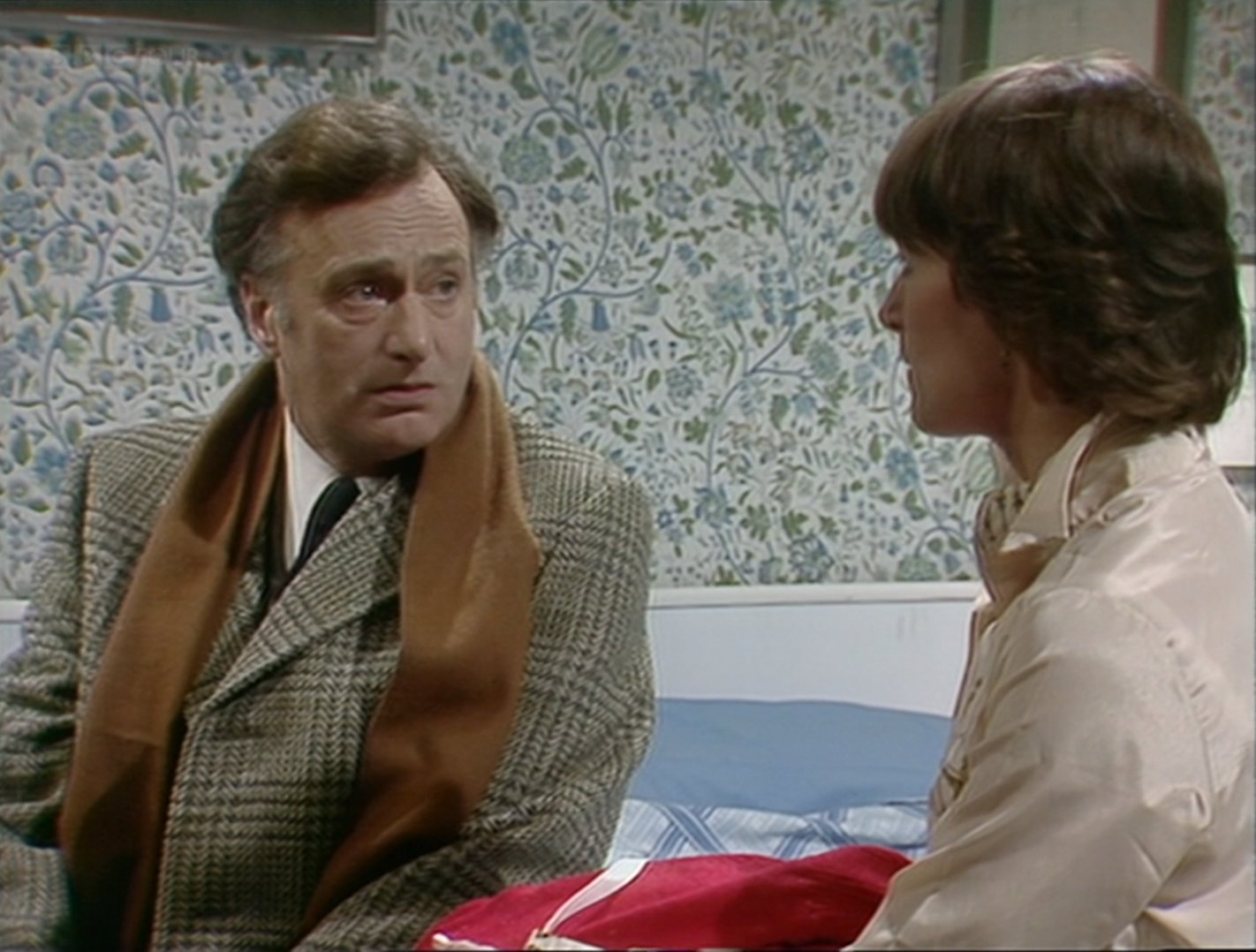
TV Quote of the Day (‘Yes, Minister,’ on How A Political Rival Succeeds)

[James Hacker is discussing a British cabinet rival with his wife Annie.]

James Hacker [played by Paul Eddington]: “Don't forget, there's Basil Corbett. He's still out to get me.”

Annie Hacker [played by Diana Hoddinott]: “Oh, he's out to get everyone.”

James: “He's a smooth-tongued, hardnosed, cold-eyed, two-faced creep.”

Annie: “Why is he so successful?”

James: “Because he's a smooth-tongued, hardnosed, cold-eyed, two-faced creep.” — Yes, Minister, Season 2, Episode 5, “The Devil You Know,” original air date Mar. 23, 1981, teleplay by Antony Jay and Jonathan Lynn, directed by Peter Whitmore (uncredited)

Thursday, August 20, 2020

Song Lyric of the Day (Bacharach and David, on the ‘Dream in Your Heart’)


“Fame and fortune is a magnet
It can pull you far away from home
With a dream in your heart you're never alone.”— "Do You Know the Way to San Jose," music by Burt Bacharach, lyrics by Hal David, recorded by Dionne Warwick for her Valley of the Dolls LP (1968)

Bacharach’s effervescent melody and Warwick’s lighter-than-air vocals can only go so far in camouflaging David’s melancholy, even searing lyric about a disappointed dreamer returning home.

Celebrity can happen virtually overnight, but it’s a big if, and in the meantime “weeks turn into years.” In the freeway culture of Southern California, those looking for the big time may be as likely, in this setting, to be pumping gas as waiting on tables.

It’s all insubstantial and transitory. In the end, the song’s symbol of home, San Jose (not the high-tech center it is now, but a farming community filled with orchids), feels as elusive as L.A.

So, why waste one’s life and stick around for a quest so empty and unfulfilling for so many? It’s that single line, the song’s single light in the darkness: “With a dream in your heart you're never alone.” The songwriting partners could surely relate to that, with Bacharach noting that he “knew  all nine floors” of New York’s fabled Brill Building, where he had to endure constant rejection from the music publishers gathered there.

Warwick did not warm to these lyrics. “It was not one of my favorite songs that Hal David wrote,” she told People Magazine’s Liz McNeil in a 2019 interview. “I just couldn’t imagine Hal writing a lyric that had ‘whoa, whoa, whoa, whoa, whoa….'”

Her lack of faith in the song manifested itself initially in her first try at it. “When she performed it at the recording session, I think it was the only time during that period we didn't get a vocal from her that was good enough to use,” Bacharach recalled for Michael Fremer in a 1985 interview for Analog Planet Magazine. “So we had to bring her back into the studio to have her overdub her vocals."

The songwriting duo’s persuasion finally produced the desired result. "Do You Know the Way to San Jose" (asked rhetorically, so, oddly enough, there’s no question mark in the title) sold 3.5 million copies and earned Warwick a Grammy for Best Contemporary-Pop Vocal Performance, Female.

Or, as the singer told McNeil laughingly, she “cried all the way to the bank. What can I tell you?”

(The image accompanying this post shows David on the left and Bacharach on the right, with Warwick between them—anchoring this picture, as she did with so many of their songs.)

Saturday, January 18, 2020

Quote of the Day (Shakespeare’s Richard III, on Political Ambition)


“Why then I do but dream on sovereignty,
Like one that stands upon a promontory
And spies a far-off shore where he would tread,
Wishing his foot were equal with his eye,
And chides the sea that sunders him from thence,
Saying, he'll lade it dry to have his way:
So do I wish the crown, being so far off,
And so I chide the means that keeps me from it,
And so, I say, I'll cut the causes off,
Flattering me with impossibilities,
My eye's too quick, my heart o'erweens too much,
Unless my hand and strength could equal them.”—Richard, Duke of Gloucester (the future King Richard III), in English playwright-poet William Shakespeare (1564-1616), King Henry VI, Part 3 (1591)

Several months ago, bored during a TV commercial break, I switched channels and came across, on a PBS station, The Hollow Crown: The Wars of the Roses. I watched transfixed for about a half hour. Nearly 40 years after first encountering this multitude of characters on the printed page, the pitch-dark political vision of William Shakespeare began to make sense to me. I resolved to watch the whole thing on DVD as soon as I had the chance. This past week, I finally did.

If you want to understand much of the creative inspiration for Game of Thrones, with its rival houses plunging entire kingdoms into division, chaos and violence, you can start here. (GOT novelist George R.R. Martin admitted as much in a 2014 interview with Rolling Stone Magazine’s Mikal Gilmore.)

At the same time, I can’t help but think that this nine-hour BBC miniseries, combining Richard III with its less well-known predecessors, the three parts of Henry VI, took much of its look—notably, its stress on location shooting and bloody battle scenes—from the long-running HBO series. (And this was only the second half of this TV treatment of Shakespeare’s English history plays—the first half covered Richard II, Henry IV Parts I and II, and Henry V.)

In any case, Dominic Cook and Sam Mendes—director and executive producer, respectively, of The Hollow Crown—have made me look at Shakespeare’s “Wars of the Roses” tetralogy in a way I never imagined when I took a college course on The Bard nearly 40 years ago. The course was an academic sprint that felt like a marathon: all of the playwright’s 37 plays, plus his poetry, compressed into two semesters. Some plays received extensive treatment; others, barely a mention. I only took the first semester, on Shakespeare’s early career. I can’t say I missed taking the other semester.

Among the works shortchanged in all of this were the Henry VI plays. I didn’t appreciate either their rich language or their complex, compelling characters until I saw the magic that Cook conjured with the help of his all-star British cast, which included Hugh Bonneville, Sophie Okonedo, Judi Dench and Tom Sturridge.

Oh, yes: and Benedict Cumberbatch as Richard III (in the image accompanying this post). Though Shakespeare named this early portion of his play cycle after Henry VI, this last of the Lancaster monarchs increasingly is overshadowed by the hunchbacked villain.

From the moment he first appears onscreen, with his character’s misshapen form blocking out the sun as he lurches through a doorway, Cumberbatch (beloved by thousands of mystery fans as Sherlock) convincingly depicts Richard as a demon of the dark, desperate to fill his psychic void with increasingly bold grasps for power.

In the passage quoted here, Richard is all too aware of the obstacles blocking him from the English throne, which at this point appears “so far off” (including, at this point, the possibility that his brother, King Edward IV, and his wife Lady Anne Grey might produce heirs). Previously ruthless but at least indefatigable and brave in battle fighting on behalf of his family, the House of York, he now reveals that he hopes to seize the throne himself—even if that involves the removal of his brothers and Edward’s young children.

Energy and audacity, channeled constructively, can lead to accomplishment and fame. But through Richard (whose soliloquys continually invite us into his schemes), Shakespeare shows how those qualities can be warped by the unscrupulous pursuit and retention of power.

Along with being a master psychologist, Shakespeare also unravels the conditions that set the table for authoritarians: vacillating and/or innocent current leaders (such as King Henry), people in the orbit of a usurper who are gulled by his brazen lies, despite themselves (Anne Neville, who agrees to wed Richard), and the enablers (Hastings, Catesby, and Buckingham) who mistakenly believe they can aid his rise without falling victim to his machinations themselves.

What stands between Richard and his current counterparts around the world are a series of restraints on power, which can indeed, as he notes, look as formidable as a sea. That makes all the more astonishing his resolve to “lade [i.e., drain] it dry to have his way.” It’s a frightening metaphor for a process that leaves the security and liberty of a nation as void as its would-be authoritarian’s own emotional and spiritual resources.

As Abraham Lincoln scholar Douglas L. Wilson’s Winter 2012 article in The American Scholar noted, America’s 16th President was a fan of Richard III. He thoroughly absorbed its lesson that a leader’s energy had to be tempered by integrity and compassion in using power. If he ever got around to seeing or watching Shakespeare (itself a doubtful proposition), Lincoln’s current GOP successor in the White House long since forgot that message.

Tuesday, November 6, 2018

Quote of the Day (Jonathan Swift, on Ambition)


“Ambition often puts men upon doing the meanest offices; so climbing is performed in the same posture with creeping.”—Anglo-Irish satirist Jonathan Swift (1667-1745), Miscellanies (1711) 

A sobering thought, post-Election Day—no matter what your political party…

Wednesday, July 27, 2016

Quote of the Day (Ronald Syme, on Politics and Ambition)


“Politics can be controlled but not abolished, ambition curbed but not crushed.”— Ronald Syme, The Roman Revolution (1939)

Saturday, December 5, 2015

Quote of the Day (T.C. Boyle, on the Ambitious--Especially Novelists--as ‘Damaged’)


“All of us, especially novelists, are damaged, psychologically damaged. We have big problems, and we are not good people. We’re drug addicts, we’re drunks. So we want to even the score—we want adulation. If you are single-minded, as many writers are, as I am, the work is all you are. There is nothing else. And so if the work goes away, then it’s the gun. We’ve seen it through generations of American writers. That is the downside to ambition.” —Novelist and short-story writer T.C. Boyle, quoted in “Soapbox: The Columnists, WSJ. Asks Six Luminaries to Weigh in on a Single Topic. This Month: Ambition,” WSJ.com, March 2015 issue

"All of us"? Glad he's using hyperbole--or, more broadly, creative license. That, or he's moving in a small circle.