Showing posts with label William Shakespeare. Show all posts

Thursday, April 23, 2026

Quote of the Day (William Shakespeare, on a Fearful People ‘Possessed With Rumors’)

“But as I traveled hither through the land,
I find the people strangely fantasied,
Possessed with rumors, full of idle dreams,
Not knowing what they fear, but full of fear.”English playwright-poet William Shakespeare (1564-1616), King John (1594-6), Act 4, Scene 3 

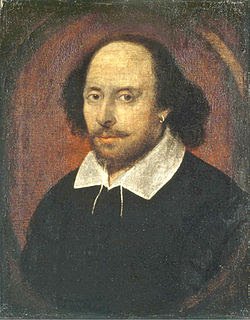
William Shakespeare died on this day in 1616 at age 52, but his influence reverberates to this day.

Following decades of Tudor authoritarianism, Shakespeare knew that it was safer to project his insights into distant times (King John’s death predated the playwright’s by four centuries) and even distant lands (in the case of The Tempest, a small, remote island in the Mediterranean).

His history play King John is one of his thornier and less performed works, but such was The Bard’s genius that even in this passage from the play, he served as a profound analyst of how corruption and tyranny at the highest government levels lead inevitably to rampant conspiracy theories and contagious fear.

Wednesday, December 31, 2025

Quote of the Day (William Shakespeare, Marking the Passage of Time)

“O God! methinks it were a happy life,
To be no better than a homely swain;
To sit upon a hill, as I do now,
To carve out dials quaintly, point by point,
Thereby to see the minutes how they run,
How many make the hour full complete;
How many hours bring about the day;
How many days will finish up the year;
How many years a mortal man may live.
When this is known, then to divide the times:
So many hours must I tend my flock;
So many hours must I take my rest;
So many hours must I contemplate;
So many hours must I sport myself;
So many days my ewes have been with young;
So many weeks ere the poor fools will ean:
So many years ere I shall shear the fleece:
So minutes, hours, days, months, and years,
Pass'd over to the end they were created.”—English playwright-poet William Shakespeare (1564-1616), King Henry VI, Part 3 (1595)

Sunday, October 26, 2025

Quote of the Day (William Shakespeare, Valuing Virtue Over Vengeance)

Though with their high wrongs I am struck to th' quick,
Yet with my nobler reason 'gainst my fury
Do I take part. The rarer action is
In virtue than in vengeance.” —English playwright-poet William Shakespeare (1564-1616), The Tempest (1611)

Wednesday, August 27, 2025

Quote of the Day (William Shakespeare, Noticing How ‘Cruel Are the Times’)

“Cruel are the times when we are traitors
And do not know ourselves; when we hold rumor
From what we fear, yet know not what we fear,
But float upon a wild and violent sea
Each way and move.”
English playwright-poet William Shakespeare (1564-1616), Macbeth (1603)

Wednesday, July 2, 2025

Quote of the Day (William Shakespeare, on ‘Abuse of Greatness’)

Brutus: “Th' abuse of greatness is when it disjoins/Remorse from power.” —English playwright-poet William Shakespeare (1564-1616), Julius Caesar (1599)

The image accompanying this post shows James Mason as Brutus in the 1953 film adaptation of Julius Caesar.

Saturday, March 15, 2025

Quote of the Day (Ferdinand Mount, on ‘The Flaws of an Upcoming Caesar’)

“We must do our best to head the would-be Caesar off at the pass. We need to be alert to the flaws of an upcoming Caesar: his relentless egotism, his lack of scruple, his thoughtless brutality, his cheesy glitz.”— British novelist and Sunday Times columnist Ferdinand Mount, Big Caesars and Little Caesars: How They Rise and How They Fall, From Julius Caesar to Boris Johnson (2023)

An especially appropriate quote for the Ides of March…

(The image accompanying this post shows Louis Calhern in the title role of the 1953 film adaptation of William Shakespeare’s Julius Caesar.)

Saturday, February 22, 2025

Quote of the Day (William Shakespeare, on Will, Power, and Appetite)

“Force should be right; or rather, right and wrong,
Between whose endless jar justice resides,
Should lose their names, and so should justice too.
Then every thing includes itself in power,
Power into will, will into appetite;
And appetite, an universal wolf,
So doubly seconded with will and power,
Must make perforce an universal prey,
And last eat up himself.”
English playwright-poet William Shakespeare (1564-1616), Troilus and Cressida (1609)

Friday, December 6, 2024

TV Quote of the Day (‘Cunk on Shakespeare,’ on School in The Bard's Day)

"School in Shakespeare’s day and age was vastly different to our own. In fact, it was far easier because he didn't have to study Shakespeare."—English actress and comedian Diane Morgan, with her favorite line as ill-informed interviewer Philomena Cunk, on the BBC mockumentary “Cunk on Shakespeare,” original air date May 11, 2016, teleplay by Charlie Brooker, Jason Hazeley, and Joel Morris, directed by Lorry Powles

Saturday, November 30, 2024

Flashback, November 1604: Shakespeare’s ‘Othello’ Premieres With Dark Mirror of Its Time

When it was presented by "the King's Majesty's players” 420 years ago this month, Othello seems to have pleased his primary audience, King James I, still only a year and a half into his reign.

Understandably, considering that “the Moor of Venice” is the only black character in all of William Shakespeare’s 38 plays, current dramaturgy tries to examine how the playwright speaks to the racism of our time. It has, as part of that process, thrown into question the common practice of actors donning blackface for the role.

But the tragedy should also be subjected to literary excavation to determine how the play was written, performed, and viewed in its own time—an era of danger and secrets.

Shakespeare had learned his lesson well while crafting plays under the watchful eye of James’ predecessor, Queen Elizabeth I: searingly depict the society and psyches of courts swirling with intrigue, but set the action far away, lest listeners find the plots and characters striking too close to home. 

(And Renaissance Venice was much farther away in time if not distance from England than we can ever imagine today: storms in the English Channel were known to delay passage to France for as much as two weeks.)

Clare Asquith’s 2005 study, Shadowplay: The Hidden Beliefs and Coded Politics of William Shakespeare, with its contention that the playwright was a secret Catholic when the faith was banned in England, has hardly been universally accepted by Bardologists. But she draws some interesting parallels between Othello and James, including that both leaders:

*survived narrow escapes;

*professed that their wives offered life-saving love;

*came to their new status as foreigners (James had been James VI of Scotland before assuming the English throne, while Othello, “the Moor of Venice,” would have been understood by audiences of the time as being from modern North Africa);

*celebrated Venice’s preservation from Moslem invaders (James, in his poetry; Othello, in battle).

For all the coding and deflection that Shakespeare, like other literary figures of the time, resorted to throughout his work, he was also sending “an urgent message” to James in this new play: “Royal authority must not fall into the hands of base men like Angelo [the Me-Too-like abuser of Measure for Measure] and Iago; it must be exercised responsibly.”

Starting in 1600, Shakespeare wrote what are often considered his four greatest tragedies: Hamlet, King Lear, Macbeth, and Othello. Of these, the last is the most tightly constructed in character (three main ones: Othello, Desdemona, and Iona) and time.

The time element may be the most important, as Iago, with an energy to match his cunning, sets in motion with stunning speed the plot that will destroy the life, reputation, and happiness of his commander. Two days after Othello and Desdemona reunite in Cyprus with mutual ardor, they are dead.

Commercial, overcivilized, seething with intrigue, Venice provides a ripe environment in which Iago can plant the seeds of the downfall of his plain-dealing commander. But such is his sense of invention that even a military outpost like Cyprus, more congenial to Othello, furthers his nefarious purposes: this time, the innocent Desdemona is utterly at sea.

The Venetian republic had depended on foreigners to defend itself from Moslem attacks, as seen in the play by service personnel from Spain (Iago—interestingly enough, Spanish for “James”) and Othello (from North Africa). Even so, the court of King James and throngs who saw the play at both the open-air Globe playhouse and the indoor Blackfriars in the next couple of decades would have known that its possession Cyprus had eventually fallen to the Ottoman Empire.

Venice could ill afford, then, to lose the likes of great commanders like Othello, and their absence from future councils of war could only increase the vulnerability of the republic.

Even in this point of geographic deflection, Shakespeare was hinting to his audience that the personal could become the political very quickly.

In the case of the English monarch, listeners had a strong reason to think so: a monarch’s inability to produce a male heir had pushed the nation into the cohort of Protestant European nations under King Henry VIII, then had hastened the transition from his childless (Tudor) daughter Elizabeth to James (Stuart).

Literary and theatrical culture supplied Shakespeare’s plot. His major source was an Italian novella in Giraldi Cinthio's Gli Hecatommithi, translated into French (where, presumably, the playwright saw a translation).

Cinthio's “ensign” brings about the fall of his chief in this tale, too. But the lesson is decidedly different from what Shakespeare conveyed: children should obey their parents, even if—especially if— this means the bride should not marry a black male without their permission.

Shakespeare also drew on a tradition better known to English theatergoers: morality plays that were popular in his teens. As Shakespeare scholar Stephen Greenblatt observes in Will in the World, these productions had fallen out of favor by the time the playwright reached his creative zenith late in the Elizabethan era, but they had concentrated viewers’ attention on a representative figure of evil, often named Vice.

In Othello, the sin—jealousy—becomes the tragic flaw that Othello, so used to commanding men in battle, finds impossible to quell within his heart, with Iago serving as the supercharged symbol of evil.

I have seen several productions of Othello onstage or onscreen, featuring such compelling actors as Orson Welles, Laurence Olivier, James Earl Jones, Laurence Fishburne, and Ron O’Neal. This has continued the tradition that began with Shakespeare’s leading player, Richard Burbage, playing the role before King James.

But Jones’ 1982 Broadway hit crystallized one of the common dilemmas of the play: No matter how magnetic the star playing Othello might be, the spotlight, more often than not, swings to the actor embodying Iago. 

Ecstatic reviews for that show’s Iago, Christopher Plummer, considerably annoyed Jones (and, let’s face it, brought out a jealous streak not unlike his character), who was already perturbed by his co-star’s penchant for hamming up scenes with crowd-pleasing humor, according to Plummer's memoir In Spite of Myself.

But this tendency of Iago consuming greater viewer attention is also grounded in the play itself:

*Unlike other Shakespearean tragedies such as King Lear, evil is massed in one character rather than dispersed across multiple ones;

*Iago not only has more lines than Othello, but also, because he appears before he comes onstage, has the opportunity to set expectations about their relationship;

*Iago’s soliloquys render the audience complicit in his plotting;

*Iago neither makes amends for nor adequately explains his actions—indeed, he offers so many, with so little real justification, that he appears to be grasping at straws to fill what poet Samuel Taylor Coleridge memorably called the villain’s “motiveless malignity.”

The great essayist William Hazlitt, in his book Characters of Shakespeare’s Plays, aptly summarizes Iago as possessing a "diseased intellectual activity, with an almost perfect indifference to moral good or evil, or rather with a decided preference of the latter."

(The image accompanying this post shows a particularly celebrated influential production of Othello, from 1930 at London’s Savoy Theatre, with Paul Robeson as the title character and Peggy Ashcroft as Desdemona.)

Monday, November 18, 2024

Quote of the Day (Juan Ramírez, on Shakespeare and the Theater’s Hardiest Superstition)

“Perhaps the industry’s best-known bylaw is that, unless acting in Shakespeare’s early 17th-century play, one should never say the word ‘Macbeth’ inside a theater — otherwise you risk ruining the current production. The origins of this are predictably murky. The play traffics in things that might very well incur a hex — witches, hauntings, grisly murders — but one possible source could be the simple fact that, in an era when most theater companies operated in repertory (performing a rotating selection of popular works), ‘the Scottish play,’ as the piece can be safely referred to, was a guaranteed moneymaker. If your season was failing, it might be time to stage ‘Macbeth.’”— New York-based Venezuelan-American writer and critic Juan Ramírez, “Don’t Say ‘Macbeth,” in T (The New York Times Style Magazine), Nov. 17, 2024

I noticed the above article, with its explanation for the bad luck associated with saying the word “Macbeth,” on the same weekend that one of my local PBS stations was re-running a charming indie production from a few years ago, called—yes, The Scottish Play.

But even before writer-director Keith Boynton had alluded to this curse in comic cinematic fashion, someone else had beaten him to it in the early oughts: the creators of the fun Canadian TV series Slings and Arrows, set in a fictional Shakespearean festival like the real-world Stratford Festival.

One episode from its second season, “Rarer Monsters,” sends up the whole jinx with tongue in cheek, much like the rest of this series.

Some readers of this post—those who have a real sense of theatrical history—are likely to protest: “But, Mike, the curse is real!” 

They’ll point to a legendary British production of the play starring Sir John Gielgud, when three actors died during the show’s run and a costume designer killed himself right after the premiere.

And what about poor Charlton Heston, who, in a 1953 production, had severe burns to his legs—the result of his tights being soaked in kerosene?

“Fie!” as The Bard would say (and as I do now). Did that stop Gielgud from directing a 1952 production of the play with the Royal Shakespeare Company? And did the curse stop Heston from coming back to the play for the fifth time in a 1975 staging with Vanessa Redgrave?

Well, I will give the skeptics this: Those witches at the start of the show, if costumed and lit correctly (maybe like the image accompanying this post), are definitely enough to give one…the Willies.

Thursday, September 19, 2024

Quote of the Day (William Shakespeare, on ‘Time’s Glory’)

“Time’s glory is to calm contending kings,
To unmask falsehood, and bring truth to light;
To stamp the seal of time in aged things,
To wake the morn, and sentinel the night,
To wrong the wronger till he render right.”English playwright-poet William Shakespeare (1564-1616), The Complete Sonnets and Poems, edited by Colin Burrow (2002) 

Sunday, October 29, 2023

Spiritual Quote of the Day (William Shakespeare, on ‘The Instruments of Darkness’)

“Oftentimes to win us to our harm
The instruments of darkness tell us truths,
Win us with honest trifles, to betray’s
In deepest consequence.”—Banquo to Macbeth, upon hearing the prophesies of the three witches, in English playwright-poet William Shakespeare (1564-1616), Macbeth, Act I, Scene 3 (1606-07).
 
The image accompanying this post, Macbeth, Banquo and the witches on the heath, was created by England-based Swiss painter Henry Fuseli (1741–1825).

Saturday, April 29, 2023

Quote of the Day (William Shakespeare, on ‘The Journey in My Head’ Before Sleep)

“Weary with toil, I haste me to my bed,
The dear repose for limbs with travel tired;
But then begins a journey in my head,
To work my mind, when body's work's expired.”—English playwright-poet William Shakespeare (1564-1616), “Sonnet 27 

Tuesday, December 6, 2022

Quote of the Day (William Shakespeare, on Reading ‘The Book of Fate’)

“O God, that one might read the book of fate
And see the revolution of the times
Make mountains level, and the continent,
Weary of solid firmness, melt itself
Into the sea, and other times to see
The beachy girdle of the ocean
Too wide for Neptune’s hips; how chance’s mocks
And changes fill the cup of alteration.” —English playwright-poet William Shakespeare (1564-1616), Henry VI, Part II (1594)

Monday, May 2, 2022

TV Quote of the Day (‘Slings and Arrows,’ on the Curse of Shakespeare’s ‘Scottish Play’)

Ghost of Oliver Welles [played by Stephen Ouimette]: “The Scotsman is evil. Both he and Banquo encounter the witches, both their futures are foretold, but only The Scotsman goes on a killing spree.”

Geoffrey Tennant [played by Paul Gross]: “‘The Scotsman’? Oh, do you mean- Mac-beeeth?’

Oliver: “Geoffrey, please!”

Geoffrey: “What?”

Oliver: “Don’t say his name aloud!”

Geoffrey: “Who? Mac-beeeeth?”

Oliver: “You’re just asking for trouble.”

Geoffrey: “Well, we are rehearsing a play called Mac-beeeth. It’s gonna be a little awkward if I can’t say the title character’s name.”

Oliver: “This isn't actually rehearsal. This is a meeting after rehearsal.”

Geoffrey: “Oh, I'm so sorry, Oliver, I forgot—you believe in ‘the curse.’”

Oliver: “And you don't?”

Geoffrey: “No. The only thing cursed about this play is that it is extraordinarily difficult to stage effectively.”

Oliver: “So you think you're above this kind of superstitious prattle?”

Geoffrey: “As a matter of fact I do, yes.”

Oliver: “You're talking to a ghost! Wake up and smell the coffin!”— Slings and Arrows, Season 2, Episode 3, “Rarer Monsters,” original air date July 11, 2005, teleplay by Susan Coyne, Bob Martin and Mark McKinney, directed by Peter Wellington

This weekend, I couldn’t help thinking of this quote from Slings and Arrows, the great TV dramedy of the early oughts about a troupe of Canadian actors in a setting with a more-than-passing resemblance to the Stratford Festival.

It seems like quite the year for Macbeth, between the Denzel Washington-Frances McDormand film that came out this past winter and the stage adaptation starring Daniel Craig and Ruth Negga that premiered on Broadway the other night.

Besides receiving a decidedly mixed critical reception, the Bard’s tragedy is keeping up with its tradition as jinxed, suffering COVID-related nightmares (with not only Craig, its surest draw, forcing cancellation of some preview performances after he tested positive, but enough other absences that director Sam Gold was forced to play a role himself).

No matter. “The Scottish play” will endure despite the morass of challenges awaiting anyone who dares to stage it, because it says so much about the potential for evil that lies within all of us—but, most consequentially, within those close to the center of power.

Tuesday, March 29, 2022

Quote of the Day (William Shakespeare, on Reason vs. Vengeance)

“Yet with my nobler reason 'gaitist my fury
Do I take part: the rarer action is
 In virtue than in vengeance.”— ‎English playwright-poet William Shakespeare (1564-1616), The Tempest (1610-1611)

The wisdom of maturity—Prospero’s as well as Shakespeare’s—is summed up in these lines. Too bad that far too many people in public life fail to realize or practice it.

Wednesday, April 14, 2021

Quote of the Day (William Shakespeare, on ‘Glory Smear'd in Dust and Blood’)

“These eyes, that now are dimm'd with death's black veil,
Have been as piercing as the mid-day sun,
To search the secret treasons of the world:
The wrinkles in my brows, now filled with blood,
Were liken'd oft to kingly sepulchres;
For who lived king, but I could dig his grave?
And who durst mine when Warwick bent his brow?
Lo, now my glory smear'd in dust and blood!
My parks, my walks, my manors that I had
Even now forsake me, and of all my lands
Is nothing left me but my body's length.
Why, what is pomp, rule, reign, but earth and dust?
And, live we how we can, yet die we must.”—Richard Neville, 16th Earl of Warwick, in William Shakespeare (1564-1616), Henry VI Part 3, Act 5, Scene 2

Yes, I know I had a Shakespeare quote yesterday. But the one above fit perfectly with what happened on this day in 1471: Richard Neville, the 16th Earl of Warwick, was mortally wounded by the forces of King Edward IV at the Battle of Barnet, with a display of the foolish pride that had already plunged England into decades of civil war.

“Kingmaker,” Warwick’s nickname, rhymes with “Kingslayer,” Jaime Lannister’s moniker in both the George R. R. Martin novel sequence A Song of Ice and Fire as well as its television adaptation, Game of Thrones.

But other Martin characters probably more closely resemble this stealthy and cunning warrior-politician of the tumultuous War of the Roses, including Jaime’s father Tywin Lannister, Mace Tyrell and Littlefinger.

What Warwick has in common with these figures is overweening pride and a willingness to exercise power behind the scenes while avoiding public responsibility. This power behind the throne makes and breaks with allies at will—switching sides, and switching sides again—in this tumultuous era of English history.

The Warwicks of the world are made possible because of weak, incompetent leadership that creates a vacuum of chaos where ambitious men can operate without accountability.

As scholar Stephen Greenblatt points out in his perceptive and timely study of Shakespeare’s treatment of politics, Tyrant, Warwick professes to have no more knowledge of the law than a jackdaw, an aviary byword for stupidity.

But, in the compromise-averse climate that prevails in the conflict between the Dukes of York and Somerset—the “War of the Roses”—he becomes as caught up in the rhetorically violent atmosphere as anyone else. Insurrection and contempt for anyone weaker than one’s self become the order of the day.

Warwick’s career demonstrates that, whether in medieval England or modern America, struggles for power often hinge less on principle or even loyalty than on perceived offenses to one’s pride that produce rancor and opportunism.

But now, the world has taken on another aspect under “death’s black veil,” Warwick admits ruefully. He has no wealth, no land except the plot of ground that will hold his corpse (“my body's length”). The wages of his rancor at blows to his pride and his unabashed opportunism are only “earth and dust.” Or, as Thomas Gray put it more succinctly in “Elegy Written in a Country Churchyard”: “The paths of glory lead but to the grave.”

(The image accompanying this throne is the actor Stanley Townsend, playing the Earl of Warwick in the 2016 PBS series The Hollow Crown: The Wars of the Roses, based on Shakespeare’s three-part Henry VI as well as Richard III.)

Tuesday, April 13, 2021

Quote of the Day (William Shakespeare, on April’s ‘Spirit of Youth in Everything’)

“From you have I been absent in the spring,
When proud-pied April, dressed in all his trim,
Hath put a spirit of youth in everything,
That heavy Saturn laughed and leaped with him.”—English playwright and poet William Shakespeare (1564-1616), “Sonnet 98” (“From You Have I Been Absent in The Spring”), in Sonnets (1609)

Saturday, March 20, 2021

Quote of the Day (William Shakespeare, on the ‘Uses of Adversity’)

“Sweet are the uses of adversity,
Which, like the toad, ugly and venomous,
Wears yet a precious jewel in his head;
And this our life, exempt from public haunt,
Finds tongues in trees, books in the running brooks,
Sermons in stones, and good in every thing.”— English playwright-poet William Shakespeare (1564-1616), As You Like It (1599)

Tuesday, February 9, 2021

Appreciations: Christopher Plummer, Prince of Players

“No matter what I do between, the stage always beckons and gets me every time. I suppose it's because there are no tedious retakes, no endless waiting, no cutting-room floor upon which I can end up. Once on the stage, we are thrown to the lions, no barrier comes down between us and the mob; everything is exposed, dangerous and now."—Canadian Tony- and Oscar-winning actor Christopher Plummer (1929-2021), In Spite of Myself: A Memoir (2008)

The death this past weekend of Christopher Plummer at age 91 concluded a career lengthy and storied enough to land his passing on the front page of The New York Times.

Like Falstaff (the one role he scoffed at playing in his last years because it required a fat suit), Plummer had many a time “heard the chimes at midnight.” Indeed, it was nothing short of miraculous that he survived into his nineties.

Reading In Spite of Myself is likely to induce in a reader the worst case of drunkenness by osmosis since Ernest Hemingway’s The Sun Also Rises. Plummer was such a champion hell-raiser that around 20 years ago, when I visited the place that thrust him into the spotlight in the 1950s, the Stratford Festival, one aficionado of the longtime Canadian theater institution was still shaking his head over a drinking binge by the actor from years before.

With his keen intelligence, matinee-idol looks, vigorous libido, and epic thirst, Plummer could have easily sunk into sodden self-parody as John Barrymore had. But he credited his third and last wife, Elaine, with curbing his wild ways, and he proceeded to do much of his best work well into old age.

Unlike, say, Nathan Lane, whom I blogged about last week, Plummer had a significant film career. Early on, he appeared in the most high-profile vehicle imaginable, the blockbuster musical The Sound of Music (which he insisted afterward on terming The Sound of Mucus).

Although he felt his role as Captain Von Trapp to be woefully wooden and thin, he found later parts far more suited to his talents, including in John Huston’s The Man Who Would Be King; a personal favorite of mine, the Sherlock Holmes thriller Murder by Decree; and three films that netted Oscar nominations, The Last Station, All the Money in the World, and Beginners (the last of which earned him the coveted trophy, at age 82, making him the oldest actor ever to win the Academy Award for supporting actor).

But it was the stage, with its audiences reacting, its rich classic texts by Shakespeare, Sophocles, Rostand and Shaw, and its never-to-be repeated moments, that clearly catalyzed Plummer. His transatlantic theater appearances were sensations.

Much to my regret, I missed Plummer on the three different times I visited Stratford in the 1990s and 2000s. But I caught him on Broadway in the winter of 1982, and it wasn’t just any play. It was Othello, a production of fire (James Earl Jones, as the Moor of Venice) and ice (Plummer, in perhaps the greatest of all villain roles, Iago).

New York Times critic Walter Kerr called Plummer’s Iago “quite possibly the best single Shakespearean performance to have originated on this continent in our time.” I was hardly prepared to argue that point. I barely noticed then an up-and-coming young actor named Kelsey Grammar as the easily gulled Cassio, and, despite the admiration of Jones and Plummer, had little use for Diane Wiest as Desdemona. Instead, I was intent on how Plummer’s Iago devised his intricate spider’s web to ensnare Jones’ Othello.

That February night, as Plummer let his resonant voice drop as Iago vowed to turn Desdemona’s “virtue into pitch,” the atmosphere in the Winter Garden Theatre turned darker and chillier than what awaited us on the street.

That production, which began at Connecticut’s American Shakespeare Theatre, was booked for a limited Broadway run but was so popular had to be extended twice. Nevertheless, all was not well backstage.

The problems began in initial rehearsals, according to Michael Riedel’s Singular Sensation: The Triumph of Broadway, when the original director, Peter Coe, was sacked, after his impolite suggestion to Jones that “Mr. Plummer is mopping the floor with you.” A new director, Zoe Caldwell, on good terms with both leads, dissipated much of the animosity, but the issue Coe identified remained: Plummer was, astonishingly enough, “mopping the floor” with Jones.

During the play's run, I heard scuttlebutt that Jones was annoyed by Plummer. In his memoir, Plummer, while praising his co-star’s “great authority” in the role, thought he had decided to “restrain and underplay the great moments of surging poetry.” Nor did it help that Jones objected to the unexpected laughs that Plummer elicited.

How much did this barely suppressed bristling reflect honest differences in interpreting the play? How much derived from the leads’ egos? In the end, it didn’t matter. Those like myself fortunate enough to witness one of those shows will remember how an old play took on new life amid this clash of theatrical titans.

Jones shouldn’t have felt badly about coming off second best to Plummer. Over 60 years in the theater, the Canadian channeled his flamboyance and astuteness into a well-earned reputation as an international prince of players. He brought to his craft an abiding love, realizing that acting had:

“…taught me music, poetry, painting and dance; it has introduced me to the big bad world outside; it has made me face rejection; it has taught me humour in its blackest and gentlest forms; it has made me think; it has even taught me about love. It has shown me the majesty of language, the written word in all its glory, and it has taught me above all that there is no such thing as perfection -- that in the arts, there are no rules, no restrictions, no limits -- only infinity."

(The photo accompanying this post shows Christopher Plummer at the 2007 Toronto International Film Festival, September 2007. Source: https://www.flickr.com/photos/gdcgraphics/1752518829/in/set-72157602744288487/ ; author: gdcgraphics at https://www.flickr.com/photos/gdcgraphics/ )